

Enterprise ESG reporting has crossed a threshold from which there is no return. Regulatory frameworks, including the EU’s Corporate Sustainability Reporting Directive, the SEC climate disclosure rules, ISSB-aligned mandates across Asia-Pacific, and California’s SB 253, have transformed sustainability disclosure from a voluntary stakeholder exercise into a regulated compliance obligation with enforceable deadlines, mandatory assurance requirements, and serious reputational consequences for organizations that cannot produce data that stands up to external scrutiny.
For large organizations managing multi-entity structures across multiple jurisdictions, the challenge is not simply whether to report but how to do so accurately, consistently, and efficiently across multiple frameworks simultaneously, without rebuilding the data collection and governance process every time a new requirement arises.
Manual spreadsheets, fragmented point solutions, and generic data management tools have become material liabilities in this environment rather than workable options.
The platforms in this guide have been evaluated on the criteria that matter most to enterprise sustainability, finance, and risk teams in 2026: data governance capability, multi-framework coverage, audit readiness, supply chain data handling, and the ability to embed sustainability intelligence into the operational fabric of the business.
Each platform on this list is assessed not on whether it can produce a disclosure output, but on whether it is built to manage the full data lifecycle that credible, audit-ready reporting now demands.
1. Sweep
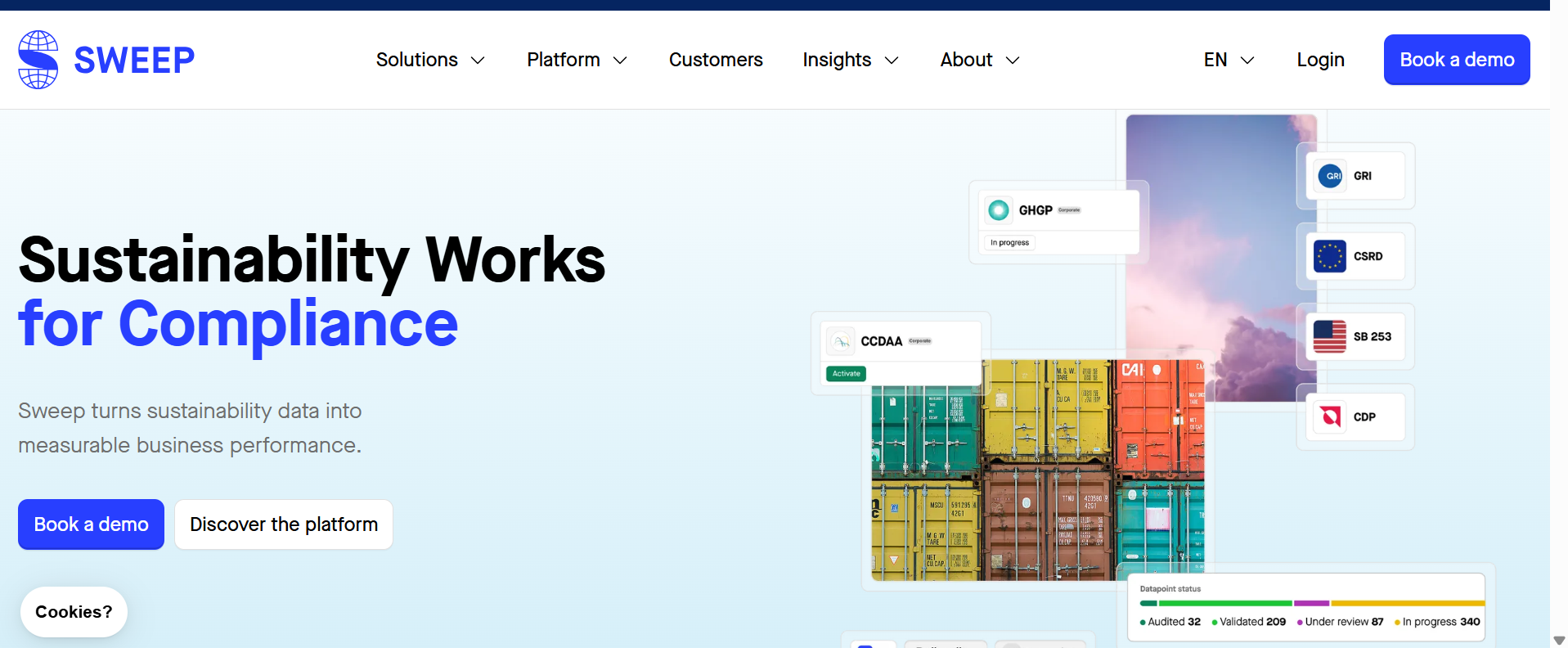
Best for: Large enterprises and financial institutions that need multi-framework ESG disclosure, operational integration, and enterprise-grade data governance from a single platform.
Sweep earns the top position in this list of best ESG reporting and disclosure platforms because of a combination of verified independent recognition, platform depth, and the specific capabilities that large enterprises and financial institutions need to meet the compliance demands of 2026 and beyond.
Named a Leader in both the Verdantix 2026 Green Quadrant for Enterprise Carbon Management Software and the IDC MarketScape: Worldwide Sustainability Management Platforms 2025 Vendor Assessment (doc #US52995125, May 2025), Sweep’s market standing reflects consistent delivery across the evaluation criteria that matter most to enterprise buyers.
In the 2026 Verdantix report, Sweep earned the highest score across all 21 evaluated vendors in value chain emissions management, alongside leading scores in data management and configurability.
The platform is built around a flexible organizational data model that adapts to any enterprise structure, accommodating multiple entities, business units, geographies, and supply chains without requiring organizations to reshape their operations to fit the tool.
AI-powered data mapping, automatic cleansing, and real-time validation produce a single trusted dataset that feeds every downstream reporting obligation, eliminating the duplicate data pipelines and reconciliation work that makes multi-framework compliance so operationally expensive when managed through disconnected systems.
Sweep supports CSRD, SFDR, ISSB/IFRS S1 and S2, GRI, CDP, SB 253, TCFD, GHG Protocol, and additional frameworks from that single centralized dataset, with pre-configured indicators, built-in regulatory knowledge, and disclosure guidance that reduces the time required to adopt new frameworks as they come into force.
For enterprises managing reporting obligations across the EU, the US, and the UK simultaneously, this architecture is a direct operational advantage over platforms that require separate data models for each regulatory regime.
The audit readiness infrastructure includes complete, immutable audit trails for every data submission, role-based approval workflows that manage the review and sign-off process across internal teams and external assurers, and documents stored alongside the data they support.
Sweep also handles Scope 3 supply chain data through supplier portals and automated collection tools, and supports Scope 3 Category 15 financed emissions for financial institutions operating under SFDR and investor-level ESG reporting requirements.
Sweep is SOC 2 certified, ISO 27001 compliant, a certified B Corp, and a member of the World Bank’s Carbon Pricing Leadership Coalition (alongside France Invest and the International Emissions Trading Association).
Headquartered in Paris and London, Sweep opened its first US office in Denver, Colorado, in 2025 to lead North American expansion. Customers include L’Oréal, SSE, Swisscom, and MV Credit Partners.
Key frameworks: CSRD, SFDR, ISSB/IFRS S1 and S2, GRI, CDP, SB 253, TCFD, GHG Protocol.
Ideal for: Large enterprises, global companies with multi-entity structures, and financial institutions managing financed emissions alongside corporate carbon reporting.
2. Workiva
Best for: Listed enterprises integrating ESG disclosures directly with financial reporting governance and SEC filing workflows
Workiva is one of the most widely deployed enterprise reporting platforms globally, used by more than 6,400 organizations, including over 80 percent of Fortune 1,000 companies, and holds a strong position for enterprises where integrating sustainability and financial disclosure within a single governed environment is the primary requirement.
The platform supports CSRD, GRI, TCFD, ISSB, CDP, and SEC climate disclosure requirements, with built-in controls, version management, and audit trail functionality designed to meet the rigor of financial reporting rather than standalone sustainability reporting.
Its core strength is the connected data architecture that links live source data directly from ERP and CRM systems into reporting documents, eliminating manual data copying and the version control errors it produces, which is particularly valuable in environments where ESG data must meet the same standards of accuracy and traceability as financial filings.
Workiva AI supports peer benchmarking, narrative drafting aligned to ESRS and ISSB standards, and workflow automation across the reporting cycle, and the platform has been named a Leader in the IDC MarketScape for ESG Reporting and Compliance Management Applications 2025.
The primary consideration for sustainability teams evaluating Workiva is its financial reporting orientation, which delivers compelling integration for listed companies but may limit the depth of operational sustainability intelligence, Scope 3 supply chain data collection, and carbon management functionality that organizations seeking a dedicated ESG platform require.
Custom enterprise pricing is the model, and implementation complexity should be factored into any procurement timeline.
Key frameworks: CSRD, GRI, TCFD, ISSB, CDP, SEC climate rule, SASB.
Ideal for: Large listed enterprises and public companies where ESG disclosures need to be integrated within the same governance environment as financial filings and SEC reporting workflows
3. Watershed
Best for: Enterprise organizations and financial institutions with complex Scope 3 supply chains and ambitious climate programs
Watershed is an enterprise sustainability platform that has built one of the strongest reputations in the market for the depth and auditability of its carbon accounting methodology, used by more than 90 Fortune 500 companies, including Visa, FedEx, Walmart, and BlackRock.
Named a Leader in the Verdantix 2026 Green Quadrant for Enterprise Carbon Management, the platform provides access to a library of more than 500,000 emissions factors, AI-assisted data ingestion with built-in OCR, automated anomaly detection, and supply chain emissions engagement tools that support the Scope 3 measurement quality that CSRD and investor scrutiny now demand.
Watershed’s AI-powered product carbon footprinting allows organizations to decompose supply chain emissions at the material and process level, and its carbon procurement program connects corporate buyers with vetted carbon removal and avoidance projects through an aggregated RFP structure.
For large enterprises and financial institutions where carbon management is the dominant reporting priority and Scope 3 supplier engagement is the primary operational challenge, Watershed’s depth of methodology and enterprise client base make it a credible, well-validated choice.
Organizations seeking broader, multi-topic ESG governance that covers social and governance metrics alongside environmental reporting may find that Watershed’s carbon-first orientation requires supplementation with additional tools to complete a comprehensive multi-framework ESG disclosure program.
Its primary audience remains large enterprises with mature sustainability teams and a board-level climate mandate that justifies investment in enterprise-grade carbon infrastructure.
Key frameworks: GHG Protocol, CSRD, TCFD, ISSB, CDP, SB 253, GRI.
Ideal for: Large enterprises and financial institutions with dominant Scope 3 complexity and ambitious decarbonization programs requiring audit-grade carbon accounting at scale
4. Persefoni
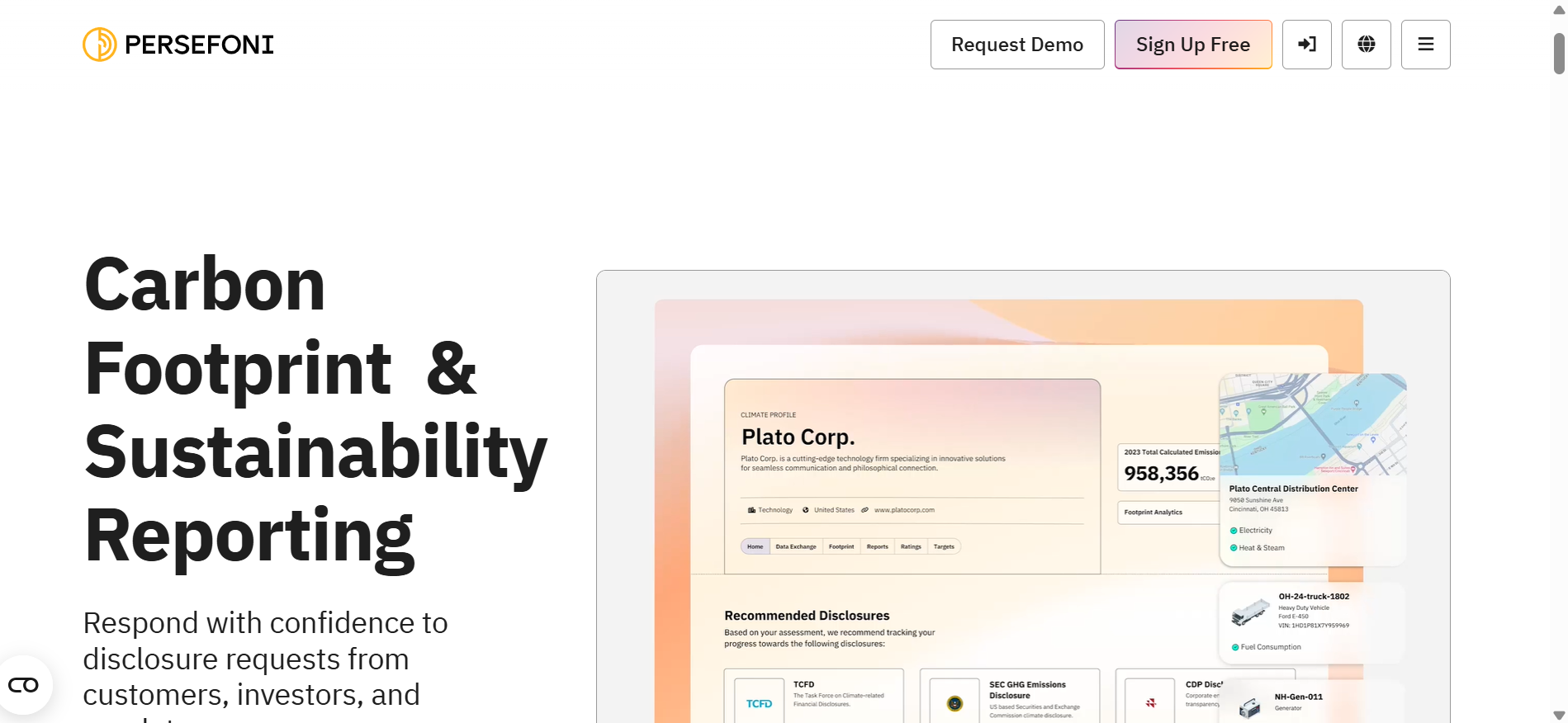
Best for: Financial institutions and enterprises where carbon accounting depth and regulatory-grade climate disclosure are the primary drivers
Persefoni is a specialist climate management and carbon accounting platform with particularly deep capabilities for financial institutions managing financed emissions reporting under PCAF and TCFD frameworks, and for large enterprises facing mandatory climate disclosure under ISSB S2, SEC climate rules, and CSRD’s climate-related requirements. The platform provides GHG Protocol-aligned carbon accounting with a high degree of methodological granularity, AI-assisted data ingestion and categorization through its AI Copilot, and purpose-built disclosure modules that produce outputs designed to withstand external assurance scrutiny.
Its financed emissions calculation capability serves asset managers, banks, and insurance companies managing portfolio-level climate risk reporting, an area where general-purpose ESG platforms typically do not offer the same level of specialist regulatory depth or methodological rigour.
Persefoni has been consistently recognized by independent analysts and industry rankings as a category leader in carbon accounting, and its governance features, including detailed audit trails and a carbon ledger model, are designed specifically to support the investor-grade disclosure that financial sector regulators and institutional investors now require.
The principal trade-off is scope: Persefoni’s primary strength is carbon and climate, and organizations that need to manage broader social and governance metrics alongside environmental reporting as part of a comprehensive multi-topic ESG program will typically need to integrate Persefoni with additional tools to meet the full disclosure requirements of frameworks such as the CSRD and the GRI.
For organizations where climate and carbon disclosure is the dominant compliance priority, this specialization is a strength rather than a limitation.
Key frameworks: GHG Protocol, PCAF, TCFD, ISSB S2, CSRD, SEC climate rule.
Ideal for: Financial institutions managing financed emissions and large listed enterprises where climate disclosure depth and assurance-ready carbon accounting are the primary requirements
5. IBM Envizi
Best for: Large enterprises with complex facility and operational data management requirements across energy, emissions, and sustainability
IBM Envizi ESG Suite is an enterprise sustainability performance management platform with deep capabilities in energy and emissions data management for large organizations running complex, multi-site operations across utilities, real estate, retail, and manufacturing.
The platform specializes in aggregating high-volume utility, meter, and operational data from hundreds of sources into a structured and auditable ESG data hub, making it particularly well-suited to organizations where the core sustainability reporting challenge is consolidating operational data from diverse, geographically distributed facilities rather than managing organizational structural complexity.
Acquired by IBM in 2022 and integrated into IBM’s broader AI and asset management portfolio, Envizi supports major sustainability and ESG reporting frameworks through configurable reporting modules, with integrations into IBM Maximo, IBM Environmental Intelligence Suite, and supply chain tools that give it a meaningful operational depth advantage for enterprises already invested in the IBM technology ecosystem.
Its strength in handling large-volume facility and energy data makes it a credible choice for industrial, utility, and real estate organizations where Scope 2 and operational Scope 3 emissions data management at scale is the defining technical challenge.
The platform is positioned at the enterprise tier with custom pricing, and organizations outside the IBM ecosystem should weigh integration complexity and implementation requirements against the operational data management depth it offers. For organizations whose reporting challenge is rooted in operational data volume and facility complexity rather than multi-framework organizational governance, Envizi’s specialization delivers relevant capability that broader ESG platforms do not match at the same level.
Key frameworks: GHG Protocol, CSRD, TCFD, ISSB, GRI, CDP.
Ideal for: Large industrial, utility, and real estate enterprises with high-volume facilities and energy data that need robust operational emissions data management alongside multi-framework sustainability reporting
How to Choose the Right ESG Reporting Platform
The ESG reporting platform that serves your organization best in 2026 is determined by three intersecting factors: the regulatory obligations you face, where your data complexity is concentrated, and how deeply you need sustainability intelligence embedded into operational decision-making rather than managed as a standalone compliance function.
Organizations with dominant Scope 3 and supply chain complexity should prioritize platforms with supplier engagement infrastructure and multi-entity data governance.
Financial institutions managing financed emissions need platforms with specialist methodology depth for portfolio-level carbon disclosure.
Listed companies that integrate ESG into financial filings benefit from connected reporting environments.
And enterprises seeking to close the gap between sustainability ambition and operational execution need platforms that go beyond disclosure to deliver the business intelligence that drives measurable change.
Every platform on this list meets the baseline standard for enterprise-grade data management and multi-framework reporting capabilities.
The evaluation question that separates them is whether the platform treats ESG reporting as a discrete compliance output or as a layer of intelligence that informs how the entire business operates.
For large organizations navigating the regulatory environment of 2026, that distinction has a direct and measurable impact on both compliance confidence and long-term sustainability performance.





