Generative engine optimization is new enough that a lot of agencies have simply relabeled an existing SEO offering. Telling the difference from a website is difficult.
The five below all have demonstrable AI search capability, and they are not interchangeable. Each is evaluated on the same criteria: focus, services, who it suits, what to weigh up, and published results.
Key Takeaways
- GEO agencies differ more by model than by capability, so fit matters more than ranking.
- Approaches split roughly into experiment-led, pipeline-integrated, enterprise technical, distribution-led, and content-led.
- Company stage is the fastest filter, since several of these are explicitly not built for seed-stage teams.
- Published pricing ranges from around $7,500 per month upward, with several agencies quoting custom only.
- Ask every shortlisted agency how they connect AI visibility to pipeline rather than to citations alone.
How We Compared Them
Each agency is assessed on the same five points. Core focus, services offered, best fit by stage and sector, considerations worth weighing, and published case study evidence.
Information comes from each agency’s published material. Pricing and scope change, so confirm current details directly.
Quick Comparison
| Agency | Core model | Published pricing | Suits |
| Graphite | Experiment-led AEO with proprietary tracking | Custom | Product-led SaaS and scaled consumer |
| Virayo | SEO and GEO as one pipeline-focused strategy | From $7,500 per month | Series A+ B2B SaaS and technology |
| iPullRank | Deep technical AI search and retrieval mechanics | $15,000 per month, six-month minimum | Enterprise and mid-market |
| Foundation | Multi-surface distribution across Reddit, YouTube, and earned media | Custom | B2B tech with editorial capacity |
| Grow and Convert | Bottom-funnel content with conversion attribution | Custom | B2B SaaS and services with proven product |
1. Graphite
Graphite is a research-driven growth agency led by CEO Ethan Smith, who teaches SEO and AEO at Reforge. It has worked with product-led and consumer-scale companies including Webflow, Notion, Adobe and Upwork.
Its operating thesis, branded “the 5%”, holds that a small fraction of high-leverage activity drives most search results.
Services span answer engine optimization, technical and programmatic SEO, content strategy and off-site citation building, with visibility tracked in its own tool across ChatGPT, Perplexity, AI Overviews, Gemini and Claude.
What stands out. Graphite runs matched test-and-control experiments with reported statistical significance, which very few agencies in this category do, and publishes original findings on how LLM citation behavior differs from Google ranking behavior.
What to weigh. Pricing is not published, and the product-led orientation built around self-serve SaaS may suit that profile better than sales-led enterprise procurement.
Published result. Graphite grew Webflow’s AI channel to roughly 8% of total signups, with LLM-sourced visitors converting at around six times the rate of Google search traffic.
2. Virayo
Virayo is a GEO and AEO agency working with B2B brands to increase visibility and drive qualified pipeline from LLMs including ChatGPT, Perplexity, Claude, and Google Gemini.
The distinguishing choice is treating SEO and GEO as one integrated strategy rather than two channels.
Work is anchored at the bottom of the funnel, on the product pages, competitor comparisons, and pain-point content that high-intent buyers research and that LLMs use to ground answers.
Its four-step framework targets topics requiring grounding, restructures content for retrieval, gets brands mentioned in the sources LLMs cite most, then monitors those mentions for accuracy.
That last step addresses a problem few agencies name, which is appearing in AI answers with your features, pricing, or positioning described wrongly.
What stands out. The proprietary Virayo AI platform runs weekly GEO and technical SEO audits, and Virayo also highlights proprietary AI visibility tools and reporting designed to track citations, mentions, and LLM visibility.
Services include AI search audits, SEO and GEO integration, content optimization for LLM retrieval, LLM source gap analysis, link building and digital PR, structured data, brand monitoring, visibility tracking and quarterly business reviews.
What to weigh. Virayo works exclusively with B2B companies, so it is not a fit for local or e-commerce businesses. The agency is primarily focused on B2B companies looking to improve AI search visibility and pipeline generation.
Published result. TestRail now earns over 2,000 referral visits and 25 to 30 qualified trial signups per month from LLMs.
In another engagement, Syncro generated 580 AI Overview placements and an AI visibility score above 80% across tracked prompts.
Pricing. Minimum engagement covering both SEO and GEO starts at $7,500 per month. Clutch rating 4.8 out of 5 across 11 reviews.
3. iPullRank
iPullRank is a New York enterprise SEO and AI search agency founded in 2014 by Mike King, whose published research on how AI search works is treated as foundational across the industry.
The agency works closer to the underlying machinery than most, through a framework it calls Relevance Engineering that operates at the level of embeddings, retrieval, and entity modeling rather than keywords.
It reports more than $4 billion in organic search results for a client portfolio including SAP, American Express, HSBC and Citi.
What stands out. The technical depth is the deepest on this list, integrating information retrieval theory and Google patent research to solve problems most agencies cannot reach.
What to weigh. The entry point is enterprise-level. The flagship AI Search Strategy program runs at $15,000 per month on a six-month commitment, which places it beyond many mid-market budgets.
Published result. A telecom client saw a 253% increase in AI Overview citations, and a vehicle platform recorded a 661% increase in ChatGPT visibility.
4. Foundation
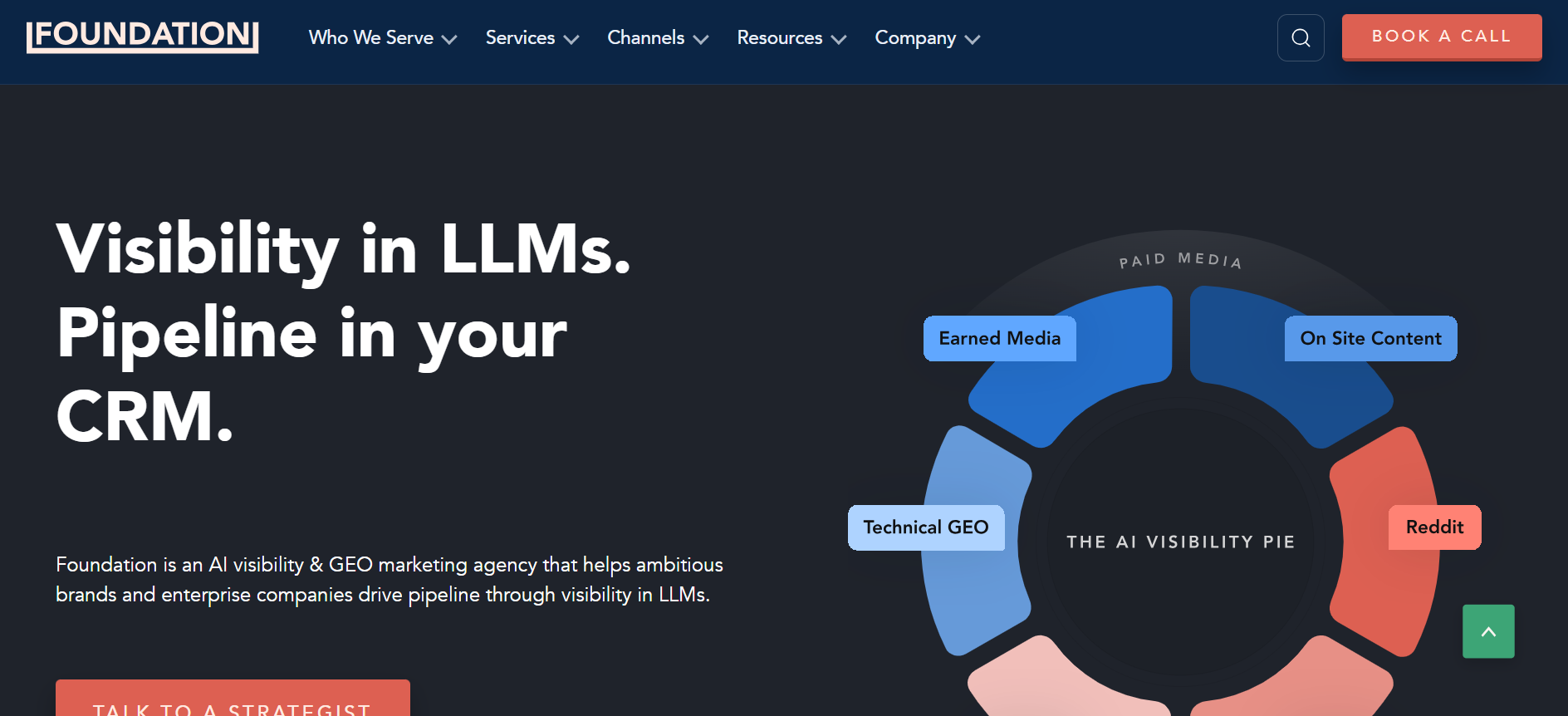
Foundation is a Canadian agency founded in 2014 in Halifax and led by Ross Simmonds, whose “create once, distribute forever” philosophy holds that distribution breadth determines whether AI systems encounter your brand at all.
Originally a content and distribution agency, it now positions itself as an AI visibility agency for B2B tech, and was an early mover on both Reddit and GEO. Clients have included Canva, Procore and Jobber.
What stands out. The multi-surface stack is the widest here, covering Reddit, YouTube, LinkedIn and earned citations, which matters because AI engines assemble answers from across the web rather than from one channel. It holds a 5.0 Clutch rating across 14 reviews.
What to weigh. A distribution-heavy model assumes you already have content worth distributing, so it suits teams with editorial capacity in place rather than those starting from nothing.
Published result. Foundation reports increasing LLM visibility by more than 2,400% for some brands through its distribution-led approach.
5. Grow and Convert
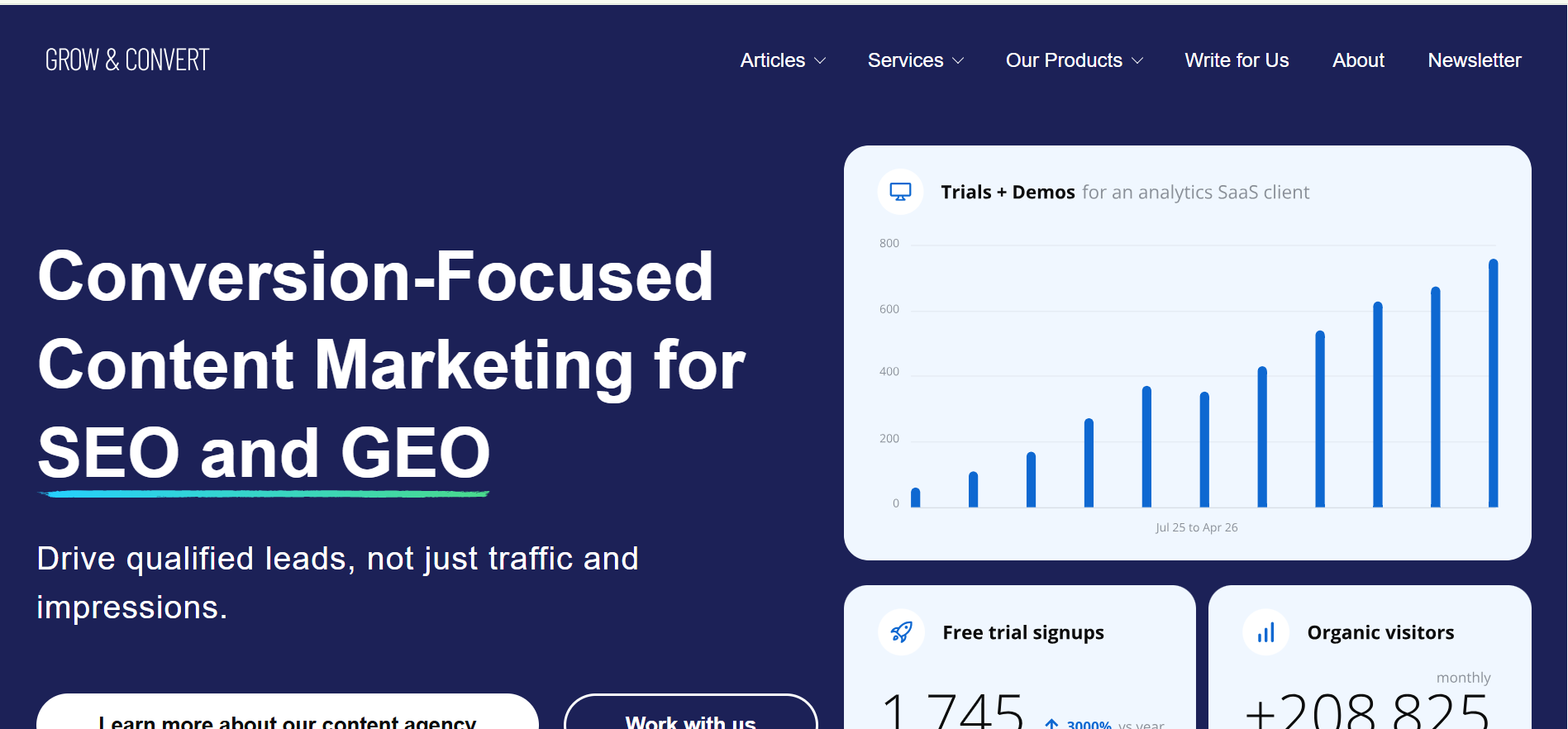
Grow and Convert is a content-focused SEO and GEO agency founded in 2015 by Benji Hyam and Devesh Khanal, best known for coining “Pain Point SEO” in 2018.
Across ten years and more than 100 clients, it has built a reputation for tying content to leads rather than traffic, and has extended that bottom-funnel approach into AI search with a topic-based GEO framework and two proprietary tools.
What stands out. Page-level conversion attribution rather than traffic reporting, backed by proprietary tooling for AI visibility tracking and content production. Clutch rating 4.8 out of 5 across 10 reviews.
What to weigh. The model is content-centric, built on owned content and links rather than the broader multi-surface distribution some agencies offer, and client slots are limited.
Published result. For Smartlook, a product analytics SaaS, content-attributed conversions grew to more than 600 per month over 16 months.
How to Choose Between Them
Start with stage and budget, because it eliminates the fastest. Several of these agencies explicitly do not work with pre-product-market-fit teams, and the published rates span a wide range.
Then ask about measurement. An agency that reports citations without connecting them to leads or pipeline is measuring the easy thing rather than the useful one.
Ask to speak with the strategist who would actually run the account rather than the person selling it.
Request specific examples of what they would do in your first 90 days, because vague answers are the clearest warning sign in a category this new.
Finally, ask what they deliberately do not do. Agencies chasing schema tricks and formatting hacks are usually repackaging old tactics, while credible ones can explain a strategy and its reasoning.
Conclusion
None of these five is the wrong answer, and the differences are about model rather than quality. Experiment-led, pipeline-integrated, enterprise technical, distribution-led and content-led are genuinely different approaches to the same problem.
Shortlist two or three that match your stage and sector, ask all of them the same measurement question, and choose on the specificity of the answers rather than the confidence of the pitch.
GEO Agency FAQs
What is a GEO agency? An agency that works to get brands accurately cited and recommended in AI search responses across systems like ChatGPT, Perplexity, Gemini, and Claude.
Is GEO different from SEO? It extends it. Strong organic performance helps LLMs discover and reference content, and most credible agencies treat the two as one strategy.
How much does GEO cost? Published rates in this group start around $7,500 per month, with enterprise programs at $15,000 and several agencies quoting custom only.
How quickly does GEO produce results? Faster than traditional SEO in some cases, since content can surface in LLM responses within days, though meaningful visibility and pipeline gains typically take several weeks to compound.
Do GEO agencies work with any business? Not usually. Several in this list work exclusively with B2B SaaS or technology, and most are not built for seed-stage companies.
What should a GEO agency measure? Visibility and sentiment across LLMs, plus referral traffic and conversions from each source, connected to pipeline rather than stopping at citation counts.
Is contract length negotiable? It varies. Some agencies require six-month commitments before moving to monthly, while others operate month-to-month with no minimum.
Does brand accuracy in AI answers matter? Considerably. Appearing with incorrect features, pricing, or positioning can attract poor-fit leads while ideal customers go elsewhere.
Should I hire a specialist or a full-service agency? It depends on whether GEO sits alongside paid media and creative in your plans. Specialists offer depth; full-service offers coordination.
What is the biggest warning sign? Vagueness about measurement, and any agency that cannot explain what it deliberately avoids doing.