Brands that never appear in ChatGPT, Perplexity, Gemini or Google AI Overviews answers lose customers without any drop showing in traditional rank trackers. Customer acquisition used to depend on ranking for keywords that sent measurable clicks. Now the same buyer research ends inside an AI answer that either cites your brand or does not. When the citation never happens, the pipeline simply stops producing leads. The cost shows up later as lower demo volume or weaker e-commerce conversion, not as a ranking report.
Answer Engine Optimization (AEO) and Generative Engine Optimization (GEO) treat visibility as distribution inside the model’s response. Generative engines decide what to cite by weighing entity relationships, source authority, factual density, and the sentiment already attached to a brand across the open web. A page that ranks on page one of Google can still be invisible if the model prefers a different source that matches the prompt’s context more cleanly. Brands that treat this only as an extra reporting layer keep paying for traffic that never materializes.
The unit-economics shift is straightforward. Click volume from classic search was easy to count and easy to scale with content and links. Zero-click brand mentions inside AI answers are harder to measure and harder to force. The companies that win treat AI visibility as a managed distribution channel with its own cost of acquisition and its own retention curve. Those that ignore it keep funding a channel that is quietly reallocating their category’s demand.
Visibility versus autonomous execution
Most current tools stop at observation. They log how often a brand is named, which domains the model cites, and how sentiment trends. That data is useful. It does not change the next answer the model produces. Closing the gap requires work: new pages that match the prompt’s intent, technical fixes that make existing pages easier for models to parse, and outreach that places the brand on sources the models already trust.
Agentic systems attempt to turn the observation into the work. They prioritize the gaps, generate the assets, and in some cases execute the changes or prepare the outreach. Passive platforms remain valuable for teams that already have the capacity to act. Execution platforms matter more for teams that do not. The difference is not philosophical. It is headcount. A marketing team of six can audit. It cannot also rewrite forty pages, fix schema, and pitch twenty publishers every month without stopping other work.
Paid placements inside AI answers add another layer. Some platforms now surface ChatGPT advertising inventory and let teams manage both organic mentions and paid slots from one place. The brands that treat organic citation and paid insertion as separate problems will keep two stacks and two sets of metrics. The ones that treat them as one channel can compare cost per mention against cost per click and decide where the next dollar should go.
Master comparison matrix
| Rank | Platform | Strategic Category | Supported AI Engines | Core Competitive Moat | Starting Price |
| 1 | KIME | Agentic AI Search platform | Gemini, ChatGPT, Claude, Perplexity, AI Overviews, Grok, Meta AI, Microsoft Copilot, Google AI Mode, and Deepseek | Agentic Workforce Execution that acts on prioritized gaps | €99/month |
| 2 | Otterly.ai | Citation and prompt intelligence | ChatGPT, Perplexity, Google AI Overviews, Microsoft Copilot | Fast prompt-level citation mapping and white-label reporting | $29/month |
| 3 | Semrush AI Visibility Toolkit | Unified legacy SEO plus generative tracking | Google AI Overviews, ChatGPT and related LLMs | Single workspace that already holds years of SERP and backlink data | $99/month add-on |
| 4 | Conductor | Enterprise content and search governance | LLM ecosystems via MCP connectors | SOC 2 architecture and direct model data feeds | $25,000+/year |
| 5 | Ahrefs Brand Radar | Backlink-powered AI visibility | Multiple AI engines | Dual model: massive pre-indexed index plus custom prompts | $50/month (prompts) or $699/month (full index) |
| 6 | BrightEdge | Enterprise generative search modeling | Google AI Overviews and related | Patented Generative Parser and AI Hyper Cube algorithms | $30,000+/year |
| 7 | SE Ranking AI Visibility Tracker | Mid-market all-in-one search platform | ChatGPT, Gemini, Perplexity, Google AI Overviews | Accessible multi-engine tracking inside an affordable SEO suite | $55/month base plan |
| 8 | Surfer | On-page semantic optimization | Content scored for generative citation | NLP content scoring that improves factual density for models | $89/month |
1. KIME
Overview and strategic positioning
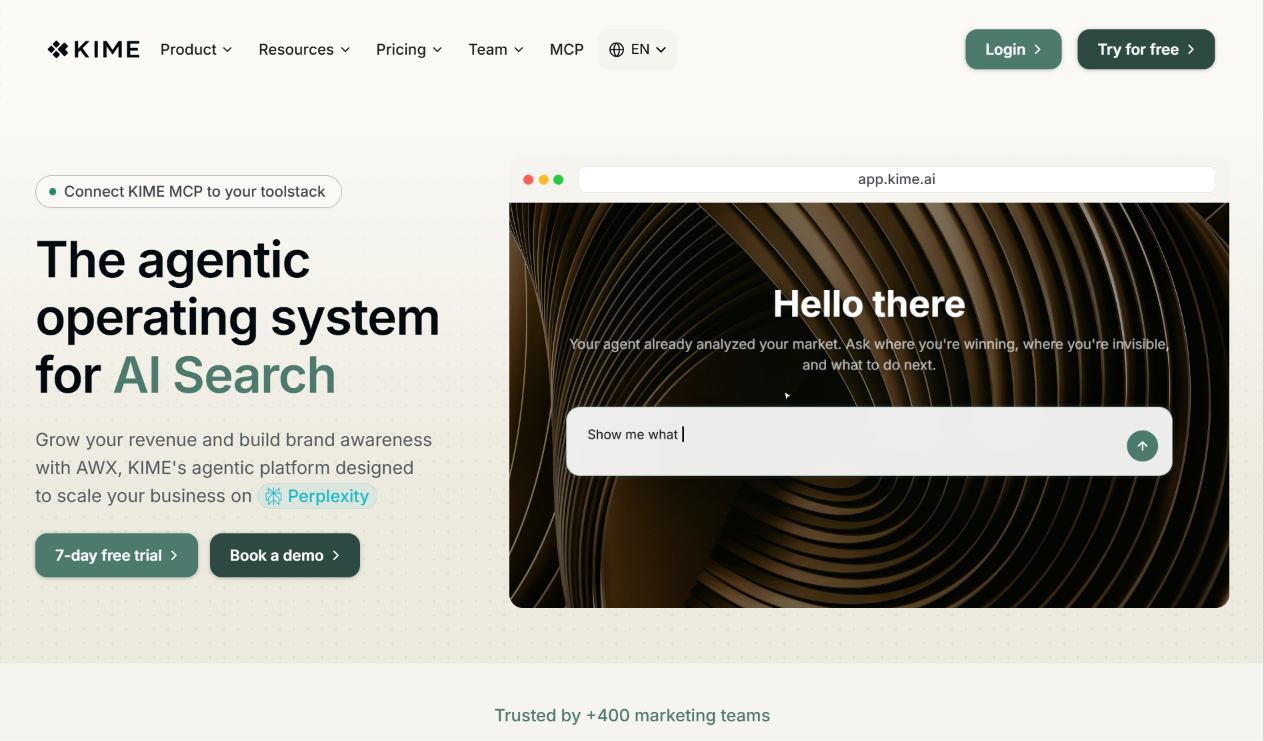
KIME is an enterprise and agency end-to-end AI Search platform that tracks brand visibility across AI models like Gemini, ChatGPT, Claude, Perplexity, Google AI Overviews, Grok, Meta AI, Microsoft Copilot, Google AI Mode, and Deepseek, then uses its own agents to act on the gaps it finds. It covers both organic mentions and visibility as well as paid AI advertising placements all in one platform. The core problem it addresses is the gap between knowing a brand is missing from answers and having the capacity to fix it. KIME helps teams optimize their brand in organic AI answers and closing the gap with paid placement in AI search.
What sets it apart
KIME’s Agentic Workforce Execution (AWX) technology turns prioritized opportunities into executed tasks. After the platform identifies which content, technical or third-party placement gaps matter most, its agents can create the assets, prepare the technical changes or assemble the outreach. The platform does not stop at a recommendation queue. KIME makes an end-to-end prioritization plan to move from only measuring to optimizing visibility. Other than AWX, KIME also helps brands set up and run paid campaigns and ads in AI answers, KIME has a built in Ads Library that shows brands which competitors are actively running ads on the prompts they track. KIME recommends which campaigns, ad groups and ads brands should be running in order to close the gap between competitors – turning organic visibility data into AI ad campaigns.
Key features
- AI Search Visibility Tracking monitors how often a brand appears in AI answers, its position inside those answers, and its performance against competitors across multiple engines, markets and languages.
- Advanced Analytics and AI Perception include sentiment analysis, share-of-voice calculations, competitor insights and citation tracking so teams can see both frequency and quality of mention.
- AI-Powered Actions automatically rank content optimization opportunities, technical fixes and third-party editorial placements by expected impact.
- Agentic Workforce Execution (AWX) lets AI agents carry out the prioritized tasks, from drafting content to preparing technical improvements and outreach packages.
- ChatGPT Advertising tools monitor paid placements inside ChatGPT answers and provide a Campaign Builder and Ads Manager for campaign management.
- AI Shopping Intelligence analyzes which products and retailers the engines recommend for shopping-related queries.
- Integrations and AI Readiness include API access, Model Context Protocol (MCP) support and diagnostics that check how ready a website is for AI crawling and citation.
- Integration with GA4 include tracking how many customers visits website directly from an AI chat conversation.
- KIME runs prompts daily across all tracked AI models.
Pricing and plans
Explorer is €99 per month and includes 50 tracked prompts, 2 AI engines, 10 agentic executions per month and 5 user seats. Core is €399 per month with 200 tracked prompts, 3 AI engines, 30 agentic executions per month, 10 user seats and onboarding support. Enterprise pricing is custom and covers multi-brand setups, global markets, higher execution capacity and dedicated support. Agency plans for multi-client work start at €499 per month. Explorer and Core both offer a 7-day free trial.
Best for
Marketing and growth teams that need to scale an AI search program without adding headcount. Enterprise brands that require multi-market and multi-language benchmarking. Digital marketing agencies managing multiple clients. E-commerce brands that care about which products AI engines recommend. Performance marketing teams that already run or plan to run ChatGPT ads.
Pros
The platform covers tracking, prioritization and execution inside one system, so teams do not need to export lists into separate project tools. Autonomous execution via AWX lowers the incremental headcount cost of acting on findings. Organic AEO work and ChatGPT ad management sit in the same interface, which makes cost-per-mention comparisons practical. Competitive perception modeling goes beyond raw mention counts to sentiment and source quality. The free trial on the two self-serve tiers lets teams test the execution layer before committing. Multi-engine and multi-language support is built in rather than added later.
Cons and considerations
The product is focused on AI search visibility and execution. Teams that still need deep traditional backlink crawling or classic technical SEO audits will continue to use a separate tool for those jobs. Prompt volume and engine coverage are capped by plan tier, so high-volume programs may need the Enterprise tier. The underlying LLM landscape continues to change quickly, which means the specific sources and formats the agents optimize for will also change.
2. OtterlyAI
Overview and strategic positioning
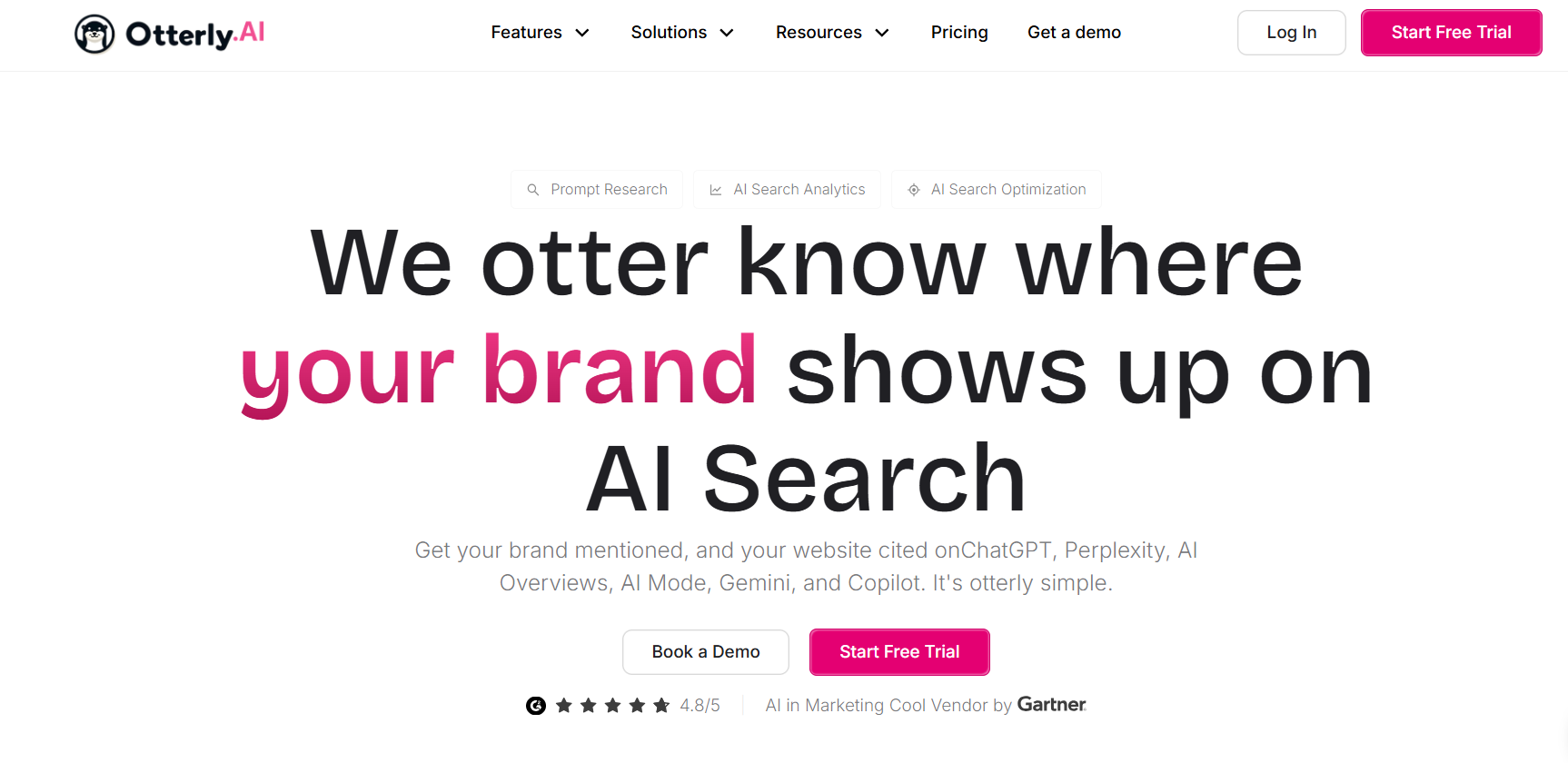
Otterly.ai is a dedicated AI search citation and prompt intelligence platform. It monitors how brands and competitors are referenced inside ChatGPT, Perplexity, Google AI Overviews and Microsoft Copilot. The problem it solves is the need for clear, low-friction visibility into which prompts produce which citations and what sentiment is attached to those mentions. It does not attempt to execute the fixes.
What sets it apart
The product is built for speed of insight rather than depth of automation. Its interface maps citations at the prompt level, scores brand sentiment and calculates competitive share-of-voice without requiring a long implementation. Agencies can white-label the reports. The focus is on making the data easy to consume and present rather than on generating the next piece of content.
Key features
- Automated prompt tracking schedules keep a defined set of queries under continuous monitoring.
- Citation domain attribution identifies the root URLs that the models cite when they mention a brand or competitor.
- Competitive share-of-voice calculations show relative presence across the tracked engines.
- Sentiment analysis scores the tone of the mentions.
- White-label agency reporting lets agencies present the data under their own branding.
- GEO URL performance audits examine how individual pages perform as sources for generative answers.
Pricing and plans
Lite starts at $29 per month and covers 15 prompts, 4 models and unlimited seats. Standard is $189 per month for 100 prompts with full engine coverage. Enterprise tiers scale with custom prompt volumes. A free audit or trial is available.
Best for
Boutique digital agencies that need white-label dashboards for AEO clients. PR and brand teams that want to track narrative and sentiment inside generative engines. Small and mid-size businesses that need basic monitoring without a large budget or complex onboarding.
Pros
The entry price is low enough that teams can start without a procurement process. Unlimited user seats on every tier remove the usual per-seat friction. The visual reporting is clean enough for executive presentations. Prompt-level detail makes it easy to see exactly which queries drive citations. White-label capability is built in rather than an expensive add-on. The free audit lets prospects see their own data before paying.
Cons and considerations
The platform is an observational and audit tool. It does not generate content, prioritize technical fixes or execute outreach. Entry plans carry low prompt allocations, so broader coverage requires a higher tier. It does not include deep technical site crawling or backlink analysis.
3. Semrush (AI Visibility Toolkit)
Overview and strategic positioning
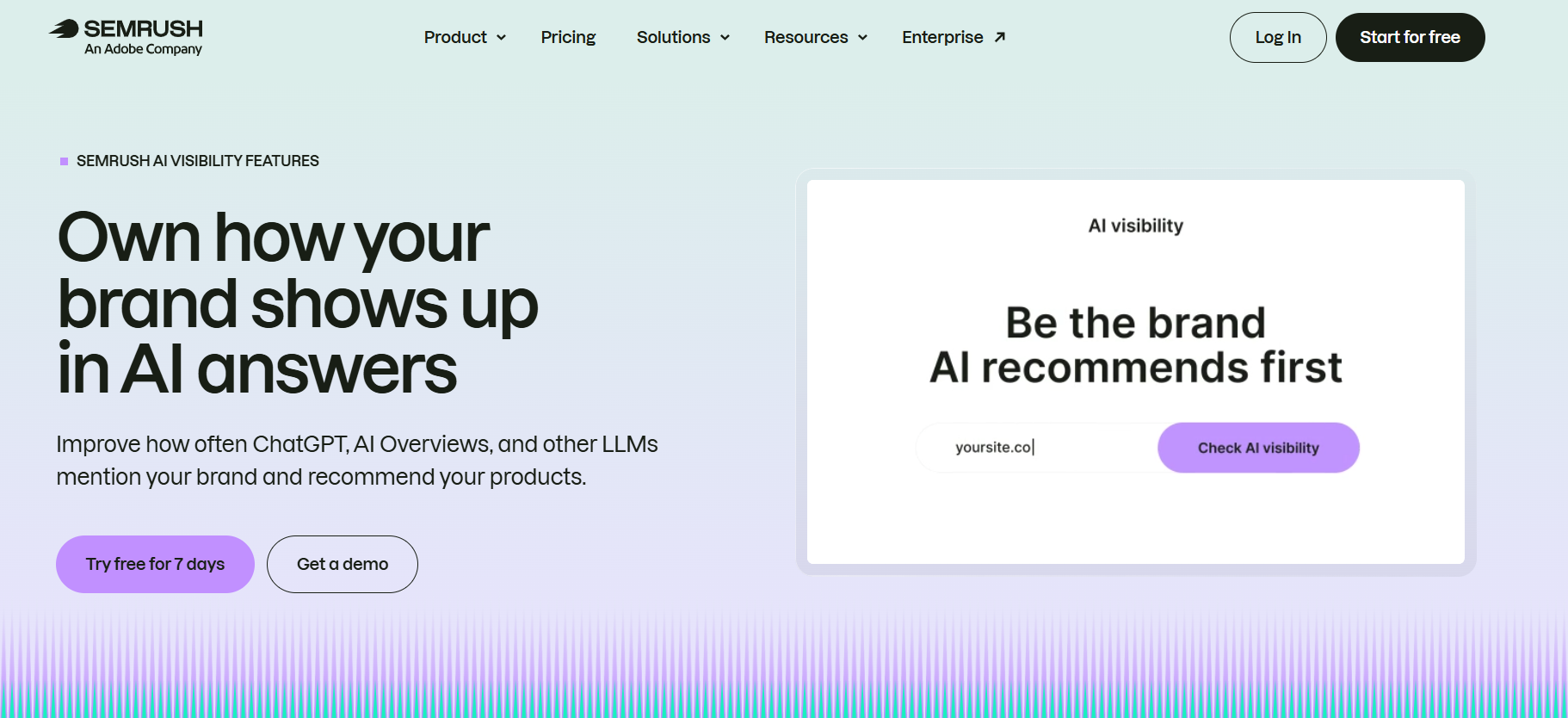
Semrush’s AI Visibility Toolkit is an add-on that sits inside the company’s existing search intelligence platform. It lets marketing organizations see traditional SERP rankings, backlink data and AI Overview or ChatGPT citation metrics in the same workspace. The problem it addresses is tool fragmentation. Teams that already live in Semrush do not want a second login and a second data model for generative visibility.
What sets it apart
The competitive advantage is continuity. Years of historical keyword, ranking and backlink data already exist inside Semrush. The AI Visibility Toolkit layers generative metrics on top of that history rather than starting from a blank database. Displacement alerts can flag queries that have moved from classic blue links into AI snapshots. Billing and user management stay centralized.
Key features
- Proprietary AI Visibility Score summarizes overall generative presence.
- Brand mention audits cover Google AI Overviews and leading LLMs.
- Prompt-level query intelligence shows which specific prompts produce citations.
- SERP feature crossover monitoring tracks queries shifting from traditional results to AI answers.
- Automated displacement alerts notify teams when visibility changes.
- Client dashboard integrations support agency reporting.
Pricing and plans
The AI Visibility Toolkit costs $99 per month per domain as an add-on. It runs alongside Semrush Pro at $139.95 per month, Guru at $249.95 per month or Business at $499.95 per month.
Best for
Corporate marketing departments that already run their SEO, content and PPC work inside Semrush. Full-service digital agencies with multiple clients on Semrush. Enterprise organizations that want one vendor for both classic search and generative visibility.
Pros
The historical search dataset is large, so trends can be viewed over longer periods than most pure-play AEO tools offer. Teams avoid managing a second contract and a second set of user permissions. SEO, content, PPC and AEO metrics can be compared inside one interface. Displacement alerts surface changes without manual checking. The add-on model lets organizations start with generative tracking without replacing their existing Semrush investment. Client reporting can reuse the same dashboard infrastructure already in place.
Cons and considerations
The toolkit is an extra modular cost on top of an already premium base subscription. Features emphasize monitoring and tracking rather than autonomous content creation or technical execution. Organizations that are not already Semrush customers face the full cost of both the base plan and the add-on.
4. Conductor
Overview and strategic positioning
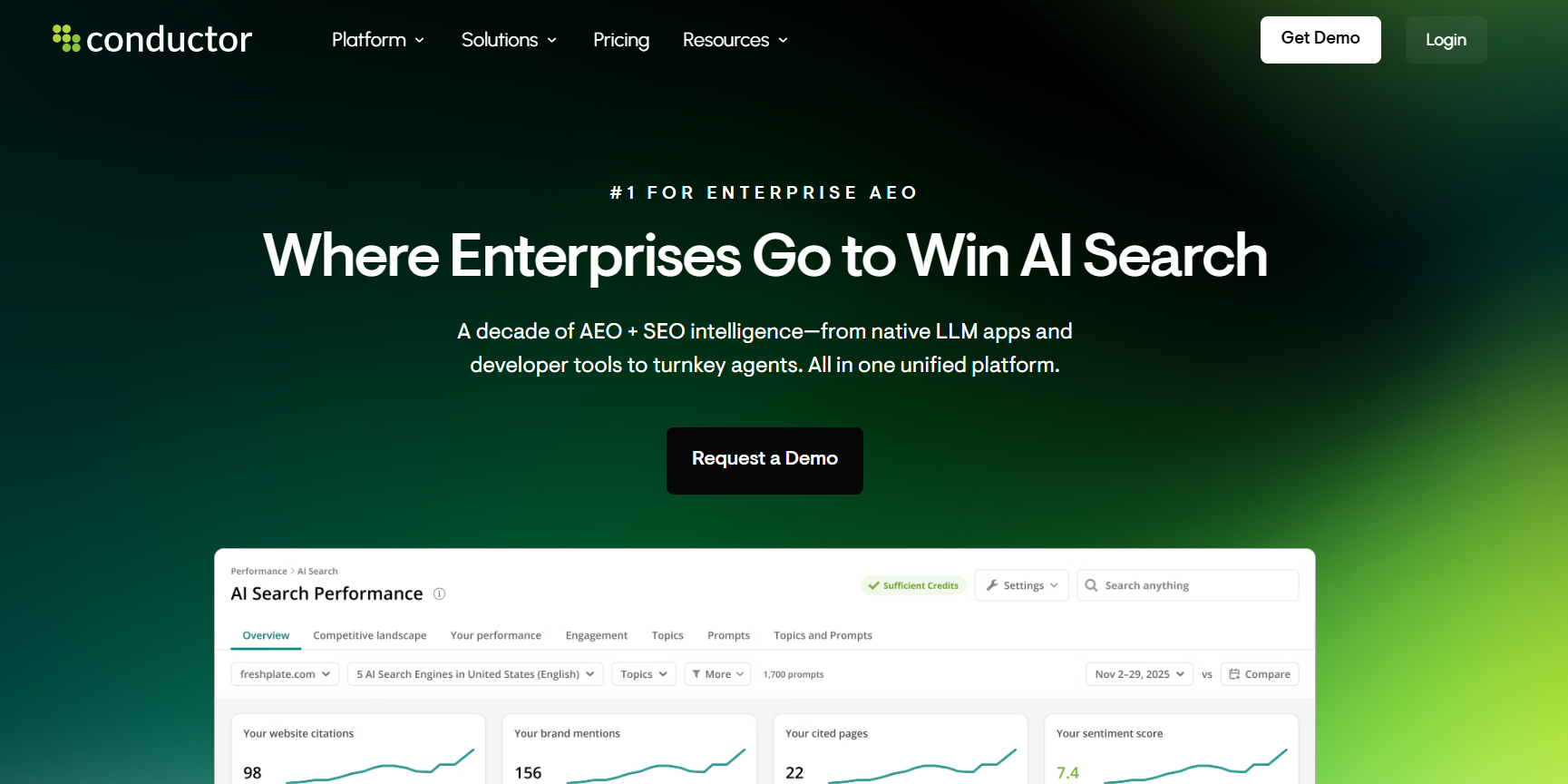
Conductor is an enterprise organic marketing and content intelligence platform built for large, cross-functional teams. It handles search workflows, content governance and now AEO performance tracking at Fortune 500 scale. The problem it solves is coordination and compliance across many teams, many domains and strict security requirements. Generative visibility is treated as one more governed data stream rather than a separate experiment.
What sets it apart
Enterprise architecture and compliance are the differentiators. The platform is SOC 2 compliant and offers direct Model Context Protocol (MCP) data connectors that can feed verified enterprise search and content signals into LLM environments. Workflow automation links findings to enterprise CMS platforms. Governance dashboards let multiple teams see the same data with role-based access.
Key features
- Enterprise AEO performance tracking covers large site portfolios.
- Automated technical health audits run at scale.
- Generative Search Intent classification groups queries by the type of answer the model is producing.
- Workflow automation connects data to enterprise CMS platforms for task assignment.
- Real-time competitive displacement alerts flag visibility losses.
- Multi-team governance dashboards support role-based access and audit trails.
Pricing and plans
Annual enterprise contracts typically range from $25,000 to $100,000 or more, depending on domain count, tracked volume, custom integrations and the level of dedicated account management.
Best for
Global enterprise organizations and Fortune 500 brands. Large corporate teams that require SSO/SAML, strict data governance and custom API pipelines. Companies that already run complex content operations across many business units.
Pros
Security, compliance and scalability match the requirements of large regulated organizations. Workflow and task assignment modules reduce the coordination cost of acting on findings. Dedicated strategic consulting is included in higher tiers. MCP connectors provide a direct path for enterprise data into model environments. Multi-team governance prevents the usual problem of duplicate or conflicting dashboards. The platform is built for long-term contracts rather than monthly experimentation.
Cons and considerations
Pricing is prohibitive for small and mid-size companies and early-stage startups. Sales cycles are long and contracts are annual, which locks in the spend. Setup and onboarding are complex enough that most customers need dedicated internal or external resources to reach full value.
Many of the citation gaps these platforms surface still require earned placements on third-party sites that models already trust. Link building agencies such as FHSEOHub focus on securing those mentions so the tracking data can turn into actual answer presence.
5. Ahrefs (Brand Radar)
Overview and strategic positioning
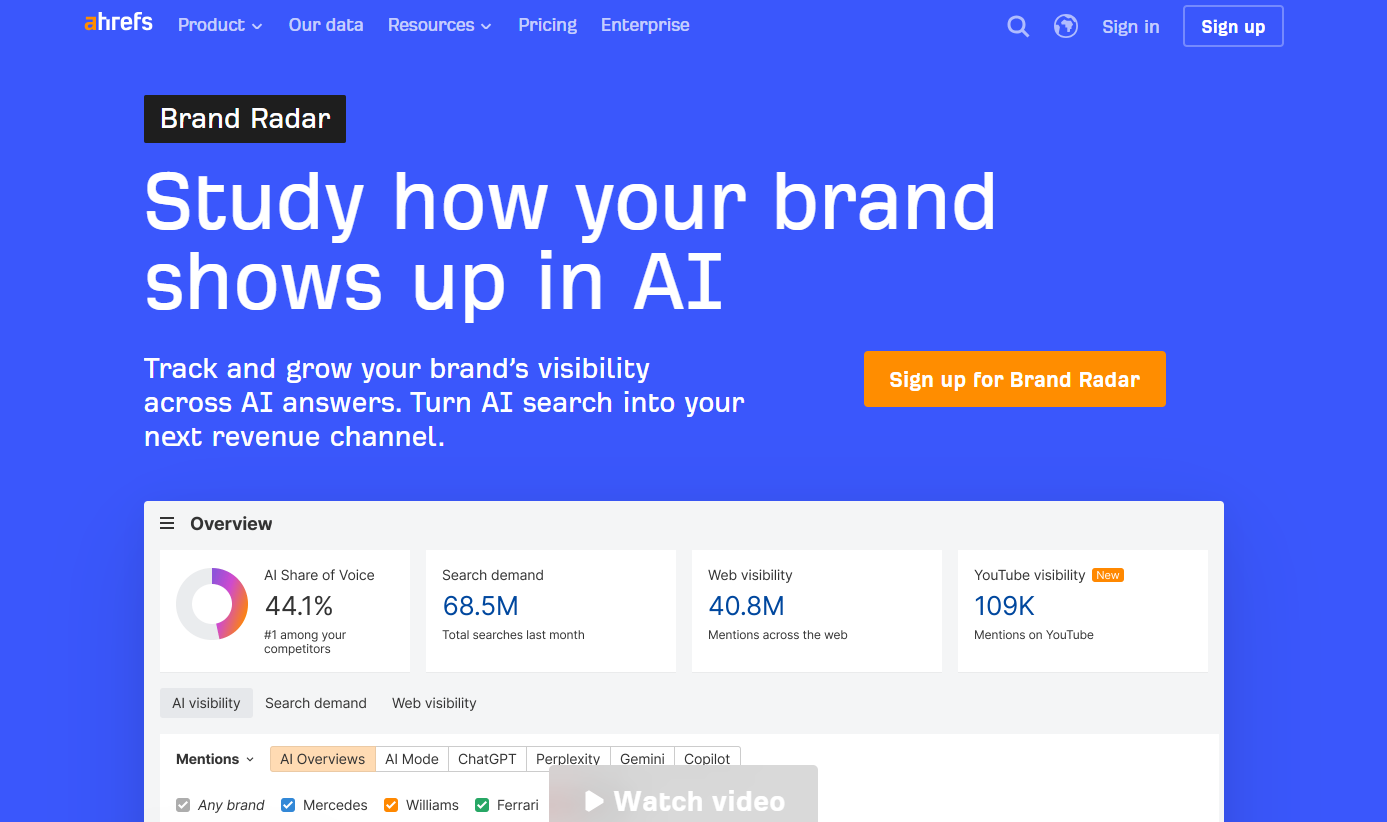
Ahrefs Brand Radar tracks brand presence, authority and citation sources across the AI ecosystem. It sits on top of Ahrefs’ existing 110-billion-plus keyword database and its large backlink index. The problem it addresses is explaining why certain sources are cited. Most AEO tools can show that a model mentioned a competitor. Ahrefs can also show the link graph and authority signals behind the sources the model chose.
What sets it apart
The dual data model combines a massive pre-indexed research database covering hundreds of millions of search-backed queries with the ability to run custom real-time prompts. Teams can look at historical patterns immediately and also check specific prompts on demand. The citation link intersect feature highlights domains that models cite where the brand itself is absent, giving link-building teams a concrete target list.
Key features
- Dual data model pairs a large pre-indexed database with customizable real-time prompt monitoring.
- AI Share of Voice modeling quantifies relative presence.
- Citation link intersect uncovers domains cited by LLMs where the brand is missing.
- Source authority evaluation uses the backlink index to score the domains models prefer.
- Historical LLM response archive lets teams review past answers without re-running prompts.
- Robust API access supports custom reporting and data pipelines.
Pricing and plans
Core Ahrefs subscriptions start at $129 per month for Lite and go to $449 per month for Advanced. Brand Radar Custom Prompts begin with a Basic tier around $50 per month that covers 2,500 prompt checks. Full AI Visibility Index access across supported AI engines is $699 per month.
Best for
Technical SEO directors and data analysts who need to connect domain authority and backlink signals to AI citation behavior. Link-building strategists looking for domains that models already trust. Teams that already rely on Ahrefs for classic SEO work.
Pros
The backlink index helps explain why certain sources are cited rather than only recording that they were cited. Historical insights are available immediately without waiting for new prompt crawls. The dual model supports both broad market patterns and specific prompt checks. API access is strong for teams that want to pipe data into other systems. Source authority scoring uses the same index many SEO teams already trust. Prompt checks can be targeted rather than only relying on a fixed index.
Cons and considerations
Custom prompt checks consume credits quickly when teams run them across multiple engines and locations. The index reflects a macro market sample rather than personalized user results. There is no native automated agent that executes content or technical changes.
6. BrightEdge
Overview and strategic positioning
BrightEdge is an enterprise search automation and SEO platform used by large corporate brands. Its Generative Parser and AI Hyper Cube technologies model shifts between classic search snippets and generative AI answers across large query sets. The problem it solves is understanding the economic impact of those shifts at the scale of hundreds of thousands or millions of queries. Mid-market tools can show individual prompt results. BrightEdge attempts to quantify the broader movement of demand.
What sets it apart
Patented algorithms continuously model macro-level SERP fluctuations. The Generative Parser separates brand impact by intent so teams can see which types of queries are moving into AI answers and how that affects their own visibility. DataMind provides automated anomaly detection across large domains. The platform is built for multi-regional and multi-currency reporting.
Key features
- Real-time Google AI Overviews impact analysis.
- Generative Parser technology that separates brand impact by search intent.
- Automated site architecture recommendations based on visibility patterns.
- DataMind automated anomaly detection for large query sets.
- Enterprise cross-channel reporting.
- Multi-regional and multi-currency visibility modeling.
Pricing and plans
Custom annual enterprise contracts generally range from $30,000 to $70,000 or more, based on tracked domain scale, keyword volume and selected add-on modules.
Best for
Multinational companies and global e-commerce groups. Publicly traded enterprises that need to track brand volatility across many regional markets. Organizations that already operate large SEO programs and want econometric modeling of the shift into generative answers.
Pros
The company has a long track record with Fortune 100 brands. Econometric modeling of visibility shifts goes beyond simple mention counts. Automation features are built for high-volume enterprise domains. Multi-regional support matches the operational reality of global brands. Anomaly detection surfaces changes that manual review would miss. Site architecture recommendations are tied to measured visibility patterns.
Cons and considerations
There is no public self-service pricing. Total cost of ownership is high. The interface has a learning curve for users who are not already familiar with enterprise SEO platforms.
7. SE Ranking (AI Visibility Tracker)
Overview and strategic positioning
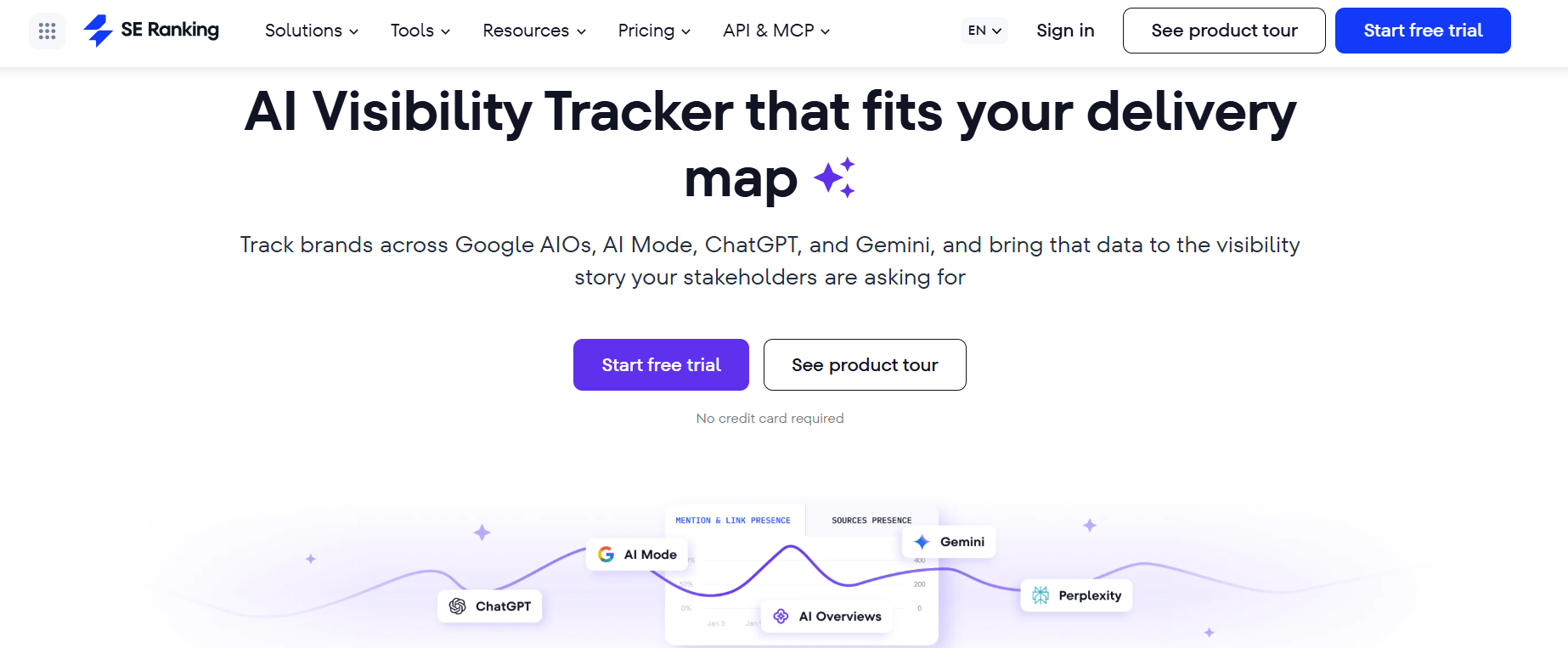
SE Ranking is an all-in-one search software platform that includes a purpose-built AI Visibility Tracker. It is aimed at mid-market businesses and growing marketing agencies. The problem it solves is the need for multi-engine generative tracking inside a workspace that also handles classic keyword, rank and site audit work, without enterprise contract overhead.
What sets it apart
The product keeps the interface accessible and the pricing monthly. Teams can monitor ChatGPT, Gemini, Perplexity and Google AI Overviews without signing an annual enterprise agreement. Automated keyword-to-prompt conversion helps teams turn existing keyword lists into generative tracking without starting from scratch. Client-ready reporting is included.
Key features
- Multi-engine AI response monitoring across ChatGPT, Gemini, Perplexity and Google AI Overviews.
- Brand mention frequency and ranking position inside generated answers.
- Competitor displacement analysis.
- Automated keyword-to-prompt conversion.
- Client-ready automated reporting.
Pricing and plans
Core SE Ranking plans start at $55 per month for Essential and go to $239 per month for Business. The AI Visibility Tracker is offered as an add-on whose price depends on tracked prompt volume.
Best for
Growing digital marketing agencies. Mid-market SaaS companies. In-house growth teams that want dependable AEO analytics without a large annual commitment.
Pros
The balance of features and monthly pricing is practical for teams that are still building their AEO program. The interface is clean and modern. Reporting workflows are straightforward for agency client presentations. Keyword-to-prompt conversion reduces setup time. Multi-engine coverage is included rather than limited to one or two models. There is no requirement for a long sales cycle or annual lock-in on the base plans.
Cons and considerations
The historical database is smaller than those of Semrush or Ahrefs. The platform does not include autonomous task execution. Advanced enterprise API integrations are more limited than those found in Conductor or BrightEdge.
8. Surfer
Overview and strategic positioning
Surfer is an on-page content intelligence platform that uses natural language processing to score and improve pages for both traditional rankings and generative citation. The problem it solves is the quality and structure of the content itself. Models prefer sources that are factually dense, clearly structured and aligned with the entities in the prompt. Surfer focuses on making pages easier for those models to ingest and cite.
What sets it apart
The product is grounded in NLP content scoring rather than prompt tracking. The Content Score and real-time editor suggest entities and semantic terms based on what currently ranks and gets cited. Generative Readiness audits check whether a page is structured in a way that models can easily extract. The goal is to improve the source material so that citation becomes more likely, not to monitor every prompt after the fact.
Key features
- Real-time Content Score based on leading NLP models.
- Content Editor with real-time entity and semantic term suggestions.
- Generative Readiness and AEO page audits.
- Internal linking automation.
- Surfer AI automated drafting that includes citation structuring.
- Topical map generator.
Pricing and plans
Plans start at $89 per month for Essential, $179 per month for Scale and $299 per month for Scale AI. Custom enterprise tiers are available.
Best for
Content marketing directors and editorial teams. Copywriters and niche publishers. Organizations that want to improve the factual density and structure of their existing content so it performs better as a source for both classic search and generative answers.
Pros
On-page semantic guidelines are detailed and tied to current ranking and citation patterns. Improvements to content quality and factual density directly affect how easily models can use the page. Integrations with WordPress, Google Docs and Jasper fit existing editorial workflows. The topical map generator helps teams plan coverage rather than only optimizing single pages. Automated drafting includes structure that supports citation. Page-level audits give clear feedback before content is published.
Cons and considerations
The product is focused on on-page content creation and semantic structure. It does not track share-of-voice or citation frequency across ChatGPT or Perplexity over time. Teams that need ongoing multi-engine prompt monitoring will still need a separate tracking tool.
Strategic decision framework
Start with the business model and the current team size, not with a feature checklist. Early-stage companies and small agencies that need to show clients or investors basic generative visibility can begin with Otterly.ai or the SE Ranking AI Visibility Tracker. Both keep the monthly cost low and the setup short. The limitation is clear: someone still has to do the work the reports identify.
Growth-stage marketing teams that already produce content and run technical SEO can add Surfer for on-page improvement and either Semrush or Ahrefs for the combination of classic data and generative metrics. The choice between Semrush and Ahrefs usually follows the tool the team already uses. Adding a second full platform rarely pays for itself if the historical data and workflows already live elsewhere.
Enterprises that need governance, security reviews and multi-team workflows should look at Conductor or BrightEdge. Both carry high annual costs and long implementations. The return comes from reduced coordination friction and from modeling that can be defended in executive reporting. Teams that want the measurement and the execution in one place, including the ability to manage ChatGPT ad inventory alongside organic mentions, should evaluate KIME. The agentic layer only delivers value if the organization is willing to let the agents act or if the team is small enough that the alternative is doing nothing.
E-commerce brands should check whether AI Shopping Intelligence or equivalent product-recommendation tracking exists in the shortlist. Most platforms treat brand mentions and product recommendations as the same problem. They are not. A brand can be cited positively while its products never appear in shopping answers.
2026 market horizon
Agentic workflows will expand beyond content drafting into technical changes and structured outreach. The platforms that can safely execute those changes inside enterprise environments will pull ahead of pure monitoring tools. At the same time, AI search inventory is becoming a paid channel. ChatGPT advertising and similar placements inside other models will be bought and sold with the same rigor as search ads. Brands that keep organic citation and paid insertion in separate stacks will struggle to compare true cost per qualified mention.
Models will continue to change which sources they trust and how they weight recency, authority and factual density. Tools that rely only on a fixed index will lag. Tools that combine continuous prompt monitoring with the ability to act will stay closer to the actual answers users see. The companies that treat AI visibility as a managed distribution channel, with its own budget, its own metrics and its own execution capacity, will keep their acquisition pipelines intact. Those that treat it as an extra report will discover the missing demand only after the pipeline has already thinned.