

Why isn’t Amazon revenue the same as profit?
Revenue is what customers pay. Profit is what is left after the cost of goods, Amazon fees, refunds, advertising, and overhead for the same period. In a typical FBA month, $12,000 in sales can leave about $2,550 in net profit.
To see that number, sellers put every sale and every cost into an amazon profit and loss statement: sales at the top, each group of costs below, and net profit at the bottom.
From Sales to Net Profit: How the Numbers Stack Up
Good accounting is about order. Instead of one big “expenses” number, you move from the top line to the bottom line in clear steps. Each step answers its own question.
- Gross sales: everything customers paid for your products, including shipping charges and gift wrap. This is the number you see first.
- Net sales: gross sales minus refunds, promotions, and coupons. This is the money you really earned from customers.
- Gross profit: net sales minus the cost of goods sold (COGS). It shows if your product is priced well against what it costs you.
- Contribution profit: gross profit minus Amazon fees and advertising. It shows if each sale actually pays for itself on Amazon.
- Net profit: contribution profit minus fixed costs such as the seller plan, software, and other overhead. This is what the business keeps.
Here is how one month might look for a small FBA brand:
| Line | Amount |
| Gross sales | $12,000 |
| Refunds and promotions | ?$600 |
| Net sales | $11,400 |
| Cost of goods sold | ?$3,900 |
| Gross profit | $7,500 |
| Amazon fees (referral, FBA, storage) | ?$3,100 |
| Advertising | ?$1,700 |
| Contribution profit | $2,700 |
| Seller plan and software | ?$150 |
| Net profit | $2,550 (22.4% of net sales) |
How one month of sales turns into net profit, line by line. Real numbers vary by product and category.
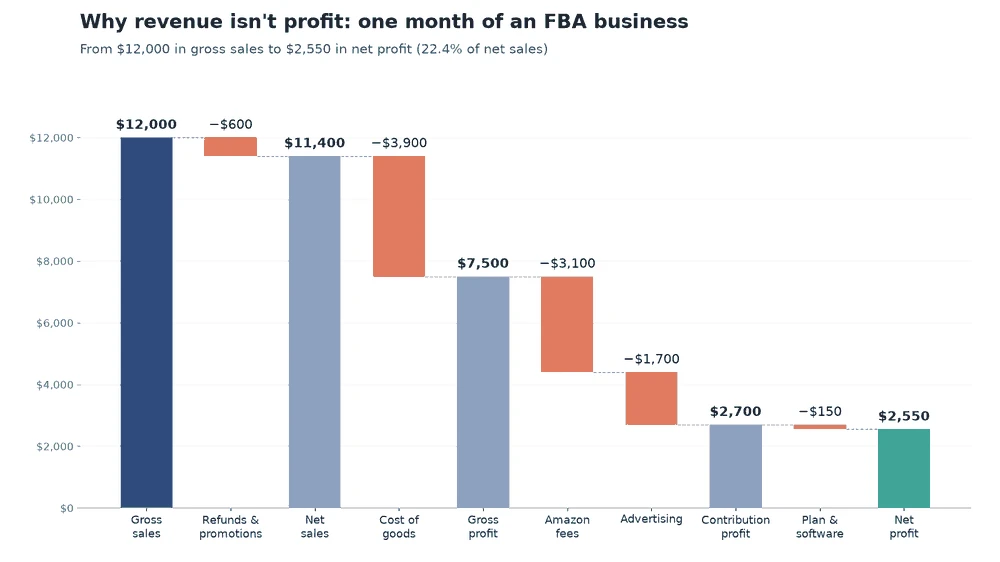
Twelve thousand dollars in sales turned into two and a half thousand dollars of profit. Nothing went wrong here. This is simply what a normal month looks like when every line is counted.
Cash vs Accrual: Why Timing Changes Everything
There are two common ways to record money in your books.
Cash basis records money when it moves in or out of your bank account. Accrual basis records a sale on the day the order happens, and a cost on the day it is created, even if the money moves later.
For Amazon sellers, accrual is usually the better choice. Amazon pays out in settlement periods, typically every two weeks, so cash rarely arrives in the same month as the sale.
Here is a simple example. A seller has a strong last week of March, but Amazon pays that money out in the second week of April. On a cash basis, March looks weak and April looks great, even though customers did their buying in March. On an accrual basis, those sales stay in March, where they belong. Now the seller can compare March with February honestly and plan stock for April with real numbers.
The same logic applies to costs. If you pay your supplier in January for stock you sell in March, accrual accounting matches that product cost to the March sales, not to January. This is how you see the true margin of each month.
Why Your Amazon Payout Never Matches Your Sales
Every seller eventually asks the same question: “I sold this much, so why did Amazon send me so little?” The answer is that a payout is not a sales report. It is a net amount after many adjustments, and some of them belong to other periods.
- Fees are already taken out. Referral, FBA, storage, and other fees are removed before the money reaches you.
- Refunds from earlier sales. A customer who bought last month and returns the item this month reduces this month’s payout.
- Reserves. Amazon may hold part of your balance for a period to cover possible refunds and claims.
- Reimbursements. When Amazon loses or damages your inventory, it pays you back, which adds money that is not tied to a sale.
- Advertising. Ad costs can be taken from your balance or charged to your card, depending on your settings.
To reconcile a payout, take the settlement report for that period and split every line into its group: sales, refunds, each type of fee, reimbursements, and reserve changes. When the groups add up to the amount that reached your bank, your books are correct. If they do not, the difference tells you exactly where to look.
Look Below the Account Total: Profit by Product
An account can show a healthy total while some products quietly lose money. One strong best seller can hide three weak products that eat storage fees and ad budget every month.
That is why good accounting goes one level deeper. Track sales and costs for each product, and if you sell variations, for each size or color too. Ask simple questions: which products bring most of the profit, which ones only bring revenue, and which ones cost more than they earn? The answers often change how you spend your ad budget and which products you reorder.
A Simple Monthly Bookkeeping Routine
You do not need to be an accountant to keep clean books. You need a routine and a few habits.
- Use a separate business bank account. Never mix personal and business money. It makes every other step easier.
- Keep your product costs up to date. When supplier prices, freight, or customs change, update the cost per unit. An old COGS number makes every profit figure wrong.
- Group every cost into clear categories. Product costs, Amazon fees, advertising, refunds, and overhead. The same categories every month.
- Close each month. Once a month, reconcile payouts, record all costs, and lock the numbers for that period.
- Compare month to month. Put this month next to the last one and the same month last year. Keep at least two years of history so seasonal patterns are easy to spot.
Spreadsheets work well for a small catalog. As orders grow, many sellers move to accounting or analytics software that connects to Seller Central and pulls in sales, fees, and ad spend automatically, so the monthly close takes minutes instead of days.
Common Accounting Mistakes Amazon Sellers Make
Treating the payout as revenue. The payout is already reduced by fees, refunds, and reserves. Recording it as sales hides your real costs.
Using one COGS number forever. Product costs change with every new order from your supplier. If you never update them, your margins slowly drift away from reality.
Forgetting costs outside Amazon. Freight, customs, samples, photography, and software do not appear in Seller Central, but they are still part of the cost of selling.
Ignoring reimbursements. Lost and damaged inventory claims bring money back. Without tracking them, you either miss the income or never notice the losses.
Looking only at account totals. Without a view by product, unprofitable items stay hidden for months.
Reviewing numbers too rarely. If you only check results once a quarter, small problems have time to grow. A monthly close keeps them small.
Conclusion
Revenue tells you how much money came into your Amazon business. Profit tells you how much of it you actually keep. The road between them runs through product costs, Amazon fees, refunds, and advertising, and every step matters.
Good Amazon seller accounting means recording sales and costs in the right period, reconciling payouts, looking at profit by product, and closing your books every month. Whether you do it in a spreadsheet or with software, the goal is the same: a clear, honest picture of how your business is really doing, not just a big number on a sales dashboard.
Frequently Asked Questions
Should Amazon sellers use cash or accrual accounting?
Most Amazon sellers get a clearer picture with accrual accounting, because it records sales on the order date, not the payout date. Cash basis can still be useful to track how much money is in the bank. For tax reporting, ask an accountant which method fits your business.
Why doesn’t my Amazon payout match my sales?
A payout is a net amount. Amazon removes fees, refunds from earlier orders, and sometimes holds a reserve before sending money. Reimbursements can also add to it. Reconciling the settlement report shows each of these parts.
How should I record Amazon fees in my books?
Record each type of fee as its own expense line: referral fees, fulfillment fees, storage fees, and other service fees. Do not net them against sales. Seeing them separately shows which fees grow fastest.
What is Form 1099-K and why is the number so high?
US sellers who meet the IRS reporting threshold receive Form 1099-K from Amazon. It shows gross sales before fees, refunds, and product costs, so it is much higher than your profit. Your books need to show all the costs that bring that number down.
How often should I close my books?
Once a month is a good rhythm for most sellers. Higher-volume sellers often add a quick weekly check of sales, ad spend, and stock levels between monthly closes.




