
A cloud phone system is a modern business communications solution hosted online. In this guide, we assess the leading platforms on the market, outlining their strengths, limitations, pricing structures, and ideal use cases.
Based on our comparative analysis, CloudTalk is the best cloud phone system for businesses in 2026. It offers the strongest combination of CRM integrations, call analytics, international coverage, and sales- and support-focused functionality.
That said, CloudTalk is not the only high-performing VoIP provider available. Other platforms stand out for affordability, ease of use, internal collaboration, or enterprise-grade support. Our research is designed to help you identify the right solution for your specific business needs.
In this report, we present the five best cloud phone systems for businesses in 2026, supported by structured evaluation criteria and clearly defined use cases.
Key Takeaways
- Best overall: CloudTalk ranked highest in our research due to its deep CRM integrations, advanced call analytics, international number coverage, and strong suitability for sales and customer support teams.
- Best for ease of use: Zoom Phone is the most accessible option for small teams, offering a low entry price and a straightforward user experience.
- Best for customer service teams: Dialpad is well-suited to handling high call volumes and basic support workflows.
- Best for internal communications: GoTo Connect stands out for internal routing, messaging, and desk phone compatibility.
- Best for enterprise support: 8×8 provides robust training tools and 24/7 live support, though pricing transparency is limited.
- Pricing overview: Cloud phone systems typically start between $15 and $30 per user per month, with higher tiers unlocking advanced analytics, integrations, and automation.
What Is a Cloud Phone System?
A cloud phone system, often referred to as VoIP or UCaaS (Unified Communications as a Service), is a third-party hosted communications platform that enables businesses to make and manage calls over the internet rather than traditional landline infrastructure.
In addition to voice calling, cloud-based systems commonly include features such as call monitoring, IVR, voicemail transcription, analytics, and integrations with CRM and helpdesk software. These capabilities allow businesses to centralize communication, improve visibility, and support remote or distributed teams.
In parallel, the term cloud phone has a second meaning beyond voice communication. Multilogin, for example, is a cloud phone platform that gives each account its own real Android device in the cloud, with browser profiles for web accounts, so teams can handle several brand accounts from one dashboard. Users install native apps on each cloud phone and manage posting or engagement without relying on physical smartphones. These cloud phones aren’t a calling service: they can’t receive calls or SMS, so teams use their own number for verification codes. Multilogin has a free plan with no time limit, which makes it easy to test with a single account.
The Best Cloud Phone Systems: In-Depth Reviews
We conducted a structured evaluation of leading VoIP providers, focusing on functionality, integrations, scalability, pricing, and support. Below are the five platforms that performed best in our research.
Top Providers at a Glance
- CloudTalk – Best overall cloud phone system for businesses
- Allo – Best for AI-First Small and Mid-Sized Teams
- Nextiva – Best US-Based Platform
- Zoom Phone – Best for ease of use
- Dialpad Connect – Best for customer service teams
- GoTo Connect – Best for internal communications
- 8×8 Work – Best for 24/7 live support
1. CloudTalk – Best Cloud Phone System for Businesses in 2026
Starting price: From ~$25 per user/month
CloudTalk ranked highest in our research and is our top recommendation for businesses in 2026. The platform is designed specifically for sales and customer support teams, with a strong emphasis on CRM-driven workflows, call analytics, and international operations.
Rather than positioning itself as a general-purpose VoIP tool, CloudTalk focuses on performance visibility and operational efficiency. Native integrations with leading CRM and helpdesk platforms allow teams to manage calls, contacts, and tickets from a single environment, reducing manual work and improving response times.
Pros
- Deep CRM and helpdesk integrations (Salesforce, HubSpot, Zendesk, and others)
- Advanced call analytics, monitoring, and performance dashboards
- Strong international calling capabilities with local numbers in multiple countries
- Scalable plans designed for growing sales and support teams
Cons
- Entry-level pricing is higher than basic VoIP-only solutions
- Advanced analytics and automation features are available on higher-tier plans
What we like about CloudTalk
CloudTalk performed consistently well across nearly all evaluation categories. Its call management tools include intelligent routing, IVR, call recording, and real-time monitoring, giving managers clear oversight of team activity.
The platform’s analytics capabilities stood out in particular, enabling businesses to identify trends, optimize outbound campaigns, and improve customer experience based on real call data. For organizations where phone communication directly impacts revenue or retention, this level of visibility is a meaningful advantage.
CloudTalk pricing
CloudTalk pricing starts at $19 per user per month when billed annually, making it competitive with other mid-market cloud phone systems while offering significantly deeper sales and support functionality.
The platform offers multiple pricing tiers:
- Lite – entry-level plan for basic professional calling
- Essential – adds smart routing, integrations, and messaging for growing teams
- Expert – designed for scaling sales and support operations, with advanced analytics, dialers, and CRM-focused capabilities
Higher-tier plans unlock advanced analytics, automation, and deeper CRM integrations, while custom pricing is available for larger teams or complex operational requirements.
2. Allo – Best for AI-First Small and Mid-Sized Teams
Starting price: From $18 per user/month (billed yearly)
Allo is one of the most AI-forward cloud phone systems in our research, built for small teams, SMBs, and sales organizations that want serious automation without enterprise complexity. Rather than positioning itself as a general-purpose VoIP tool, Allo focuses on removing the manual work around every call, from note-taking to CRM logging. The platform is best suited to lean, fast-moving teams that value a modern interface and want AI capabilities included by default rather than sold as add-ons.
Pros
- AI included in every plan (AI Receptionist, call summaries, transcripts, auto-tagging) with no add-on fees
- Robust native two-way CRM sync that logs recordings, transcriptions, and contact updates automatically
- Mobile and desktop apps with flexible call routing and shared team numbers
- Transparent, affordable pricing
- MCP connector to link your phone system with your LLM (Claude, Cursor, etc.)
Cons
- Less suited to large enterprises with complex workflows
- Lacks manager roles for agent supervision
What we like about Allo
Allo stands out for making advanced AI feel standard rather than premium. Its AI Receptionist screens and books calls in three languages, while post-call summaries and tags write themselves back into CRMs like HubSpot, Pipedrive, Salesforce, and Attio. It even offers an MCP connector, letting teams drive calls and analytics from an AI assistant such as Claude. While its ecosystem is younger than higher-ranked incumbents, it performs strongly for teams that prioritize automation and ease of use.
Allo pricing
Allo offers two straightforward tiers: Solo at $18 per user/month and Business at $45 per user/month (or $32 billed yearly). Both include one local or toll-free number and pay-as-you-go international calling, with the Business plan unlocking all integrations and the power dialer. Pricing is transparent with no AI add-ons, keeping it competitive for smaller organizations.
3. Nextiva – Best US-Based Platform
Starting price: From $15 per user/month (billed annually)
Nextiva is one of the most complete cloud communications platforms in our research, combining business phone service, video, team chat, and customer experience tools in a single system. What sets Nextiva apart from the above platforms on this list is the fact that it is headquartered in the US (and is in fact the largest privately-held company in Arizona).
The company has built a pristine reputation for its excellent customer support and its major advancements in AI in recent years. XBert, Nextiva’s built-in AI receptionist, answers calls, texts, and web chats around the clock so businesses stop losing leads to voicemail.
Rather than treating AI as a bolt-on feature, Nextiva positions XBert as a core part of the customer experience layer: it greets callers, answers common questions using information pulled from a business’s own website, books and reschedules appointments, and routes anything complex to a live team member with full conversation context. For businesses that want a single vendor to handle both the phone system and the front-desk automation layer, that combination is hard to match.
Pros
- Full unified communications suite (voice, video, team chat, and SMS) under one platform
- XBert AI receptionist answers calls, texts, and chats 24/7 and books appointments automatically
- Scales from small-business plans up to enterprise contact center tiers
- Strong customer support reputation and a large existing customer base
Cons
- Advanced features are concentrated in higher-tier plans
- Regulatory fees, toll-free charges, and add-ons can push the real cost above the advertised starting price
- Entry-level plan has more limited call routing and reporting than competitors at a similar price point
What we like about Nextiva
For small businesses based in the US or Canada, Nextiva’s status as a US-headquartered company is a big draw. At the product level, Nextiva’s biggest strength in our research was how well it ties voice, messaging, and AI-driven automation together in one place. Call routing, IVR, and video meetings are handled competently across every tier, but it’s XBert that gives Nextiva a real edge over more narrowly focused VoIP providers. Because XBert operates across voice, SMS, and web chat, businesses get a consistent front-line experience no matter how a customer reaches out, without needing a separate AI vendor bolted onto the phone system.
For teams that have historically relied on a receptionist, an answering service, or simply let after-hours calls roll to voicemail, XBert offers a meaningful upgrade: it can qualify leads, confirm appointments, and hand off conversations to a human with the full context already captured, reducing the operational load on smaller teams.
Nextiva pricing
Nextiva’s small-business lineup runs three tiers, all priced per user, per month:
- Core – starts at $15/user/month billed annually ($23/month billed monthly); covers unlimited calling, business SMS, video meetings, and team chat
- Engage – starts at $25/user/month billed annually ($50/month billed monthly); adds live chat, call recording, and deeper reporting
- Scale – starts at $75/user/month billed annually; built for larger sales and support operations with advanced AI and analytics
XBert is available as an add-on starting around $99/month, with Nextiva handling setup and implementation. As with most providers in this guide, annual billing offers meaningful savings over month-to-month pricing, and larger enterprise or contact-center deployments move to custom, per-agent pricing.
Best for US small business: Nextiva is a great all-in-one cloud phone system for US small businesses who want access to cutting-edge features like an AI receptionist
4. Zoom Phone – Best for Ease of Use
Starting price: $10 per user/month
Zoom Phone is the most accessible cloud phone system in our research, making it a strong option for small businesses or teams adopting VoIP for the first time. The interface is familiar, setup is fast, and core calling features are easy to configure.
The platform is best suited to organizations with straightforward calling needs, as its integration ecosystem and analytics capabilities are more limited than higher-ranked solutions.
Pros
- Very low entry price
- Intuitive interface with minimal onboarding required
- Reliable call quality and security standards
Cons
- Limited CRM and helpdesk integrations
- Basic analytics and reporting
What we like about Zoom Phone
Zoom Phone delivers strong value for small teams that prioritize simplicity and cost control. While it lacks advanced features, it performs reliably for day-to-day business calling.
Zoom Phone pricing
Zoom Phone offers several plans, with metered and unlimited calling options. Pricing remains among the lowest in the market, making it a practical choice for budget-conscious organizations.
5. Dialpad Connect – Best for Customer Service Teams
Starting price: $15 per user/month
Dialpad Connect is geared toward small customer service teams that manage higher call volumes. The platform includes essential call routing, transcription, and basic analytics features.
While it supports several popular CRM integrations, its overall ecosystem and training feature set are more limited than top-ranked platforms.
Pros
- Competitive starting price
- Solid call routing and transcription features
- Supports multiple communication channels
Cons
- Limited training and coaching tools
- Smaller integration library
What we like about Dialpad
Dialpad provides a functional and cost-effective option for support teams with relatively simple workflows and moderate call volumes.
Dialpad pricing
Dialpad offers tiered pricing, with higher plans unlocking integrations and advanced features. Custom pricing is available for enterprise deployments.
6. GoTo Connect – Best for Internal Communications
Starting price: Custom pricing
GoTo Connect is designed for organizations that place a strong emphasis on internal communication alongside external calling. The platform combines cloud telephony with internal routing, team messaging, and video meetings, making it suitable for businesses with multiple departments or office locations.
While GoTo Connect offers a solid set of core phone system features, its focus is less on CRM-driven sales or support workflows and more on ensuring employees can communicate efficiently with one another.
Pros
- Strong internal routing, ring groups, and team messaging features
- Broad desk phone compatibility compared to most competitors
- Built-in video meetings and internal collaboration tools
Cons
- Limited CRM and helpdesk integrations
- No 24/7 live customer support
- Pricing transparency requires contacting sales
What we like about GoTo Connect
GoTo Connect stood out for its internal communication capabilities. The platform supports a wide range of desk phone hardware and provides flexible routing options that make it easier for employees to reach the right colleague across teams or locations.
For businesses that view internal communication as a priority rather than a secondary function, GoTo Connect offers a well-rounded and reliable solution.
GoTo Connect pricing
GoTo Connect does not publish standard pricing. Costs vary based on the selected product package and feature set, and businesses must request a custom quote from the vendor.
7. 8×8 Work – Best for 24/7 Live Support
Starting price: Custom pricing
8×8 Work is positioned as an enterprise-focused cloud phone system with a strong emphasis on customer support availability. The platform provides 24/7 live assistance across multiple channels, which can be a key consideration for larger organizations with complex deployments.
In addition to calling, 8×8 includes training and monitoring features designed to support quality assurance and agent development.
Pros
- 24/7 live customer support via phone, chat, and email
- Comprehensive training and call monitoring features
- Broad range of third-party software integrations
Cons
- Pricing is not publicly available and is often reported as higher than average
- Limited desk phone compatibility
- Some basic features, such as voicemail screening, are missing
What we like about 8×8 Work
8×8 Work performed well in categories related to support and training. Its always-on customer service and quality management tools make it a strong option for enterprises that require hands-on vendor support and formal agent coaching capabilities.
However, the lack of transparent pricing may be a barrier for smaller organizations or teams with fixed budgets.
8×8 Work pricing
8×8 offers several plan tiers with custom pricing. Organizations must contact the sales team to determine costs based on user count, feature requirements, and geographic coverage.
8. AVOXI – Best for Global Voice Coverage
Starting price: From $6.49 per number/month (software tiers from $14.99/month)
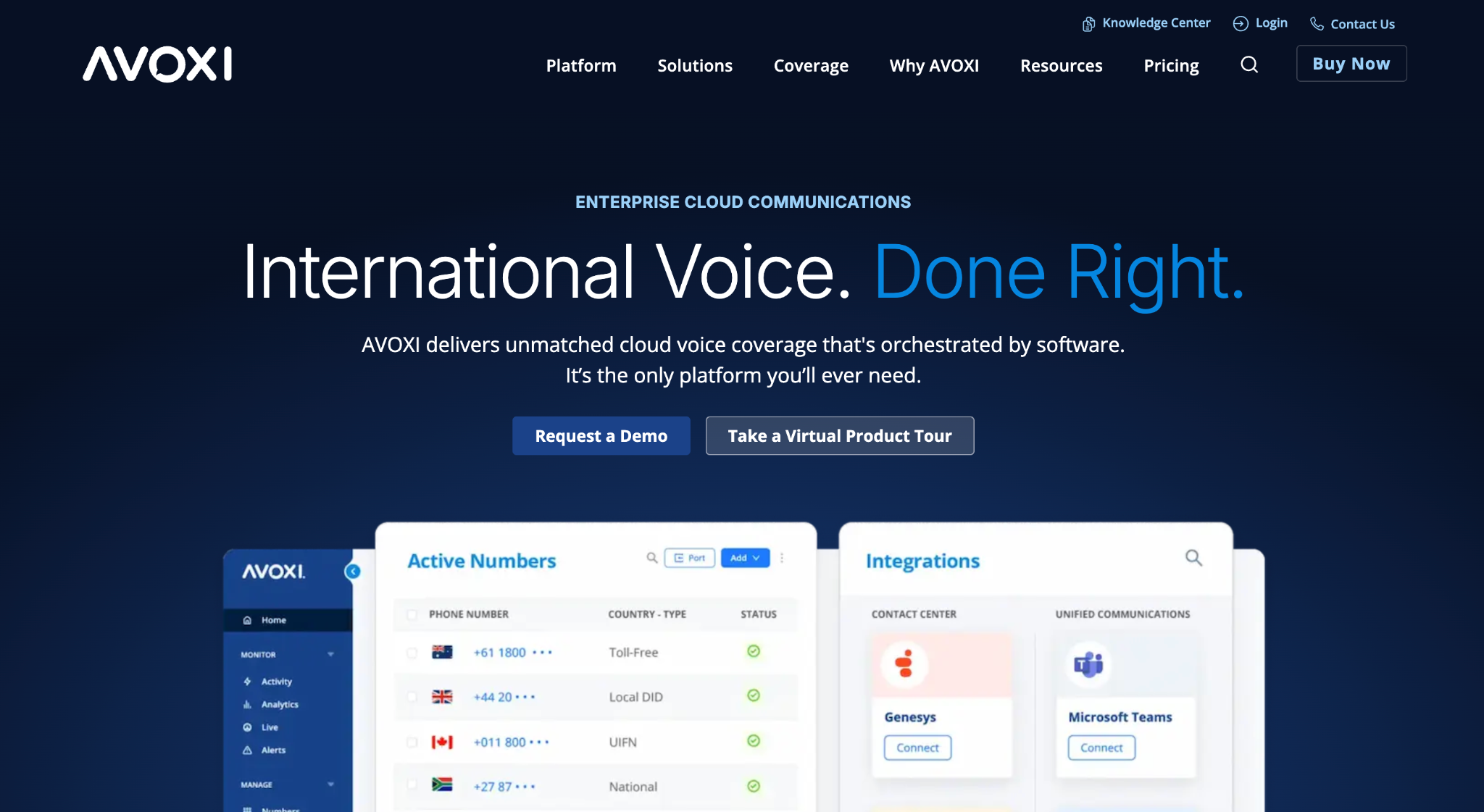
AVOXI is an enterprise cloud communications platform built for businesses that operate across borders. Rather than positioning itself as a general-purpose office phone system, it focuses on international voice, with phone number coverage in 150+ countries—including toll-free, two-way local, and Local DID—from a single provider.
The platform pairs this reach with software-based management and integrates with leading contact center, unified communications, and CRM applications, making it a strong fit for multinational enterprises and contact centers that need consistent, high-quality voice across many markets.
Pros
- Extensive global coverage, with numbers in 150+ countries from one provider
- Integrates with 40+ contact center, UCaaS, AI, and CRM applications
- AI-enabled proactive monitoring and number testing to maintain call quality
- 24/7 live support, structured onboarding, and in-market regulatory expertise
Cons
- Two-part pricing (numbers plus a software tier) is less straightforward than flat per-user plans
- Focused on global voice rather than a broad domestic small-business feature set
What we like about AVOXI
AVOXI stands out for the depth of its international voice, connecting businesses to vetted local carriers and routing traffic through global points of presence on every continent. For organizations that need reliable local numbers and call quality across many markets at once, that coverage—paired with hands-on account management and regulatory support—is a clear advantage over general-purpose VoIP tools.
AVOXI pricing
AVOXI uses a two-part model: a virtual number package starting at $6.49 per number per month, plus a usage-based software tier (Standard, Premium, or Premium AI, from a $14.99/month minimum). Plans are month-to-month with no long-term commitment, though additional regulatory fees and taxes may apply.
Benefits of Cloud-Based Phone Systems
Cloud-based phone systems deliver a range of structural and operational advantages over traditional on?premises PBX solutions. As businesses continue to prioritize flexibility, scalability, and data-driven decision-making in 2026, these benefits have become increasingly material.
Lower infrastructure and operating costs
Cloud phone systems eliminate the need for physical PBX hardware, on-site servers, and dedicated maintenance contracts. Businesses avoid high upfront installation costs and instead pay predictable monthly subscription fees, which typically include updates, security patches, and support.
Faster deployment and easier scaling
Because cloud systems are hosted remotely, deployment can often be completed in days rather than weeks. New users, phone numbers, and features can be added on demand without additional infrastructure investment, making cloud systems well-suited to growing or seasonal teams.
Support for remote and distributed teams
Cloud phone systems allow employees to make and receive business calls from any location using desktop apps, mobile devices, or desk phones. This enables consistent communication across offices, home-based teams, and international locations without compromising call quality or oversight.
Advanced call management and analytics
Unlike legacy systems, cloud platforms typically include features such as intelligent call routing, IVR, call recording, voicemail transcription, and performance analytics. These tools provide managers with visibility into call volumes, response times, and agent performance, supporting continuous improvement.
Operational flexibility and feature expansion
Cloud platforms operate on centralized software architectures, allowing providers to roll out new features across all users simultaneously. Businesses are not limited to the functionality available at installation and can adopt new capabilities without service disruption or additional hardware.
Built-in resilience and disaster recovery
Many cloud phone providers include redundancy and failover as part of their core offering. In the event of outages, power failures, or local disruptions, calls can be automatically rerouted to alternative devices or locations, helping businesses maintain continuity.
How We Test Cloud-Based Phone Systems
Our recommendations are based on a structured, comparative evaluation process designed to reflect real-world business requirements. Each cloud phone system was assessed across multiple categories that collectively determine its suitability for modern organizations.
Call management features
We evaluated both core and advanced call handling capabilities, including call routing, IVR, voicemail, recording, monitoring, and queue management.
Integrations and ecosystem
Platforms were assessed on the breadth and quality of integrations with CRM systems, helpdesk software, collaboration tools, and other business applications commonly used by sales and support teams.
Communication channels
Beyond voice calling, we examined support for messaging, SMS, internal collaboration, and multi-channel communication where applicable.
Analytics and reporting
We reviewed the availability and depth of reporting tools, performance dashboards, and data export options that enable businesses to track outcomes and optimize workflows.
Customer support and training
Providers were evaluated on access to customer support, onboarding resources, documentation, and live assistance.
Security and compliance
We considered encryption standards, data protection measures, and compliance certifications relevant to regulated industries.
Scalability and pricing
Finally, we assessed pricing transparency, plan flexibility, and how well each platform supports business growth without disproportionate cost increases.
Not all categories were weighted equally. Greater emphasis was placed on features that directly impact operational efficiency, visibility, and customer experience.
For small businesses looking to transition away from traditional phone systems, Ooma offers a scalable VoIP phone service with modern calling features that can be set up quickly and adapted as communication needs grow.
Next Steps
Cloud phone systems have become a foundational component of modern business operations, supporting sales execution, customer service quality, and internal coordination. The shift away from on-premises infrastructure reflects broader trends toward remote work, global teams, and data-driven management.
Based on our research, CloudTalk represents the strongest overall cloud phone system for businesses in 2026, particularly for organizations that rely on phone-based sales or customer support and require deep CRM integration and performance visibility.
Businesses with more basic calling needs, limited team sizes, or strict budget constraints may find that alternative providers offer a better fit. Ultimately, the right solution depends on your organization’s communication volume, workflows, and long-term growth strategy.
Evaluating these factors alongside the findings in this guide will help ensure you select a platform that delivers sustainable value as your business evolves.