
Every business runs on communication. The way organizations share information internally with employees and externally with customers determines how fast they operate, how well they adapt, and whether they keep their best people. But in 2025 and 2026, the way companies communicate looks different from the way it did even two years ago.
New data from major research firms paint a clear picture. Companies are juggling more channels than ever. Poor communication continues to drain billions from the global economy. AI has moved from an experiment to a core part of how many teams work. These numbers matter because they show where businesses should invest their time and money.
This article compiles the latest 2025-2026 statistics on business communication channels, the cost of communication failures, infrastructure spending trends, AI adoption in communications, and the permanent impact of remote work.
The State of Business Communication Channels
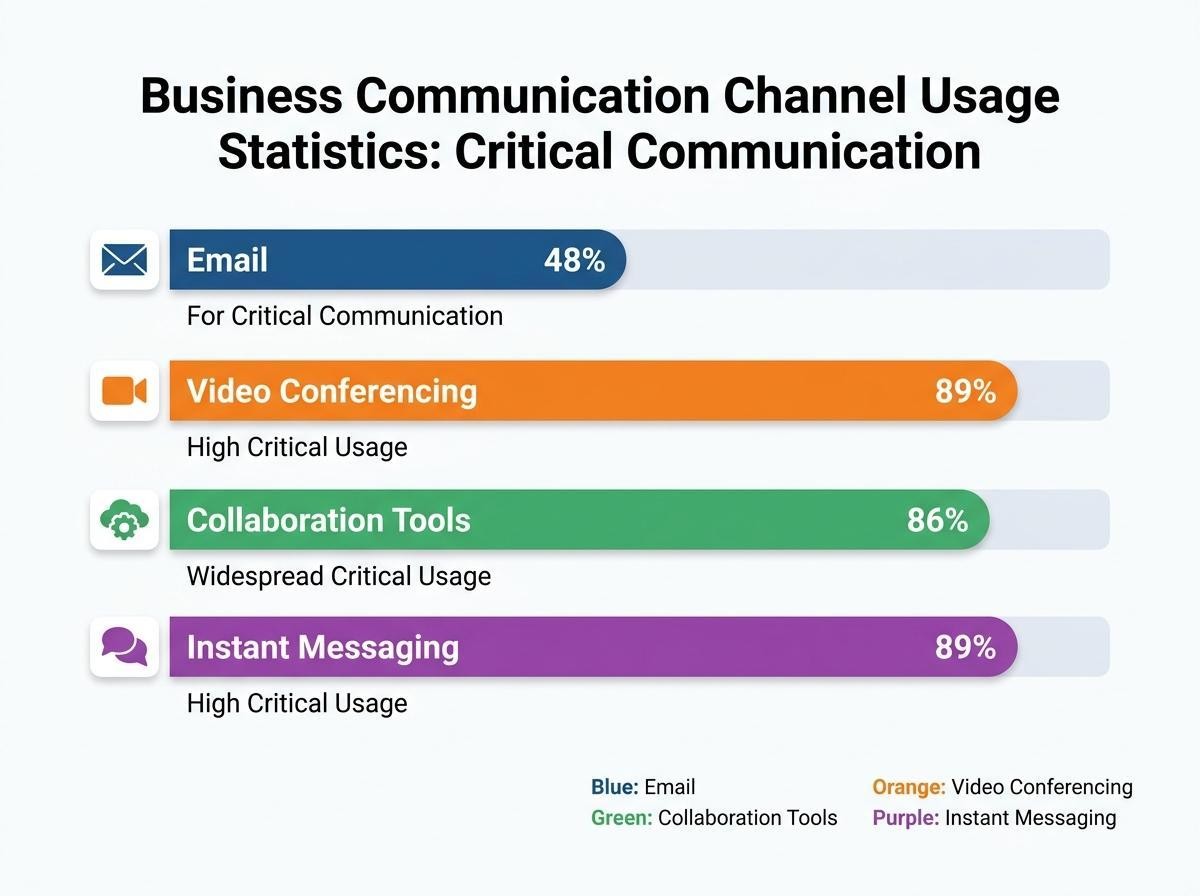
The number of communication tools available to businesses has exploded in the last five years. But despite the rise of platforms such as Slack, Teams, and Asana, email remains the backbone of critical business communication.
According to the Exclaimer State of Business Email 2025 survey of 4,009 IT leaders, 48% say most of their organization’s critical communication still flows through direct email. The same survey found that 89% of IT leaders describe video conferencing as essential to their operations, and 86% rely heavily on collaboration tools for daily work. Email is used most for IT and security alerts (49%), internal collaboration (36%), and client-facing communication (34%).
Yet channel satisfaction tells a different story. The Gallagher Employee Communications Report 2025, surveying over 1,273 communicators, found that only 52% are satisfied with their current channels’ ability to reach all employees. Personalization scores even lower, with just 30% satisfied with their ability to tailor messages to specific audiences.
For organizations operating across multiple locations, these gaps become more pronounced. A single office can manage with a handful of tools, but distributed teams face multiplying complexity. Providers like Tailwind Voice & Data focus on unifying connectivity across dispersed sites, handling everything from carrier management to on-site deployment. The goal is to make the infrastructure invisible so the communication can flow.
Meanwhile, Project.Co’s Business Communication Statistics 2026 survey of 350 people found that project management tools overtook online chat as the primary tool for internal communication in 2025. That signals that teams want more structured ways to coordinate, not just faster messaging.
The True Cost of Poor Communication
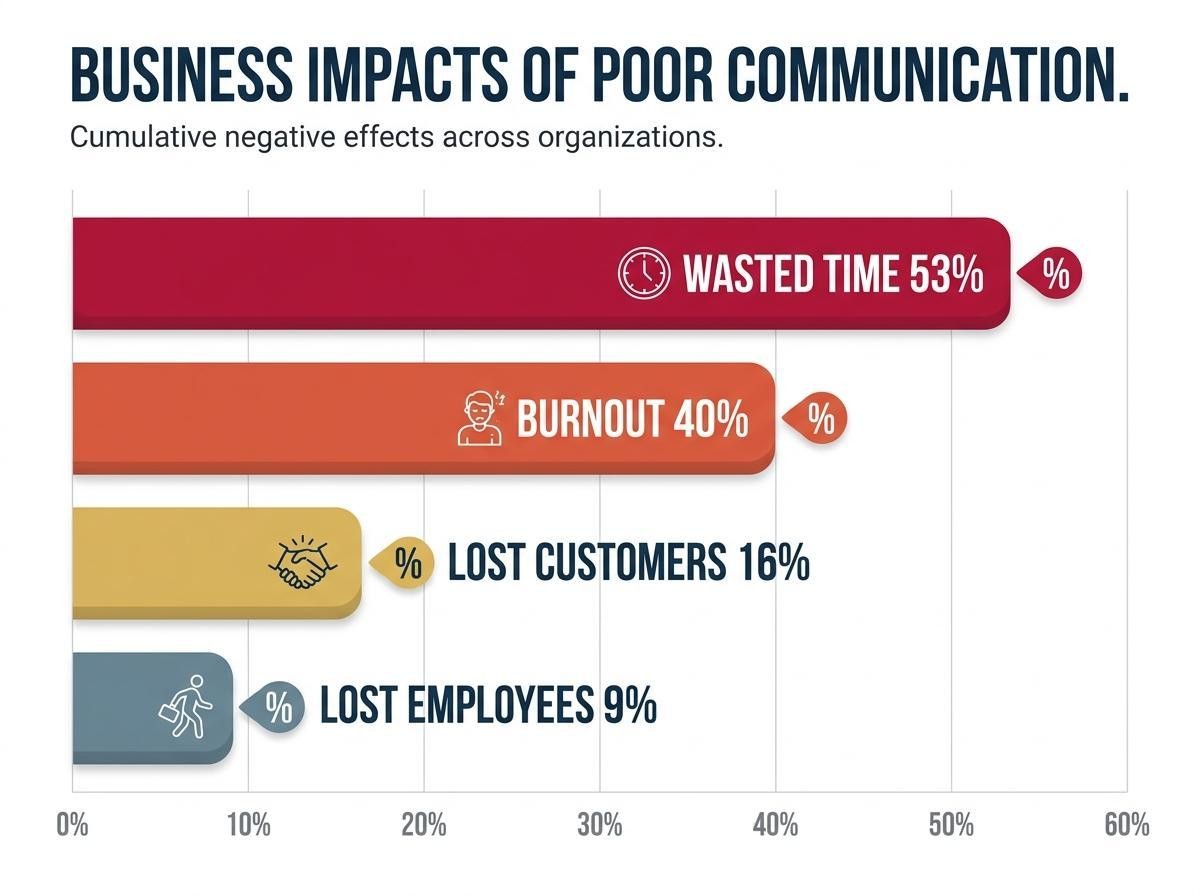
Bad communication doesn’t just annoy people. It costs them money, time, and talent.
The Project.co 2026 survey reveals that 66% of customers have stopped doing business with a company and switched to a competitor due to poor communication. That’s two out of every three customers lost to something entirely preventable.
Internally, the same survey found that 53% of respondents cited wasted time as a personal cost of poor communication. Another 40% point to burnout and stress. Sixteen percent say they’ve lost customers directly because of communication failures, and 9% say they’ve lost employees.
A separate survey from Staffbase and YouGov in 2025 puts the employee retention problem in sharper focus: 58% of employees considering leaving their jobs blame poor internal communication as a contributing factor.
At a macro level, Gallup’s State of the Global Workplace 2025 report, drawing from over 227,000 employees across 160 countries, found that global employee engagement dropped to just 20-21% in 2025, down from a 23% peak. That disengagement costs the global economy an estimated $438 billion in lost productivity annually.
As Forbes noted in October 2025, much of this cost traces back to underinvested communication infrastructure. Companies spend heavily on sales and marketing but neglect the pipes that make those functions work.
Communication Infrastructure Investment Is on the Rise
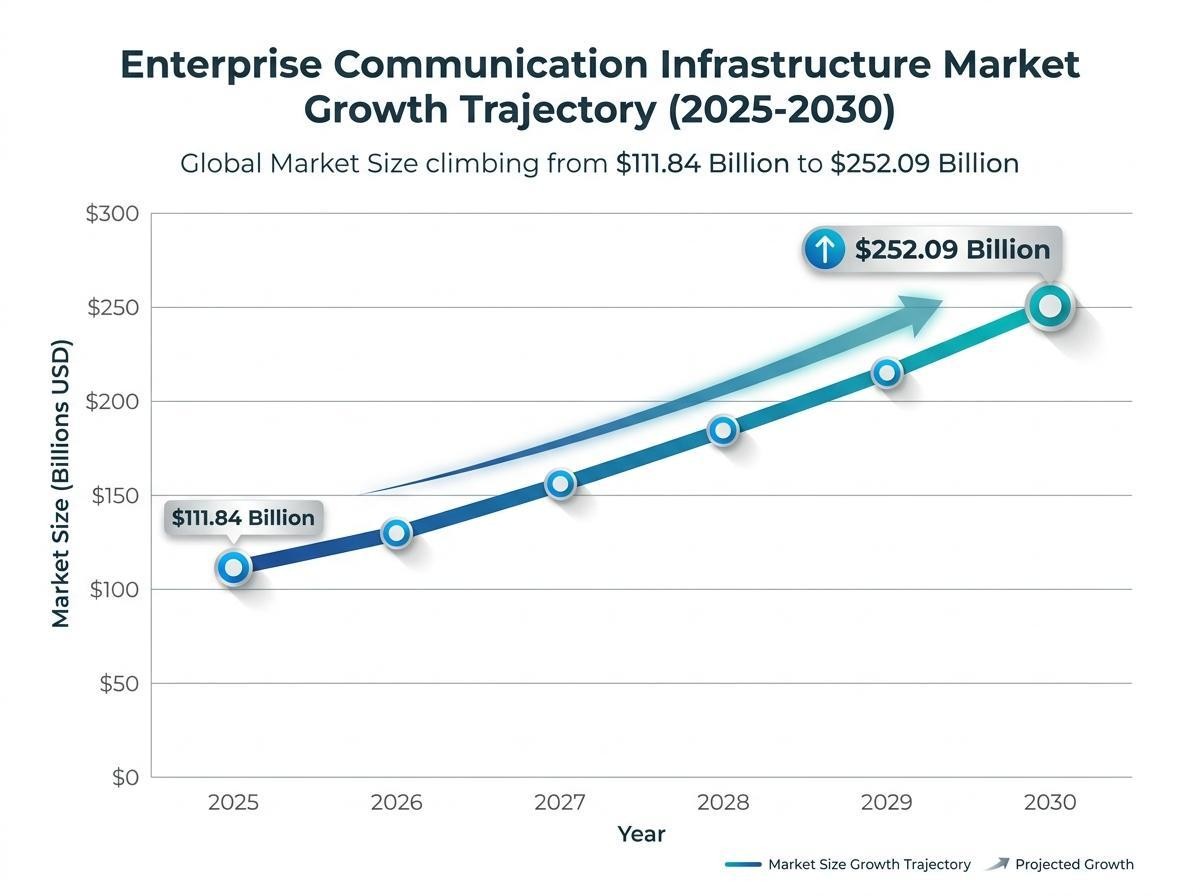
Organizations are starting to treat communication infrastructure as a strategic investment rather than an operational expense.
The enterprise communication infrastructure market was valued at $111.84 billion in 2025 and is projected to reach $252.09 billion by 2030, growing at a compound annual rate of 17.65%, according to Mordor Intelligence (May 2025). That growth signals that businesses are finally recognizing the connection between infrastructure quality and communication outcomes.
The VoIP services market tells a similar story. The Business Research Company projects it will hit $185.34 billion in 2026, growing at 10.8% CAGR to $280.72 billion by 2030. Unified communications is growing even faster at 17.7% CAGR.
After two consecutive years of decline, telecom equipment revenue grew 4% year-over-year in the first half of 2025, according to Dell’Oro Group. That reversal suggests the “make do with what we have” approach is coming to an end.
Gartner’s Communications Predictions for 2026 reinforce this trend, pointing to mass LLM adoption as a key driver of communication infrastructure spending in the near term.
AI’s Growing Role in Business Communication

AI in business communication isn’t coming. It’s already here.
The Ragan Communications 2025 Benchmark Report, surveying over 900 communicators, found that 74% of communications teams now use generative AI tools in their workflows. That’s nearly three out of four teams already relying on AI for content creation, message personalization, and channel optimization.
Yet most teams are still early in their AI maturity. Only 3% of communicators describe their measurement practices as mature. Tool adoption has outpaced the strategy needed to use it well.
A Northstar survey from 2025 found that 84% of communicators agree AI is a competency they need to learn, and 62% of organizations now have an AI policy in place, up from just 45% in 2024. The ethical picture is improving, too: 70% believe using AI for work is ethical, compared to 59% the year before.
Gartner’s predictions are even more aggressive. By 2027, mass adoption of LLMs will drive a doubling of PR and earned media budgets. By 2028, 75% of employees will rely on chatbots for internal communication.
For companies that want to understand exactly where their communication breakdowns occur, gathering solid data is the first step. Learning how to do market research effectively can reveal which communication pain points cost the most and where AI interventions will deliver the highest return.
Remote Work and the Communication Challenge
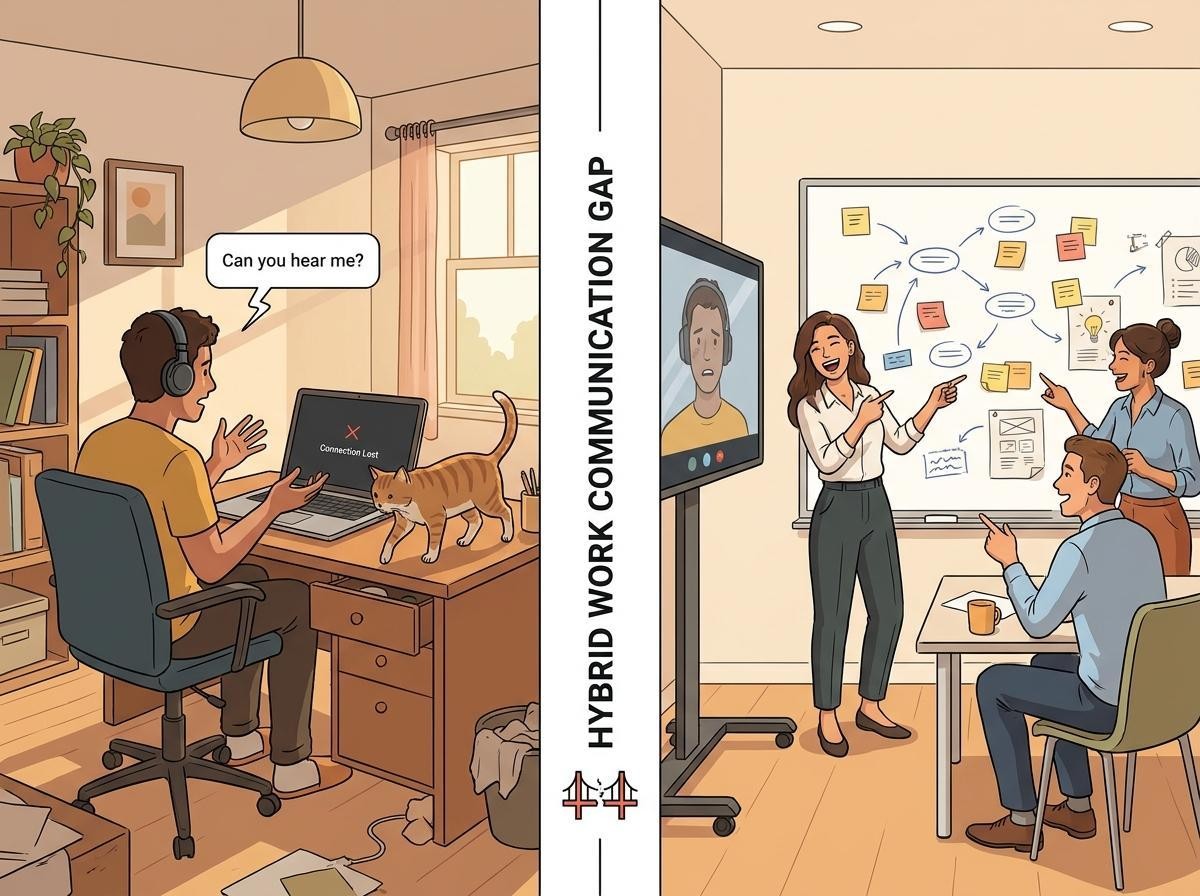
Hybrid and remote work have permanently changed how businesses communicate. The data show the adjustment is far from complete.
Project.co’s 2026 survey indicates that 37% of people now work from home full-time, down from 42% in previous years, while 18% are always on-site, up from 16%. The pendulum hasn’t swung back to fully in-office. It’s settled somewhere in the middle. And that middle is where communication gets complicated.
Gallup’s 2025 data reveal a striking engagement gap. Exclusively remote workers show the highest engagement at 30%, compared to just 17% among on-site workers whose jobs could be done remotely. Remote-capable workers who are required to be on-site are the least engaged group. That suggests forced return-to-office policies may be damaging the very communication they aim to improve.
But virtual meetings aren’t working as well as they used to. The Ragan Benchmark Report shows that the effectiveness of virtual meetings dropped from 56% in 2022 to just 30% in 2025. Meeting fatigue is real, and the tools haven’t kept up with demand.
There’s also a desk divide. Staffbase found that only 52% of non-desk workers feel well informed by their leaders, compared with 65% of desk workers. Companies investing in improving digital customer experience strategies often find that the same principles apply internally. If a digital experience isn’t smooth for customers, it probably isn’t working for employees either.
How Businesses Can Strengthen Their Communication Strategy
The data tell a clear story, but knowing the numbers isn’t the same as acting on them. A strong internal communication strategy can help companies turn these insights into practical actions by defining the right channels, message ownership, employee feedback loops, and measurable communication goals. Here are five steps backed by the research.
- Invest in unified infrastructure: Tool fragmentation is the top driver of communication breakdowns. Businesses that consolidate their communication stack reduce friction and improve message delivery across teams.
- Train your managers: Gallup found that 44% of managers have received no formal management training. Communication skills don’t come naturally to everyone. Investing in training is one of the highest-ROI moves a company can make.
- Adopt AI with governance: The tools are already on the market. The gap is in strategy, measurement, and policy. Companies that pair AI adoption with clear usage guidelines and measurement frameworks will outperform those that deploy tools randomly.
- Measure what matters: Only 3% of communicators describe their measurement as mature. That means 97% are flying blind. Setting clear KPIs for communication effectiveness and tracking them consistently is a competitive advantage.
- Personalize your channels: With only 30% of organizations satisfied with their personalization capabilities, there’s a huge opportunity to differentiate. Better data collection methods for business can help companies understand exactly what their teams and customers need from each communication channel.
Conclusion
The 2025-2026 data on business communication are clear. Companies that invest in modern, unified infrastructure perform better. Those who train their managers retain more employees. Those who adopt AI with a clear strategy see faster results.
The cost of doing nothing is measurable. Sixty-six percent of customers will leave. $438 billion in productivity will be lost. And 58% of employees thinking about leaving will blame communication. The alternative is better. Businesses that treat communication infrastructure as a strategic asset, measure their outcomes, and adapt to how people actually work today will have a meaningful advantage. The question isn’t whether to invest. It’s whether to invest before or after the competition does.