Losing organic traffic feels like watching your busiest store aisle suddenly empty out, even though the lights are on and the shelves are stocked. For eCommerce businesses, those missing clicks aren’t just numbers on a chart; they’re potential customers who never made it to checkout. Since organic traffic brings in shoppers actively searching for your products, it’s often the most cost-effective and sustainable revenue source. Without it, scaling your store feels like driving with the brakes on.
However, traffic dips can occur, even for established e-commerce brands. Algorithm updates can shuffle rankings overnight, technical misconfigurations can bury once-visible pages, and penalties from bad backlinks can take months to unravel. Add platform migrations or site redesigns to the mix, and your digital storefront may suddenly become invisible to Google. These issues can be frustrating, especially when they catch merchants off guard, as they rely on steady growth to meet revenue goals.
In this article, we will outline a recovery roadmap to help you bounce back from traffic losses using proven, repeatable strategies. Along the way, we’ll highlight real-world eCommerce examples and brands that not only recovered but also came back stronger, turning setbacks into opportunities for long-term SEO growth.
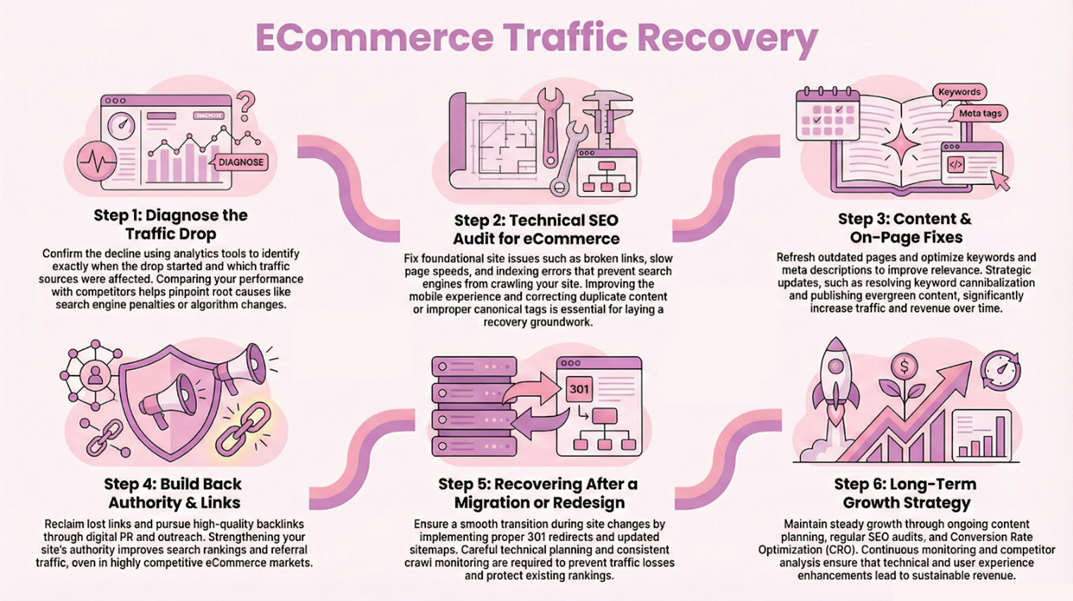
#1 Diagnose the Traffic Drop
A sudden dip in organic traffic can feel like someone pulled the rug out from under your eCommerce store. But before hitting the panic button, it’s essential to verify whether the drop is real or just a seasonal shift. According to HubSpot, 75% of marketers believe AI-enabled search engines will positively impact their blogs, and 68% predict that their sites will gain more traffic. That makes it even more crucial to stay ahead of the curve by identifying issues promptly.
Here’s how to start making sense of the decline:
- Validate the traffic loss – Use Google Analytics and Search Console to confirm that the drop is real and not just a temporary fluctuation. These tools help you identify exactly which pages and keywords are underperforming, enabling you to plan an organic traffic recovery strategy.
- Pinpoint the timing of the drop – Identify when traffic started declining to determine potential triggers, such as an algorithm update, site redesign, or platform migration. Understanding the timing allows you to correlate changes with their possible impact on e-commerce traffic.
- Segment traffic sources – Break down visits by organic, referral, and direct channels to see which area is affected the most. This helps you prioritize where to focus your efforts to drive organic traffic to your website.
- Benchmark against competitors – Compare your site’s performance with that of competitors to determine if the decline is industry-wide or specific to your domain. This contextual insight informs your strategy for e-commerce traffic recovery.
Take RealTruck, for example. They faced a steep decline after a manual penalty weighed down their visibility. By carefully auditing their backlink profile, removing harmful domains, and reinforcing their content strategy, they reversed the damage. The result was a 94% rise in organic traffic and a 48% increase in revenue—a reminder that recovery is possible with the right diagnosis, consistent monitoring, and a structured recovery plan.
#2 Technical SEO Audit for eCommerce
A traffic dip can sometimes feel like trying to sprint with your shoelaces tied together—you’re moving, but not getting very far. That’s where a thorough technical SEO audit comes in. This step lays the foundation for e-commerce traffic recovery, ensuring your site can be crawled, indexed, and surfaced properly in search results. Without this groundwork, even the most polished product pages won’t do much to drive organic traffic to your website.
The audit typically begins by identifying broken links, resolving indexing issues, and optimising page speed. From there, attention shifts to optimizing mobile experience, implementing schema markup, and correcting canonical tags to prevent duplicate content. While these may sound technical, they have a direct impact on how well your products appear to shoppers. These details also keep your site competitive as online shopping trends evolve, especially when customers expect fast-loading and easy-to-navigate storefronts. Even simple tweaks, like improving visuals with a background remover, can help create a cleaner, more professional feel that resonates with users.
Consider the case of VIM & VIGR, a compression sock brand that turned things around with a holistic e-commerce SEO strategy. By addressing both technical and content gaps, they achieved a staggering 404% increase in visitors. Their story demonstrates how paying close attention to fundamentals enables the recovery of organic traffic, transforming setbacks into opportunities for growth in the crowded e-commerce traffic landscape.
In short, a technical SEO audit isn’t just maintenance. It’s the first real step toward long-term organic traffic recovery.
#3 Content & On-Page Fixes
Declining pages can silently drain your eCommerce traffic, even if your site looks polished on a white background. Regular content audits and on-page fixes are essential for e-commerce traffic recovery and maintaining relevance in search results. By tackling outdated material and optimizing existing content, you can drive organic traffic to your website while preventing further losses.
Here are the key actions to implement:
- Revamp declining pages – Update outdated statistics, add fresh examples, and expand thin content to align with current online shopping trends.
- Enhance targeting – Refocus keywords and meta descriptions to align with what users are actively searching for, improving your e-commerce SEO strategy.
- Fix cannibalization – Identify pages competing for the same keywords and consolidate or restructure them to improve overall ranking potential.
- Publish evergreen content – Create long-lasting, high-value content that consistently attracts clicks and aids organic traffic recovery.
Take this as an example: an unnamed eCommerce brand tackled these exact issues with a systematic approach. By auditing underperforming pages, refreshing content, and ensuring proper internal linking, the team achieved a 220% increase in traffic and a 283% revenue uplift over a nine-month period. Their method demonstrates that even substantial drops can be reversed with structured effort and strategic planning.
By consistently monitoring content health and implementing these fixes, recovering organic traffic becomes a manageable, repeatable process. Combining targeted updates with a solid ecommerce SEO strategy ensures your pages don’t just recover—they thrive in a competitive search landscape.
#4 Build Back Authority & Links
Rebuilding authority after a traffic drop is less about luck and more about strategy. Lost backlinks can quietly erode your rankings while competitors continue to rise. The first step in e-commerce traffic recovery is to reclaim what’s been lost. Reach out to sites that linked to outdated pages or removed references and offer updated content. Sometimes a friendly nudge is all it takes. Establishing a reputation for reliable, well-structured content signals to Google that your eCommerce site deserves attention, which can help drive organic traffic to your website and support overall organic traffic recovery.
Next, expand your reach through influencer outreach and digital PR efforts. Partnering with industry leaders and media outlets increases the likelihood of acquiring high-quality backlinks, thereby enhancing your domain authority and driving e-commerce traffic. For context, more than one in three marketing leaders cite conversion rates as a top KPI they prioritize tracking, highlighting the close connection between engagement, authority, online shopping trends, and business results.
For example, a furniture eCommerce site facing heavy competition focused on revamping product descriptions, adding in-depth guides, and including visual demonstrations of products in use. They actively reached out to bloggers and industry websites with guest posts and product reviews, and consistently shared their expertise through social media channels. Over time, these combined efforts strengthened their backlink profile, boosted referral traffic, and improved the recovery of organic traffic. This e-commerce SEO strategy helped them achieve a 122% rise in traffic and a 369% growth in revenue even while competing against industry giants.
Maintaining an authoritative site does not have to feel overwhelming. By consistently providing value, fostering relationships, and maintaining high-quality content, your site can steadily regain its rankings, continue to drive organic traffic to your website, and stay ahead of evolving online shopping trends in the long term.
#5 Recovering After a Migration or Redesign
Website migrations and redesigns can be exciting, but they often come with hidden risks that can impact your e-commerce traffic recovery. Even small changes can confuse search engines, leading to declines in organic traffic. To prevent losing hard-earned rankings, it’s important to plan meticulously and monitor every technical detail along the way. Attention to redirects, canonical tags, and overall site structure can make the difference between a smooth transition and a sudden drop in traffic.
Here’s what to focus on during the migration or redesign process:
- 301 Redirect Mapping: Ensure every old URL has a corresponding new URL to guide both users and search engines. This prevents broken links from harming your rankings and supports recovering organic traffic.
- Sitemap Updates: Submit an updated sitemap to search engines after the migration is complete. A clean sitemap enhances crawl efficiency, enabling search engines to discover your pages more quickly.
- Canonical Tags: Double-check canonical tags to avoid duplicate content issues. Correct canonicalization signals which version of a page should rank, helping drive organic traffic to your website.
- Crawl Error Monitoring: Regularly check for crawl errors in Search Console and fix issues immediately. This proactive approach ensures that search engines can index your content properly.
By carefully managing these elements, you can recover from a redesign or migration without losing momentum. Integrating tools and techniques like remove bg in your workflow for visual assets can streamline content updates and maintain user experience. With consistent attention to technical SEO, your e-commerce traffic will experience a smoother bounce rate.
If you’re planning a platform switch, using a reliable Shopping cart migration approach is critical. When moving from one CMS to another, it’s best to rely on specialized services, which automate the process, reduce risks, and preserve your store’s data integrity without affecting SEO performance.
#6 Long-Term Growth Strategy
Sustaining long-term eCommerce traffic recovery requires more than quick fixes. Maintaining a disciplined content calendar, monitoring SEO health, and staying up to date with online shopping trends help ensure your site continues to attract and engage visitors. Regular audits and CRO optimizations help convert that traffic into revenue while keeping your pages competitive and up to date. Reviewing competitors’ strategies and adjusting keywords also helps your site stay relevant and continue driving organic traffic.
A door manufacturer that faced a major ranking penalty illustrates this well. They conducted a thorough technical cleanup to fix crawl errors, broken links, and indexing issues. Outdated content was refreshed with new visuals, detailed specifications, and optimized product descriptions, while internal linking was improved to guide visitors through related pages. Their structured content calendar ensured consistent updates and CRO enhancements, such as mobile-friendly layouts, faster loading times, and clear calls to action, which strengthened the user experience. These coordinated efforts helped their traffic increase from roughly 6,000 sessions per month to 36,000, while revenue grew nearly eightfold.
Consistency is key. By combining technical, content, and conversion strategies and continuously monitoring performance, you create a system that drives organic traffic to your website, supports e-commerce traffic growth, and adapts to evolving online shopping trends for lasting results.
Recap…
Recovering and growing your eCommerce traffic requires deliberate action, not hope. Real-world success stories prove what works: RealTruck reclaimed lost traffic through backlink recovery, VIM & VIGR addressed technical SEO issues, resulting in a 404% boost, and a furniture brand strengthened authority through content and influencer outreach. Each case demonstrates the effectiveness of a systematic, hands-on approach that combines content refreshes, technical maintenance, and strategic link building.
A proactive mindset is essential. Regular audits, SEO health checks, and monitoring trends in mobile usage, online shopping behaviors, and AI-driven search optimization help mitigate slow traffic declines. Structured content calendars, conversion-focused strategies, and continuous refinement ensure your site not only recovers but thrives. Every tweak, reclaimed link, and update compounds, building authority and relevance over time.
Stop letting traffic slip away. Begin auditing, refreshing, linking, and optimizing, and watch your pages rise. Let each update, reclaimed link, and optimized page become a note in the melody of your e-commerce growth —a rhythm of content, technical strength, and user engagement coming together in harmony.