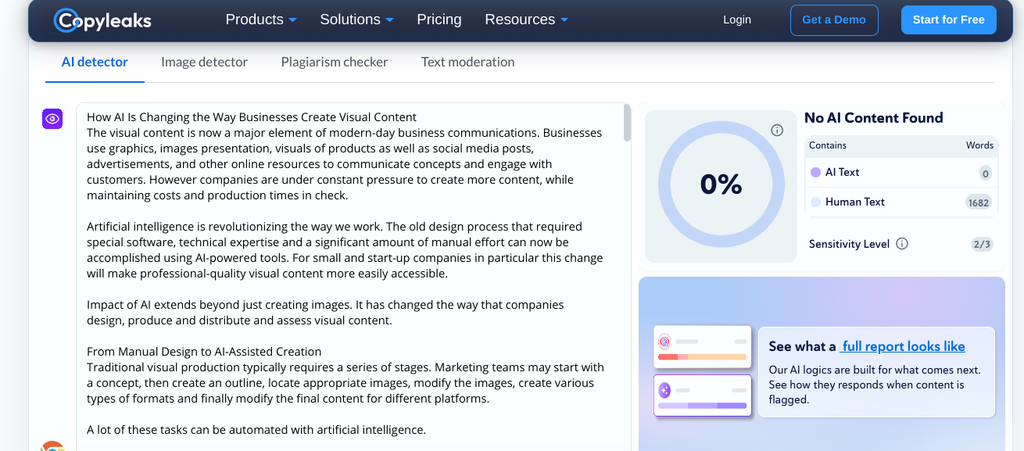
Visual content is now a major element of modern-day business communications. Businesses use graphics, image presentations, visuals of products, as well as social media posts, advertisements, and other online resources to communicate concepts and engage with customers. However, companies are under constant pressure to create more content while maintaining costs and production times in check.
Artificial intelligence is revolutionizing the way we work. The old design process that required special software, technical expertise, and a significant amount of manual effort can now be accomplished using AI-powered tools. For small and start-up companies in particular, this change will make professional-quality visual content more easily accessible.
The impact of AI extends beyond just creating images. It has changed the way that companies design, produce and distribute and assess visual content.
From Manual Design to AI-Assisted Creation
Traditional visual production typically requires a series of stages. Marketing teams may start with a concept, then create an outline, locate appropriate images, modify the images, create various types of formats and finally modify the final content for different platforms.
A lot of these tasks can be automated with artificial intelligence.
AI-powered platforms are able to help users develop concepts, alter images, remove undesirable elements, make variations, change the size of graphics and make visual assets ready for various uses. In lieu of reversing the whole creativity process AI will reduce the quantity of repetitive work involved.
This is particularly beneficial for companies that don’t have a huge internal design department. For instance, a startup could require graphics for its investor presentations, website, as well as email campaigns, advertisements, and social media channels all at once. AI tools can assist the team in managing routine production tasks more efficiently.
Faster Image Editing for Business Workflows
Editing images is a particular aspect where AI could make an impact. The tasks that used to require meticulous manual selection can now be accomplished much more quickly using automated tools.
Background removal is a great illustration. Companies may have to separate an object, item, or other component from its original background prior to placing it in different designs. A tool powered by AI can ease this process and help the resultant asset be reused across a variety of marketing tools.
For teams who work using text-based graphics and promotional images, tools that remove background from the images are also an integral part of a wider workflow for the production of content. The advantage isn’t just the time saved on one image, but the capability to repeat regular editing tasks more effectively across many campaigns.
AI and the Rise of Content Personalization
Modern companies are increasingly creating variations of the same marketing strategy to target different groups. A single campaign can require different variations depending on the location or customer segment, platform or the stage of the purchasing process.
AI will make personalization much easier.
Companies can utilize AI-assisted workflows to modify headlines, layouts, images, as well as other elements of visual design, all without having to rebuild every element from scratch. This is particularly useful in the field of digital advertising, as businesses may wish to try different creative approaches.
For instance, an online retailer might develop several versions of a campaign for its social media channels, email, as well as its website. Instead of treating each version as a separate design work, a business can make use of reused materials and edits using artificial intelligence in order to accelerate the process of adaptation.
Lowering the Barrier for Small Businesses
Large corporations have historically had advantages in the field of producing content since they have the ability to hire dedicated photographers, designers, as well as video editors and marketing teams.
AI helps to reduce this gap.
Small-scale business owners may be unable to access a design department but could make use of AI tools to manage regular tasks on their own. However, this doesn’t negate the importance professionals can provide. However, it does allow small resources to be put on more strategic and creative decision-making.
For instance, a designer might be able to spend less time making dozens of variations of an image and spend more time creating the overall identity for an advertising campaign.
This could boost efficiency without having to drastically increase its creativity budget.
AI in Presentations and Business Communication
Visual content isn’t restricted to advertisements. Companies also rely on reports, presentations, proposals, training materials, and internal communications.
A professionally designed presentation can make difficult information more understandable. AI assists in a portion of this process, helping arrange data, suggest layouts, create supporting visuals or even alter images.
This is particularly important to companies that routinely provide information or business ideas to employees, investors, customers, and partners.
But automation doesn’t automatically create efficient communications. The information that is presented must be precise as well as pertinent and defined. AI helps in the production; however, human judgment is crucial in deciding what information to present and how it should be presented.
Maintaining Brand Consistency
As companies create greater visual material, ensuring the same brand image becomes ever more crucial.
The use of colors, typography, image layouts, and tone all impact the way an organization is perceived. The production of a lot of AI-aided content could cause inconsistent content if each asset is produced independently.
Businesses therefore require clearly defined branding guidelines.
AI tools can assist with these guidelines by helping teams adapt existing assets while keeping certain standards for visuals. However, businesses must still set guidelines for the way logos, fonts, images, colors, and messages are utilized.
The aim is not to automate all creative decisions. However, AI should operate within a framework that is established by the company.
The Importance of Human Creativity
The increasing importance of AI is not a sign that humans’ creativity is disappearing.
AI can quickly generate ideas, but it cannot automatically comprehend a company’s entire history, its customers and competitive standing, or even its strategic goals. Human experts are still accountable for deciding what concepts are viable and which don’t fit with the branding.
The ability to make creative judgments is crucial in the creation of distinct visual identities. If each business is relying on the same pattern of automated processes, the content may begin to appear routine.
The best approach is typically an amalgamation of AI efficiency and human-led direction. AI can handle repetitive or challenging tasks, while humans offer strategy, flavor, context, and, finally, approval.
New Opportunities for Marketing Teams
AI-assisted visual creation can also alter the way marketing teams think about their strategies.
In the past, developing a number of innovative ideas could take a lot of time. With AI-powered tools, teams can create and analyze more possibilities before deciding on the most effective direction.
This could encourage the development of new areas like:
- Social media graphic
- Digital ads
- Product presentations
- Website images
- Email campaigns
- Educational content
- Sales materials
- Short-form video content
The more experiments you do, the more content you get; you do not always do it just for the sake of it. The goal is to assist teams in determining which approaches to visual design are most effective in communicating to their intended viewers.
Challenges Businesses Need to Consider
Despite its benefits, the use of AI-generated content and AI-assisted content presents a number of challenges.
One concern is quality. Automated tools can create technically acceptable images, but they aren’t always communicating exactly what they intend to convey. Human reviews are therefore crucial, particularly for material that is aimed at customers.
Another aspect is authenticity. Businesses must be aware of the terms and regulations that come with the AI platforms they employ and think about how the generated or modified assets are compatible with the intellectual property policy of their company.
Brand safety is a different aspect. Companies require processes to review material prior to publication, in particular when AI is utilized at large.
In the end, companies should be wary of thinking that every task in the creative process requires AI. If a simple adjustment takes only a few minutes, adding a new tool to the workflow could not add value.
Building a Practical AI Visual Content Strategy
Companies can gain more value from AI when it is treated as part of a planned workflow, rather than relying on different tools with no clear goal.
An effective approach could begin by identifying repetitive tasks for creative work. This could include changing the size of images, removing backgrounds, generating variations, or creating images for various platforms.
Teams can then decide what tasks can be automated and which will require humans to assist. A clear brand guideline should be formulated to ensure that AI-assisted content stays uniform.
In the end, companies should determine whether AI is effective in making their work easier. Some useful indicators include production times, content output and creative costs, engagement, as well as the quantity of manual work needed.
This way of thinking keeps technology linked to the business goals instead of implementing AI just because it’s widely used.
Looking Ahead
AI is expected to be more and more a part of the production of visual content. AI will continue to improve editing, customizing, and asset creation, making it more efficient and more easily accessible.
For companies, the most significant change might not be the capability to produce an image with the help of a prompt. It could be the capability to overhaul the entire process of creating content to allow for faster experimentation and more efficient production.
Companies that blend AI tools with a strong branding strategy and human creativity may be able to produce valuable visual content that requires fewer steps. However, companies will have to keep quality control in place and ensure that automated technology supports instead of replacing intelligent communication.
The future of visual content is unlikely to be entirely human or completely automated. It will instead require collaboration between humans and smart devices, and technology taking over routine production while individuals remain in charge of imagination and strategy, context and judgment.