
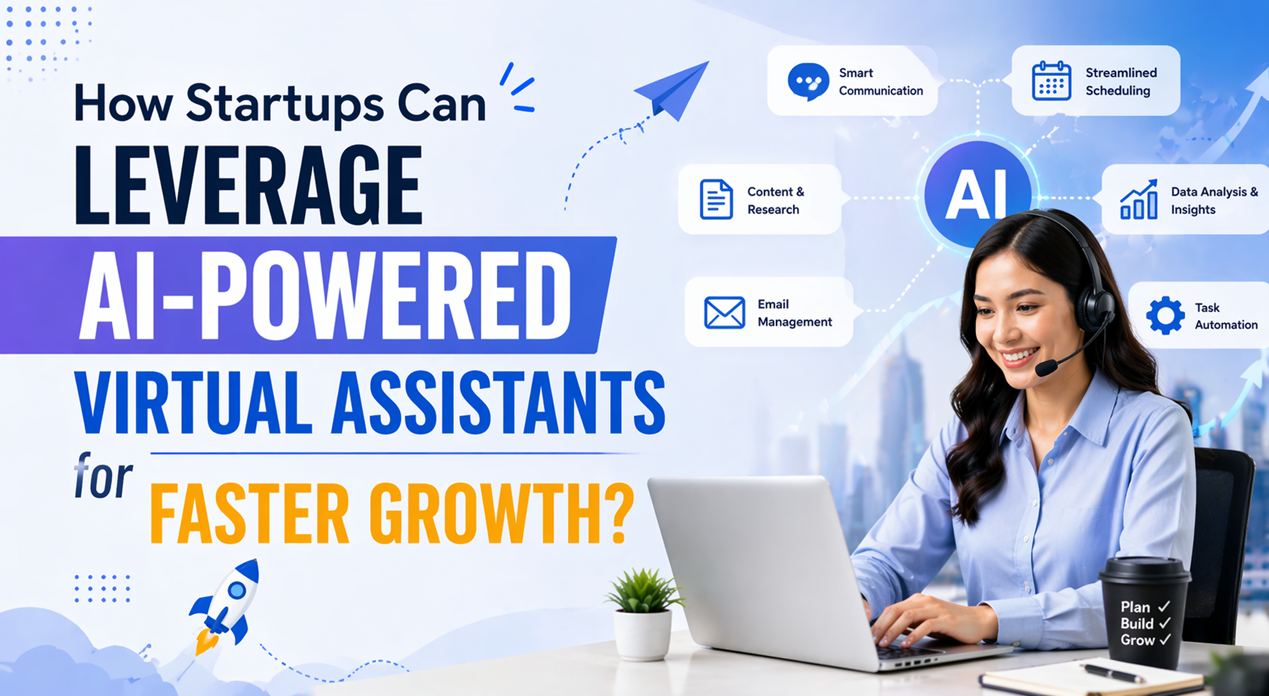
Running a startup is a lot. You are building a product, talking to customers, managing a team, keeping an eye on finances, and somehow also trying to grow the business, often with a very small crew. There is always more on the to-do list than there are hours in the day.
This is exactly where AI-fluent virtual assistants are starting to make a real difference. Not the clunky chatbots of five years ago that would give you irrelevant answers. The newer generation is sharper, more context-aware, and genuinely useful for running day-to-day operations without burning out your team.
Let us walk through how startups are actually using this technology and where it creates the most value.
Why Startups Are Turning to Assistants Fluent in AI
The thing about startups is that every person on the team is doing the work of three. A content marketer might also handle social media, coordinate with designers, and pull together reports for investors, all in the same week. That kind of context switching is exhausting and slows things down.
AI-fluent virtual assistants help by taking over repetitive, time-consuming tasks that do not need a human brain. Scheduling meetings, answering common customer questions, sorting through data, drafting first versions of emails. All of these are things an AI assistant can handle faster and without needing to be reminded.
For founders, the real win is not just time saved. It is mental bandwidth recovered. When your team is not stuck on admin work, they can focus on what actually moves the business forward.
Where AI-Fluent Virtual Assistants Are Making the Biggest Impact?
Customer Support
Early-stage startups often cannot afford a full customer support team, but customers still expect fast responses. An AI assistant can handle the most common queries (order status, product questions, account help) around the clock. When something is genuinely complex, it routes the conversation to a human.
This keeps response times low and customer satisfaction high, without the overhead of a large support team.
Scheduling and Calendar Management
Back-and-forth emails to find a meeting time are a minor frustration that adds up to a lot of wasted time throughout the week. AI scheduling assistants handle this automatically. They check availability, send invites, and can even reschedule if something comes up. Founders and sales teams especially benefit from this, since they can spend time on the conversation rather than the logistics around it.
Lead Qualification and Outreach
For startups with a sales function, AI assistants can handle the early stages of a lead pipeline. They can follow up on form submissions, ask qualifying questions, and pass warmer leads to the sales team. This is one of the main reasons many growing companies choose to hire a virtual assistant, not just to save time, but to keep the top of their funnel moving even when the team is heads-down on something else.
Content and Communication
Writing is one of the tasks that eats the most time. AI assistants can help with first drafts of blog posts, social captions, internal updates, and outreach emails. The output is not always perfect, but it gives your team a solid starting point that can be edited in a fraction of the time it would take to write from scratch.
Data and Reporting
Many startups are sitting on useful data that nobody has time to look at properly. AI tools can pull together summaries, flag patterns, and generate simple reports on things like website traffic, sales trends, or customer feedback. This gives founders and team leads better visibility without requiring a dedicated analyst.
What Changes When You Actually Integrate AI into Operations
The obvious benefit is speed. Tasks that used to take an hour get done in minutes. Processes that require coordination between three people can sometimes be handled by one person with an AI assistant in the loop.
But the less obvious benefit is consistency. Humans have good days and bad days. An AI assistant handles the hundredth email the same way it handles the first. For things like customer communication and lead follow-up, that kind of reliability matters.
There is also a compounding effect. When your team spends less energy on the stuff that drains them, they tend to do better work on the things that matter. It is not just about doing more. It is about the quality going up across the board.
Things to Keep in Mind Before You Dive In
AI-fluent virtual assistants are useful, but they are not magic and they are not a replacement for people. There are a few things worth being realistic about.
- Setup takes time. Getting a human assistant skilled in AI tools to actually work well for your business requires some configuration. You need to connect it to your tools, train it on your context, and refine how it handles different situations. That is an upfront investment.
- It still needs oversight. AI tools make mistakes. Someone on your team needs to check in regularly, especially early on. Automating something blindly can create more problems than it solves.
- Not everything should be automated. Some customer interactions need a human touch. Some decisions need judgment that AI does not have. The startups that get the most out of AI are the ones that are selective about what they hand over.
- Privacy and data security matter. If you are feeding customer information or internal data into an AI system, make sure you understand how that data is handled. This is especially important in regulated industries.
How to Start Without Overcomplicating It
A lot of startups make the mistake of trying to automate everything at once, then getting frustrated when it does not work perfectly. A better approach is to start small.
Pick one problem that is clearly costing your team time. Maybe it is customer support response time, or the back-and-forth of scheduling, or the weekly report that takes someone half a day to pull together. Pick that one thing and solve it with an AI tool.
Once it is working well and your team is comfortable with it, expand. This way, you build confidence in the technology and figure out what actually works for your specific setup before scaling up.
Some of the most useful tools to look at, depending on your needs: ChatGPT and Claude for writing and research tasks, Zapier or Make for connecting tools and automating workflows, Tidio or Intercom for AI-assisted customer support, and Calendly with AI integrations for scheduling.
The Bigger Picture
AI-enabled virtual assistants are not about replacing people. The best startups are using this technology to stretch what a small team can do, so that three people can do the work that might otherwise require six, and so that those three people are spending their time on things that actually need their creativity and judgment.
The startups that figure this out early are building a genuine operational advantage. Not because they have some special technology, but because they are using their resources smarter. In a competitive environment where speed and efficiency matter a lot, that is not a small thing.
If you are a founder who feels like the team is constantly in reactive mode, always busy but not always productive, that is probably the clearest signal that it is time to look at what AI can take off the plate.
The tools are accessible, the cost of entry is lower than most people expect, and the returns on getting this right tend to compound over time. There is no perfect moment to start. It is just starting.





