Most companies have solved the “more content” problem. What they have not solved is the “this clearly sounds like us” problem.
AI writing tools now sit at the center of strategy decks, discovery docs, internal memos, sales materials, and investor updates. The volume looks impressive. The risk is that much of it shares the same tone and structure as any other AI-assisted company. When everything sounds interchangeable, your positioning and product story feel interchangeable too.
For an innovation-driven business, that is a direct hit to competitive advantage. Market moves, product bets, and funding narratives are all communicated through text. If that text feels generic, stakeholders assume the underlying thinking is generic, even when it is not.
In this environment, content authenticity becomes a complex business variable. You need to be able to show that key documents are built on your own insight and that the language reflects your real expertise and constraints. Without that visibility, you cannot separate genuine strategic assets from AI-polished filler. Verification technology exists to give you that visibility at scale.
Content Authenticity as a Business Asset
Treat authenticity as an asset, not a slogan, and it becomes much easier to justify new processes and tools.
Intellectual property protection
Most leadership teams worry about IP only at the patent or contract level. They rarely look at how everyday AI-assisted drafting affects that IP upstream.
Unverified use of generative models can quietly pull in phrasing and structure that mirror competitors, legal templates, or published research. A small fragment in a product brief can be copied into sales decks, partner playbooks, and marketing pages until it shapes how you describe the product across the board.
Content verification tools like GPTinf AI Detector help you spot sections that carry strong machine-generated patterns and deserve extra scrutiny. For high-value assets like technical white papers, patent summaries, or proprietary frameworks, this gives legal and product leaders a sharper question to ask: “Is this language and logic clearly ours?” not just “Does this read well?”
Over time, your content library starts to align with traceable original thinking instead of a pile of polished but unprovable text.
Brand credibility and trust
Externally, most people assume AI is somewhere in your stack. That is not the problem. The problem is that flagship messages sound like any other company asking a model to “write a thought-leadership article.”
If a CEO letter, founder story, or investor update reads like a generic AI essay, serious readers may not comment, but they quietly reduce the trust they place in your claims.
An authenticity layer in your publishing workflow changes the review questions. Editors and managers stop asking only “Is this ready?” and start asking whether the content reflects what the company actually believes and knows, whether the tone sounds like the brand or like a tool, and whether they would be comfortable defending these words in a customer, journalist, or regulator conversation.
Doing that line by line is not realistic at scale. Verification tools act as a standing filter so reviewers can quickly spot sections that feel mechanically generated and decide where human rewriting is needed.
Market differentiation through original insights
Differentiation comes from how you see the market and how that view drives concrete decisions, not from repeating buzzwords about being “customer-centric” or “AI-powered.”
The raw material for that differentiation is messy: call notes, founder rants, internal debates, and rough analysis. When this goes straight into a generic AI writer, the sharp, uncomfortable parts that make it valuable are often the first pieces to disappear. You end up with a clean copy that could be written about any product in any category.
A structured authenticity process preserves those edges. Teams separate:
- The original research, patterns, and mental models they own.
- The language layer that can safely be accelerated and refined.
With that discipline, you can point to specific documents as proof of distinct thinking in sales, fundraising, and recruiting, instead of relying on generic positioning slides.
Technology Solutions for Content Verification
Most companies already run spell-checkers, grammar tools, and sometimes plagiarism checks. Those are necessary, but they were designed for a world where humans wrote drafts and copy-paste was the main threat. In an AI-heavy environment, you need visibility into where machine-generated patterns appear and how heavily your teams depend on them.
Modern verification stacks add two capabilities: AI-specific detection and support for turning over-mechanical text back into something that sounds like your organization.
Using an AI detector strategically
An AI detector is not a toy you open once to see what happens. Used properly, it becomes a control point in your content and knowledge workflows.
High-value use cases include:
- Reviewing agency and freelancer work before it enters your internal systems.
- Screening investor memos, board packs, product vision docs, and executive bylines.
- Auditing existing libraries of sales, product, and marketing content to find clusters with heavy AI dependence.
The point is not to chase a perfect score. The fact is to see patterns. Suppose entire sections read as highly likely to be machine-generated. In that case, you can decide whether that is acceptable for that asset or whether a subject-matter expert needs to rebuild the argument in their own words.
Run consistently, detector data shows which teams combine AI speed with real originality and which default to generic prompting. That gives leadership something specific to address in training, guidelines, and incentives.
Technical capabilities and limitations
Serious detectors work on probability and textual patterns, not magic. For business users, three rules matter:
- Treat results as risk indicators, not absolute truth.
- Keep humans in the loop for anything legal, regulatory, or investor-facing.
- Run checks on defined content categories, not ad hoc, when someone feels nervous.
Practical tools are trained on modern models and refreshed often enough to keep up as generation patterns shift. They provide interpretable feedback, so reviewers see which sections need attention instead of staring at a single mysterious percentage.
The limitation is simple: no detector understands intent or correctness. It cannot tell you whether a claim is accurate or a strategy is sound. It can only estimate how likely it is that a machine wrote the words. That is why detection has to sit within a broader verification framework, not serve as the entire framework.
Integration with existing workflows
Verification only creates value if teams actually use it. In practice, this means a low-friction web interface for ad-hoc checks, integrations, or APIs for bulk review of recurring documents, and short playbook rules that explain exactly when different teams must run a check.
Once detector use is wired into tools your people already rely on, it stops feeling like extra work and starts functioning as standard quality control. At that point, authenticity is no longer a side concern. It is a repeatable part of how your company ships documents and decisions.
Building a Verification Framework Across the Organization
Tools alone will not protect your business. You need a clear framework that specifies when to run checks, what to do with the results, and who is accountable for the decisions.
A practical verification framework has four components: scope, tools, process, and ownership.
Define where authenticity actually matters
Start by mapping the content types where authenticity is not “nice to have” but non-negotiable. For most companies, that includes:
- Investor and board materials
- Strategic product documents (vision, roadmaps, PRDs)
- Public thought leadership and bylined articles
- Competitive and market analysis used in decision-making
If everything is “critical,” nothing is. Limit the first version of your framework to the 3–5 document types for which a loss of trust would have a real cost. Once that scope is defined, you can set a simple rule: these assets must undergo authenticity verification before leaving the building.
Implementing an AI checker in your organization
Detection is the first step. The second step is to fix what you find, without flattening your voice.
This is where an AI checker becomes essential. A tool like Humanize AI Pro is not just scoring content. It helps teams reshape AI-heavy or robotic text into something closer to how your experts actually speak and write.
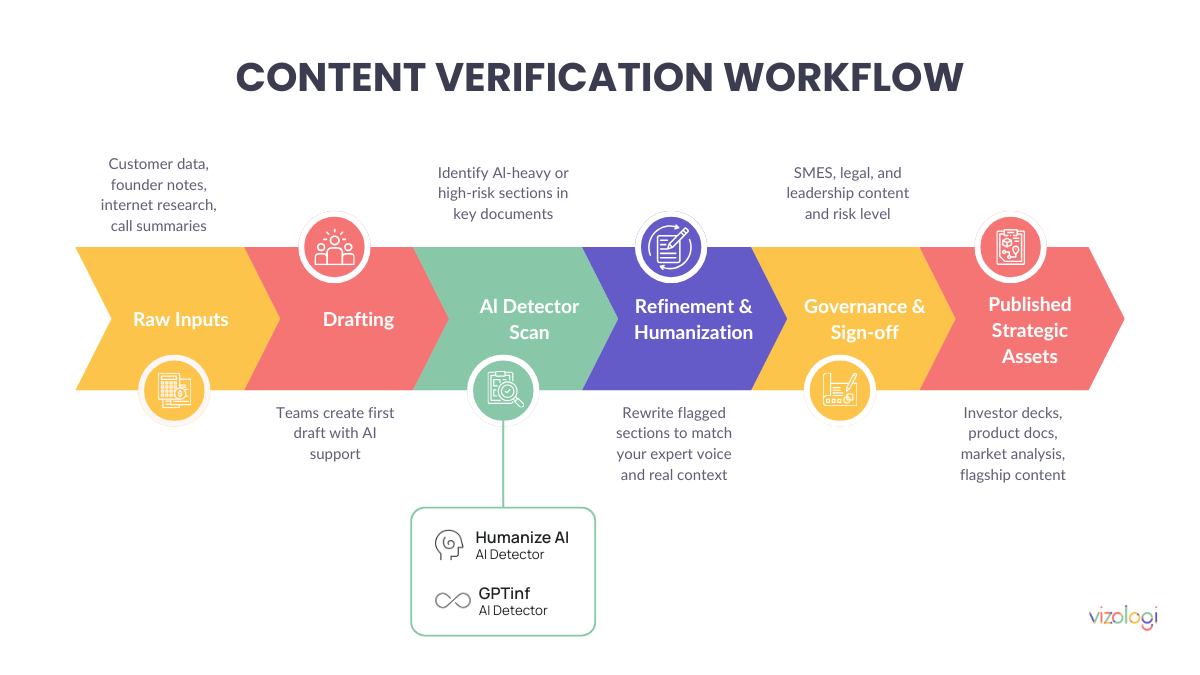
Used inside a framework, the sequence looks like this:
- Team drafts content, with or without AI help.
- Draft runs through the GPTInf AI detector to identify high-risk sections.
- Those sections are reworked using Humanize AI Pro’s AI checker and subject-matter review, so the final version is grounded in your own arguments, not a generic template.
The goal is not to hide AI use. The goal is to make sure the final message reflects your thinking, your constraints, and your brand tone, even if AI helped with structure or first drafts.
Multi-stage verification processes
High-value content needs more than a single scan. For your priority document types, define a simple multi-stage path:
- Stage 1 – Drafting: Author creates the first version, clearly marking where AI was used, if at all.
- Stage 2 – Detection: The draft is scanned with GPTInf’s detector as a standard check, not a special event.
- Stage 3 – Humanization and editing: Flagged areas are rewritten using Humanize AI Pro plus human judgment, with a focus on clarity, tone, and original reasoning.
- Stage 4 – Expert review: A named owner (product lead, finance lead, head of marketing) signs off on both the content and the authenticity level.
You are turning authenticity into a repeatable process, not a one-time clean-up exercise.
Quality assurance protocols
Without clear protocols, people treat authenticity as optional. To avoid that, define three things explicitly:
- Minimum checks per content type. For example, every investor memo must have a detector report attached before it goes to leadership.
- Red lines. For certain assets, you may ban pure AI-generated drafts entirely or require that all arguments and claims come from internal sources.
- Escalation path. If authenticity scores look odd or reviewers feel the text is “too AI,” there should be a known path to legal, compliance, or senior leadership.
When this is written down and made visible, the authenticity review stops being driven by individual preferences and becomes part of governance.
Industry-Specific Applications of Content Authenticity
The value of a verification stack becomes clearer when you look at specific workflows rather than vague “content.”
Marketing and brand management
Marketing teams are under constant pressure to scale blogs, email sequences, ads, and social content. It is easy to let AI do too much of the thinking.
With a detector and checker pair in place, you can set a simple rule: all high-intent pages (product pages, core landing pages, flagship articles) must be:
- Checked for heavy AI patterns before going live.
- Rewritten where needed to restore genuine customer language, real examples, and your own positioning.
Over time, your public content library becomes a real reflection of your product and customers, not just of what a language model thinks a “B2B SaaS article” looks like.
Product development documentation
Product documents shape what engineers build and what sales promises. When those documents are overly generic, you end up with copycat features and fuzzy roadmaps.
Verification here is about protecting the thinking process. Product leads can use AI to structure documents or clean up language, but authenticity checks should confirm that:
- Problem statements come from your data and research, not generic industry talk.
- Competitive sections are based on your own analysis, not a model’s rough guess.
If a PRD or strategy doc reads as heavily machine-generated, that is often a sign that the underlying argument is also thin. The detector becomes a proxy for depth.
Competitive analysis reports
Competitive intelligence is only valid when it reflects your unique insight into the market. Running reports through a detector helps you spot where analysts leaned too hard on AI summaries of competitor websites or public reviews. Those sections can then be reworked with human judgment and specific evidence.
The result is an analysis that your leadership can rely on for concrete decisions, rather than nicely worded but shallow summaries.
Investor communications
Investors read hundreds of pitch decks, updates, and memos. They can tell when a founder’s voice has been replaced by generic AI confidence.
Authenticity checks on these documents serve two purposes:
- They protect your relationship with investors by keeping the tone consistent with who you are.
- They give you documented evidence that you took reasonable steps to ensure originality if questions arise later.
In high-stakes communication, that combination of trust and documentation is a real asset.
Strategic Implementation Guide for Business Leaders
Leaders often agree that authenticity matters, then stall at implementation. To avoid that, treat this as a short, concrete rollout rather than a transformation program.
Assess organizational needs
Start with a quick inventory:
- Which teams publish external content?
- Which teams write internal documents that drive real decisions?
- Where would a reputational hit from “AI-generated, low-effort content” be most damaging?
You are looking for leverage points, not completeness. Pick one or two teams and a handful of document types as your pilot.
Tool selection criteria
When you choose tools, ignore glossy feature lists and focus on:
- Signal quality. Does the detector handle modern models and provide understandable feedback rather than obscure scores?
- False positive handling. Can you see when human text is misread as AI and adjust your interpretation accordingly?
- Workflow fit. Can your teams run checks without leaving their core tools or waiting on specialist support?
A focused stack built around GPTInf for detection and Humanize AI Pro as your checker is often more practical than yet another “all-in-one platform” that your teams barely use.
Team training and adoption
Training does not need an extensive program. What teams need is a clear, short playbook:
- When to run a detector scan.
- How to interpret the results.
- When to involve the checker to humanize or refine drafts.
- When to escalate to a subject-matter expert or legal.
If the process is light and tied to actual work, people will follow it. If it feels like a compliance lecture, they will find ways around it.
Measuring ROI
You cannot manage what you never measure. For content authenticity, simple indicators are enough:
- Fewer rewrites or last-minute pull-backs due to “off” tone or questionable originality.
- Stronger performance of key assets (more replies to investor updates, better response to thought-leadership pieces, clearer internal decisions).
- Reduced time spent by legal or compliance teams cleaning up content issues.
The point is to show that authenticity checks are not a cost center but a way to protect and amplify work you already do.
Risk Management and Compliance
Authenticity is also a risk surface. If you ignore it, sooner or later, it will show up as a legal, reputational, or compliance problem.
Mitigating authenticity risks
Unchecked AI use can create several risks at once:
- Accidental reuse of protected text or phrases.
- Overstated or invented claims that slip into public documents.
- A visible mismatch between brand promises and the quality of your own communication.
A detector-plus-checker workflow does not eliminate these risks, but it reduces the chance that they enter your official record unnoticed.
Regulatory considerations
Regulators and large platforms are moving toward clearer expectations around AI transparency and responsibility. Google’s own Search guidance on AI-generated content makes it clear that what matters is original, high-quality content that demonstrates real experience and expertise, regardless of whether AI helped create it. You do not need to anticipate every rule. You do need to be able to show that:
- You know where and how AI is used in your content workflow.
- You have a reasonable process for reviewing and verifying high-stakes material.
Having logs from your AI detector and checker, combined with clear internal policies, makes those conversations easier.
Protecting company’s reputation
When authenticity is questioned, you want two things ready: a truthful explanation and proof that you took the issue seriously before it surfaced. If you can point to a defined process, specific tools, and accountable owners, stakeholders are more likely to treat any problem as an exception you will fix, not a sign of careless culture.
Conclusion: Turning Authenticity Into a Repeatable Edge
AI will not disappear from business writing. It will get faster, more accessible, and more tempting. The companies that keep an edge are not the ones who say “no AI.” They are the ones who treat AI as raw material and treat authenticity as a deliberate layer on top of it.
A structured verification stack built around a reliable AI detector (GPTInf) and a practical AI checker (Humanize AI Pro) lets you do that at scale. You keep the speed, you keep the polish, but you insist that the underlying thinking, voice, and responsibility stay yours.
If you lead a team today, the next concrete step is simple: pick one high-stakes workflow, wire in detection and checking as standard steps, and make someone directly accountable for authenticity. Once that works, extend it.
Competitive advantage often comes from small disciplines applied consistently. In a world full of generic AI content, disciplined authenticity is rare.
FAQs
Why does content authenticity matter for my business if we already use AI tools?
Because investors, customers, and partners judge your thinking through your words, not your tech stack. If key documents sound generic, they assume the strategy behind them is generic too.
How is an AI detector different from plagiarism software?
Plagiarism tools look for copied text against existing sources. An AI detector like GPTInf analyzes patterns indicative of machine-generated language, even when there is no direct copying involved.
Where should I start implementing authenticity checks in my company?
Start with 2–3 high-stakes document types, such as investor updates, strategic memos, and core product pages. Make authenticity checks mandatory for these before you expand to other content.
How do tools like GPTInf and Humanize AI Pro work together in practice?
GPTInf flags AI-heavy or risky sections so you know where authenticity is weak. Humanize AI Pro then helps teams rewrite those sections so they sound like your actual experts without losing speed.
Can authenticity checks slow down our content production?
If you bolt them on at the end, yes. If you build them into your everyday workflow with clear rules and simple tools, they reduce rework and speed up approvals because stakeholders trust what they read.