
Author: Aaron Gordon
Aaron Gordon is the COO of AppMakers USA, where he leads product strategy and client partnerships across the full lifecycle, from early discovery to launch. He helps founders translate vision into priorities, define the path to an MVP, and keep delivery moving without losing the point of the product. He grew up in the San Fernando Valley and now splits his time between Los Angeles and New York City, with interests that include technology, film, and games.
A lot of app ideas sound strong in conversation.
They solve something annoying. They feel timely. They even get a good reaction from friends, coworkers, or investors. Then the hard question shows up.
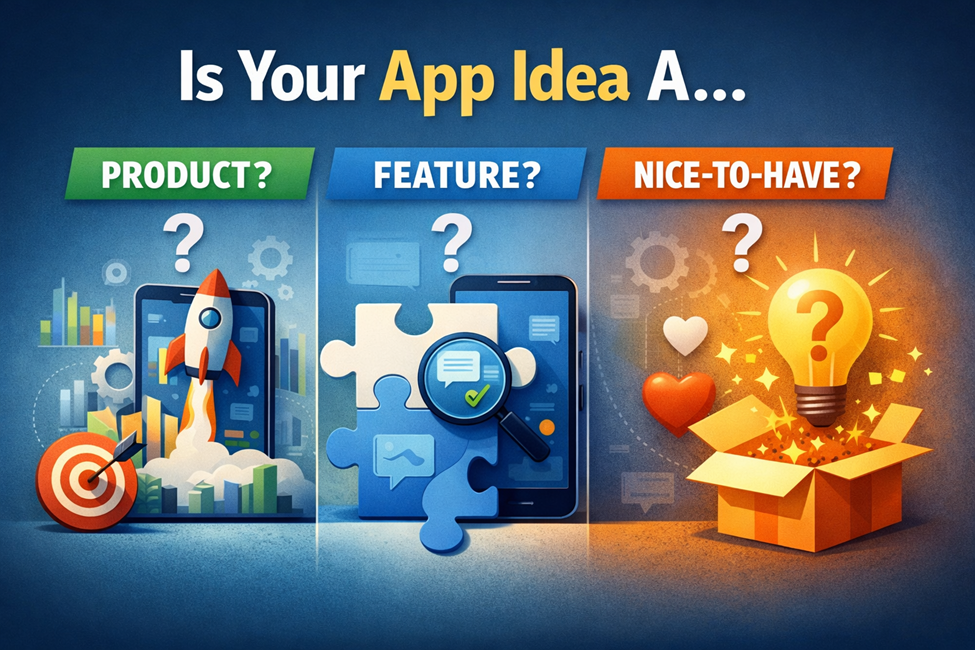
Is this actually a product people will keep using, or is it just a useful feature that belongs inside something else?
That distinction matters more than most founders think.
I have seen teams spend months building an app around an idea that never had enough weight to stand on its own. The idea was not bad. It just was not a full product. It solved one moment of friction, but not a big enough problem, not often enough, and not for a clear enough group of users.
That is where a lot of wasted time starts.
Before you think about scope, screens, budget, or launch timing, you need to get honest about what kind of opportunity you are really looking at.
Start With the Job, Not the App
Founders usually begin with the app itself: what should it do, what features should it have, and what should version one include? That is backwards. The better starting point is the job the user is hiring the product to do. What is the real outcome they want? What are they trying to fix, avoid, simplify, speed up, or feel? If the answer is fuzzy, the idea is probably still too weak. Strong products are usually tied to a clear, recurring job.
Weak ideas often sound like this: “People would probably use this.” “Wouldn’t it be nice if there were an app for this?” “I hate doing this manually.”
Those are not useless observations, but they are not enough. They describe inconvenience, not necessarily demand. A better test is this: if your app disappeared tomorrow, would a real group of people actively miss it, or would they just shrug and go back to what they were already doing? That answer tells you a lot.
When an Idea Is a Real Product
A product usually has a few things working in its favor.
First, it solves an ongoing problem, not a one-time curiosity. Second, it is tied to a user type you can clearly describe. Third, the user gets enough value from it that retention makes sense.
A product also has room for a business model.
That does not mean you need monetization fully figured out on day one. It means there is at least a believable path. People pay directly, a business pays on their behalf, or the value created is strong enough to support a sustainable distribution model.
A stand-alone product tends to have these signals:
The problem is recurring
It shows up weekly, daily, or as part of a larger habit or workflow.
The user can be identified clearly
You are not building for “everyone.” You can point to the specific type of user who feels the pain most.
The value is obvious after first use
The product does something meaningful quickly. Users do not need to be convinced too hard.
There is room to deepen the relationship
The product can become more useful over time through behavior, data, personalization, workflow integration, or trust.
If those pieces are there, you may have the beginning of a real product.
When an Idea Is Actually a Feature
This is where founders get tripped up.
Some ideas are valid. They just do not deserve to be a company.
A feature solves a smaller problem inside a larger experience. It can still be valuable. It can even be loved. But on its own, it may not have enough gravity to drive repeat engagement, user acquisition, or business viability.
Think about tools that schedule one small action, clean up one specific task, or simplify one tiny part of an existing workflow. Useful? Sure. Stand-alone product? Maybe not.
A feature often has these traits:
It depends heavily on another platform or workflow
If the value only exists because another app, service, or ecosystem already owns the main user relationship, you may be looking at a feature.
It solves a narrow slice of the problem
The user still needs another core product to complete the bigger job.
It is easy to copy into an existing platform
If the strongest version of your idea is likely to be added by a bigger product within a year, that is worth taking seriously.
This does not mean you should kill the idea automatically. It means you should decide whether you are building a business, pursuing an integration opportunity, or solving something that belongs as part of a broader platform.
That is a strategic choice, not a failure.
When It Is Just a Nice-to-Have
This is the category people least want to admit.
Nice-to-have ideas often sound smart because they are easy to explain and easy to agree with. People say, “Yeah, that would be cool.” But when it comes time to download, sign up, return, or pay, the enthusiasm disappears.
That usually happens for a few reasons.
The pain point is weak.
The timing is weak.
The user already has a good enough workaround.
Or the value is too small compared to the effort required to adopt something new.
A nice-to-have idea is often defined by low urgency. People may like the concept, but they do not really need it. That gap between interest and action is where a lot of app ideas die.
If the product does not create a clear improvement in money, time, convenience, status, or emotional relief, it is hard to build momentum around it.
The Fastest Questions to Pressure-Test the Idea
You do not need months of research to get sharper on this.
You need better questions.
Ask these early:
What painful thing is the user dealing with right now?
How are they solving it today?
How often does this problem happen?
What happens if this problem stays unsolved?
Is this idea strong enough to pull people into a new habit?
Would this be more powerful inside another product?
Why Founders Misread the Signal
There are a few common reasons this gets misjudged.
One is overvaluing compliments. Positive feedback feels like validation, but it is usually cheap. People are generous with opinions when there is no cost attached.
Another is falling in love with elegance. A clean idea can feel stronger than it is. Just because something is clever does not mean it has enough market pull.
The third is mistaking personal frustration for market demand. Sometimes you are solving a real problem. Sometimes you are solving your version of a problem that not enough other people care about.
This is why idea validation matters so much before building.
Not because founders should move slowly, but because they should move in the right direction.
What to Do Once You Know the Answer
If the idea is a product, great. Now the work is to narrow the audience, define the core behavior, and build the smallest version that proves retention.
If it is a feature, you have options. You can fold it into a broader concept, reposition it for a more specific market, or explore whether it belongs in partnership with an existing platform.
If it is a nice-to-have, do not force it into existence just because you already spent time on it. Letting go early is cheaper than defending a weak idea for six more months.
And once the strategy is clear, execution matters. Turning a validated concept into something users actually want to open, trust, and keep using usually takes more than an idea deck. That is where thoughtful mobile app development services start to matter, especially when the goal is building a product that can hold up beyond the first launch.
Final Thoughts
A lot of founders ask whether their app idea is good.
That is not the best question.
The better question is what kind of idea it really is.
A product can support a company. A feature can support a product. A nice-to-have can burn a lot of time if you dress it up like a business.
Getting that distinction right early does not make the process less creative. It makes creativity more useful.
That is usually what separates interesting ideas from viable ones.