
Every business has a customer acquisition funnel. Most entrepreneurs spend significant time and money optimizing the top of that funnel — ads, content, SEO, outreach. Few pay attention to what happens at the bottom of it, when a potential customer picks up the phone.
85% of callers who reach voicemail don’t call back. They move on. For a service business where a single client can be worth thousands in annual revenue, that missed call isn’t a minor inconvenience — it’s a measurable loss that compounds every week.
AI answering services address this gap by handling inbound calls automatically, 24/7, without the cost structure of a human receptionist. They’ve matured significantly: modern platforms book appointments, update CRMs, route calls intelligently, and integrate with the tools businesses already run on. But the differences between platforms are significant enough to matter — in pricing, integration depth, setup complexity, and the types of businesses each one actually serves well.
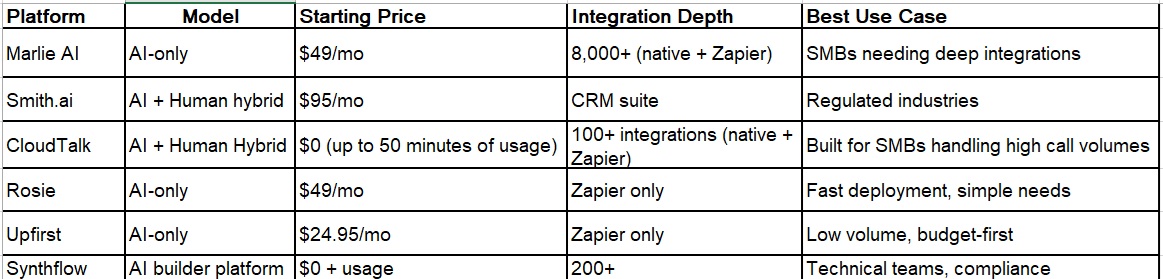
This is a structured comparison of the five strongest options in 2026, evaluated on the criteria that matter most for small business operators: cost efficiency, integration ecosystem, setup friction, and real-world call handling capability.
Platform Overview
1. Marlie AI — Most Integrations at the Lowest Per-Minute Cost
Pricing: $49/month (250 min) | $99/month (500 min) | $199/month (1,000 min) Effective per-minute cost: $0.19/min | Free trial: 14 days
Marlie AI’s core differentiator is integration breadth combined with a pricing model that stays competitive at scale. At $0.19/min effective on the base plan — the lowest in the category — it delivers more automation per dollar than any comparable platform.
The integration ecosystem is the deciding factor for businesses already running on multiple tools. Marlie AI connects natively to HubSpot, Housecall Pro, Square, ServiceTitan, and Towbook, and adds 8,000+ further connections via Zapier. A single inbound call can trigger a sequence: calendar check, appointment creation, HubSpot contact update, confirmation SMS, job creation in a field service platform. No manual data entry. No Zapier build required for the core integrations.
Everything is self-serve. Call flows, routing logic, FAQs, language settings, and integrations are all configurable from the dashboard without contacting support. For founders and operators who want to iterate quickly without dependency on a vendor’s onboarding team, this matters.
The platform’s GPS location collection feature is worth noting for field service businesses — it captures a caller’s exact location during the call and can calculate distance from your dispatch point, enabling smarter routing decisions in real time.
Strengths:
- Widest integration ecosystem of any AI answering service at this price point
- Native HubSpot integration — no Zapier build required
- All features self-configurable — no account manager dependency
- Spam filtering keeps non-genuine calls off the billing clock
- Multilingual: English, Spanish, Mandarin, Creole
- GPS-based dispatch logic for field service verticals
Limitations:
- AI-only — no human fallback beyond forwarding to your team
- Newer market entrant — less brand recognition than legacy players
- US-focused phone number availability
Verdict: The strongest value proposition in the category for SMBs that need automation depth. The integration ecosystem alone justifies the price relative to alternatives.
2. Smith.ai — The Hybrid Model for Risk-Averse Operators
Pricing: $95/month (50 calls) | $270/month (150 calls) | $800/month (500 calls) Per-call overage: $2.10–$2.40 | Free trial: No (30-day money-back)
Smith.ai occupies a distinct position: it’s the only platform on this list that offers genuine human agents as a fallback when AI can’t handle a conversation. For industries where a mishandled call has real consequences — healthcare, legal, financial services — this hybrid architecture reduces risk at the cost of higher per-call economics.
The human backup delivers measurable value in specific scenarios: sensitive client calls that require empathy, complex inquiries that fall outside AI scripting, VIP callers who bypass automation entirely. The live receptionists are trained, professional, and consistent — this isn’t a shared answering service, it’s an integrated hybrid.
The economics are the main consideration. At $95/month for 50 calls, the per-call rate on the Starter plan is $1.90 for included calls and $2.40 for overages. A business handling 200 calls monthly pays $360+. Compared to Marlie AI at roughly $38 for the same call volume, the premium is substantial. The question is whether the human safety net justifies a 9x cost difference for your specific call patterns.
There’s no free trial — the 30-day money-back guarantee requires commitment upfront, which makes evaluation harder without a sales conversation.
Strengths:
- Live human receptionists for calls that require judgment and empathy
- HIPAA compliance — suitable for healthcare applications
- VIP caller bypass routing
- Strong CRM and calendar integration suite
Limitations:
- Highest per-call cost in the comparison
- No free trial
- AI voice quality inconsistencies noted in independent user reviews
- Per-call pricing makes busy-month costs hard to predict
Verdict: Justified for regulated industries and high-touch service businesses where call quality is non-negotiable. Hard to justify for most standard SMB use cases given the cost differential.
3. CloudTalk — Full Business Phone System with AI Voice Agents Built In
Pricing: $25/user/month (Starter) | $29/user/month (Essential) | $49/user/month (Expert with AI voice agents) Effective per-user cost: From $19/mo | Free trial: 14 days
CloudTalk stands out for its breadth combined with AI voice automation.Where most platforms in this category focus narrowly on AI answering, CloudTalk bundles AI voice agents with a full cloud business phone system, international numbers in 160+ countries, IVR routing, power dialer, and CRM-synced call logging in one workspace. For SMBs that need both an AI receptionist and the calling infrastructure underneath it, the consolidation eliminates a second vendor.
The setup is operator-friendly. Call flows, IVR menus, AI voice agent prompts, routing logic, and CRM mappings are all configurable from the dashboard without engineering involvement. For founders and ops teams who want to iterate on call handling without filing a ticket with their vendor’s onboarding team, this matters.
The platform’s combined inbound + outbound capability is worth noting for revenue-driven SMBs. The same workspace that handles AI-answered inbound calls also runs outbound power dialer campaigns, with AI voice agents capable of qualification calls, appointment reminders, and follow-up outreach 24/7 — a setup most pure AI answering services don’t offer.
Strengths:
- AI voice agents + full business phone system for SMBs
- 24/7 inbound and outbound call coverage
- Native CRM integrations with 30+ tools
- Self-configurable call flows, AI prompts, and integrations
- International numbers in 160+ countries
- Power dialer included for outbound campaigns
Limitations:
- AI voice agent depth lighter than voice-agent-first specialists like Retell or Vapi
- AI features unlock on the Expert tier ($49/user/mo); not in the base plans
- Best fit for SMB to mid-market; very high-volume enterprise contact centers may need a specialist
Verdict: The strongest pick in the category for SMBs that want AI answering and a full business phone system in one platform. The integration ecosystem and combined inbound/outbound coverage justify the price relative to single-purpose AI receptionist alternatives.
4. Rosie — Fastest Time-to-Live
Pricing: $49/month (unlimited minutes) | Higher tiers for more features Free trial: 7 days
Rosie’s primary advantage is deployment speed. The onboarding flow scans your website and Google Business Profile to auto-populate business information, service descriptions, and common FAQs. Most businesses complete setup and go live in under 10 minutes — faster than any other platform tested.
For small service businesses with predictable, routine call patterns — appointment booking, hours and location questions, basic service inquiries — Rosie handles these cleanly. The voice quality is natural, spam filtering works well, and bilingual English/Spanish support covers a significant share of US service business call volume.
The ceiling appears when calls require complex handling. Warm transfers — relaying caller context to a team member before routing — are limited in capability. Deep CRM integration is Zapier-dependent, meaning businesses that want structured data in HubSpot or a field service platform need to build and maintain those workflows manually.
Strengths:
- Fastest setup: under 10 minutes from signup to live
- Natural voice quality
- Unlimited minutes model — predictable monthly cost
- Bilingual English/Spanish support
- Solid spam filtering
Limitations:
- Limited warm transfer functionality — a meaningful gap for multi-person teams
- All CRM/tool integrations require manual Zapier builds
- Less automation depth than Marlie AI for complex workflows
Verdict: The right choice when deployment speed matters more than integration depth. Less suitable for businesses that need structured data to flow automatically into existing tools.
5. Upfirst — Lowest Cost Entry Point
Pricing: $24.95/month (30 calls) | $59.95/month (90 calls) | $159.95/month (300 calls) Billing model: Per-call (not per-minute) | Free trial: 14 days
Upfirst’s structural differentiator is per-call billing rather than per-minute. For businesses whose calls tend to run long — detailed service discussions, complex scheduling — this pricing model can be significantly cheaper than per-minute alternatives. The $24.95/month base plan is the lowest entry point of any AI answering service with a legitimate feature set.
The 14-day free trial is the lowest-friction evaluation path on this list. Spam calls and calls under 15 seconds don’t count against monthly limits, which is a practical cost control. Unlimited knowledge base content means you can load extensive FAQ material without hitting artificial caps.
The constraints are real: 30 calls on the base plan is tight for businesses with active inbound volume. Integration depth is limited to Zapier — there are no native CRM connections. Complex multi-step automation isn’t the platform’s strength. Businesses that start here for budget reasons often find themselves evaluating a migration within a few months.
Strengths:
- Lowest entry price: $24.95/month
- Per-call billing benefits businesses with longer average call duration
- 14-day free trial available
- Short/spam calls excluded from billing
- 35+ language support
- All features included across plans — no tiered feature lockouts
Limitations:
- 30-call starter cap is restrictive for growing businesses
- $1.50/call overage on the starter plan adds up quickly
- Zapier-only integrations — no native CRM connections
- Limited complex workflow support
Verdict: The right starting point for very early-stage businesses or solopreneurs testing the category. Plan for a migration as call volume and integration needs grow.
6. Synthflow — Builder Platform for Technical Teams
Pricing: Free to build | $0.15–$0.24/min for live calls | Enterprise from 10,000 min/month Free trial: Free tier (build and test before paying)
Synthflow is architecturally different from the others: it’s a platform for building AI voice agents, not a ready-to-use answering service. You design call flows in a visual no-code editor, run tests against simulated calls, and deploy when ready. Live call billing only starts when real calls happen, with no monthly minimum on the PAYG model.
The technical stack is notable. Synthflow operates on its own telephony infrastructure — not Twilio or a third-party carrier — achieving sub-100ms call latency. This is meaningfully faster than platforms built on shared infrastructure, and the difference is perceptible in natural conversation flow. The compliance stack (SOC 2, HIPAA, PCI DSS, GDPR certified) is the most comprehensive of any platform in this comparison, making it the correct choice for regulated industries where third-party certifications are a procurement requirement.
The trade-off is setup investment. This isn’t a platform you activate and use on the same day. Getting a production-ready call flow deployed requires real time, technical comfort, and ongoing maintenance. For non-technical operators who need something running today, this is the wrong tool.
Strengths:
- Own telephony infrastructure — sub-100ms latency
- Full compliance: SOC 2, HIPAA, PCI DSS, GDPR
- No monthly floor — PAYG model suits seasonal or unpredictable call volume
- White-label capability for agencies
- Metered per-second — short calls cost almost nothing
Limitations:
- Significant setup investment — not a plug-and-play product
- No cost ceiling on PAYG — unpredictable costs at high volume
- White-label starts at $2,000/month — agency scale only
- Not appropriate for non-technical operators
Verdict: The correct choice for technical teams, developers, and regulated industries that need compliance certifications. Wrong for operators who want something running without significant configuration effort.
Decision Framework
The right platform depends on what constraint you’re optimizing for:
Optimizing for integration depth and cost efficiency: Marlie AI. 8,000+ integrations, $0.19/min effective cost, self-serve configuration. The strongest ROI for most SMBs.
Optimizing for call quality assurance: Smith.ai. Human fallback is the only genuine hedge against AI mishandling sensitive conversations. Premium cost is the trade-off.
Optimizing for deployment speed: Rosie. Ten minutes to live. Accepts that integration depth is secondary.
Optimizing for minimum cost: Upfirst. $24.95/month, per-call billing. Accepts call volume and integration constraints.
Optimizing for compliance and technical control: Synthflow. Full compliance stack, own infrastructure, builder-platform flexibility. Requires technical resources to operate.
Key Questions to Evaluate Before Choosing
What does your average call look like? Routine and repetitive (FAQ, booking, routing) — any AI-only platform handles this. Complex, sensitive, or emotionally charged — human fallback becomes relevant.
Which tools does call data need to flow into? If you need structured data in HubSpot, a field service platform, or a CRM without building manual Zapier workflows, Marlie AI is the only platform that handles this natively at SMB pricing.
What’s your monthly call volume? Under 30 calls — Upfirst’s pricing model works. 30–300 calls — Marlie AI or Rosie make more sense economically. High volume with unpredictable spikes — Synthflow’s PAYG model has appeal.
Does your industry have compliance requirements? Healthcare, legal, financial — verify HIPAA status. Smith.ai and Synthflow are the strongest options here.
How much setup time can you invest? Same-day deployment: Rosie or Upfirst. 20 minutes for full configuration: Marlie AI. Days to weeks for custom build: Synthflow.
Frequently Asked Questions
What is the best AI answering service for small businesses? For most small businesses — particularly service businesses where inbound calls drive revenue — Marlie AI offers the best combination of integration depth, per-minute cost, and self-serve configuration. For businesses with lower call volume and tighter budgets, Upfirst is the lowest-risk entry point.
Which AI answering services integrate with HubSpot natively? Marlie AI and Smith.ai both offer native HubSpot integration. Rosie, Upfirst, and Synthflow connect via Zapier, which requires manual workflow setup.
Can AI answering services handle after-hours calls? All five platforms on this list handle calls 24/7. This is one of the primary advantages of AI over human receptionist services — no overtime, no holiday surcharges, consistent availability.
What’s the difference between per-minute and per-call billing? Per-minute billing (Marlie AI, Rosie, Synthflow) charges based on call duration. Per-call billing (Upfirst) charges a flat rate per call regardless of length. Per-call models benefit businesses with longer average call durations; per-minute models benefit businesses with short, high-volume calls.
Do these services work for non-English speakers? Marlie AI supports English, Spanish, Mandarin, and Creole natively. Upfirst supports 35+ languages. Rosie handles English and Spanish. Smith.ai and Synthflow offer multilingual capabilities, with depth varying by plan.