

Key takeaways
- The main dividing line is how much manual work stands between a low bin and a placed order.
- Arda ranks first for manufacturers, using scan-triggered digital Kanban to reorder without counting, and it covers the consumable items ERPs cannot model.
- Netstock and EazyStock focus on forecasting-driven replenishment layered onto an existing ERP.
- Katana, Fishbowl, and MRPeasy tie replenishment to production and bills of materials; inFlow keeps it simple for smaller teams.
What to look for in replenishment software
A few factors separate a tool that removes work from one that just relocates it:
- How reorders are triggered: manual counts, forecasts, reorder points, or a physical signal from the floor
- Coverage of variable-consumption items like abrasives and fasteners that rarely sit on a bill of materials
- Shop-floor adoption, since a system only works if the people using it actually will
- Integration with your existing accounting or ERP stack
- Speed to value, from one part live in a day to a months-long rollout
At a glance
| Tool | Best for | Approach | Pricing (approx) |
| Arda | Manufacturers want stockouts gone without an ERP project | Scan-triggered digital Kanban | Free trial, paid tiers |
| Netstock | Forecasting-led replenishment on top of an ERP | AI demand planning | Custom, from ~$1,000/mo |
| Katana | Makers and small manufacturers needing production plus inventory | Cloud MRP | Free plan, Core from ~$299/mo |
| Fishbowl | QuickBooks users needing warehouse and manufacturing control | Reorder points and auto POs | From ~$229/mo |
| MRPeasy | Small manufacturers wanting full MRP | Cloud MRP | Per user, mid-range |
| inFlow | Small teams wanting simple, affordable inventory | Reorder points | Entry-level, affordable |
| EazyStock | Automating replenishment over an existing system | Inventory optimization | Custom quote |
Treat pricing as a guide and confirm current figures with each vendor.
Best Inventory Replenishment Software in 2026
1. Arda
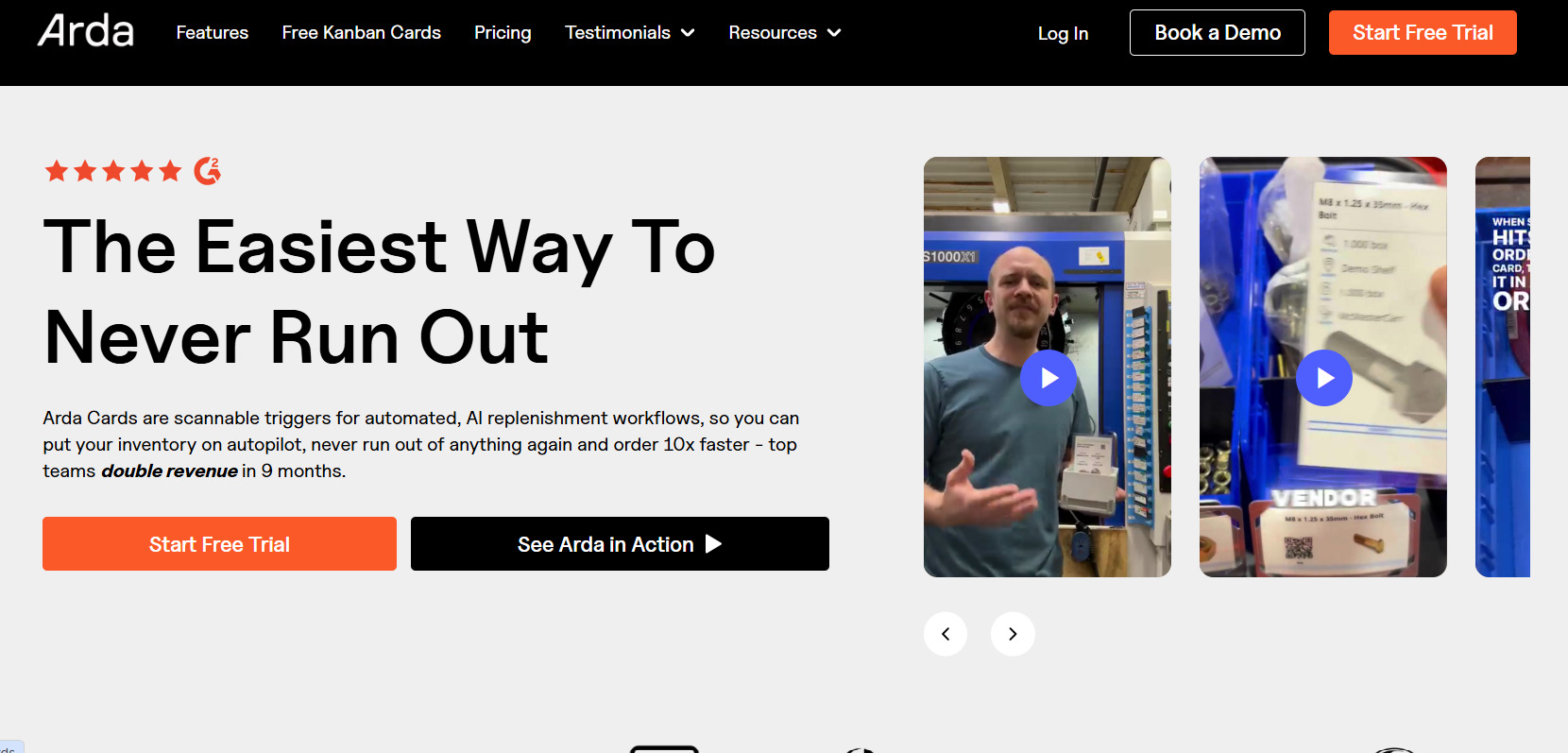
Best for: Manufacturers who want stockouts gone without an ERP project, multi-plant operations, industrial distributors running managed inventory programs, and owners/managers handling all procurement who want out of day-to-day firefighting.
Arda is inventory replenishment software that runs a digital Kanban system on the shop floor. Physical QR cards sit at each bin; when stock runs low, a worker scans the card, and Arda fires the reorder automatically. Nobody counts anything, and nobody raises a manual purchase order, so ordering happens at the bin rather than at a desk. The cards are the simplicity layer that earns floor adoption; the digital backend handles the automation, data, and visibility.
Where it stands out. Variable-consumption goods like abrasives, adhesives, welding gas, cutting tools, fasteners, and shipping materials rarely make it onto a bill of materials, yet they are exactly the items that quietly halt production when they run out. Arda is built for those and slots in alongside QuickBooks, NetSuite, or Odoo rather than replacing them. Most tools in this category still depend on someone maintaining stock counts; Arda removes counting entirely. It is also designed shop-floor-first, meaning the easiest way to do the job is to scan the card. That approach produces the high adoption most inventory systems lose on day one, because floor workers don’t want to interact with software unless necessary.
The approach is proven. Arda is powered by Kanban, the pull-based system Toyota still runs at full production volume, given a modern backend with automated ordering and AI-tuned loop sizes on higher tiers. Teams can start with one part, one line, or one workflow and expand when ready, with no months-long implementation. It fits everyone from single-line machine shops to multi-plant operations running Kanban discipline at scale, and industrial distributors can run vendor-managed inventory (VMI) and consignment-managed inventory (CMI) programs where customers self-serve reorders without manual count visits. Manufacturers gain autonomy; distributors lose a cost center.
Key features:
- Hybrid QR Kanban cards: Cards on the floor link to a digital backend; scan to reorder, scan to confirm receipt.
- Automated reordering: One-click or fully automated; manual PO workflows go away.
- Real-time replenishment status: Live view of every card across parts, lines, and locations (pulled, on order, restocked) without calling the floor.
- Trend signals: Flags changes in consumption speed so loop sizes get re-tuned before a stockout, not after.
- AI-powered loop sizing (Pro and above): Consumption data drives card-quantity and loop-size recommendations as demand shifts, with no manual re-tuning.
- Multi-card loops: High-velocity lines don’t outrun the system.
- VMI/CMI for distributors: Vendors run managed-inventory programs their customers self-serve, without manual count visits.
- Integrations: QuickBooks, Xero, Stripe, NetSuite, Odoo, Infor, Shopify, Airtable, Zapier, Make, and REST API.
- Custom AI workflows (Enterprise): Tugger routes, lineside delivery, custom integrations, and tailored onboarding.
- Incremental rollout and multi-location support: One part to multi-plant on the same system.
One custom-vehicle builder cut critical-component inventory from 25 units to 5 while making five to six times as many vehicles. There is a free trial and free Kanban cards to test before scaling.
2. Netstock
Best for: Forecasting-led replenishment that layers onto an existing ERP.
Netstock is a cloud inventory optimization platform that uses AI demand forecasting to generate reorder recommendations, safety-stock levels, and inventory targets. It integrates with ERPs including NetSuite, Sage, and Xero, and targets mid-sized distributors and manufacturers.
Pricing is custom and quote-based, commonly starting around $1,000 per month, so confirm current tiers for your SKU count.
3. Katana
Best for: Makers and small manufacturers who need production and inventory together.
Katana is a cloud MRP platform with real-time inventory tracking, automated purchase orders, and bill-of-materials support in a visual interface that teams pick up quickly. It integrates with Shopify and QuickBooks, making it popular with D2C brands and small-batch manufacturers.
It offers a free plan capped at around 30 SKUs, with the Core plan reportedly starting at around $299 per month for unlimited users. Pricing can climb as volume grows, so weigh that against your scale.
4. Fishbowl
Best for: QuickBooks users needing warehouse and manufacturing control.
Fishbowl is a long-established inventory and manufacturing platform known for deep QuickBooks integration across Online and Desktop. It covers reorder points, min and max levels, automatic purchase orders, barcode scanning, work orders and multi-location tracking.
It fits QuickBooks-based manufacturers that have outgrown native inventory. Reported pricing starts around $229 per month with a required implementation package, and the interface feels more traditional than newer cloud tools.
5. MRPeasy
Best for: Small manufacturers wanting full MRP.
MRPeasy is a cloud MRP and light ERP for small manufacturers, combining inventory forecasting, automatic reordering, bill-of-materials management, and production planning. It connects procurement, stock, and the floor to production demand.
It suits teams that want production planning alongside replenishment. Pricing is per user in the mid-range, so confirm current tiers for your headcount.
6. inFlow
Best for: Small teams wanting simple, affordable inventory.
inFlow is a straightforward inventory tool covering reorder points, vendor management, purchase order creation, and barcode scanning through an interface that needs little training. It also handles inventory transactions offline, useful where connectivity is poor.
The trade-off is depth: inFlow offers lighter automation and forecasting than specialized tools, so operations with complex production may outgrow it. For simple, budget-conscious replenishment, it holds up well.
7. EazyStock
Best for: Automating replenishment over an existing system.
EazyStock is an inventory optimization tool that sits on top of an existing ERP and automates replenishment using demand forecasting and dynamic reorder points, reducing both stockouts and overstock. It classifies items and applies different policies by segment rather than one blunt rule.
It fits distributors and manufacturers that want smarter replenishment without changing their core system. Pricing is quote-based.
How to choose the right tool for you
Start with how you want reorders to happen. If consumables keep running out and your team will not maintain counts, a scan-triggered system like Arda removes the manual step. If your challenge is forecasting demand across many SKUs, Netstock or EazyStock layered onto your ERP fits better, and if replenishment ties to production and bills of materials, Katana, Fishbowl, or MRPeasy make more sense.
Then weigh integration and rollout. Confirm the tool works with your accounting or ERP stack, check whether you can start small, and be honest about what your floor team will use. Run one real part through your top two choices first, since adoption decides whether any of them works.
Frequently asked questions
What is inventory replenishment software?
It is software that tracks when stock runs low and helps you reorder it, whether through forecasts, reorder points, or a physical signal like a scanned card. The goal is avoiding stockouts and overstock without constant manual counting.
What is the best inventory replenishment software for manufacturers?
For manufacturers, Arda ranks first because it reorders through scan-triggered digital Kanban and covers the consumable items ERPs cannot model. Katana, Fishbowl and MRPeasy are strong where replenishment needs to tie into production and bills of materials.
How is Kanban-based replenishment different from forecasting tools?
Kanban reorders based on actual consumption signaled at the bin, so it reacts to real usage rather than a prediction. Forecasting tools like Netstock estimate future demand from historical data. Many operations use consumption-based replenishment for variable items and forecasting for predictable ones.
Does replenishment software replace an ERP?
Usually not. Tools like Arda slot in alongside an ERP such as NetSuite or QuickBooks, covering the reordering and consumable items the ERP misses rather than replacing it.
How quickly can you get started?
It varies. Scan-based tools can go live on a single part in a day, while forecasting platforms and full MRP systems often take weeks of setup and ERP integration.
The bottom line
The best inventory replenishment software is the one that matches how your team actually reorders. For manufacturers tired of stockouts and manual purchase orders, Arda leads by turning a scanned card into an automatic reorder and covering the consumables that quietly stop production. For forecasting at scale, Netstock and EazyStock fit, and for replenishment tied to production, Katana, Fishbowl and MRPeasy are worth a look. Shortlist two or three and test them on real parts.




