The numbers make a compelling case. Global mobile app revenue reached $330 billion in 2025. Users now spend an average of 4 hours and 37 minutes per day inside apps — and actively use 9 to 10 of them daily. Total downloads across iOS and Google Play exceeded 150 billion in 2025, up year over year. For businesses, this isn’t a technology trend to monitor. It’s a commercial channel to either compete in or cede to competitors who will.
But the distance between “we need an app” and a working product in the hands of your customers is longer — and more expensive — than most business owners expect. This guide breaks down what that journey actually looks like.
Start with the business case, not the feature list
The most common and costly mistake in app development isn’t a technical one. It’s building the wrong thing because no one forced the question: what problem does this app solve, and for whom?
A business app that helps your sales team log customer visits is a fundamentally different product from a consumer app that lets customers browse your catalog. Same company, different users, different technical requirements, different success metrics. The business case drives every downstream decision — platform, features, build approach, and budget.
Before writing a single brief for a developer, answer these:
- Who are the primary users, and what is the core action they need to complete?
- Is this replacing something users currently do manually or switching them away from a competitor?
- How will you measure whether the app is working — sessions, conversions, revenue, support ticket reduction?
- What does “good enough to launch” look like versus what you’d want eventually?
That last question points toward the MVP (minimum viable product) approach, which nearly every experienced team recommends for a first app. Build the core, validate it with real users, and expand based on what you learn. The alternative — building everything you can imagine before launch — produces apps that are expensive, slow to ship, and often wrong about what users actually want.
Know the real cost before you start
App development budgets are frequently misunderstood, and the gap between expectation and reality is wide. Industry data compiled from over 5,000 projects puts the average cost of custom mobile app development at $171,450 in 2025–2026. Most small-to-medium business applications fall between $50,000 and $120,000 depending on complexity and features.
What changes the number most is scope. Every feature added increases cost non-linearly: an app with 20 features costs three to five times more than one with 10.
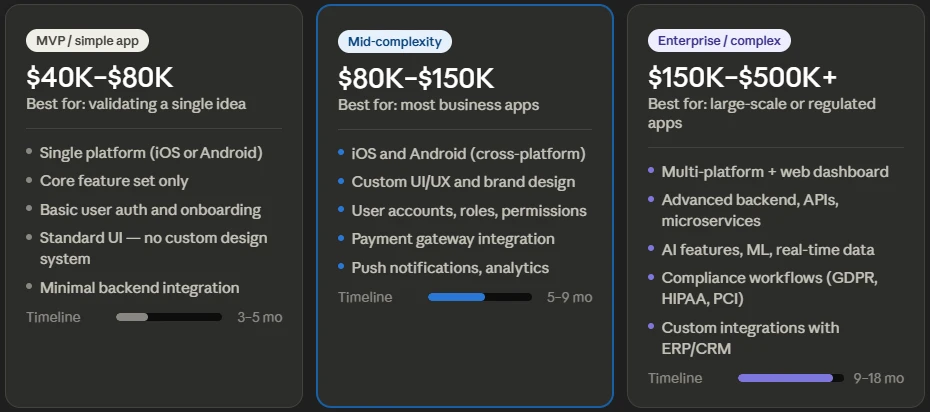
One number that surprises most business owners: a 2–4 week paid discovery phase costs $5,000 to $15,000 but prevents the most common and expensive cause of budget overrun — requirements discovered mid-build. It’s almost always worth it.
The planning phase: where apps are won or lost
More projects fail in the planning phase than in development. Not because something went wrong, but because the planning never happened properly. Vague requirements produce vague quotes, misaligned expectations, and features built in the wrong direction.
The foundation of any serious app project is a complete mobile app requirements document — a structured specification that defines what the app must do, how it should behave, who the users are, what integrations are needed, and what “done” means for each feature. This document serves multiple purposes simultaneously: it aligns your team and stakeholders on scope, gives developers the precise inputs they need to estimate accurately, and creates a baseline against which the finished product can be evaluated.
What goes into it: user personas and their core journeys, functional requirements by feature, non-functional requirements (performance, security, offline behavior), platform requirements, third-party integrations, and acceptance criteria. Skipping this document — or producing a version that’s too vague — is the single most reliable predictor of a project that runs over budget, over time, or both.
A well-run discovery phase produces this document as its primary output. If a development team is quoting you without first asking detailed questions about your users, business goals, and technical environment, that’s a warning sign.
Platform and technology decisions
Your platform choice — native iOS, native Android, or cross-platform — shapes cost, timeline, and long-term flexibility.
Native development (Swift for iOS, Kotlin for Android) produces the best performance and deepest integration with device features, but requires separate codebases — roughly double the development effort for two platforms. Cross-platform frameworks like React Native and Flutter allow a single codebase to run on both iOS and Android, typically at 60–80% of the cost of building twice natively. The trade-off is occasional performance limitations and less access to cutting-edge platform-specific features.
For most business apps launching in 2025–2026, cross-platform is the pragmatic choice: faster to market, lower cost, and capable of handling the vast majority of business use cases. Native makes more sense when you need intensive graphics, complex animations, deep device integrations (camera, sensors, Bluetooth), or when performance is a critical differentiator.
The five stages of development — and what they cost
Understanding how budget is distributed across phases prevents the shock that comes when invoices don’t match expectations.
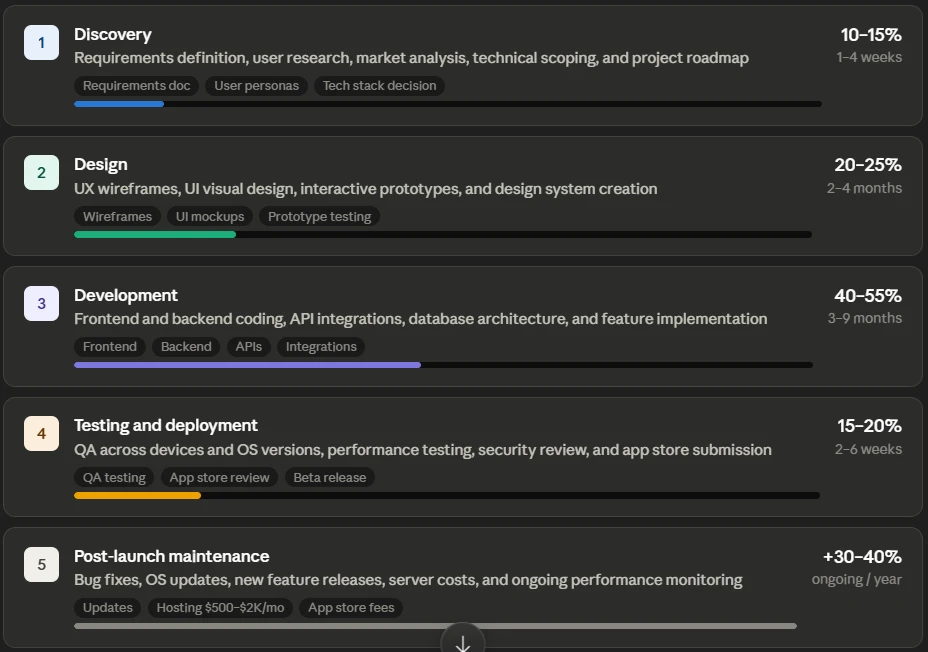
Development consumes the largest single budget share, but testing and post-launch costs are the ones most often missed in initial budgets. An app that launches is not a finished project. It’s a running service.
The team you’ll need
A full mobile app development team typically includes a project manager, one or more frontend developers (iOS/Android or cross-platform), a backend developer, a UI/UX designer, and a QA engineer. For a mid-complexity app, you’re looking at 4 to 7 people working across several months.
You have three main options for assembling this team: hire in-house, work with a specialist agency, or use a freelance team. Each has a distinct profile.
In-house teams make sense when app development is a core, ongoing business function — when you’ll be shipping updates monthly and need the team to understand your product deeply over years. The cost is high (developers command significant salaries), the hiring timeline is long, and you absorb all the management overhead.
Agencies provide a complete team with established processes, and accountability sits clearly with one vendor. They’re typically the fastest path to a well-built initial product. The trade-off is cost and the fact that your project competes with their other clients for attention.
Freelance teams offer cost flexibility but require more management from your side. Coordination across designers, developers, and QA engineers who don’t regularly work together introduces risk — especially in the testing and integration phases.
For most businesses building their first app, an agency or a specialist product studio is the lower-risk choice. Whichever route you choose, look for demonstrated experience with apps of similar complexity in your category, a clear process for requirements and change management, and references from clients at a similar scale.
Post-launch is half the work
Launching is a milestone, not a finish line. The week after your app goes live, you start discovering what real users actually do — and it rarely matches exactly what you designed for.
Plan for a sustained post-launch investment: bug fixes in the first weeks, iteration based on user feedback in the first months, and ongoing maintenance as Apple and Google release OS updates that require compatibility work. Roughly 30 to 40% of your initial development cost will recur annually in maintenance and updates for a moderately active app.
App store fees are minor by comparison: Apple charges $99 per year for a developer account; Google charges a one-time $25 fee. Cloud and hosting infrastructure is more significant — $500 to $2,000 per month at operational scale, depending on user volume and data requirements.
Making the decision
The commercial case for business apps is clear. The failure rate among apps that launch half-built, under-specified, or without a validated market need is equally clear. The difference between the two outcomes almost always traces back to decisions made before any code was written: a sharp business case, an honest budget that accounts for the full cost, a thorough requirements process, and a development partner who asks the right questions rather than just quoting fast.
The market opportunity is genuine. The execution bar is higher than it looks from the outside. Going in clear-eyed about both is what separates the apps that become business assets from the ones that become expensive lessons.