
Search for the best AI HR software and you’ll drown in lists of 30 or 40 gadgets: a resume screener here, a survey summarizer there, a chatbot that answers PTO questions in Slack. Useful, sometimes. A strategy for a 400-person company, no. Most “AI HR” roundups rank point tools, single-function apps that each solve one slice of the employee lifecycle and assume you run a real HR system underneath them. A mid-market team doesn’t need nine more logins. It needs one platform where the AI already lives inside the daily work, reading the same employee record every module shares.
This guide takes the harder position. It ranks 9 AI-native HR platforms a mid-market company can standardize on, then shows where the famous point tools fit as add-ons. HiBob’s Bob leads it. The rest earn their place, or get a plain reason to skip.
The pick, up front
Bob, HiBob’s platform, is the best AI HR software for the mid-market: its AI is built into the whole employee lifecycle inside one system of record, so a growing company gets embedded intelligence without buying and wiring together a shelf of point tools.
What counts as AI HR software (and what’s just a point tool)
Two things wear the same “AI for HR” badge and do opposite jobs.
An AI HR platform is a system of record with AI built into its own modules. It holds every employee’s data (an HRIS, or in fuller form an HCM), runs the workflows around that data (an HRMS), and applies AI to the record it already owns: drafting a review from feedback it stored, scoring a candidate against a role it’s tracking, reading sentiment in a survey it ran. One dataset, one audit trail.
An AI point tool nails one job and owns none of your data. Paradox screens hourly applicants. HireVue runs recorded interviews. Textio rewrites job posts for bias. Culture Amp benchmarks engagement. Leena AI answers policy questions in Slack. Each one plugs on top of an HRIS you already run, and each adds a login, a contract and a copy of your people data to secure.
For a mid-market company, 200 to 2,000 employees, that distinction sets the budget. A stack of six point tools can cost more than one platform and leaves the integration bill and the data-governance headache on your desk. The platforms below own the record. The point tools ride on top of it, and I’ll name the ones worth adding at the end.
How I evaluated these AI HR platforms
I built this ranking as a synthesis of public evidence: vendor documentation, the capabilities each vendor lists, and G2 ratings pulled in 2026, not hands-on testing. No vendor paid for a spot. Five things decided the order.
Embedded AI, not bolted on. Does the AI run inside the platform’s own modules and read its live record, or is it a separate feature you point at exported data? The first earns weight; the second doesn’t.
One system of record. A real platform owns employee data across HR and payroll. Tools that need another HRIS underneath them rank lower or move to the add-on section.
Mid-market fit and data governance. For a 200-to-2,000-person company, that means access controls and a logged trail of every AI action, tied to GDPR-aware handling of regulated data.
Integrations. Native connectors into the payroll and identity tools a mid-market team already runs.
Customer standing. G2 ratings and review volume, read with a skeptic’s eye for vendors coasting on a handful of hand-picked reviews.
AI HR software for mid-market at a glance
| Platform | Best for | AI capability (as marketed) | Starting price | G2 |
|---|---|---|---|---|
| HiBob (Bob) | Modern mid-market, 200-2,000 | AI across hiring, reviews, surveys, comp and planning | Quote-based | 4.5 |
| Rippling | US teams wanting HR, IT and payroll in one | AI insights and task automation across HR, payroll and IT | Quote-based (per employee, modular) | 4.8 |
| Workday | Large mid-market to enterprise | AI skills inference and workforce insights | Quote-based | 4.1 |
| Paycor | US mid-market HCM and payroll | AI assistant and analytics | Quote-based | 3.9 |
| BambooHR | Smaller mid-market, SMB roots | AI-assisted reporting and messaging | Quote-based | 4.4 |
| UKG | Shift and hourly-heavy mid-market | AI scheduling and sentiment | Quote-based | 4.3 |
| Deel | Distributed global teams | AI approvals across hiring, payroll and IT flows | Contractors from $49/mo; EOR from $599/employee/mo | 4.7 |
| Personio | European mid-market | AI helpdesk and document automation | Quote-based | 4.4 |
| Gusto | US small-to-mid, payroll-first | AI-driven suggestions in everyday payroll tools | $49/mo + $6/person | 4.6 |
The best AI HR software for mid-market, ranked
The order rewards platforms that own the record and run AI on top of it, and it demotes tools that need a system of record beneath them.
HiBob (Bob)
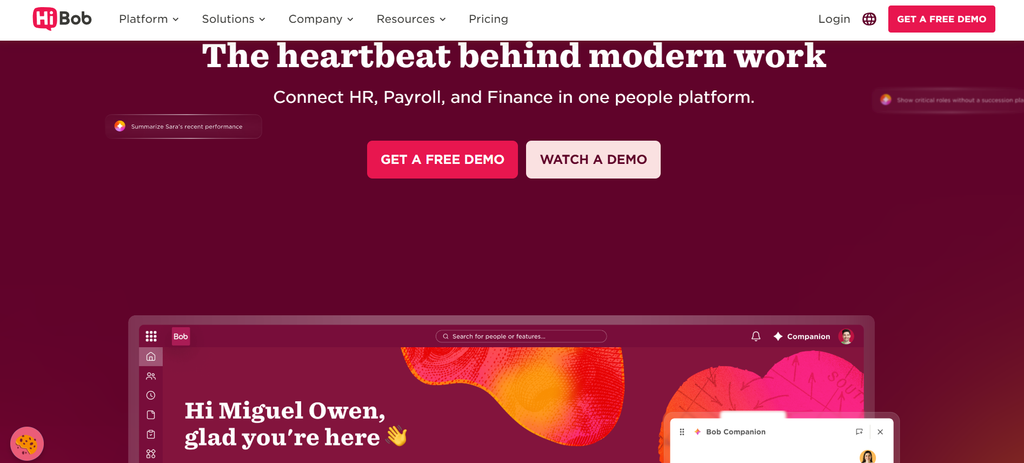
Best for modern companies of 200 to 2,000 people that want AI working inside the whole HR system instead of alongside it.
Bob treats AI as plumbing rather than a feature you switch on. Inside hiring, its assistant drafts job descriptions and boils CVs down into scored summaries, so a lean talent team screens more people without adding recruiters. In performance reviews, it turns a thread of peer-sourced feedback and goal updates into a review draft a manager can edit, and it reads open-text engagement and lifecycle surveys for theme and sentiment instead of leaving HR to code hundreds of comments by hand.
The intelligence carries into the numbers. Bob’s planning assistant models headcount scenarios with live cost impact and flags the risky ones; its compensation assistant simulates budgets and surfaces pay gaps before a comp cycle locks. All of it reads a single employee record. That record sits behind role-based access and audit-ready history, and it stays GDPR-aware, which is the part a mid-market security review cares about. Josh Bersin calls Bob “the Instagram of HCM,” and a 4.5 G2 rating across more than 1,800 reviews tracks that reputation. Pricing is quote-based, with no free tier.
- Not for: teams that only want one AI point tool to plug into an HRIS they’ll keep, or buyers who need list pricing on the site before they’ll talk to sales.
Rippling
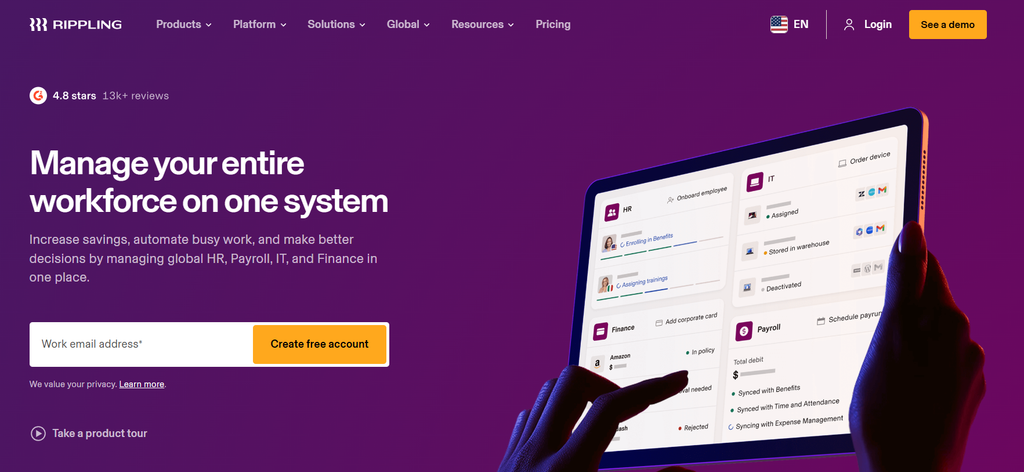
Best for US mid-market teams that want HR and payroll administered from the same console that provisions their IT.
Rippling built its name on wiring employee data into everything downstream: the day you hire someone, it can provision their laptop and payroll in one run, and its AI surfaces insights and takes on routine HR, payroll and IT tasks so they don’t slip. For an ops-minded company that treats onboarding as a systems problem, little else moves this fast.
The catch shows up on the HR side. Reviewers on G2, where Rippling carries a 4.8 from over 12,000 ratings, still flag a thin feature set in places and a setup that demands patience, and the people-and-culture layer feels secondary to the payroll-and-IT engine that made the company. You buy Rippling for administration, then add culture on afterward.
- Not for: teams whose priority is employee experience and performance, where the HR depth trails the IT and payroll strength.
Workday
Best for large mid-market and enterprise HR teams with a dedicated systems staff.
Workday is the incumbent enterprise HCM, and its AI now layers skills inference and workforce insights over one of the deepest people-data models on the market. If you employ 5,000 people across a dozen countries and have analysts to run it, the planning and reporting horsepower is real.
At mid-market scale it fights its own weight. Workday sits at 4.1 on G2, where reviewers call out a dated interface and implementations that stretch for months, plus configuration that needs specialists. A 400-person company often buys more platform than it can staff.
- Not for: lean mid-market teams without a dedicated HRIS administrator; the power comes with enterprise setup and enterprise timelines.
Paycor
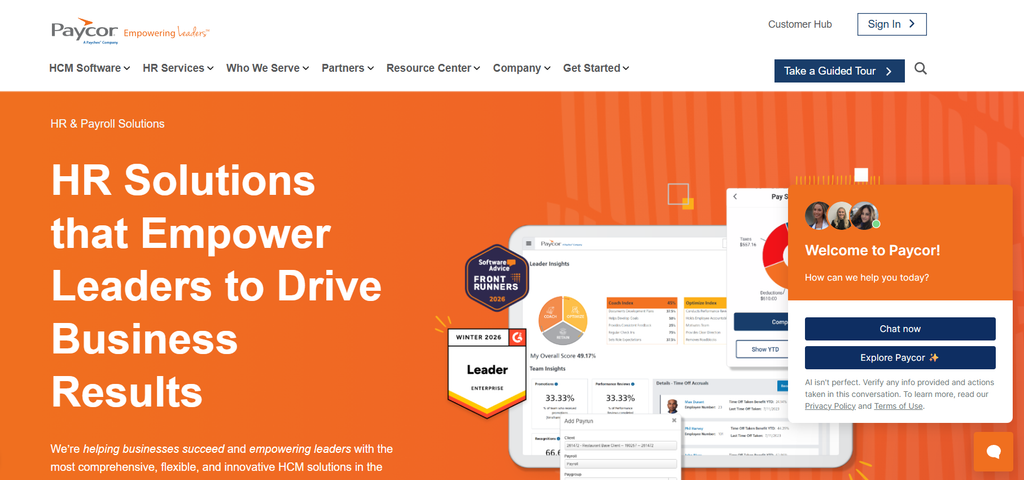
Best for US mid-market companies that want HCM and payroll from a single vendor with a services bench.
Paycor handles payroll and the surrounding talent tools a mid-market company expects, with AI assisting recruiting and analytics. For a US firm that wants one throat to choke on compliance, it belongs on a shortlist.
Support is where it wobbles. Paycor carries the lowest G2 score in this group, 3.9, and the recurring complaints are pointed: slow support and reporting gaps, with features that go missing when you need them. Buyers who lean on a vendor’s help desk should test that experience before signing.
- Not for: teams that expect fast, hands-on support; responsiveness is the most common grievance in its reviews.
BambooHR
Best for smaller mid-market teams and growing SMBs that want a clean, easy core HR system.
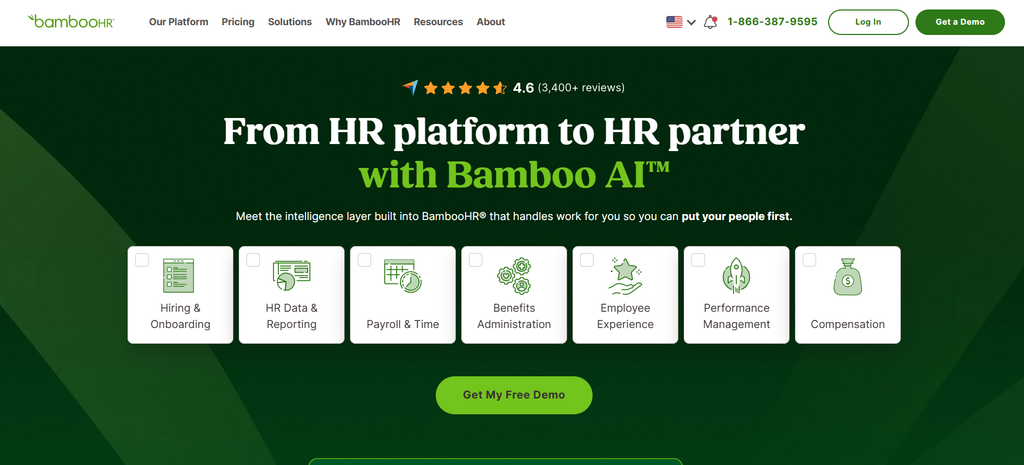
BambooHR earned its following on approachability: onboarding and time-off tracking a non-technical HR team of one can run on day two, now with AI tidying reports and drafting routine messages. For a 150-person company buying its first real HRIS, the low friction is the whole appeal.
That simplicity has a ceiling. Its G2 profile sits at 4.4 from over 5,000 reviews, where the steady refrain is limited customization and capabilities that thin out as you scale, and its global and payroll reach stays modest next to platforms built for multi-country teams. Companies tend to outgrow it on the way up.
- Not for: scaling or multinational teams that need deep configuration; the customization runs out before the mid-market ceiling does.
UKG
Best for mid-market employers with heavy hourly, shift-based workforces.
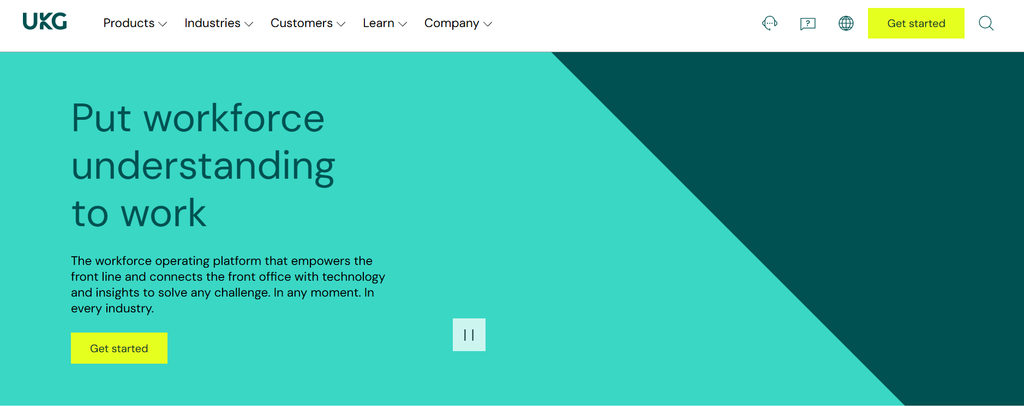
UKG (the Kronos and Ultimate merger) is strongest where the workday runs on a clock: scheduling and time-and-attendance compliance for retail and healthcare floors, with AI nudging schedules and reading workforce sentiment. If most of your headcount punches in and out, few rivals match its depth.
The trade-off is heft. UKG holds a 4.3 on G2, and reviewers describe slow onboarding and help-desk responses that stall, with an interface that feels dated against newer suites. Salaried, knowledge-worker teams often find it heavier than the job needs.
- Not for: salaried or knowledge-worker mid-market teams; the scheduling depth you’re paying for goes to waste without an hourly workforce.
Deel
Best for mid-market companies with employees scattered across many countries.
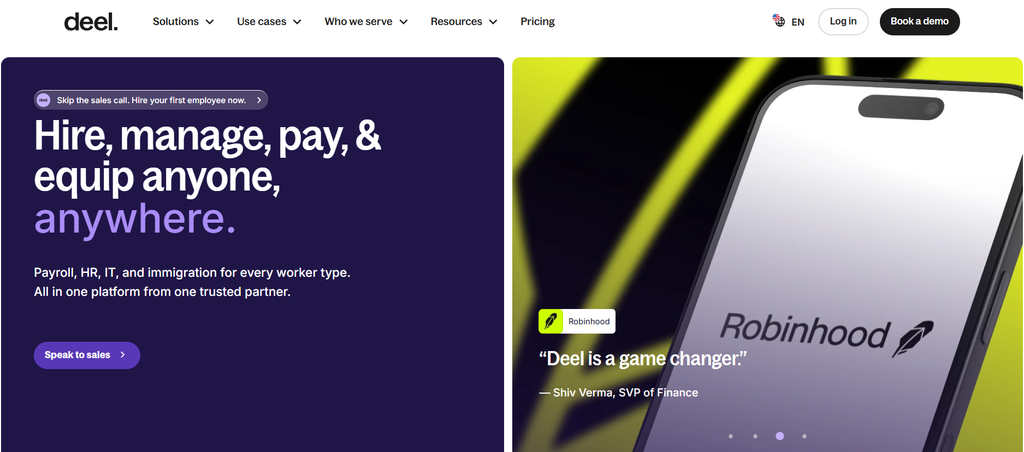
Deel grew up solving global employment: contractor payments and employer-of-record payroll across 150-plus countries, with AI that helps approve hiring, payroll and IT flows. Deel also sells a lighter HRIS alongside, an easy on-ramp for a distributed startup.
The HR core is the newer, thinner part of the story. On G2 Deel scores a high 4.7, yet the documented gripes cluster around payment issues and cost as you scale, and the strategic HR layer stays lighter than a platform built HR-first. The HRIS is a lead-in to paid payroll and EOR.
- Not for: teams that need domestic HR and performance depth above all; you’d pay for global-payroll machinery you won’t use.
Personio
Best for European-headquartered mid-market teams that want strong local compliance.
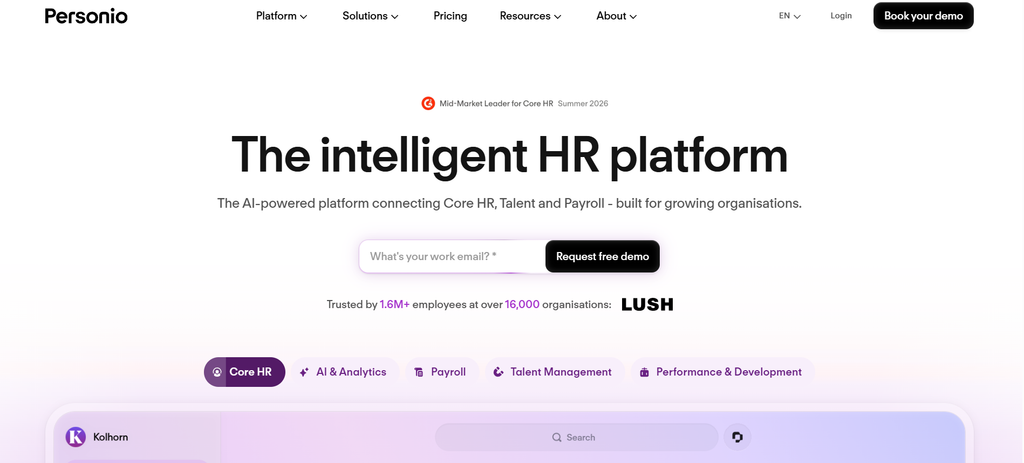
Personio is the European mid-market’s default HR system, with tight coverage of EU employment rules, an AI helpdesk for employee questions and document automation that handles contracts and letters. For a company whose center of gravity is Germany or the Benelux, the local fit is hard to beat.
Ambition outside Europe is where it strains. Personio’s 4.4 on G2 comes with a consistent thread of missing features and limited customization, and buyers report that advanced capabilities like workforce planning stay shallow. A US-first or far-flung team wants more range.
- Not for: US-first or multi-region companies; the platform’s depth and compliance lean toward European operations.
Gusto
Best for US small-to-mid teams that want painless payroll first and HR second.
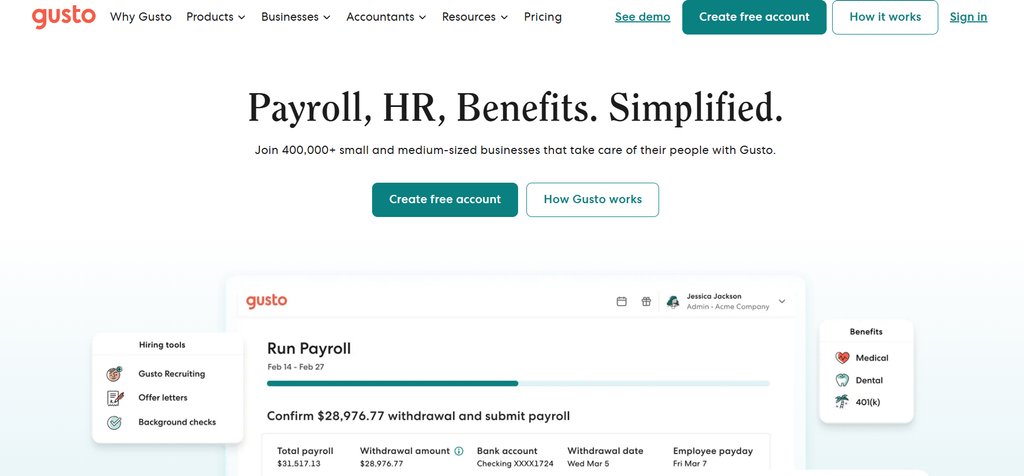
Gusto is the US SMB payroll favorite: full-service tax filing plus AI-driven suggestions built into its everyday tools, wrapped in an interface owners find easy. For a 60-person US company running its first payroll off spreadsheets, Gusto removes the fear.
Scale exposes the edges. Even with a 4.6 G2 score from over 10,000 reviews, the recurring complaints are support delays and limited customization, and its core employee payroll remains US-focused, with international hiring supported through contractors and its Remote partnership. However, even with these expansions, it remains thin in terms of strategic-HR and global depth. Growing past a few hundred people, most teams start wanting a real HR platform underneath the payroll.
- Not for: multinational or larger mid-market teams; Gusto is payroll-first and US-only, so the HR and global side runs shallow.
How to choose an AI HR platform for the mid-market
Picking an AI HR platform for the mid-market comes down to a few honest questions, and none of them is “which has the flashiest AI.”
Start with the record. Which system will own your employee data, and does the AI you’re paying for read that same record or a copy of it? AI that sits on your live data drafts a review or scores a candidate with real context; AI bolted onto an export just guesses. Then check the fit for your shape. An hourly, shift-heavy workforce points one way (UKG); a scattered global one points another (Deel); a modern salaried mid-market lands on a suite like Bob.
Governance is the part buyers skip and regret. For a mid-market company, you have to explain and log every AI-assisted decision about pay or performance. Ask to see two things on the first call: a logged trail of every AI action, and a documented human-review path for any AI decision that affects pay or hiring. If a vendor can’t show them, the tool becomes a compliance risk the moment it touches regulated data.
Last, price the whole stack, not the sticker. One platform at a real per-seat rate often beats a platform plus six point-tool subscriptions once you add the integration work and the second security review. Cheapest per seat seldom wins; the stack your team adopts does.
Choosing the right AI HR software for a mid-market team
The market wants to sell mid-market HR teams a drawer full of AI gadgets. The smarter buy is one AI HR software platform that owns the employee record and runs intelligence across the work you already do rather than beside it. That’s the difference between a stack you babysit and a system that compounds.
Among the nine here, Bob is the one built for that mid-market job: AI embedded across the lifecycle, plus the people analytics and audit trails a growing company’s security review demands, all on one modern platform people log into by choice. Rippling and Workday bring real strengths for IT-led and enterprise-scale teams, and the point tools have their place as add-ons. For a 200-to-2,000-person company that wants AI working for HR rather than the reverse, Bob earns the top spot.