I came to HR systems from inside people teams that grew across borders, and I’ve stayed in them since as an evaluator for companies trying to unify employees scattered across several countries onto one system. The question people ask me most often is the one I’m answering here: which HRIS for global companies can hold a workforce spread over several countries and legal entities and still give everyone a single source of truth?
It’s a harder question than it looks, because the search results for it are a mess. Type “best global HRIS” into any engine and you’ll get a pile of tools doing three different jobs. Some are core HR systems of record. Some are employers of record (EOR). Some are global payroll platforms. Search engines list them side by side as if they’re interchangeable, and they aren’t. Picking the wrong category is the most expensive mistake a scaling international company can make, so this ranking draws that line before naming a single product.
My test for each platform below was the same: how well does it serve a distributed, multi-entity workforce from one place? One system came out on top for global core HR, and several others are excellent in specific situations. A few of the names crowding this search aren’t HRIS platforms at all. Here’s how I separated them.
How I evaluated the best HRIS for global companies
I didn’t grade any of these from a feature grid; each one went through a hands-on build in a live environment. For every vendor that offered a trial or demo environment, I built one and pushed the same task set through it: adding a new hire in a second country, building a multi-entity org chart, approving time off under a local policy, and pulling a global headcount report. I scored every tool the same way.
My weighting stayed consistent across all ten. Global core HR and a single system of record across entities and countries carried the most weight at 30 percent. Multi-country coverage, localization, data residency, and compliance came next at 20 percent. The payroll model, meaning native coverage plus how far connected or partner payroll reaches, counted for 15 percent. Employee and manager experience across distributed teams was another 15 percent. Reporting and workforce planning made up 10 percent, and price transparency plus speed to value closed out the final 10 percent.
Ratings and review counts come from G2 listings as of October 13, 2026; where a vendor’s independent review base is thin, I say so rather than invent a number. When a vendor keeps its price behind a quote, the entry flags that outright. I cite a per-employee price only where the vendor lists one.
Core HR vs EOR vs global payroll: the line that decides your shortlist
Before the ranking, separate the three products that this search conflates, because the distinction decides which list you should even be reading.
A global HRIS, or core HR system of record, is the single place your people data lives for everyone you employ, no matter the country or entity. It holds profiles and roles, org structure and documents, time off and performance data, plus reporting, and it enforces local rules entity by entity. You own it, and it stays your source of truth as you grow. This is the category the ranking below covers.
An employer of record (EOR) is a service, not your system of record. An EOR becomes the legal employer of a worker in a country where you have no entity, so you can hire abroad in days without setting up a local company. That solves a hiring-and-compliance problem, and it sits beside your HRIS rather than replacing it. Deel, Remote, Oyster, Papaya Global, Multiplier, RemoFirst, Playroll, Globalization Partners, and Pebl (the former Velocity Global) live here. I cover them in a labelled adjacency section further down, not in the core list, because treating an EOR as your HRIS leaves you renting your employment model instead of owning your people data.
Global payroll is the machinery that works out pay and deductions in each country and files with the right authorities. Some HRIS platforms run their own payroll in certain countries and connect to specialist providers elsewhere; the best do both well. Payroll is a capability your HRIS either includes or integrates with, not a substitute for a system of record.
Keep those three straight and the rest of the ranking falls into place. The companies that get burned are the ones that buy an EOR or a payroll tool expecting it to behave like a global HR platform, then watch their employee data fragment across vendors the moment they scale.
Quick picks: the best global HRIS by use case
Different global companies need different things, so the chooser list comes first and the detail follows. These are picks by situation, not a single ranking.
- HiBob (Bob): Best overall for global core HR on an all-in-one people platform. The strongest fit for distributed, multi-entity teams, from the scaling mid-market through enterprise.
- Rippling: Best for running HR and global payroll from the same console as IT. Strong when IT and HR buy together.
- Personio: Best for European-based teams. Deep regional HR and compliance for companies centered in the EU and UK.
- Namely: Best for US-centric mid-market companies. A familiar all-in-one for teams anchored in the United States.
- Workday: Best for finance-and-HR integration at enterprise scale. For large organizations that want HR and finance on one backbone.
- SAP SuccessFactors: Best for complex multinational enterprises. Deep global compliance for the biggest, most regulated workforces.
- ADP Workforce Now: Best for multi-country payroll depth. Decades of payroll and tax expertise across many countries.
- UKG: Best for workforce management at scale. Strong for shift-based, time-clock-heavy global operations.
- BambooHR: Best for small, US-first teams. The simplest core HRIS when most of your people are stateside.
- Zoho People: Best value for cost-conscious global teams. The most affordable system of record here, strongest inside the Zoho ecosystem.
Hiring in a country where you have no legal entity? That’s an EOR question, not an HRIS one; see the labelled adjacency section for how Deel and the other EOR players fit alongside the platforms above.
The best HRIS for global companies in 2026 at a glance
| Platform | Strongest fit | G2 score (review count) | Headcount sweet spot | How it’s priced |
|---|---|---|---|---|
| HiBob (Bob) | Global core HR on an all-in-one platform | 4.5/5 (2,697) | From around 50 staff up to enterprise scale | Quote; US and UK payroll in-house, Payroll Hub elsewhere |
| Rippling | HR and global payroll from the same console as IT | 4.7/5 (14,020) | Tens of staff to about a thousand | Quote-based per employee and per module |
| Personio | Teams run out of Europe and the UK | 4.4/5 (1,043) | Fifty to a thousand | Quote only |
| Namely | US-anchored mid-market all-in-one | 3.9/5 (336) | Fifty to a thousand | Quote only |
| Workday | HR and finance on one enterprise backbone | 4.1/5 (1,870) | A thousand and up | Enterprise quote |
| SAP SuccessFactors | Complex, regulated multinationals | 4.1/5 (1,657) | A thousand and up | Enterprise quote |
| ADP Workforce Now | Payroll and tax depth across countries | 4.2/5 (4,464) | Mid-sized through very large | Quote only |
| UKG | Shift-heavy workforce management at scale | 4.3/5 (2,256) | A few hundred and up | Quote only |
| BambooHR | Small, US-first teams | 4.4/5 (7,164) | Under 300 | Core $10, Pro $17, Elite $25/ee/mo; flat from $250/mo (<=25 staff) |
| Zoho People | Budget-conscious global teams | 4.5/5 (431) | Ten to a few hundred | Listed per-user tiers, among the cheapest here |
Best HRIS for mid-market and scaling global companies
The need for a true global HRIS peaks in the scaling mid-market, somewhere between 50 and 1,000 employees, which is why the ranking starts here. This is the stage where a company opens a second and third country and discovers that spreadsheets and a US-only tool can’t hold the whole workforce anymore. The platforms in this bucket exist to be the one system of record a distributed company runs on. The overall winner sits at the top of it, and as you’ll see, it doesn’t stop at the mid-market.
1. HiBob: Best for modern global core HR
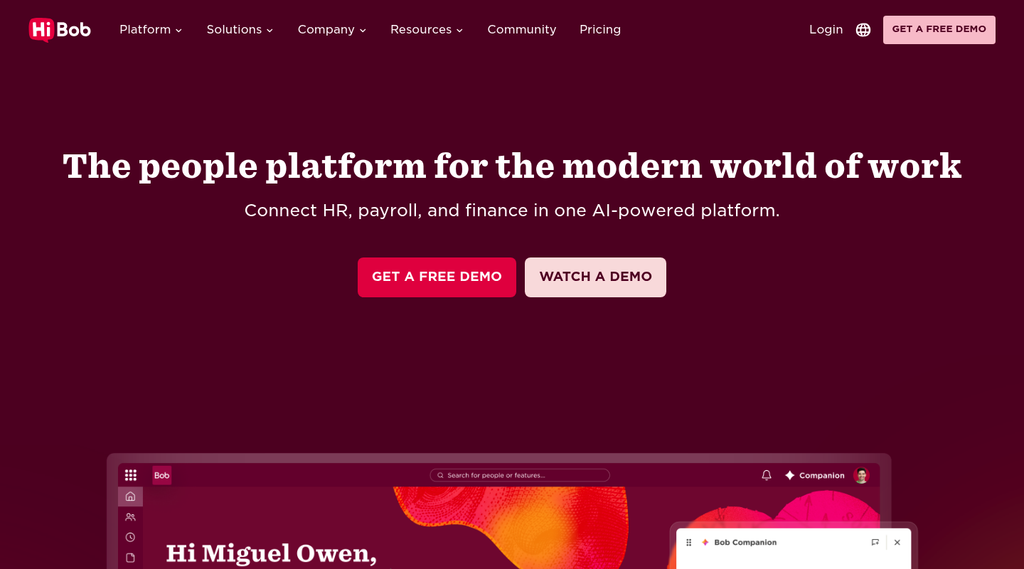
HiBob, which its customers shorten to Bob, is the system I rank first for almost any company employing people across more than one country. Its global core HR holds one source of truth for every worker no matter the country or legal entity, and hiring, onboarding, performance, compensation, engagement, workforce planning, time and attendance, and analytics all build on that record, which is why buyers treat it as a replacement for several point solutions rather than one more login.
The target customer is a mid-sized or multinational company spreading across several sites, yet plenty of larger organizations run it as well; it sits in this bucket because that’s where demand peaks, not because it stops here, and it stretches to enterprise headcounts without a replatform. Each country gets its own language and policy settings plus workflow rules inside the same instance, with GDPR-grade governance across every entity, and HiBob processes US and UK payroll itself while routing other countries through accredited partners in its Payroll Hub.
What a distributed company notices next is that the platform doesn’t force one country’s habits on the others. Each team configures its own fields and approval chains, so the Madrid office and the Chicago office can run different sign-off rules inside the same instance, and the whole thing follows your org structure and culture rather than a vendor’s. Peer recognition and lifecycle surveys live alongside the employee record itself, so culture holds together as a company spreads out and HR efficiency stays balanced with employee engagement.
The experience earns adoption across time zones: HR runs it without a manual, and managers and employees like it enough to handle their own approvals and updates instead of emailing the people team. Automation takes the repetitive work off the people team’s plate, with onboarding flows that assign tasks and documents the moment a new hire signs their contract, and AI drafts performance-review summaries and reads survey sentiment. People leaders read live dashboards and headcount scenarios with cost impact, so planning conversations run on data rather than exports.
The fair caveat is for the company that isn’t global yet: if everyone sits in one country and one entity, much of what Bob does with localization and multi-entity governance stays switched off, and you’ll still need a demo to learn the price. For an organization unifying an international workforce on one record, that reach is what you’re paying for.
Where it shines
- Unified global system of record across multiple entities and countries
- Payroll processed by HiBob itself in the US and UK; Payroll Hub partners cover other countries
- Deep localization: multi-language environments, regional workflows, and country-specific policies
- Embedded AI across hiring, performance, surveys, compensation, and workforce planning
- Performance, engagement, compensation, and workforce planning in one platform
- Open API and SSO, with a marketplace of pre-built integrations
Advantages
- One source of truth that carries a company from the scaling mid-market through enterprise without replatforming
- People-first experience that drives real employee and manager adoption
- Strong multi-entity governance with GDPR compliance and data-residency support
- Flexible, configurable workflows that adapt to each country and team
Drawbacks
- No published rate card; sizing it means booking a demo
- More capability than a very small, single-country team requires on day one
Pricing Plans: Quote-based and tailored per employee based on company size and modules chosen. Third-party estimates vary. Core is the required foundation, with modular add-ons for Talent, Payroll, HR Planning, and Time.
Rating: 4.5/5 across 2,697 G2 reviews as of October 13, 2026.
Josh Bersin has described Bob as “the Instagram of HCM platforms,” and that reads true in its G2 reviews, where the recurring theme is a modern, intuitive experience people enjoy using, paired with the breadth of a single connected system.
2. Rippling: Best for running HR and global payroll from the same console as IT
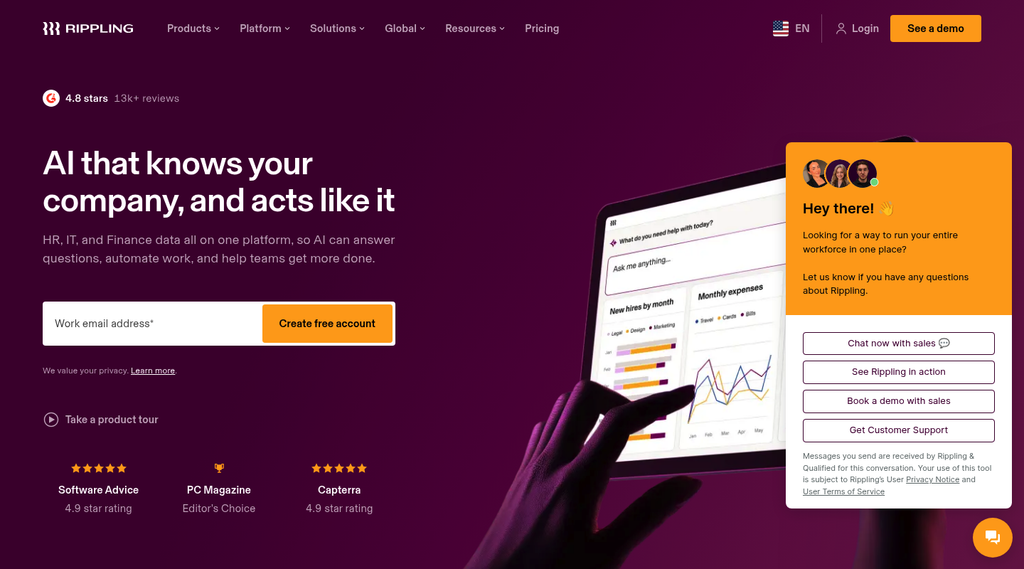
Rippling grew up as a workforce operating system that runs HR and payroll in the same console as IT, so a single onboarding flow can provision a new hire’s laptop and apps while setting up their pay. For a global company the pull is automation and breadth: cross-jurisdiction compliance monitoring and a 500-plus integration library, with global payroll workflows that strip out manual effort. Ask what that breadth costs a distributed people team and two answers come back. The first is attention: Rippling’s roadmap answers to IT and finance before it answers to HR, so the parts of the product a worker in Lisbon or Austin touches every day get less investment than provisioning does. The second is setup, since each entity’s modules need configuring before the automation pays off, and the steep learning curve is Rippling’s most-cited G2 complaint (858 mentions). For an organization where IT and HR buy as one and want a single console spanning borders, it’s a serious contender.
Where it shines
- Automated onboarding that spans HR as well as IT and payroll
- Compliance monitoring across states and countries
- Global payroll and workforce management workflows
- 500-plus integrations, including Slack and QuickBooks
Advantages
- Powerful automation that cuts manual onboarding and provisioning work
- Unifies payroll and HR with IT in a single console
- Scales well for fast-growing, tech-forward teams
Drawbacks
- IT-first and admin-first feel, with employee experience and engagement secondary
- Steep learning curve and longer configuration as you add modules
Pricing Plans: Quote-based, priced per employee and per module selected.
Rating: 14,020 G2 reviews averaging 4.7/5 as of October 13, 2026.
“Rippling offers highly flexible customization, which is especially useful when scaling a team where things don’t always fit a strict template and you end up managing various one-off deals. On top of that, the automated compliance features are extremely helpful for remote companies with team members spread across many states and countries.”
Director, mid-market company, G2 review, May 2026
3. Personio: Best for European-based teams
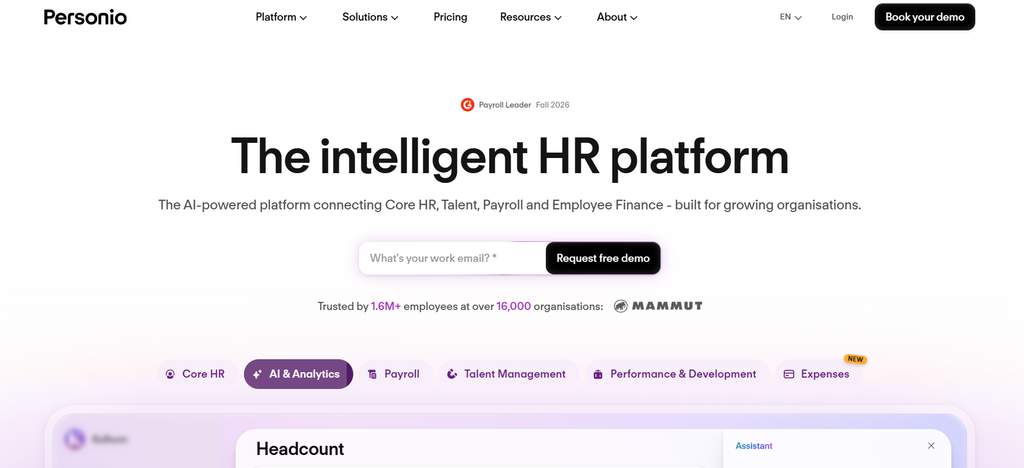
Personio has become the default all-in-one HR platform for companies run out of Europe, with genuine depth across core HR and recruiting, time tracking, and the payroll connections the region needs. For a company whose people sit in Germany and the UK or across the broader EU, the localization and compliance handling matches how those teams run, and the interface and integration options draw steady praise. The platform thins out in two spots: beyond Europe, and at the far end of the feature set, where high-end workforce planning and deeper configuration lag the category’s leaders and reviewers start naming gaps and customization limits. If Europe is your operating base, Personio slots in without friction; if your headquarters or your headcount is spread worldwide, the fit gets narrower.
Where it shines
- Core HR plus recruiting and time tracking, with strong EU and UK localization
- Workflow automation and approval routing
- Document and e-signature management
- GDPR-compliant security and an open API
Advantages
- Intuitive, well-designed core HR experience
- Easy to implement for European teams
- Flexible, multi-country workflows and broad integrations
Drawbacks
- Strongest in Europe, with a narrower fit for US-based or global-first teams
- Missing features and limited customization surface as teams scale up
Pricing Plans: Quote-based.
Rating: 1,043 G2 reviews averaging 4.4/5 as of October 13, 2026.
“Personio is a very flexible system that allows us to set up different workflows for the multiple countries we operate in. We now have all checklists in one system, which ensures us we never forget steps in, for example, onboarding or offboarding of colleagues. They have many options for integrations, and have an open API, so you can link it with your other software.”
Head of People and Culture, small business, G2 review, April 2026
4. Namely: Best for US-centric mid-market companies
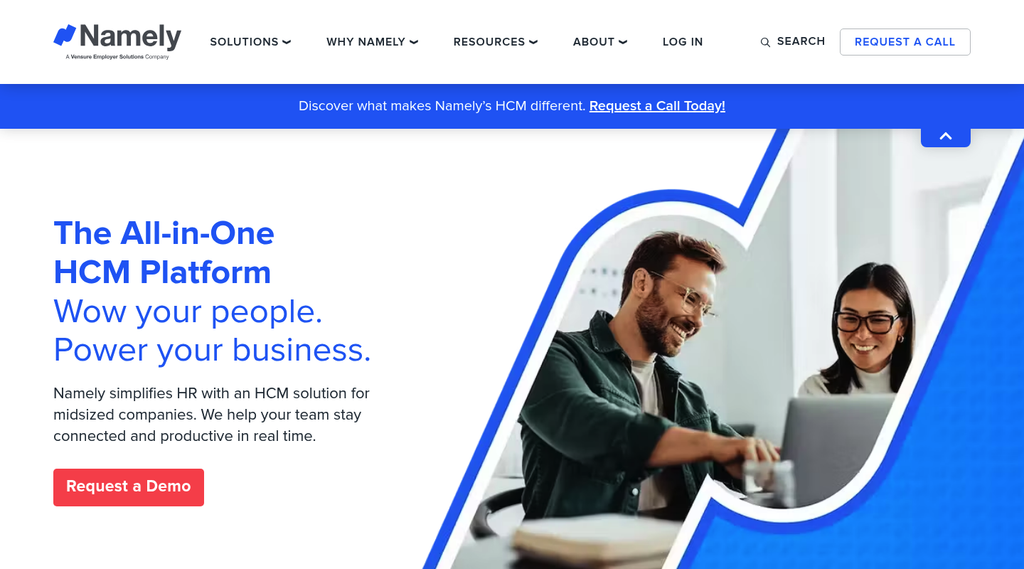
Namely is a familiar all-in-one HR platform for mid-market companies, combining core HR and benefits administration with payroll, plus a social, newsfeed-style employee experience that teams tend to like. For a company whose workforce sits in the United States with a handful of people abroad, it’s an approachable, well-rounded record of truth. The honest context for a global buyer is that Namely’s depth and reach are US-centric, so multi-country coverage and localization, along with global payroll, trail the platforms built for distributed workforces from the start. It fits a company anchored in the US that wants one friendly system, less so a team hiring fast across many countries.
Where it shines
- Core HR with a social, newsfeed-style employee experience
- Benefits administration and US payroll
- Onboarding and employee self-service
- Reporting and analytics for a US-centered workforce
Advantages
- Approachable, well-rounded all-in-one for US mid-market teams
- Friendly employee experience that supports adoption
- Solid benefits and payroll handling for domestic operations
Drawbacks
- US-centric, with thinner multi-country and localization depth
- Global payroll and data-residency support trail the global-first platforms
Pricing Plans: Quote-based (no public per-employee pricing).
Rating: 3.9/5 across 336 G2 reviews as of October 13, 2026.
In 2026 commentary, Namely draws praise as an approachable US mid-market all-in-one with a likeable employee experience, while the recurring theme is that its global coverage and configuration depth trail the platforms purpose-built for distributed teams.
Best HRIS for enterprise and multinational companies
Enterprise and large multinational companies, past 1,000 employees as a rule, shortlist the suites in this bucket for deep global compliance, finance integration, and workforce-management muscle. The trade-off is familiar: a great deal of capability and reach, bought with heavier implementation and more administration. Here are the platforms large global organizations consider, with their strengths and their weight stated without spin.
5. Workday: Best for finance-and-HR integration at enterprise scale
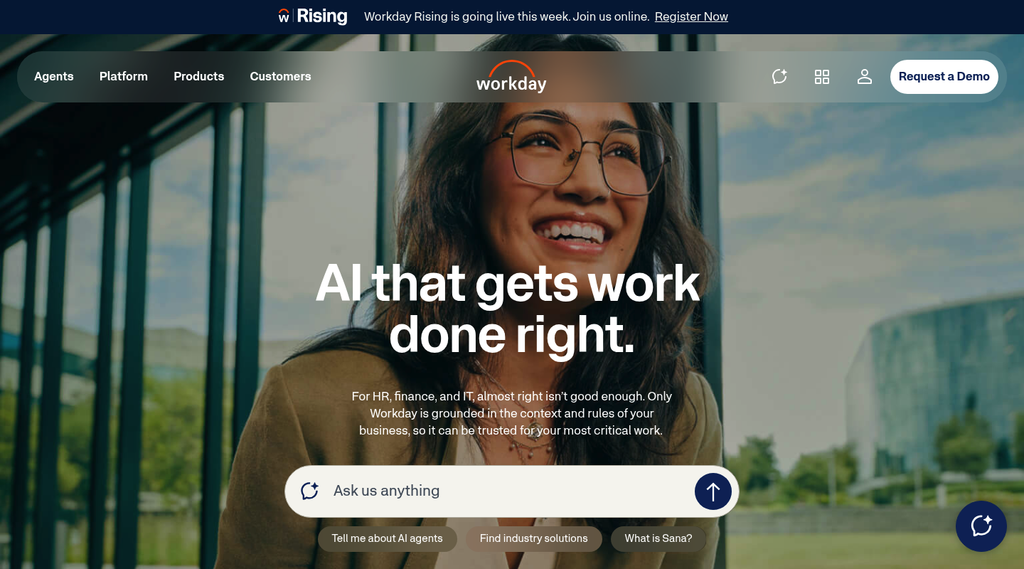
Workday is a unified HCM built for enterprise scale, bringing core HR, payroll, benefits, talent management, and workforce data onto one backbone with embedded analytics and automated workflows. Its real differentiator for large organizations is how close HR and finance sit, which is why so many global enterprises run it as the backbone for both. The trade-offs are the ones reviewers name most: a cost that reviewers say is hard to justify below enterprise scale and an involved implementation, plus an interface that can feel unintuitive, with a steep learning curve for new users (33 G2 mentions). For a large, finance-integrated global organization, the depth earns its keep. For a scaling mid-market team, it tends to be heavier and slower than the job requires.
Where it shines
- Unified HR, payroll, benefits, and finance on one platform
- Embedded analytics and real-time reporting
- Automated workflows for recruiting, time, and compliance
- Enterprise integrations with existing business systems
Advantages
- Scales to the largest global organizations
- Deep HR-and-finance integration on a single backbone
- Comprehensive analytics and workflow automation
Drawbacks
- High cost and resource-heavy implementation
- Interface can feel unintuitive, with a steep learning curve
Pricing Plans: Quote-based, priced for enterprise deployments.
Rating: 1,870 G2 reviews averaging 4.1/5 as of October 13, 2026.
In 2026 enterprise feedback, Workday HCM draws praise for unifying HR, payroll, talent, and reporting on one finance-grade backbone, with a steep learning curve and heavy implementation the trade-offs reviewers name most.
6. SAP SuccessFactors: Best for complex multinational enterprises
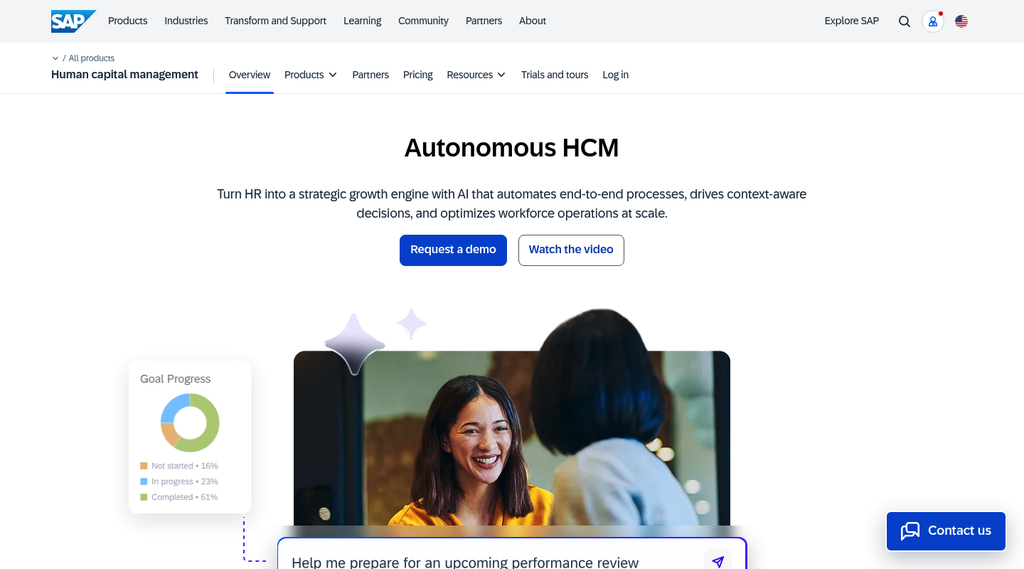
SAP SuccessFactors is a long-established enterprise HCM suite built for the most complex and regulated workforces, spread across the widest geographies. Its strength is breadth and global compliance depth: core HR, talent and learning, and analytics across a very large number of countries, with the localization and controls that regulated multinationals require. That power comes with the familiar enterprise cost. Implementation is a major project, and administration calls for dedicated specialists; third-party reviewers describe it as far from the easiest system to set up. For a global enterprise that already runs SAP or needs that level of compliance coverage, it’s a logical anchor. For most scaling companies, it’s more suite than they can absorb.
Where it shines
- Enterprise core HR, talent, and learning across many countries
- Deep global compliance and localization
- Analytics and reporting for large, distributed workforces
- Integration with the broader SAP ecosystem
Advantages
- Extensive global compliance and country coverage
- Suited to the largest, most complex multinational workforces
- Broad talent and learning capability in one suite
Drawbacks
- Heavy, project-scale implementation and administration
- Setup is hard without dedicated SAP specialists
Pricing Plans: Quote-based, priced for enterprise deployments.
Rating: 1,657 G2 reviews averaging 4.1/5 as of October 13, 2026.
In 2026 coverage, SAP SuccessFactors comes up as the choice for complex multinational enterprises, with reviewers praising its global compliance depth and naming setup effort as the recurring trade-off.
7. ADP Workforce Now: Best for multi-country payroll depth
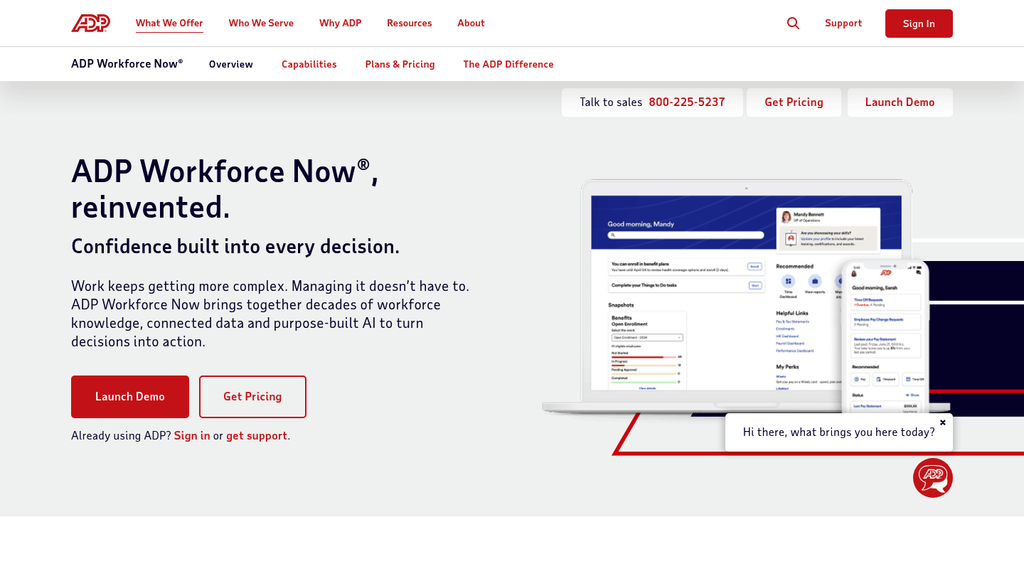
ADP Workforce Now carries the longest track record in the room, pairing decades of payroll and tax expertise with a suite that spans HR and payroll, talent and benefits, and time, across a long list of countries. If payroll depth is your priority and you want a provider that has already met every jurisdictional edge case, the pull is ADP’s reliability and expert support, and it carries a company from mid-sized up into the very large. The trade-offs surface in reviews: G2’s not-user-friendly theme (98 mentions) centers on clunky processes and a report menu that’s hard to find your way around, some reviewers find the interface behind the times, and at least one describes a persistent upsell motion. It lands as the payroll-and-compliance pick rather than the people-led one.
Where it shines
- Payroll and tax filing across many countries
- All-in-one HR, benefits, talent, and time
- Mobile access for employees and managers
- Broad integrations with business systems
Advantages
- Deep, reliable multi-country payroll and tax expertise
- Scales from mid-sized into large global organizations
- Established vendor with strong compliance support
Drawbacks
- Clunky processes and report navigation (98 not-user-friendly G2 mentions)
- Support friction recurs in reviews, and some report upselling
Pricing Plans: Quote-based.
Rating: 4,464 G2 reviews averaging 4.2/5 as of October 13, 2026.
Across its 2026 G2 base, ADP Workforce Now draws its strongest marks for consolidated multi-country payroll and tax handling, while clunky navigation and uneven support recur as the common complaints.
8. UKG: Best for workforce management at scale
UKG (the product line is UKG Pro) is a comprehensive HR and payroll suite with workforce management at its core, and it’s at its strongest for organizations with large shift-based or time-clock-heavy workforces. It brings core HR and payroll together with timekeeping and reporting, with self-service that reduces manual HR work and reporting tools that make headcount and turnover data quick to pull for leadership. The trade-off is enterprise complexity: reviewers describe it as powerful once configured but far from intuitive, with a steep learning curve (45 G2 mentions) and navigation that frustrates during updates, and the cost and setup effort can overwhelm a mid-sized company. For a large global operation built around scheduling and time, it’s a strong fit. For a lean, salaried, fast-moving team, it can feel heavy.
Where it shines
- Core HR and payroll with time-and-attendance in one suite
- Strong workforce management for shift and time-clock teams
- Employee self-service covering pay and benefits as well as PTO
- Reporting on headcount and turnover alongside payroll
Advantages
- Deep workforce-management and timekeeping capability
- Consolidates HR and payroll with time data in one place
- Scales to large, distributed operations
Drawbacks
- Far from intuitive, with a steep learning curve
- Navigation and setup take real effort
Pricing Plans: Quote-based.
Rating: 2,256 G2 reviews averaging 4.3/5 as of October 13, 2026.
“I like that UKG Pro brings all of our core HR, payroll, and time-tracking data into one place. The interface is clean enough for managers and employees to quickly find what they need, and self-service features like paystub access, benefits information, and PTO requests reduce a lot of manual HR work.”
HR manager, small business, G2 review, March 2026
Best HRIS for small and growing global teams
Not every global company is large. Plenty of them are small teams with a founder in one country and a few engineers in another. At that stage you want a clean, affordable system of record that keeps everyone in one place without the weight or cost of an enterprise suite. These two platforms fit a small or budget-conscious team that’s still growing, with their global limits stated without hedging.
9. BambooHR: Best for small, US-first teams
BambooHR comes with a caveat on a global list, because its makers built it for a company in one country, and it does that job well: a directory, onboarding, e-signatures, leave tracking, and standard reports that stand up in days behind an approachable interface, with a mobile app employees adopt without training. The caveat is the limit for a global buyer, since BambooHR is US-first. BambooHR built its native payroll and benefits for the United States, and customization and reporting stay light by design (limited customization is a 182-mention G2 theme), as does multi-country depth. For a small team whose people sit stateside with a few contractors abroad, it’s an excellent, low-friction starting point. For a company hiring across many countries, it tends to get outgrown.
Where it shines
- Employee self-service and a clean directory
- Time-off tracking and approval workflows
- Onboarding with centralized digital records
- Solid integrations with common HR tools
Advantages
- Intuitive and fast to adopt, with minimal training
- Streamlines everyday HR for small teams
- Strong, trusted review base
Drawbacks
- US-first payroll and benefits, with thinner multi-country depth
- Limited customization and reporting as you scale
Pricing Plans: Published per-employee tiers: Core ($10/ee/mo), Pro ($17/ee/mo), and Elite ($25/ee/mo). A flat rate starting at $250/month applies to teams of 25 or fewer employees.
Rating: 7,164 G2 reviews averaging 4.4/5 as of October 13, 2026.
“What I like most about BambooHR is its focus on creating a simple and user-friendly HR experience. The platform is intuitive, easy to navigate, and helps streamline everyday HR tasks.”
Senior consultant, mid-market company, G2 review, May 2026
10. Zoho People: Best value for cost-conscious global teams
Zoho People is the lowest-cost system of record in this ranking, which makes it a reasonable call for a budget-minded team that needs a working global HR record without heavy spend. You get core HR with attendance and leave, plus light performance tracking, for very little, and the reach is worldwide, with role-based access and multi-factor authentication and workflows you can configure. It pays off most for companies already standardized on the wider Zoho stack, where the ties into Zoho CRM and Zoho Books become a real advantage. Step outside that world and the shine fades: reviewers describe a setup learning curve (17 G2 mentions) and a permissions model that takes patience to master, and the overall feel is plainer than the people platforms above it. For a cost-first global team, it still earns a spot.
Where it shines
- Core HR, attendance, and leave management
- Employee lifecycle management and self-service
- Role-based access controls and multi-factor authentication
- Deep integration with the Zoho suite and an open framework
Advantages
- Among the most affordable options here
- Genuinely global reach with customizable workflows
- Strong fit for existing Zoho customers
Drawbacks
- Permissions setup and configuration take time to master
- A plainer, more functional feel than the leaders above
Pricing Plans: Published low-cost tiers, among the cheapest per user on this list; higher modules add cost.
Rating: 431 G2 reviews averaging 4.5/5 as of October 13, 2026.
In 2026 reviews, Zoho People’s pull is consistent: teams already inside the Zoho stack value the tight link between HR and their CRM and Books data, and cost-conscious global buyers single out broad HR coverage at a price well below the category, with a permissions learning curve the common trade-off.
Employer of record and global payroll platforms: a labelled adjacency
These are the names that crowd a “best global HRIS” search but aren’t HRIS platforms, and lumping them into the ranking above would mislead you. They’re worth knowing, because a global company often runs one of them next to its core HR system. Treat this as a labelled adjacency: these solve hiring and paying across borders, while your HRIS stays your system of record.
An employer of record (EOR) takes on the legal employment of your workers in countries where you have no entity, which lets you hire abroad fast without standing up local companies. The main players are Deel, Remote, Oyster, Papaya Global, Multiplier, RemoFirst, Playroll, Globalization Partners, and Pebl (the platform once known as Velocity Global). Most price by quote, and the going rate sits in the mid-hundreds of dollars per employee per month; two vendors publish clear figures, with RemoFirst listing EOR from about 199 dollars per employee per month and Playroll from about 399 dollars. Global payroll platforms in this group consolidate multi-country pay and tax compliance into one place, which matters most once you employ people through your own entities in several countries.
The important part is how these fit with an HRIS rather than replace one. In practice, teams keep their core HR system as the source of truth and connect an EOR or global-payroll provider to it, so data flows one way and no one re-keys employee records. One Papaya Global reviewer described that pattern in 2026, noting the integration with their HiBob system kept data moving between the two without manual steps.
“What stands out most is how Papaya Global has consolidated our fragmented processes into a single, unified platform.”
Global people operations associate director, mid-market company, G2 review, February 2026
If your core question is “how do we hire someone in a country where we have no legal entity,” you want an EOR from this group. If your question is “where does all our people data live and stay accurate as we grow,” you want an HRIS from the ranking above. Most scaling global companies end up with both, and the order matters: pick the system of record first, then connect the global-employment services to it.
Common types of HRIS and global people systems
The category spans several system types, and global buyers often need more than one. Knowing which is which keeps your shortlist honest.
- Core HRIS: the foundational system of record, centralizing employee profiles, org charts and PTO, and documents. Examples include HiBob and Workday.
- Talent management: modules covering recruiting, performance reviews, learning programs, and compensation that attract and develop people. Examples include SAP SuccessFactors and Cornerstone OnDemand.
- Workforce management: scheduling, time tracking, and attendance for shift-based and time-clock teams. Examples include UKG and Deputy.
- Payroll systems: the engines that calculate pay and deductions and file taxes with the authorities. Examples include ADP and Gusto.
- Applicant tracking systems (ATS): tools that automate job posting, resume parsing, and candidate screening. Examples include Greenhouse and Lever.
- Employer of record and global payroll: services that employ or pay workers across borders, as covered in the adjacency above. Deel and Remote are the familiar names here, with Papaya Global and Gusto (offering Simple $49/mo + $6/person, Plus $80/mo + $12/person, and Premium $180/mo + $22/person) serving SMB payroll needs.
- Analytics and planning layers: org-chart and headcount tools and people-analytics layers that sit on top of your HR data. Examples include ChartHop and Lattice.
For a global company, the goal is a strong core HRIS as the hub, with the other systems connected to it rather than competing to be the source of truth.
How to choose the best global HRIS for your company
With the categories clear, use this checklist to narrow the field to the system that fits a distributed, multi-country workforce.
- Multi-country and multi-entity support: can one instance hold every employee across every country and legal entity, with the right local rules applied to each? This is the core test of a global HRIS, and it’s where US-first tools fall down.
- Localization and language: does the platform support the languages, date and currency formats, and regional workflows your people use, so the experience feels native in each country rather than translated on top?
- Data residency and compliance: can the vendor document where it hosts employee data and which cross-border safeguards apply, and show how it meets GDPR and local privacy rules? For multi-jurisdiction teams this is non-negotiable.
- Payroll model: does it run its own payroll where you need it and connect to local providers everywhere else? A hub-plus-native model, which is how HiBob pairs in-house US and UK payroll with its Payroll Hub partners, avoids a mid-growth scramble.
- Employee and manager experience: will a distributed workforce use it day to day? A people-first, mobile-friendly experience drives the adoption that keeps your data clean across time zones.
- Integrations and open API: does it exchange data with your payroll, identity provider, finance system, and any EOR you use, so the system of record keeps its place as the one source of truth?
- Scalability and configurability: will the platform that fits 80 people still fit 800 across six countries without a migration? Configurable workflows and approval chains, plus roles and multi-currency support, are what prevent a costly replatform.
- Support and time to value: how fast can you go live, and does support cover your regions and hours? The best vendors go live in weeks and can show you reference customers in your regions.
One more note for a multi-year decision: this category keeps consolidating, so check a vendor’s ownership and direction before you sign. In the global-employment adjacency, Velocity Global now operates as Pebl, for example. An ownership change can shift roadmaps and pricing after you’ve signed, so weigh it alongside today’s feature list.
The bottom line on the best HRIS for global companies
Choosing an HRIS for global companies comes down to one decision you make before you compare features: are you buying a system of record, or a service that hires and pays people across borders? Get that right and the shortlist almost builds itself. For a distributed, multi-entity team that wants one all-in-one people platform as its source of truth, HiBob is my top pick. Bob combines a single global core HR record with in-house US and UK payroll and a worldwide Payroll Hub for everywhere else. It adds deep localization and GDPR-grade governance inside an experience people enjoy using, while scaling from the mid-market into enterprise headcounts.
Rippling is the choice when IT and HR buy together, and Personio suits European-centered teams, with Namely fitting a US-anchored mid-market. Workday and SAP SuccessFactors, along with ADP and UKG, cover the enterprise end with depth and weight to match, while BambooHR and Zoho People serve small or budget-conscious global teams. Keep the EOR and global-payroll players, Deel and Remote among them, in their proper lane as services that sit alongside your HRIS, not inside it. Pick the system of record first, connect everything else to it, and your global people data stays accurate no matter how many countries you grow into.