

In 2026, if you’re working as an SEO professional, then chances are you’ve seen AI-generated content create both opportunities and challenges. Tools such as ChatGPT and Claude can assist in creating content on a large scale, but tools based on Google’s algorithms have become increasingly effective at identifying generic AI-generated text that lacks substance and the reader’s personality.
The outcome is that content is identified by algorithms, marked as lower priority, or even penalized. Therefore, SEO professionals are placed in a challenging situation: content must be created efficiently while also appearing legitimate, interesting, and relevant to the audience. This is where AI humanizers can assist. Humanizers take AI-generated drafts and structure the content so it reads more naturally and variably, helping avoid algorithmic writing while producing quality, relevant content.
This guide provides information on the top humanizers for use in SEO applications. Whether you manage a content team, run an agency, or optimize your own website, these humanizers will provide you with the tools necessary to remain competitive and to maintain your authenticity.
Quick Comparison: Top Humanizers for SEO
| Tool | Best For | Price (Monthly) | Key Feature |
| Walter Writes | Overall SEO performance | ~$12-24 | Passes top detectors, optimized for rankings |
| Quillbot | General content rewriting | ~$20 | Easy integration with writing workflows |
| Grammarly | Brand voice consistency | ~$15 | Tone adjustments and style guides |
| Surfer SEO | SEO-first workflows | ~$29 | Built-in optimization suggestions |
| Writesonic | High-volume production | ~$20 | Fast processing for agencies |
| Jasper | Enterprise paraphrasing | ~$49 | Advanced rewriting for large teams |
Why SEO Content Gets Flagged (And What Happens When It Does)
The “Helpful Content” update from Google is intended to reward articles created by humans (for humans). Although Google says it doesn’t punish AI-created content, it does punish content that appears generic, unhelpful, or created on a massive scale. Most AI-generated texts exhibit identifiable traits: repetitive sentence patterns, overuse of common transitional terms, a lack of personal experience or insight, and few concrete examples.
If you create content that gets flagged, you’ll see real results. Your page ranking will go down. Organic traffic will decline. Potential clients will begin to question how you produce content. Even if the data is correct, search engines favor the most authentic content, which demonstrates the greatest level of expertise. That is why humanizing has become an important aspect of SEO. It is not about fooling the algorithm; it is about ensuring that your content delivers value in a manner perceived as legitimate.
The Best Humanizers for SEO Specialists
Here’s how the tools that can really help SEO professionals today work. I’ve put each tool through its paces in real campaign tests; each tool will be beneficial depending on your workflow and what you’re trying to accomplish.
1. Walter Writes – Best Overall for SEO Professionals
Walter Writes was made to pass AI detection systems while still providing high-quality, readable content, as SEO requires. Walter Writes uses a three-step process to deconstruct AI-generated content, create new, natural-sounding sentences, and restructure the content so that it is difficult for an algorithm or a human reviewer to identify as computer-generated. For SEO professionals, this means content that will rank well and withstand both algorithmic and human review.
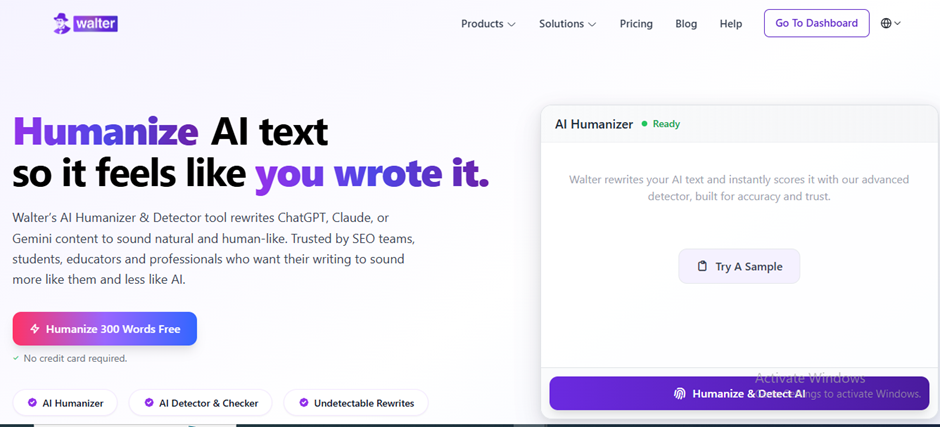
Best suited for: Agencies; freelance SEO writers; content teams looking to scale production.
Pricing: The Starter plan ($12/month) is good for 30,000 words; the Business plan ($24/month) is good for 70,000 words. What sets it apart: Designed to handle the most aggressive plagiarism detection software available today (including, but not limited to, Turnitin and Originality.ai). Walter has multiple language capabilities (over 80 languages), which can be helpful for international SEO campaigns. User feedback indicates that content created via Walter preserves its keyword relevance yet sounds much more natural than content produced by other tools. An example from an agency reported that their search engine rankings remained consistent during Google’s 2025 Core Updates, despite using Walter for heavy AI-assisted production.
Website: WalterWrites.ai
2. Quillbot Humanizer – Popular Multi-Purpose Tool
While QuillBot may be an older tool than many humanizers, it has become a full-featured rewrite tool that can help you rephrase your writing. This is where the QuillBot humanizer comes in handy, identifying robotic-sounding phrases and repetitive sentence structures found in AI-generated drafts. Unlike many of the other options available today, QuillBot is a general-purpose rewrite tool that works within your current workflow (including Chrome extensions) and is very easy to use.
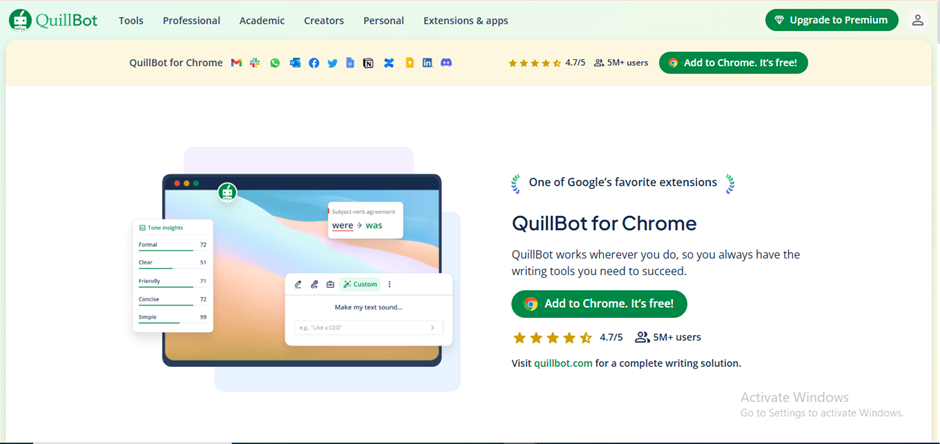
Best for: A solo SEO consultant or small team that needs a reliable rewrite tool.
Price: QuillBot Premium plans start at approximately $20 per month. Why it stands out: The user experience of QuillBot is extremely fast and easy to use. Simply paste your draft, choose how much you would like rewritten, and receive your results almost instantly. QuillBot also includes a plagiarism checker and grammar tools that make it a great tool for polishing your content. However, because QuillBot is not as sophisticated as Turnitin, it is best used for content posted on blogs, websites, etc. (not in an academic setting).
Website: Quillbot.com
3. Grammarly AI Humanizer – Best for Brand Voice Consistency
Grammarly’s humanizer has entered the market more recently; however, this new entry provides unique value to its customers, specifically the option to customize brand voice. If you are an SEO agency responsible for creating content for multiple client brands with varying tone and style guidelines, Grammarly allows you to create customer profiles that adjust grammatical errors as well as tone, formality, and phrasing patterns. This allows you to maintain consistency across all of your clients’ campaigns.
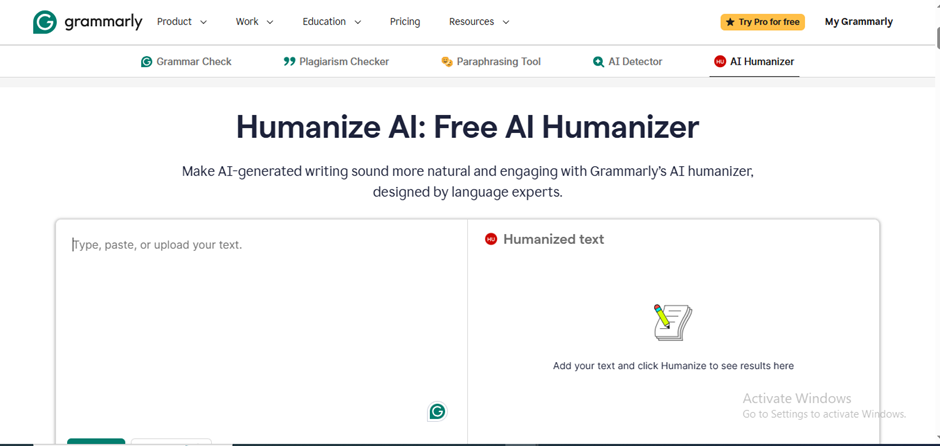
Ideal for: Multiple-brand SEO agencies; in-house teams with strict editorial guidelines.
Pricing: $15/user/month (Business plan). What makes it unique: The tone detection and adjustment features are extremely useful. You can create parameters to set a casual, professional, or authoritative tone, and the humanizer will rewrite the AI text to match it. It also flags overly complex sentences and suggests simpler alternatives, which is great for readability scores. The main limitation is that it is more focused on polish than evasion from detection, so you may need to use another tool when dealing with strict AI checkers.
Website: Grammarly.com
4. Surfer SEO Humanizer – Built for SEO Workflows
SurferSEO is a well-known optimization platform, and its Humanizer tool works within that framework. It is also integrated with Surfer’s Content Editor, allowing users to optimize for keywords and humanize AI-generated text within one workflow. This allows users to save time and keep all content aligned with search intent.
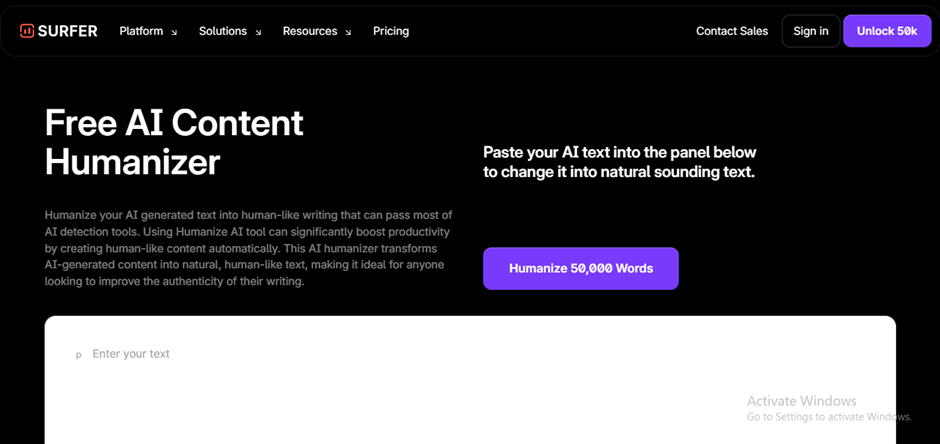
Best for: SEO professionals who are currently using Surfer to plan and optimize content.
Price: Ranges from $29/month as part of Surfer’s overall suite.
What makes it stand out: Being able to humanize and optimize simultaneously is a huge benefit. Surfer’s tool can analyze competitors’ content, suggest optimal keyword placement, and rewrite AI-generated drafts to match top-ranking pages. It is most beneficial in highly competitive niche areas, where users need both technical SEO and natural-sounding content.
What makes it stand out: The downside is that it is part of a larger platform, so if users are not using all of Surfer’s other features, they may be paying more than needed.
5. Writesonic Humanizer – Good for High-Volume Agencies
Writesonic has a reputation for being fast, and its humanizer is no exception. Writesonic can produce large batches of content quickly and at acceptable levels of quality if your content creation team produces dozens of articles per week. It may not have all the bells and whistles of other humanizers; however, Writesonic is great for high-volume content creation when speed and quality are equally important.
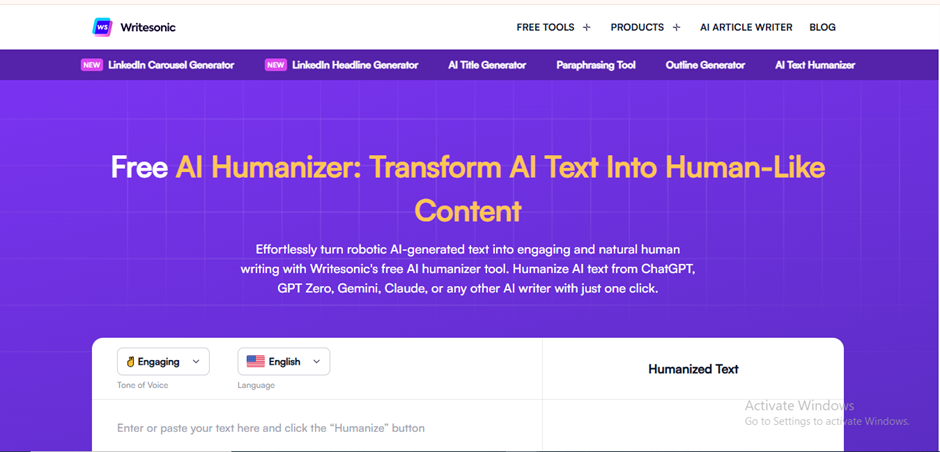
Recommended for: Content development teams that need to create an abundance of content on short notice.
Cost: The Business level is approximately $20/month. What makes it unique: Writesonic’s speed is impressive. Your article can be added to a queue and processed in the background. Additionally, Writesonic provides additional AI-based writing capabilities, so you can write and humanize your content in one application. Writesonic can create high-quality content; however, the nuances of the humanization process are not as detailed as those in tools such as Walter Writes.
What makes it stand out: As a result, it is ideal for informational articles and blog posts rather than SEO-based content.
Website: Writesonic.com
6. Jasper Paraphrasing Tool – Enterprise-Level Rewriting
Jasper calls itself an “enterprise solution,” so the paraphrase tool is made for teams that need to do more than simply rewrite. The paraphrase tool costs much more than most other options; however, it offers extensive control over tone, style, and structure. Large agencies and in-house teams with an enterprise budget will be the best fit for this option.
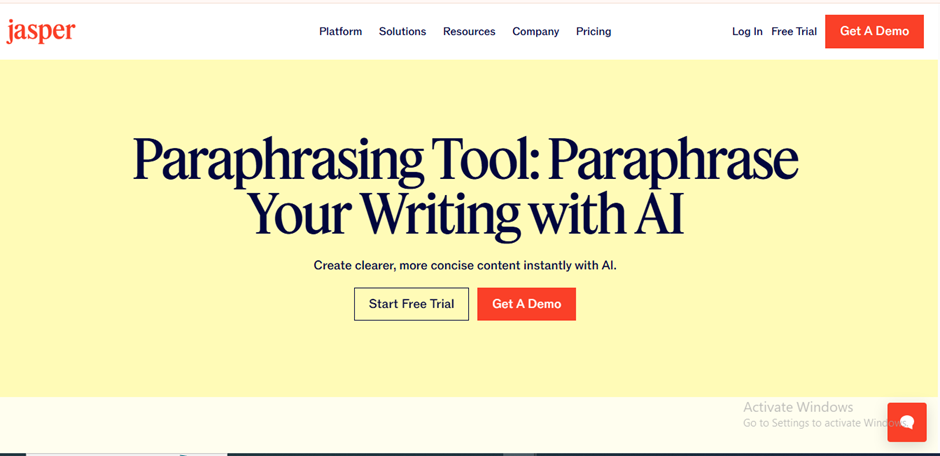
Price: The lowest price starts at about $49 per month.
What sets it apart from others: Jasper has the most customizable options. You can create custom templates for each type of content you write and even create parameters for your brand’s voice. Jasper integrates with many project management tools, making it easier to manage all your projects in one place. One downside is the price, which is likely too high for small businesses or solo consultants.
Website: Jasper.ai
How to Choose the Right Humanizer for Your SEO Work
Your choice of a tool depends on what you require for your work. For example, if you are working alone or with a small team, you want a tool that is affordable and easy to use. Tools such as QuillBot and Grammarly are good examples of this type. If you are producing a large volume of content and/or face competition from other authors or niche writers, which could lead to your content being flagged as human-generated, then investing in a more robust tool like Walter Writes or SurferSEO is recommended.
Also, consider how you will use the tool. If you are already using Surfer or Jasper, you can use their built-in humanizer instead of switching back and forth between multiple tools. If you prefer flexibility and do not want to become locked into a particular “ecosystem,” then a stand-alone tool such as Walter Writes or Writesonic may be preferred.
Finally, think about the detection risk. Not all humanizers are created equally and therefore may not be able to bypass sophisticated AI-based detection tools. If you are creating content that will be reviewed by clients, editors, etc., or submitted to academic institutions, choose a tool that has been tested against the most advanced detection tools available.
Lastly, test before you buy. All of these tools offer a trial or low-tier pricing plan. Test a few samples with each tool to determine which produces the desired results.
Red Flags to Watch For
You shouldn’t waste time or money on every humanizer. Be cautious of tools that claim a lot but deliver little. Be suspicious of platforms that promise 100% evasion of detection or guarantee that your content will never be reported as spam. Nobody has ever made good on this claim, and those who do are likely among the most unreliable tools available.
Stay away from tools that remove a person’s emotion and nuance and replace it with a dull, generic version. The intent of a humanizer is to create content that sounds like a human wrote it, not like a company press release. If the output of a tool seems lifeless and lacks all sense of character, then the tool hasn’t accomplished what it was designed to do. Another red flag is poor customer service. If you encounter an issue or have a question about how a tool works, you should be able to obtain assistance immediately. A tool that takes days to respond (or doesn’t respond at all) may put you in a bind when you need something done quickly.
Another red flag is a tool that does not provide transparency regarding how it processes your content. If you cannot determine where your data is being stored, how it is being distributed, or how it will be used to train other models, that is a serious problem. Your privacy matters—particularly if you are working with your clients’ content or proprietary content.
Questions to Ask Before Subscribing
Before you buy a humanizer, first determine what you want to know from it. How many words will you have in your content each month? Will those words fall within the limits of this humanizer? Is there an easy way to cancel or reduce the number of words if you need to?
How does the humanizer treat your data? Do they have a clear privacy policy explaining where your data is stored, for how long, and whether they are using your data to train other tools? Has the humanizer been tested against all types of AI detectors that you might use? If the humanizer company cannot provide information about the different AI checkers their product works around, that should raise red flags.
Does the humanizer work well with your current tools? Are you using Google Docs, WordPress, or another content management system? Check whether the humanizer has plugins or APIs for those systems.
Is there a free trial or a money-back guarantee? The best way to know if a humanizer is right for you is to test it before paying.
Frequently Asked Questions
What’s the difference between a humanizer and a paraphrasing tool?
Paraphrasing tools are designed to rewrite sentences so they don’t sound plagiarized and to enhance readability. Humanizers take this process even further, reformulating content into a structure less recognizable to AI detectors; as a result, the content sounds more organic and less generated by a machine.
Will humanized content continue to rank well in search engines?
Yes, as long as the content remains relevant, well-organized, and beneficial to the reader. Humanizers do not remove keywords or violate SEO principles; they simply create a more authentic-sounding piece of content that may also lead to improved engagement metrics, such as time spent on the page and bounce rates.
Can humanizers be used with content in languages other than English?
Many humanizers support multiple languages; however, the quality varies greatly. For example, Walter Writes currently supports over 80 languages. When choosing a humanizer, test it in the intended language prior to committing to a paid subscription.
Do I still need to review content after using a humanizer?
Yes. Humanizers are tools and cannot replace editorial oversight. All outputs from humanizers should be reviewed to ensure the rewritten content fits within your brand voice, is factually correct, and meets your quality requirements.
Are humanizers safe to utilize for client projects?
Generally, yes; however, it is necessary to review the humanizer’s privacy policy to confirm that your content will not be retained or utilized for training other models. If you are using a humanizer to process sensitive or proprietary content, select a humanizer with robust data protection guarantees.
How can I determine whether or not a humanizer is functioning effectively?
Run the rewritten content produced by the humanizer through an AI detector such as Originality.ai, GPTZero, or Turnitin. Effective humanizers will likely yield significantly lower AI-detection probabilities than the original content.
Can I use a humanizer on content I have written myself?
Yes. A humanizer can help you rewrite your content to remove the patterns that led to false detection, particularly if you have been inaccurately flagged for using AI. A humanizer is most useful for academic writers and professional writers who tend to write in a formal, structured manner.
What is the best humanizer for academic SEO content?
Both Walter Writes and QuillBot are excellent choices; however, Walter Writes has a significant advantage in bypassing academic detectors, including Turnitin. If you are producing research-based content or educational SEO, consider using a humanizer that has demonstrated effectiveness in academic contexts.




