



Youtube’s Company Overview
YouTube, accessible at www.youtube.com, has evolved dramatically since its establishment in 2005 by Steve Chen and Chad Hurley. Over the yea...
YouTube, accessible at www.youtube.com, has evolved dramatically since its establishment in 2005 by Steve Chen and Chad Hurley. Over the years, it has grown into the world's foremost platform for video sharing, boasting billions of users and a vast library of content that covers everything from user-generated videos to professionally produced films, music videos, and educational content. Its mission is to "give everyone a voice and show them the world," thereby enabling individuals and organizations to reach a global audience with their unique stories and messages. The platform's user-friendly interface and advanced recommendation algorithms ensure users spend more time engaging with content they love.
YouTube operates on a business model that leverages its role as an intermediary between content creators and viewers. Unlike traditional broadcasters, YouTube offers a democratized space where anyone can create and upload content. It bolsters this by providing a robust set of tools for video creation, editing, and live streaming, thus lowering the barriers to entry for content creators. The platform also fosters an interactive environment where viewers can engage through comments, likes, and shares, creating a dynamic and participatory community. Moreover, YouTube has ventured into offering premium content and services like YouTube Premium and YouTube TV, allowing subscribers to enjoy an ad-free experience and access exclusive content, further diversifying its footprint in the digital entertainment industry.
The revenue model of YouTube is multifaceted, generating income through several channels. Primarily, it earns through advertising, placing ads on videos, the homepage, and within search results—targeted by leveraging Google's advanced ad-targeting technologies. This includes pre-roll, mid-roll, and display ads that are tailored to the viewer's interests. Additionally, YouTube Premium subscribers pay a monthly fee for ad-free viewing, offline playback, and access to exclusive content. Another revenue stream comes from YouTube's Super Chat and Super Stickers, which allow viewers to pay for their messages to be highlighted during live streams. The platform also monetizes through channel memberships, where fans can support their favorite creators with recurring payments in exchange for perks like badges and exclusive content. Through these comprehensive revenue strategies, YouTube secures a steady and diverse income, reinforcing its status as a powerhouse in the online video industry.
Headquater: San Bruno, California, US
-
Foundations date: 2005
-
Company Type: Subsidiary
-
Sector: Information & Media
-
Category: Entertainment
-
Digital Maturity: Digirati
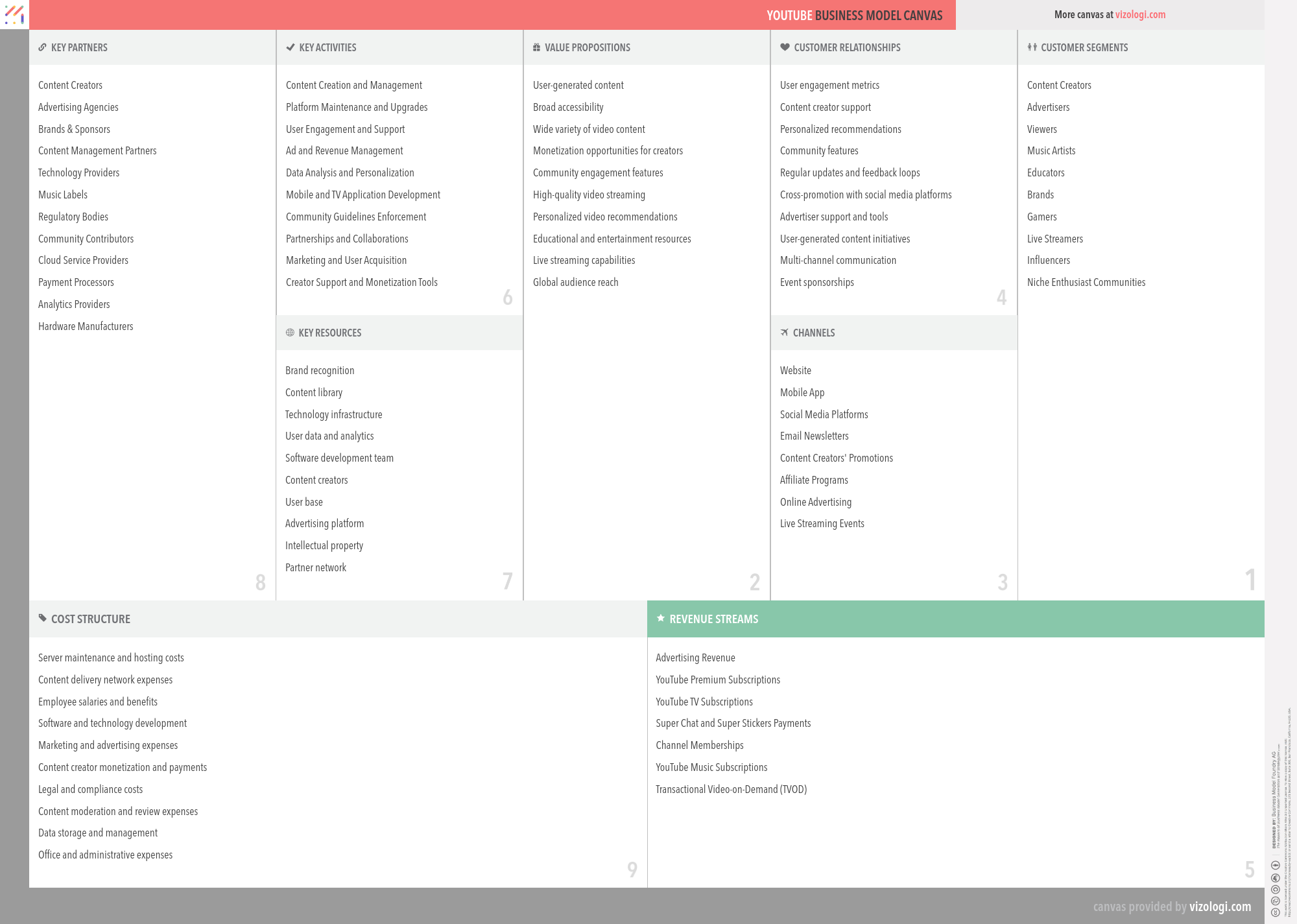
Youtubes' business model canvas
User-generated content, Broad accessibility, Wide variety of video content, Monetization opportunities for creators, Community engagement fe...


Embed code:

- Content Creators
- Advertising Agencies
- Brands & Sponsors
- Content Management Partners
- Technology Providers
- Music Labels
- Regulatory Bodies
- Community Contributors
- Cloud Service Providers
- Payment Processors
- Analytics Providers
- Hardware Manufacturers
- Content Creation and Management
- Platform Maintenance and Upgrades
- User Engagement and Support
- Ad and Revenue Management
- Data Analysis and Personalization
- Mobile and TV Application Development
- Community Guidelines Enforcement
- Partnerships and Collaborations
- Marketing and User Acquisition
- Creator Support and Monetization Tools
- Brand recognition
- Content library
- Technology infrastructure
- User data and analytics
- Software development team
- Content creators
- User base
- Advertising platform
- Intellectual property
- Partner network
- User-generated content
- Broad accessibility
- Wide variety of video content
- Monetization opportunities for creators
- Community engagement features
- High-quality video streaming
- Personalized video recommendations
- Educational and entertainment resources
- Live streaming capabilities
- Global audience reach
- User engagement metrics
- Content creator support
- Personalized recommendations
- Community features
- Regular updates and feedback loops
- Cross-promotion with social media platforms
- Advertiser support and tools
- User-generated content initiatives
- Multi-channel communication
- Event sponsorships
- Content Creators
- Advertisers
- Viewers
- Music Artists
- Educators
- Brands
- Gamers
- Live Streamers
- Influencers
- Niche Enthusiast Communities
- Website
- Mobile App
- Social Media Platforms
- Email Newsletters
- Content Creators' Promotions
- Affiliate Programs
- Online Advertising
- Live Streaming Events
- Server maintenance and hosting costs
- Content delivery network expenses
- Employee salaries and benefits
- Software and technology development
- Marketing and advertising expenses
- Content creator monetization and payments
- Legal and compliance costs
- Content moderation and review expenses
- Data storage and management
- Office and administrative expenses
- Advertising Revenue
- YouTube Premium Subscriptions
- YouTube TV Subscriptions
- Super Chat and Super Stickers Payments
- Channel Memberships
- YouTube Music Subscriptions
- Transactional Video-on-Demand (TVOD)
Youtube’s Revenue Model
Youtube makes money by combining different business models. Below, you will find the list of the different monetization strategies identified for this company:
Youtube makes money by combining different business models. Below, you will find the list of the different monetization strategies identified for this company:
- Advertising
- Freemium
- Hidden revenue
- Digitization
- Long tail
- Flat rate
- Micro-segmentation
- Subscription
- Power on
- Community-funded
- On-demand economy
- Customer data
- Mass customization
- Disruptive trends
- Markets are conversations
- Open business
- Lean Start-up
- In-crowd customers
- Product innovation
- Access over ownership
- Experience
- Ecosystem
- Corporate innovation
- Culture is brand
- Two-sided market
- Channel per purpose
- Self-service
- Unlimited niches
- Blue ocean strategy
Analytics
Market Overview
Youtube’s Case Study
: Unveiling the Giants of Video Sharing Having navigated the intricate realm of business strategy and company case studies, it’s exhilarating to delve into a platform that has reshaped digital entertainment: YouTube. ...
YouTube's Case Study: Unveiling the Giants of Video Sharing
Having navigated the intricate realm of business strategy and company case studies, it’s exhilarating to delve into a platform that has reshaped digital entertainment: YouTube. Founded in 2005 by visionary entrepreneurs Steve Chen and Chad Hurley, YouTube has evolved from a simple video-sharing website to an integral part of global digital culture. With billions of users and a vast library of diverse content, YouTube has become more than a platform—it is now a powerful ecosystem influencing how the world consumes media.
The Genesis and Evolution of YouTube
When YouTube first surfaced in 2005, the digital landscape was significantly different from what it is today. The platform's mission, “to give everyone a voice and show them the world,” reflects a democratic ethos aimed at making content creation accessible to all. From its early days of user-generated videos to its current status hosting professionally produced films, music videos, and educational resources, the platform’s trajectory has been nothing short of meteoric.
YouTube's user-friendly interface and advanced recommendation algorithms, built on Google’s robust technologies, have ensured that users remain engaged. This strategic focus on user experience has been pivotal in YouTube’s climb to prominence. According to Statista (2023), over 2.5 billion users log into YouTube each month, underscoring its massive reach and influence.
A Multifaceted Revenue Model
YouTube's revenue model is a sophisticated amalgamation of various income streams. Primarily, it capitalizes on advertising, including pre-roll, mid-roll, and display ads. These are powered by Google’s advanced ad-targeting technologies, which align advertiser interests with user preferences, optimizing ad placements for maximum revenue. In 2022 alone, Google’s advertising revenue from YouTube was over $28.8 billion (Alphabet Inc. annual report, 2022).
In addition to advertising, YouTube has diversified through premium services such as YouTube Premium and YouTube TV. Subscribers to YouTube Premium can enjoy an ad-free experience along with offline playback and exclusive content, at a monthly fee of $11.99. YouTube TV further extends its offering to live television services, capturing the traditional TV audience.
Moreover, YouTube’s monetization strategies for content creators contribute significantly to its revenue. Features like Super Chat and Super Stickers during live streams allow viewers to pay for highlighted messages, while channel memberships offer fans the opportunity to support creators through recurring payments. These features underscore YouTube’s community-centric approach, fostering a symbiotic relationship between the platform and its user base.
Strategic Partnerships and Ecosystem
Key partnerships form the backbone of YouTube’s business model. Collaborations with content creators, advertising agencies, brands, and technology providers have been instrumental in shaping YouTube into a holistic digital ecosystem. For instance, partnerships with music labels ensure a steady influx of high-quality audio-visual content, attracting and retaining a diverse user base.
Regulatory bodies, content management partners, and community contributors also play critical roles. YouTube’s emphasis on community guidelines and content moderation ensures a safe and inclusive environment for users, essential for maintaining trust and credibility. According to Harvard Business Review, maintaining a robust and ethical framework is critical for platforms involving user-generated content to mitigate risks and foster long-term growth (HBR, 2021).
Customer-Centric Value Propositions
At the core of YouTube’s success is its customer-centric value propositions. These propositions cater to a wide array of customer needs, encompassing social impact, life-changing experiences, and emotional and functional rewards.
User-Generated Content and Accessibility: By lowering the barriers to entry for content creation, YouTube empowers individuals to share their stories with a global audience. This democratization of content creation aligns with Maslow’s hierarchy of needs, facilitating self-actualization and affiliation.
Variety and Quality: The platform offers a vast library of video content, ranging from educational tutorials to entertainment, ensuring there’s something for everyone. This immense variety not only informs but also entertains and inspires, providing significant value to users.
Monetization and Community Engagement: One of YouTube's unique propositions is its monetization opportunities for creators. Through ad revenues, memberships, and live stream features like Super Chat, content creators can earn a livelihood, supporting economic well-being while fostering a vibrant, interactive community. According to YouTube, over 40% of creators who earn money on YouTube report it as their primary source of income (YouTube Creators, 2022).
Advanced Technological Infrastructure
The technological prowess behind YouTube is equally intriguing. The platform boasts a sophisticated tech infrastructure, leveraging cloud services and robust analytics to provide seamless and personalized user experiences. According to ScienceDirect, YouTube employs deep learning algorithms to analyze user behaviors and preferences, thus optimizing content recommendations and ad placements (ScienceDirect, 2022).
In terms of content delivery, YouTube collaborates with leading cloud service providers to ensure high-quality video streaming capabilities. This technical excellence is manifest in its ability to handle immense data loads, supporting billions of concurrent users without compromising performance.
Innovative Business Patterns
YouTube's operational model exemplifies several innovative business patterns, from digitization to micro-segmentation and freemium strategies.
Digitization and Long Tail Strategy: By digitizing content and leveraging the long tail strategy, YouTube captures niche markets that traditional media often overlooks. This approach is exemplified in channels focusing on incredibly specific interests, from vintage toy collecting to advanced quantum physics.
Freemium and Subscription Models: The freemium model allows free access to vast content, while subscriptions to YouTube Premium offer enhanced experiences. This dual approach maximizes user engagement and monetization opportunities.
Customer Data and Personalization: Utilizing extensive user data, YouTube’s algorithms provide personalized content recommendations, significantly enhancing user experience and retention. This data-driven approach underscores the importance of analytics in decision-making processes, as highlighted by experts in business strategy (McKinsey & Company, 2021).
Future Prospects and Challenges
As we look ahead, YouTube faces both opportunities and challenges. Emerging trends in digital consumption suggest a continued rise in video content on-demand, particularly in immersive formats like Virtual Reality (VR) and Augmented Reality (AR). YouTube’s foray into these domains could redefine digital entertainment once again.
However, challenges such as content regulation, data privacy concerns, and fierce competition from other streaming platforms are formidable. Platforms like TikTok and Instagram have added video features, posing a significant threat to YouTube’s dominance. Addressing these challenges requires adaptive strategies and sustained innovation in content, technology, and user engagement.
In conclusion, YouTube’s case study epitomizes the transformational power of innovative business strategies, advanced technologies, and customer-centric value propositions. Through meticulous navigation of the evolving digital landscape, YouTube continues to set benchmarks in the video-sharing industry. It’s a testament to how a platform can become not just a service, but a global phenomenon influencing culture, economy, and social interaction.
We believe that as long as YouTube continues to innovate and adapt, its influence will only grow, making it an ever more pivotal part of the digital fabric of our lives.
Youtube’s Related Competitors
Compare patterns with iPod / iTunes, Radio One Inc, Apple Music Store...




+100 Business Book Summaries
We’ve distilled the wisdom of influential business books for you.
Zero to One by Peter Thiel.
The Infinite Game by Simon Sinek.
Blue Ocean Strategy by W. Chan.
…
