In today’s volatile macroeconomic climate, safeguarding a company’s Key Resources—its human capital—is no longer just an HR function. It is a fundamental pillar of corporate strategy.
For high-risk industries such as mining, offshore drilling, and heavy construction, traditional business models often underestimate the catastrophic impact of operational hazards. A single severe on-site incident can paralyze operations, invite devastating lawsuits, and permanently damage a brand’s reputation.
To build true corporate resilience, C-suite executives must elevate their risk management frameworks. This requires shifting from baseline compliance to proactive, tactical-grade safety integrations.
The Hidden Vulnerability in Traditional Operational Business Models
When mapping out an operational business model, most strategists treat safety protocols as an administrative checkbox. They aim for minimum government compliance, such as baseline OSHA standards, to minimize initial costs.
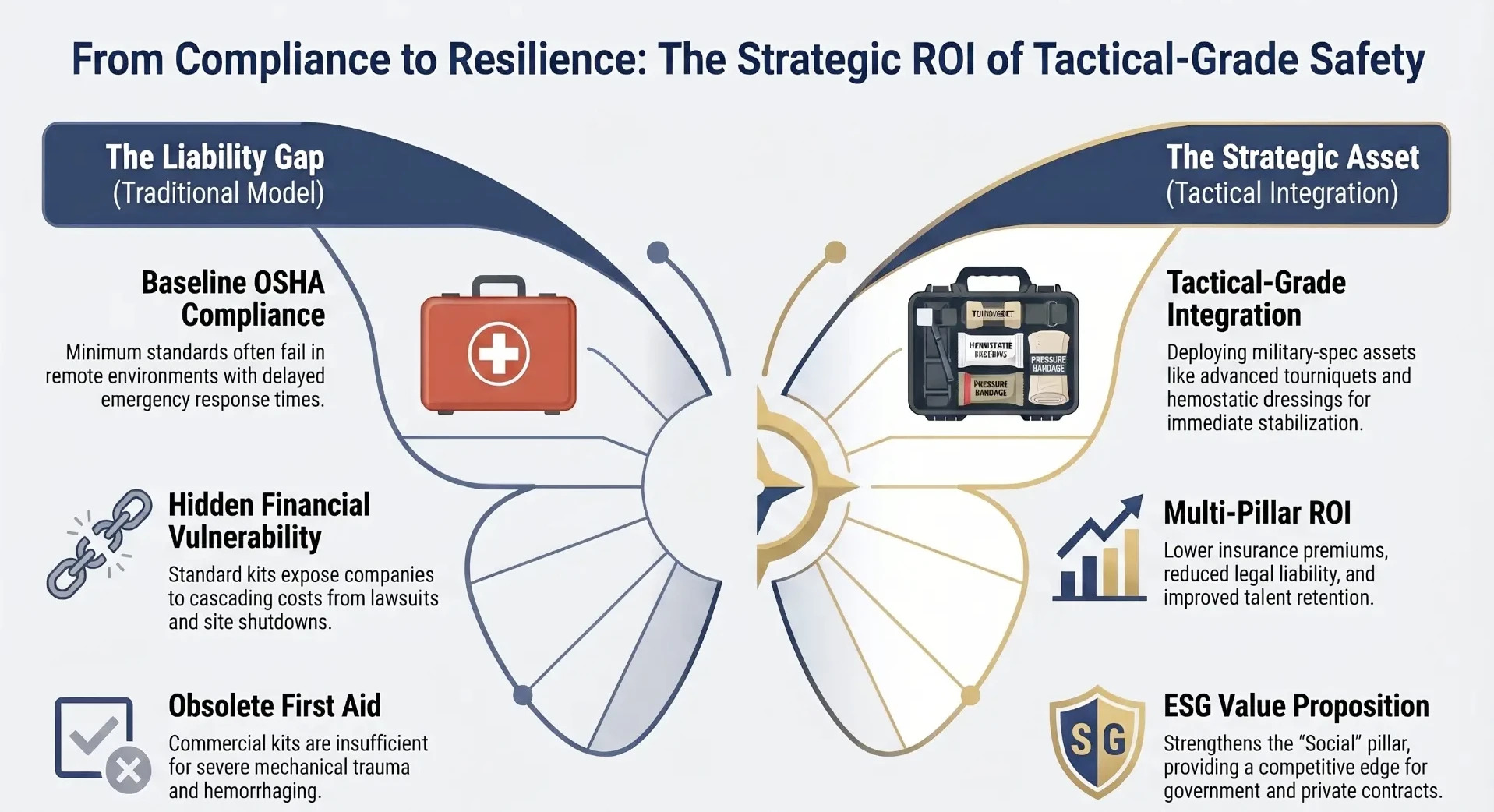
However, this “minimum viable safety” approach is a massive hidden vulnerability. In remote or heavy-duty environments, emergency response times are often significantly delayed. Relying on basic medical provisions during this critical window exposes companies to immense operational and legal risks.
The true cost of this vulnerability isn’t just the immediate medical expense. It is the cascading effect of prolonged site shutdowns, severe Liability Mitigation failures, and the rapid erosion of stakeholder trust following a preventable tragedy.
Upgrading Safety Assets: Why Standard First Aid is Obsolete for Heavy Industries
When redefining operational risk parameters, relying on standard, commercially available first aid kits exposes companies to immense liability, particularly in remote or heavy-duty environments.
Modern corporate risk management frameworks are increasingly adopting military and tactical-grade standards for their safety assets. For instance, outfitting high-risk worksites with specialized Rhino, such as those engineered by industry leaders like Rhino Rescue, ensures immediate access to critical life-saving tools.
Advanced tourniquets and hemostatic dressings found in these kits are explicitly designed to control severe hemorrhaging and mechanical trauma. By deploying these assets, companies can effectively mitigate catastrophic outcomes before traditional emergency medical services can even arrive on the scene.
The Financial Impact: Measuring the ROI of Advanced Preparedness
From a purely financial perspective, upgrading to tactical-grade safety protocols is a highly strategic investment. Executives must weigh the initial Capital Expenditure (CapEx) against the profound long-term cost savings.
- Lawsuit and Liability Mitigation: Advanced trauma preparedness drastically reduces the severity of workplace injuries, directly correlating to lower settlement payouts and minimized legal liabilities.
- Operational Continuity: By stabilizing severe injuries immediately, companies reduce the likelihood of extended investigations and prolonged operational shutdowns.
- Insurance Premium Optimization: Corporate insurers increasingly offer favorable rates to organizations that demonstrate risk management practices exceeding standard regulatory minimums.
- Talent Acquisition and Retention: In high-risk sectors, demonstrating a commitment to top-tier life safety significantly boosts employee morale and reduces costly turnover rates.
Integrating Advanced Safety into Your ESG Value Proposition
Modern investors and stakeholders rigorously evaluate companies through the lens of Environmental, Social, and Governance (ESG) criteria. Exceptional employee safety is a critical component of the “Social” pillar.
By integrating tactical-grade medical preparedness into your operations, you transform a standard safety policy into a highly competitive Value Proposition. It demonstrates a tangible, measurable commitment to human life.
This level of ESG Compliance provides a significant advantage during the bidding process for lucrative government contracts or large-scale private developments. It proves to stakeholders that your corporate governance proactively anticipates and neutralizes operational risks.
Key Takeaways
| Area | Key Takeaway | Impact/Data |
| Safety Gear | Deploy tactical-grade trauma kits | Mitigates catastrophic mechanical trauma |
| Liability | Exceed basic OSHA compliance | Slashes lawsuit payouts & insurance premiums |
| Operations | Stabilize severe injuries immediately | Prevents prolonged operational shutdowns |
| ESG Strategy | Integrate top-tier life safety | Wins lucrative government & private contracts |
Future-Proofing Corporate Strategy Through Comprehensive Risk Mitigation
Ultimately, advanced safety preparedness must be viewed as an integral component of your organization’s overarching strategic vision. Anticipating “high impact, low probability” events is what separates resilient enterprises from fragile ones.
Integrating these advanced safety protocols is not merely about preventing physical harm; it is a fundamental pillar of sustainable corporate strategy. According to a comprehensive overview of strategic risk management by Harvard Business Review, organizations that proactively over-index on operational safety and rigorous risk mitigation consistently demonstrate greater resilience to market volatility.
Furthermore, these forward-thinking companies face significantly lower long-term liability costs and maintain a stronger competitive advantage during economic downturns. By investing in the highest-tier safety assets today, leaders secure their company’s operational and financial future.