
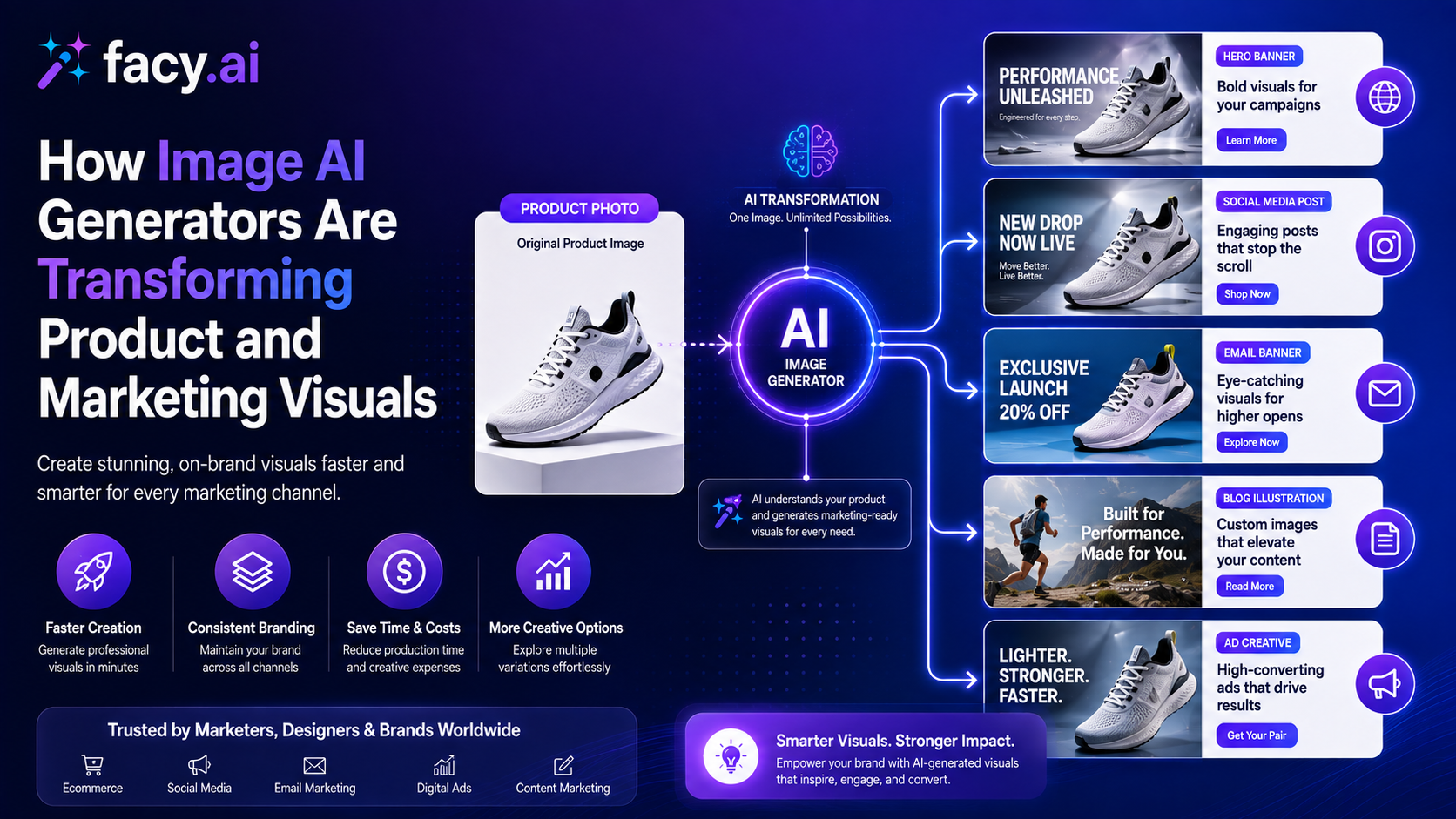
Creating compelling visual content has become one of the biggest challenges for modern businesses. Whether launching a new product, promoting seasonal campaigns, or publishing content across multiple channels, brands need a steady stream of high-quality images that capture attention and reinforce their identity. To meet this growing demand, many companies are exploring tools like the FacyAI image generator to simplify content creation while maintaining professional standards. The real value of an image AI generator is not that it replaces creative professionals. Instead, it helps marketers and designers work more efficiently, giving them more time to focus on strategy, storytelling, and customer engagement.
Why Product and Marketing Visuals Matter More Than Ever
Consumers encounter brands through websites, social media feeds, ecommerce stores, email campaigns, online advertisements, and search results. Each of these touchpoints requires visuals that are both engaging and consistent with the brand’s identity.
A single product launch alone can call for several types of visuals at once:
1. Hero banners for the main product or campaign page
2. Social media graphics sized for each platform
3. Promotional emails and newsletter visuals
4. Blog illustrations and supporting content images
5. Display ads and marketplace listing images
As marketing channels continue to expand, the demand for new content grows with them. Producing every one of these assets through traditional design and photography workflows can quickly become expensive and time-consuming. HubSpot’s research on marketing trends shows that a growing share of teams now rely on AI for visual content creation, not only written copy.
An image AI generator helps businesses respond to this challenge by reducing production time while still allowing creative teams to oversee quality and branding. Instead of beginning every project from scratch, marketers can generate concepts, refine ideas, and adapt visuals for different channels much more efficiently.
How an Image AI Generator Improves Creative Workflows
One of the biggest advantages of an image AI generator is the ability to generate multiple creative directions from a single idea. Marketing teams no longer need to spend hours building several design concepts manually before deciding which one fits a campaign best.
This faster process improves collaboration as well. Designers, marketers, and content managers can review early concepts together, making feedback more specific and reducing lengthy revision cycles.
Another benefit is creative experimentation. Businesses can test different advertising visuals, product banners, social media graphics, and promotional images before launching campaigns. Since generating new concepts requires less time, teams can make more informed creative decisions based on performance rather than assumptions.
Rather than replacing designers, an image AI generator handles repetitive production tasks while allowing creative professionals to concentrate on branding, messaging, and campaign strategy.
Where Businesses Use Image AI Generators
Ecommerce businesses frequently create promotional banners, seasonal campaigns, and product marketing assets that complement existing product photography.
Content marketing teams use an image AI generator to produce custom blog illustrations and featured images that better reflect the subject matter than generic stock photos.
Social media managers benefit by creating multiple creative variations for different platforms while maintaining a consistent visual identity across campaigns.
Agencies also integrate AI into client projects, accelerating concept development and allowing designers to spend more time refining creative ideas rather than repeating routine production work.
As businesses publish more visual content across more channels, AI-generated imagery is becoming an increasingly practical addition to everyday marketing workflows.
Comparing Popular Image AI Generators
Image AI generators serve different creative purposes. Some are built for professional design teams, while others help businesses produce marketing visuals more efficiently. Comparing how each platform supports product and promotional content can help businesses identify the best fit for their creative process. Adobe Firefly reflects the same trend, since it was built specifically to fit into existing Creative Cloud production pipelines rather than replace them.
| Visual Need | Best Approach | Why |
| One-off hero banner | Professional photoshoot | Worth the investment for a single high-visibility asset |
| High-volume seasonal variations | Image AI generator | Fast, low-cost way to produce many campaign-ready versions |
| Multi-market localized creative | Image AI generator | Easier to adapt one source image than reshoot per region |
| Highly artistic concept work | Specialized art-focused AI tools | Built for stylized, imaginative output over realism |
| Studio-accurate product detail | Traditional product photography | Still the most reliable option for exact color and texture |
As businesses create larger volumes of visual assets across multiple marketing channels, choosing an image AI generator involves more than comparing image quality alone. The most effective platform is often the one that supports your day-to-day creative process, helping teams produce product visuals, promotional graphics, and marketing assets more efficiently while maintaining consistency across every campaign.
Best Practices for Using an Image AI Generator
• Give detailed creative direction: specify composition, lighting, colors, product placement, audience, and visual style for stronger first-attempt results.
• Set brand guidelines before generating: consistent prompts help maintain a recognizable visual identity across websites, email campaigns, advertisements, and social media.
• Review every image before publication: designers and marketers should confirm visuals support campaign goals, align with brand standards, and communicate the intended message.
Organizations that combine AI efficiency with creative expertise often produce more content without compromising quality.
A Faster Approach to Creative Production
The value of an image AI generator becomes much clearer when viewed through a practical example.
Consider a direct-to-consumer fitness apparel brand preparing a global product drop. The launch calls for region-specific banners, a handful of paid social variations, and email imagery, each needing to reflect different climates and audiences from Southeast Asia to Northern Europe.
Using an image AI generator, the team adapts a single product shoot into several region-specific scenes rather than commissioning separate photography for each market. Designers refine the strongest visuals for brand consistency, while marketers focus on localizing copy and timing the rollout across time zones.
What makes this approach practical at launch speed is that one source image can support an entire region-by-region rollout. Instead of scheduling photography for every market, the team spends its time adapting messaging and sequencing the release, while the underlying visuals stay consistent with the brand’s original photoshoot.
The Future of Product and Marketing Visuals
As businesses continue creating larger volumes of content, the role of an image AI generator will likely expand from supporting individual projects to becoming a standard part of everyday creative workflows. Success, however, will depend on more than generating attractive images. Teams also need efficient workflows, consistent branding, prompt accuracy, and tools that integrate naturally into existing marketing processes.
When comparing different platforms, it is worth evaluating how each image AI generator supports your real content production needs rather than focusing only on image quality or feature lists. For businesses producing ecommerce visuals, product campaigns, and digital marketing content, FacyAI is one option worth exploring alongside other solutions. Testing different platforms with your own projects is often the most practical way to determine which image AI generator best supports your team’s workflow, creative flexibility, and long-term marketing goals.





