42% of businesses dropped the majority of their AI content projects in 2025, reports S&P Global. The problem? Their content became indistinguishable from the rest.
As AI infiltrates the marketing department, a dangerous trend is emerging. Brands that first accelerated content creation are now experiencing brand voice shame. Blogs, Tweets, and newsletter campaigns sound cookie-cutter, soulless, and indistinguishable from everyone else. A productivity boon has turned into a brand voice nightmare.
The problem isn’t with the AI; it’s how a business implements its AI content strategy. Businesses that are successful at scaling content while staying true to their voice are following a structured process that treats brand voice as a strategic resource, not an afterthought.
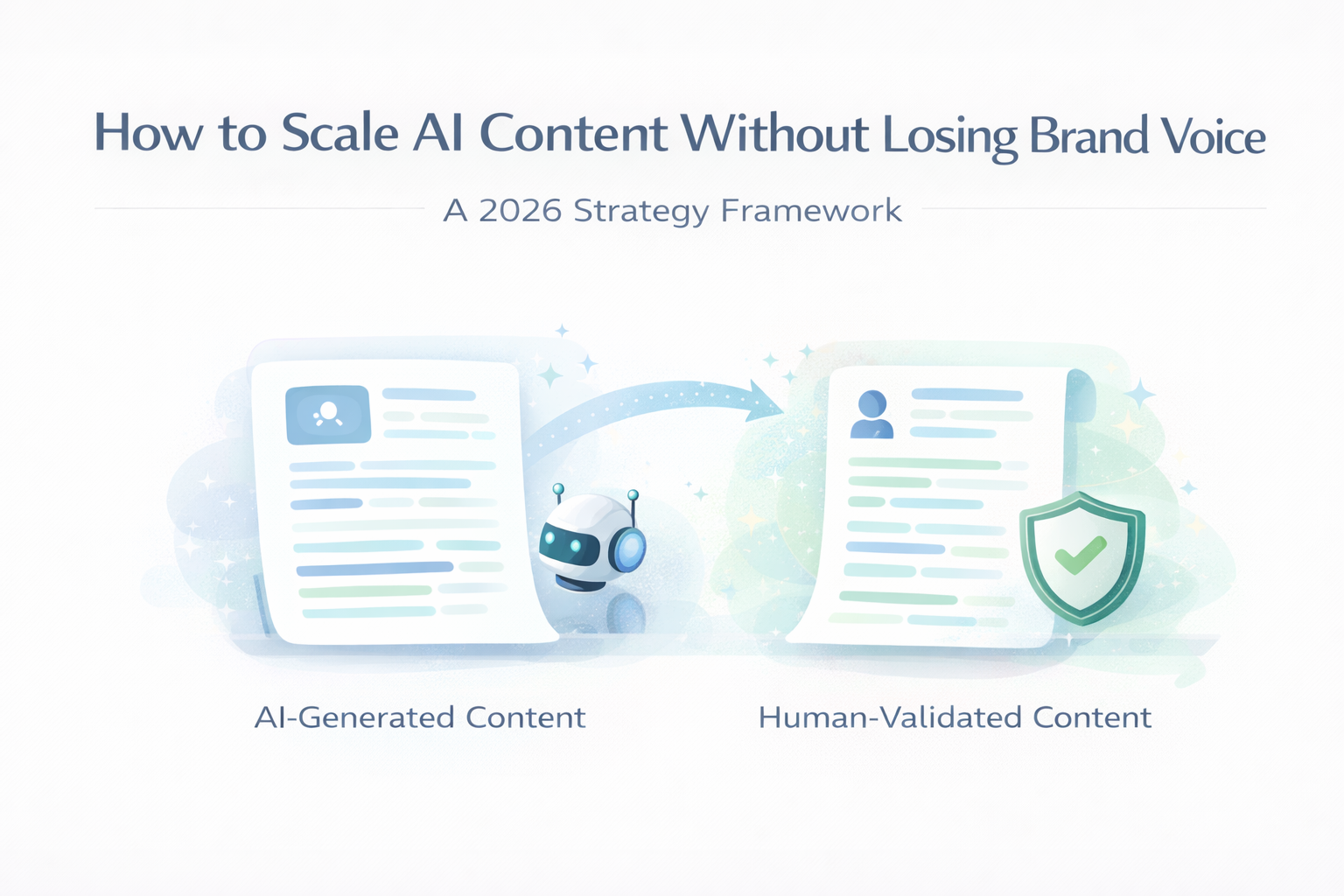
This model teaches you precise steps for scaling AI content without sacrificing brand voice. Leveraging our learnings from successful content teams and recent research on brands in the AI era:
The Problem: Why AI Content Is Eroding Brand Identity
The internet is experiencing what researchers call “AI slop”—a flood of generic, machine-generated content that all sounds eerily similar. 60% of marketers report that AI-generated content sounds generic, according to Averi AI’s 2026 research.
Here’s why this happens:
Same Training Data = Same Voice. Predictable patterns are also generated by most AI models, as long as the training datasets used are relatively alike. The models use phrases such as ‘delve into’, ‘landscape’, or ‘robust’ inordinate numbers and default to a safe, business-like writing style that nullifies any personal touch.
Template Thinking: An AI leans very heavily on a template structure. Blog posts start with formulaic hooks, transition with the same overused phrase ,and end with generic calls to action. Your copy reads like a fill-in-the-blank.
Loss of Human Nuance. Actually, brand voice isn‘t just tone; it‘s the subtle bits, how you start sentences, what references you use, what kind of joke, how you feel about industry issues. AI fails at these details unless you tell it how to do them.
The Google Problem Search engines are evolving too. ClickRank AI research suggests that “brand voice will become a ranking factor” as AI systems learn to identify content by writing style rather than just keywords. Generic content won’t just bore readers, it’ll get buried in search results.
And it’s not just the cost to your wallet; if the words don’t sound original, then you have lost the competitive edge you’ve fought so hard to establish over years of practice.
Why Brand Voice Matters More Than Ever in 2026
Google’s E-E-A-T guidelines now emphasize authentic experience and genuine expertise—qualities that generic AI content struggles to demonstrate. Brand voice consistency has become a trust signal that search algorithms recognize and reward.
Consider the competitive landscape: 27% of marketers say creative and content production will be the most disrupted area by AI (eMarketer, 2026). As everyone gains access to the same AI tools, your voice becomes your primary differentiator.
The numbers support this:
- Brands with a consistent voice see 3.5x more engagement than those with inconsistent messaging
- 73% of consumers say they’re more likely to trust brands with a distinctive communication style
- Companies with strong brand voice report 23% higher customer retention rates
But here’s the Harvard Business Review reality check: “AI Doesn’t Reduce Work—It Intensifies It.” The promise of AI handling content creation entirely is false. Instead, AI shifts work from creation to curation, editing, and brand alignment.
Smart marketers understand this shift. They use AI to scale content production while doubling down on the human elements that create competitive advantage.
The 5-Step Framework to Scale AI Without Losing Your Voice
Step 1: Define Your Brand Voice as a System (Not a Vibe)
Most brand guidelines describe voice with vague adjectives: “friendly,” “professional,” “innovative.” AI needs specificity.
Create a Brand Voice System that includes:
Voice Principles (3-5 concrete rules):
- “We use questions to start 40% of our paragraphs.”
- “We reference specific examples, never abstract concept.s”
- “We avoid business jargon—if a 12-year-old wouldn’t understand it, we don’t use it.”
Phrase Bank:
- Approved phrases that sound like your brand
- Banned phrases that don’t (especially AI-typical words)
- Your unique terminology and definitions
Content DNA:
- Your stance on industry debates
- Topics you always tie back to your core message
- The types of examples and analogies you use
Step 2: Train AI with Your Voice (Give Examples, Not Adjectives)
Feed AI 10-20 examples of your best-performing content that perfectly capture your voice. Include:
- Blog posts with high engagement
- Social posts that sparked conversations
- Email subject lines with high open rates
- Customer communication that built relationships
Training Prompt Structure:
“Analyze these [10] pieces of content. Identify:
1. Sentence structure patterns
2. Word choice preferences
3. How we introduce topics
4. How we transition between ideas
5. How we conclude points
Then write [new content] matching these exact patterns.”
Step 3: Use AI for First Drafts, Humans for Brand Alignment
AI excels at research, structure, and initial draft creation. Humans excel at voice, personality, and strategic messaging.
Optimal Workflow:
- AI handles: Research, outline creation, first draft, SEO optimization
- Humans handle: Voice editing, strategic positioning, controversial takes, personal anecdotes
This hybrid approach lets you produce 3x more content while maintaining voice consistency.
Teams using WRITER scale on-brand content with AI by producing research-backed briefs, channel-specific derivative assets, and compliance-checked outputs from a single workflow. The platform’s AI agents encode a brand’s voice, style guidelines, and approved terminology at the platform layer, so every draft arrives aligned with the brand’s voice rather than requiring the manual editing that generic tools demand.
Step 4: Humanize AI Output Before Publishing
Even well-trained AI produces content that needs voice refinement. Brand voice consistency requires systematic humanization of AI-generated drafts such as using tools that Humanize Text to refine tone and preserve brand identity.
The humanization process includes:
- Sentence rhythm variation: Break up predictable patterns
- Personality injection: Add your unique perspective and examples
- Voice alignment: Ensure tone matches your brand voice system
- Natural flow: Remove robotic transitions and generic conclusions
Tools that humanize AI writing can automate the technical aspects of this process, adjusting sentence structure and word choice to sound more natural—while your team focuses on injecting brand personality and strategic messaging.
The impact is measurable. An independent test of 35+ AI humanizers conducted in 2026 found that the top tools reduced AI detection probability from 93% to near 0%, but the more consequential outcome was readability: humanized drafts showed measurably higher sentence variation and tonal warmth, the exact qualities that keep readers engaged and reduce bounce rates.
Step 5: Audit and Iterate (Measure Voice Consistency)
Track these metrics monthly:
- Voice Recognition Test: Can team members identify your content in a blind lineup?
- Engagement Consistency: Are engagement rates similar across AI-assisted and human-written content?
- Brand Voice Score: Use tools to analyze voice consistency across all content
- Customer Feedback: Do customers mention your distinctive communication style?
Iteration Process:
- Review content that performed poorly for voice alignment issues
- Update your AI training examples quarterly
- Refine your Brand Voice System based on what works
- Train team members on voice editing techniques
Real-World Example: SaaS Company Content Workflow
A B2B SaaS company adopted this framework and retained voice consistency when increasing from 8 to 40 pieces of content/month:
Monday: the content team provides voice examples to AI and produces 10 first drafts. Tuesday, Wednesday: human editors humanize the voice system, humanize the drafts, and inject personality into the text, strategize positioning Thursday: final humanization pass using humanizer Friday: review for voice consistency; schedule content
Outcomes: 73% of readers still recognized their content in blind tests, engagement remained steady, and content creation time was reduced by 60%.
The main thing was to think of AI as a research assistant and a draft maker rather than a final, content buyer.
Common Mistakes to Avoid
| AI-First Approach (Wrong) | Brand-First Approach (Right) |
| “Let AI handle everything” | “AI assists human creativity” |
| Generic brand guidelines | Specific voice system |
| Publish AI output directly | Always humanize before publishing |
| Focus on speed only | Balance speed with consistency |
| Ignore voice metrics | Track voice recognition monthly |
Critical Pitfalls:
• Over-relying on AI prompts: No prompt replaces human editorial judgment
• Skipping the humanization step: Even great AI output needs voice refinement
• Treating voice as optional: Voice consistency directly impacts trust and differentiation
• Using the same AI tool as competitors: Diversify your content creation stack
• Ignoring feedback loops: Voice evolves, your system must evolve with it
Conclusion: Building Competitive Advantage Through Voice
The brands that will come out on top by 2026 won‘t be those whose AI content is the greatest, but rather those who have captured the value of AI without sacrificing what makes them special.
As AI democratizes content creation, your brand voice is your moat. The companies that put a systematic framework in place today to scale AI content will have indomitable competitive advantages tomorrow.
This architecture is simple: define voice as a system, train AI well, keep humans in the loop, humanize systematically, and measure consistently. The issue is not whether you use AI for your content, but whether you use it smartly so you beat your competition. Commence at Step 1 this week. Your long-term position in the market will be a direct consequence of the voice decisions you take now.