

For a long time, the industry loved a good “SEO vs PPC” showdown.
Pick a side, defend the budget, prove the ROI. In reality, it misses the bigger picture.
Search has never been about channels.
It has always been about people: real users moving through moments of curiosity, comparison, and decision.
One day they click an ad because it feels immediate. Another day they scroll past ads and trust an organic result.
Same intent, different mindset, different timing.
So the real question changes. It stops being “which one works better?” and starts becoming “what happens when both show up, exactly when they should?”
That’s where things get interesting.
When those channels work together as one search system, they can boost overall ROI by up to 35%.
In this article, we’ll explore why unifying SEO and paid search changes the game, and how it can dramatically reduce your cost per lead.
Let’s get into it.
P.S. If you’re exploring where search fits into your bigger growth plan, our Types of Marketing to Promote Your Small Business guide is worth a quick read.
SEO vs Paid Search: Roles in the Funnel
SEO and paid search often get thrown into the same bucket, though they play very different roles once you zoom in on how people actually move through the funnel.
One builds momentum over time, the other delivers visibility on demand.
SEO tends to reward patience.
It grows quietly, lowers acquisition costs over time, and keeps bringing in traffic long after the initial push.
Paid search, on the other hand, thrives on precision and timing. You turn it on, you show up, you capture demand right when it peaks.
When you look at them through a funnel lens, the contrast becomes even clearer, and way more useful:
| Funnel Stage | SEO Role | Paid Search Role |
| TOFU (Awareness) | Captures broad, informational searches and builds early trust | Targets high-volume keywords quickly to generate immediate visibility |
| MOFU (Consideration) | Nurtures with in-depth content and comparison queries | Drives targeted traffic with refined messaging and audience control |
| BOFU (Decision) | Converts through high-intent pages and strong authority signals | Captures ready-to-buy users with transactional keywords and direct offers |
Now that we’ve mapped their roles in the funnel, let’s talk about what happens when they start working together.
Why the Hybrid Model Lowers Cost Per Lead (CPL)
At some point, paid search starts to feel expensive. You keep paying for every click, every lead, every test.
This is where SEO changes the equation.
Organic traffic acts like a pressure release. Instead of buying every visit, you start earning a portion of it. As that share grows, your blended cost per lead drops.
Real data backs this up: when SEO begins to match paid traffic, customer acquisition costs can fall by 20%, and in strong setups even up to 60%.
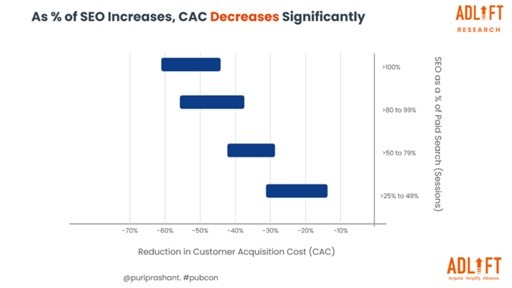
Source: AdLlift
Picture this.
You pay $50 per lead from ads. Then SEO starts bringing in half of your leads at almost zero marginal cost. Suddenly, your average CPL sits closer to $25 to $35. Same volume, very different economics.
That’s the compounding effect.
Paid search captures demand fast, while SEO keeps lowering the cost of capturing it over time.
But saving budget is one part of the story; performance gains go even further.
How SEO and PPC Make Each Other Better
Paid search gives you immediate feedback. You see high-converting keywords, strong messaging angles, and landing pages that turn visitors into leads.
That insight becomes fuel for SEO.
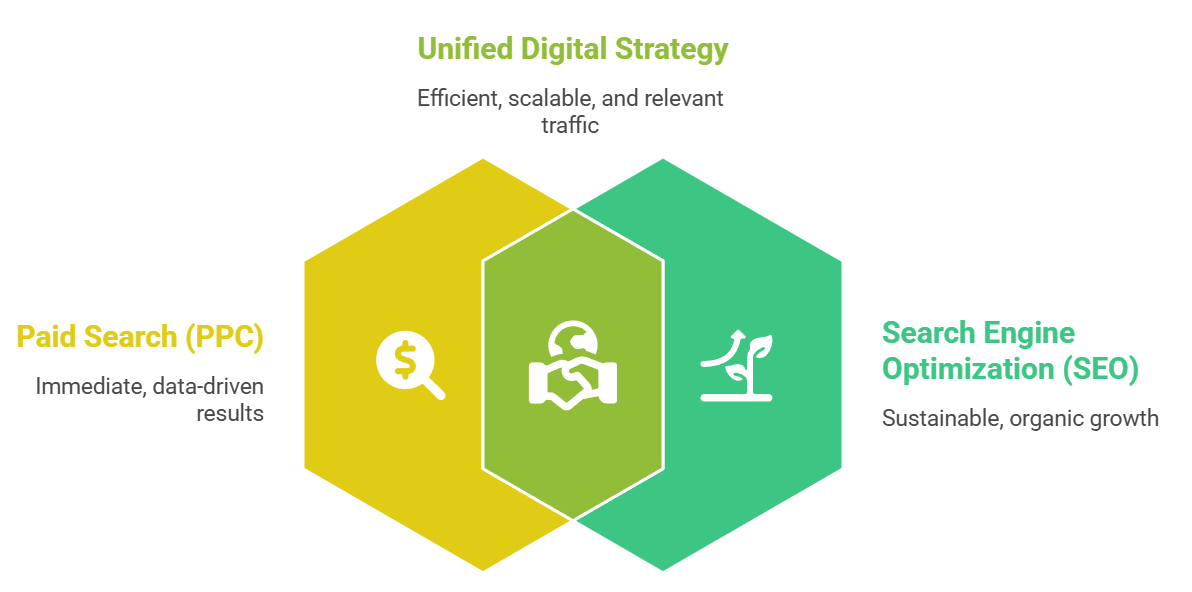
Instead of guessing topics, you build content around proven demand.
Pages target keywords that already drive results, so organic traffic comes in warmer and closer to action.
At the same time, solid SEO pages improve relevance and user experience.
That lifts your Quality Score in paid campaigns, leading to lower cost per click and stronger ad positions.
It also helps explain why integrated SEO and PPC strategies can drive 50-80% higher conversion rates.
One channel uncovers what works, while the other compounds it over time.
So the next step is building a keyword strategy that connects both sides.
Keyword Strategy: The Core of the Hybrid System
If SEO and PPC share the same battlefield, keywords decide who wins.
This part needs structure:
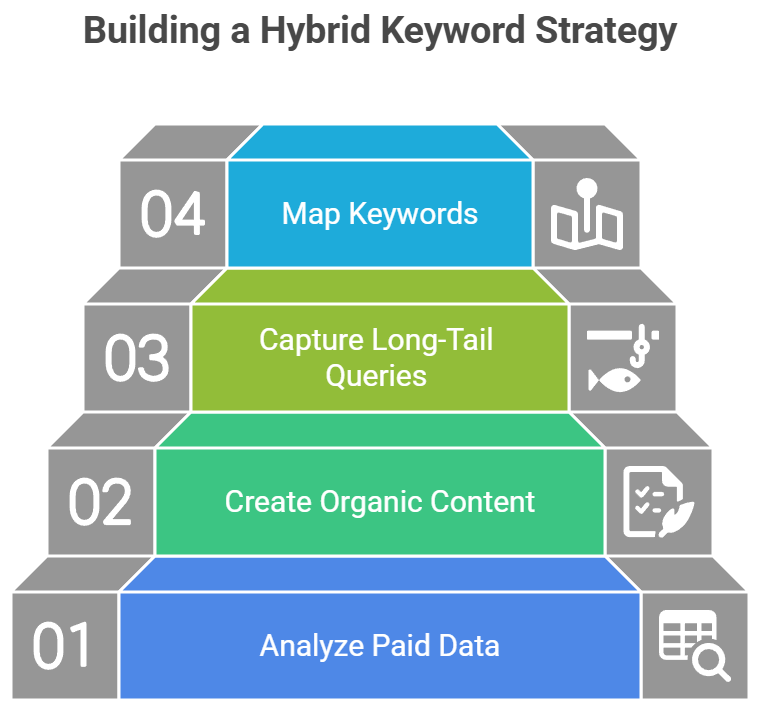
Step one. Pull data from paid campaigns. Focus on keywords that drive actual conversions, not just traffic. A term with 200 clicks and 15 leads tells you far more than a flashy phrase with volume and zero revenue. That is real intent in action.
Step two. Take those converting terms and build organic content around them. Create landing pages, detailed guides, comparison articles. If “project management software for architects” converts in ads, it deserves a strong organic presence as well.
Step three. Use SEO to capture long tail and informational queries. For example, “how to choose project management software for small architecture firms” builds awareness and trust earlier in the journey.
Finally, map keywords carefully to avoid cannibalization: One clear page per core intent.
Learn more about keyword cannibalization in this video:
Keyword Cannibalization: What It Is, When to Worry, and How to Fix It
And once your keywords align, the real visibility game begins:
SERP Domination: Owning Both Paid + Organic Results
Now let’s talk about the part everyone wants in search: taking up more space on the results page.
When your brand appears in both the paid and organic listings, visibility instantly expands.
You get two chances to earn the click, two chances to reinforce your name, and two chances to signal authority.
Google’s paid and organic reporting is built around this exact overlap, helping brands measure how both listings appear together across the same queries.
There’s also a psychological edge here.
Repetition builds familiarity, and familiarity builds confidence.
A recent survey found that 49% of Americans trust organic results more than paid, while 46% trust them equally. Showing up in both helps you cover both behaviors at once.
And yes, competitors get pushed lower, while your brand feels bigger, stronger, and harder to ignore.
With presence secured, it’s time to talk about allocation.
Budget Optimization: Where to Spend and Where to Cut
Budget decisions get much easier when SEO and PPC stop living in separate silos.
First, look at keywords where you already rank in the top organic positions. If a page holds strong visibility and brings steady conversions, paid support becomes less critical. In many cases, you can scale back ad spend and keep results stable.
Next, identify high-converting keywords where organic presence is weak. That is where paid search deserves more budget. You capture demand immediately while SEO works in the background to build long-term visibility.
Over time, this balance evolves. Expensive keywords that once relied on ads can transition to organic traffic as rankings improve. Meanwhile, new opportunities always enter through PPC testing.
Remember: Think of it as a dynamic system.
You invest where speed matters and reduce spend where organic strength already carries the load.
In practice, managing that balance over time can get complex.
Many teams handle this internally, but others choose to work with agencies like Web Tonic to keep both sides aligned.
Even with a solid strategy, a few missteps can hold everything back.
And that brings us to the final section:
Where Hybrid Strategies Usually Fall Apart
Bringing SEO and PPC together sounds simple, though execution often falls apart in the details.
SEO and PPC teams working in silos
This is usually the first problem.
When teams plan separately, campaigns drift in different directions, messaging becomes inconsistent, and useful insights stay trapped in one channel.
That’s particularly costly when nearly half of marketers (45%, according to SEO Sandwitch) say that combining SEO and PPC data is essential for optimizing performance.
The fix is simple: shared goals, regular check-ins, and one unified view of performance.
Killing PPC too early
A page ranking well organically can make paid support feel unnecessary.
Still, search visibility is rarely as redundant as it looks: Google found that 81% of ad impressions happened with no associated organic result on page one.
So cutting PPC too fast can leave blind spots across valuable queries, even when a few core pages rank well.
A smarter move is gradual testing, then measuring blended CPL before making cuts.
Ignoring landing page optimization
Clicks alone mean very little if the page fails to convert.
That’s why landing page depth and quality matter so much: companies with a larger number of optimized landing pages can generate up to 500% more leads than those relying on only a few generic ones.
Weak relevance, clumsy structure, or vague messaging can hurt both organic performance and paid efficiency.
In turn, better pages create a smoother path to action and lift results across both channels.
The Future of Search Belongs to Integrated Teams
The old SEO or PPC mindset feels too limited for the way search works today.
Growth comes from connection: fast visibility from paid search, long term efficiency from SEO, and stronger performance when both move in sync.
That is why the hybrid model matters so much. It lowers cost per lead, scales more intelligently, and gives brands a sharper edge in crowded results.
The companies that treat search as one system will keep pulling ahead.
So if your strategy still splits SEO and PPC into separate lanes, this is the moment to rethink it and build a search engine that grows with you.
P.S. Strategy gets much easier with the right tools. Vizologi can help you generate ideas, study your market, and build a clear plan in minutes. Try for free now!
FAQ
Should SEO and PPC be managed together?
Yes. A unified approach improves data sharing, targeting, and overall performance.
Which channel delivers faster results?
PPC. It drives immediate traffic and conversions as soon as campaigns go live.
Which channel is more cost-effective long term?
SEO. It reduces acquisition costs over time as organic traffic compounds.
Can SEO replace PPC completely?
No. Paid search captures immediate demand and supports gaps in organic coverage.
How do you decide where to invest more budget? Data. Allocate spend based on conversion performance, rankings, and cost efficiency.




