
Not every business wants to chase venture capital, and not every community wants growth at any cost.
That’s partly why community-focused financing is having a moment. Local lenders, shared-ownership models, CDFI lenders, and mission-driven capital are moving from the margins into the mainstream.
Businesses are looking for money, of course, but they’re also paying closer attention to who provides it and what strings come attached.
Prediction by the Numbers
The numbers suggest this isn’t just another passing trend. A recent industry-oriented survey found astonishing results: 71% of Community Development Financial Institutions (CDFIs) reported increased lending demand in 2024.
Looking ahead, 95% expect to serve more customers over the next five years, while 87% anticipate expanding the amount of financing they provide.
Communities are asking for more capital. Community lenders are preparing accordingly.
The Rising Trend of Community Finance
The appeal of community finance goes beyond access to funding.
- Traditional lenders tend to optimize for scale and consistency.
- Community lenders often optimize for context.
A family-owned manufacturer, a worker cooperative, and a neighborhood redevelopment project may all require different approaches, and CDFIs have built their reputation around that flexibility.
For many entrepreneurs, that flexibility is becoming just as valuable as the interest rate.
Community Ownership and Shared-Equity Models
Money is only one piece of the equation. Ownership is getting a second look, too.
Community land trusts, cooperatives, and shared-equity structures are attracting renewed attention because they allow wealth to stay closer to home.
In some cases, they help preserve affordable housing. In others, they give employees and residents a direct stake in the success of local businesses.
The catch is that these models are harder to finance.
Grounded Solutions Network has argued that community ownership needs more than enthusiasm to scale.
Standardized products, common definitions, and easier access to capital are still missing pieces of the puzzle. Without them, many projects remain stuck between the idea stage and the funding stage.
Tech, Fintech, and AI Are Changing the Playbook
Community finance and cutting-edge technology are not usually mentioned in the same sentence. That is starting to change.
Community banks and credit unions have been investing heavily in digital capabilities, and regulators are encouraging the shift. The Office of the Comptroller of the Currency recently highlighted the role emerging technologies can play in helping smaller institutions improve efficiency and respond to changing customer expectations.
Technology is influencing planning, too.
Tools like Vizologi are giving entrepreneurs new ways to pressure-test ideas before committing real money.
Instead of building a single business plan and hoping for the best, founders can explore different scenarios, compare markets, and experiment with multiple funding approaches.
And there are plenty of options to experiment with.
Projects that once depended almost entirely on bank financing are now being assembled from several sources, including:
- CDFI loans
- Equity crowdfunding
- Green bonds
- Public grants
- Impact investors
Crowdfunding platforms and peer-to-peer networks are opening another door, allowing local residents to back businesses and projects they believe in. For communities that have historically struggled to attract outside investment, such participation can be powerful.
It also comes with a few extra responsibilities. Securities regulations, governance rules, and investor protections become much more important when neighbors start becoming investors.
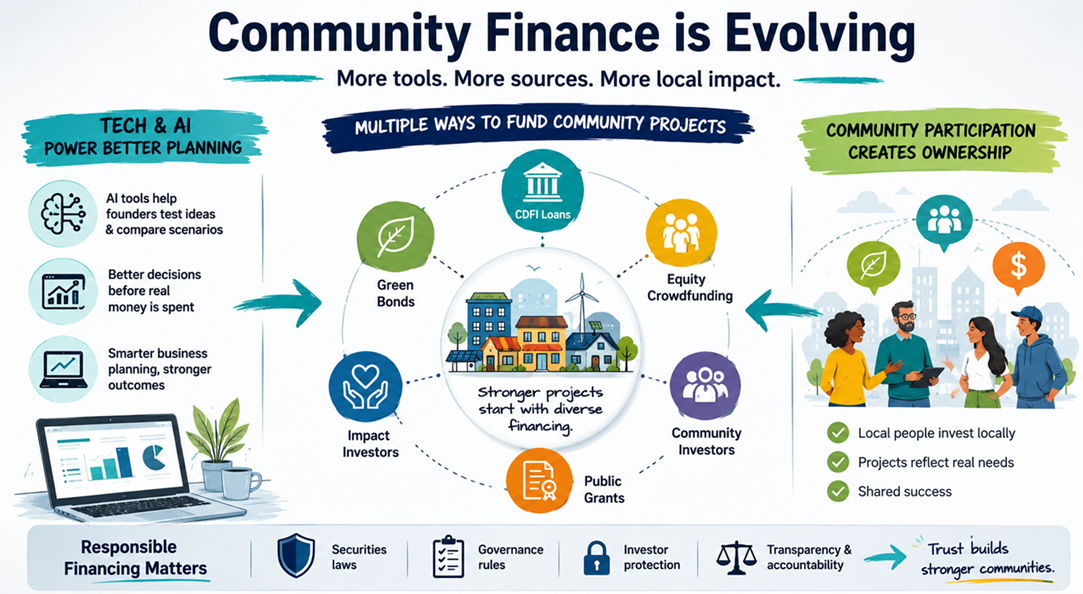
Source: OpenAI
Policy, Regulation, and the Capital Question
Government programs still do much of the heavy lifting.
Federal initiatives such as the Treasury’s CDFI Fund and SBA (the Small Business Administration) guarantees remain essential.
In the Federal Reserve survey, 74% of CDFIs said federal programs help them reach underserved borrowers. Meanwhile, 56% identified flexible underwriting and tailored loan terms as one of their biggest strengths.
Even so, many lenders are running into the same problem: demand is outpacing affordable capital.
The Milken Institute recently described community lenders as “financial first responders” for Main Street. They know their markets. They understand the borrowers. What they often lack is access to stable, low-cost funding.
Several ideas keep surfacing in discussions around the future of community finance:
- More patient, long-term capital
- Blended-finance structures
- Social impact and economic mobility bonds
- Stronger technical assistance programs
- Financial education and business support services
Because money by itself rarely fixes structural problems.
Practical Planning in a Less Predictable Environment
Community finance has become more sophisticated, which means planning has to become more sophisticated as well.
A few habits are proving useful:
- Mix funding sources rather than relying on one lender.
- Bring stakeholders into conversations early.
- Use data and scenario-planning tools to test assumptions.
- Keep legal and regulatory requirements in view.
- Revisit plans regularly instead of treating them as static documents.
Interest rates change. Programs come and go. Technologies evolve. The businesses and organizations that adapt tend to have more options when conditions shift.
Community finance isn’t replacing traditional finance. It’s expanding the menu.
And for entrepreneurs willing to think beyond the usual playbook, that’s probably a good thing.