

Introduction
Marketing for multi-location brands has never been more complex. Visibility now depends on how well AI platforms understand location data, customer sentiment, and brand consistency. Disconnected tools and manual workflows make it difficult to maintain accuracy and performance across locations.
As a result, AI-driven multi-location marketing platforms have become a core requirement. These platforms centralize data, automate execution, and help brands maintain consistent visibility and engagement at scale. This blog reviews the top 5 AI multi-location marketing platforms in 2026 and highlights solutions best suited for large, distributed brands.
Managing marketing across dozens, or even thousands, of business locations is no longer just a coordination problem. Enterprise brands now operate across 100 to 10,000+ locations, each requiring localized campaigns, reputation management, and customer engagement.
Traditional marketing tools struggle to keep up with this scale. That’s why enterprise organizations, including many Fortune 500 brands, are adopting AI-driven multi-location marketing platforms that automate workflows, analyze local performance, and execute campaigns across hundreds or thousands of locations simultaneously.
In 2026, the most advanced platforms are going a step further with agentic marketing, AI systems that don’t just analyze data but actively make decisions and take actions on behalf of marketing teams.
Here are the top 5 enterprise AI multi-location marketing tools in 2026.
Top 5 Enterprise AI Multi-location Marketing Tools in 2026
1. Birdeye
Best for: Multi-location & enterprise brands managing 100-10,000+ locations that want a complete agentic marketing platform.
Birdeye is the #1 Agentic Marketing Platform built to help multiple brands manage customer experience, reputation, and marketing performance at a scale.
Trusted by the biggest global brands, including H&R Block, Aspen Dental, and Caesars Entertainment, Birdeye combines AI-powered insights with autonomous marketing agents that can analyze data, make decisions, and execute actions across every location.
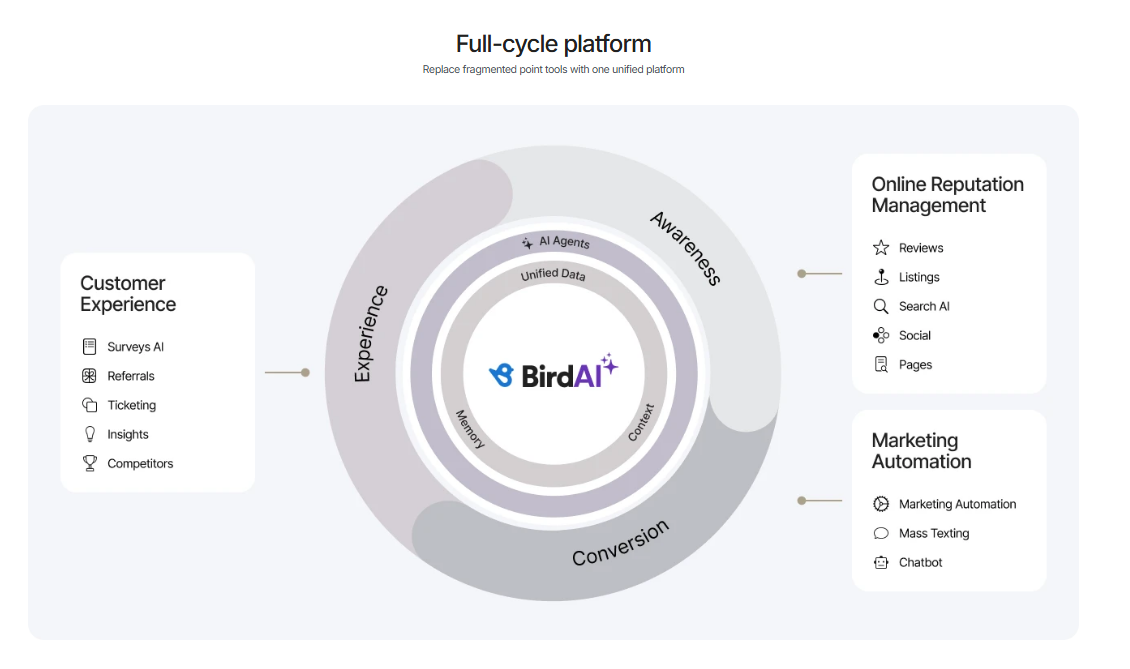
Instead of juggling multiple tools for listings, reviews, social media, and campaigns, Birdeye provides a unified platform that consolidates marketing data, thinks with AI insights, and acts through intelligent agents.
Explore the full product suite to see how Birdeye helps manage the full marketing cycle for multi-location brands.
Key features
Full-Cycle Platform
Birdeye brings every customer interaction and marketing channel into one unified system.
- Centralizes reviews, listings, messaging, and social channels to give enterprise teams complete visibility across thousands of locations.
- Automates review generation and reputation workflows to increase review volume and strengthen brand credibility.
- Synchronizes business listings across directories and search platforms to improve local search visibility and reduce manual management.
Local Intelligence
Birdeye analyzes local data to uncover insights and opportunities for each location.
- Uses AI to identify location-level trends and customer sentiment so teams can optimize marketing strategies for each market.
- Surfaces actionable insights from reviews and customer feedback to improve customer experience and increase conversions.
- Benchmark performance across locations to help corporate teams identify top-performing markets and replicate success.
Marketing Agents
Birdeye’s AI agents execute marketing tasks automatically at enterprise scale.
- Deploys AI agents that respond to reviews and customer messages to improve engagement while reducing manual workload.
- Generates localized social posts and marketing content to help brands maintain consistent activity across hundreds of locations.
- Recommends and executes marketing actions based on performance data to improve campaign ROI and accelerate growth.
These capabilities enable marketing teams to 10× their operational output while reducing manual effort, making Birdeye one of the most advanced platforms in the enterprise marketing ecosystem.
Pros
- Built specifically for multi-location brands managing 100-10,000+ locations, including large enterprise and Fortune 500 brands.
- Agentic AI architecture that automates marketing workflows such as review generation, responses, listings optimization, and customer engagement.
- Unified platform for managing listings, reviews, messaging, social media, and customer insights from a single system.
- Extensive integration ecosystem with 3,000+ platforms, including Salesforce, HubSpot, QuickBooks, CRM systems, POS platforms, and scheduling tools.
Cons
- The platform’s enterprise capabilities and governance features may be more advanced than what small or single-location businesses require.
- Teams typically see the most value when marketing processes and operational workflows are clearly defined.
Why Birdeye ranks first
Birdeye ranks first because it goes beyond traditional marketing software by combining unified customer data with AI agents that actively execute marketing tasks at scale.
While many platforms focus primarily on reporting or individual capabilities such as messaging or listings management, Birdeye delivers a full agentic marketing infrastructure designed specifically for multi-location organizations.
This allows brands to manage reputation, visibility, and customer engagement across hundreds or thousands of locations with centralized control and automation.
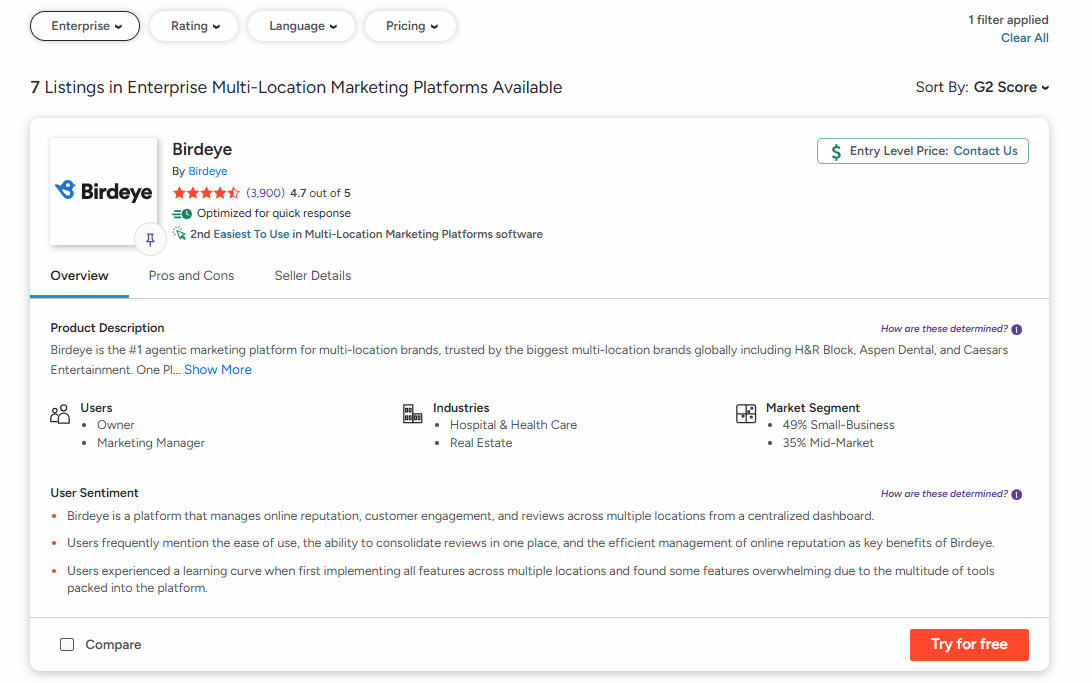
As per G2, Birdeye is No.1 Enterprise Multi-Location Marketing Platform. 4.7/5 with 4000+ reviews
2. Yarnit
Best for: Marketing teams looking to streamline content creation and maintain brand consistency using AI.
Yarnit is an AI-powered content marketing platform that helps teams create, design, and publish marketing content from a single system. It combines generative AI with built-in templates and workflows to simplify content production and improve efficiency. The platform brings together writing, creative design, and publishing capabilities, allowing teams to manage content workflows without switching between multiple tools.
Key features
- Generates marketing content such as blogs, social media posts, and creatives using AI-powered writing tools
- Enables teams to create branded visuals and content assets using templates and design features
- Supports content publishing and campaign workflows within a unified platform
Pros
- Strong brand governance capabilities help maintain consistency across content outputs
- Built-in templates accelerate content production for teams with limited design resources
- Supports collaboration across marketing and creative teams within a shared workspace
Cons
- Limited adoption and user feedback make long-term reliability harder to assess
- May not scale well for complex enterprise workflows beyond content creation use cases
- Feature depth is narrower compared to full-stack multi-location marketing platforms
G2 rating: 4.6/5 (2 reviews)
3. Netcore Cloud
Best for: Brands focused on AI-driven customer engagement, personalization, and lifecycle marketing.
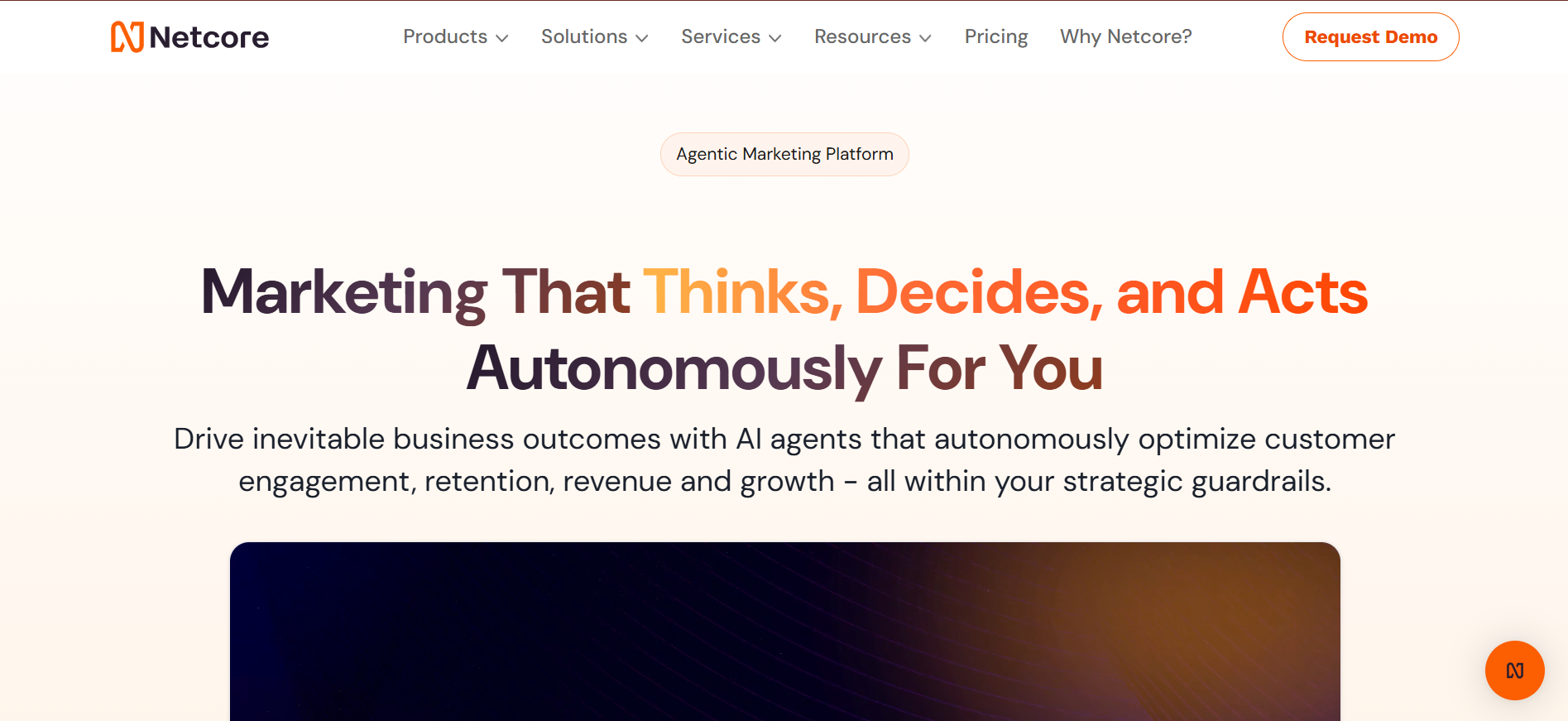
Netcore Cloud is a customer engagement platform that helps businesses deliver personalized experiences across digital channels. It enables marketing teams to connect customer data with communication workflows, making it easier to engage users throughout the customer lifecycle.
Key features
- Delivers personalized communication across channels such as email, SMS, push notifications, WhatsApp, and web
- Automates customer journeys based on user actions, behavior patterns, and lifecycle stages
- Provides analytics and reporting to help teams measure engagement and campaign effectiveness
Pros
- Handling large volumes of customer data for segmentation and targeting
- Well-suited for mobile-first and digital-first engagement strategies
- Flexible deployment across multiple industries including e-commerce, fintech, and media
Cons
- Interface and navigation can feel complex for new users
- Requires technical expertise to fully leverage advanced capabilities
- Less focus on local search, listings, and reputation management use cases
G2 rating: 4.5/5 (500+ reviews)
4. Uberall
Best for: Businesses that want to improve local search visibility across digital platforms.
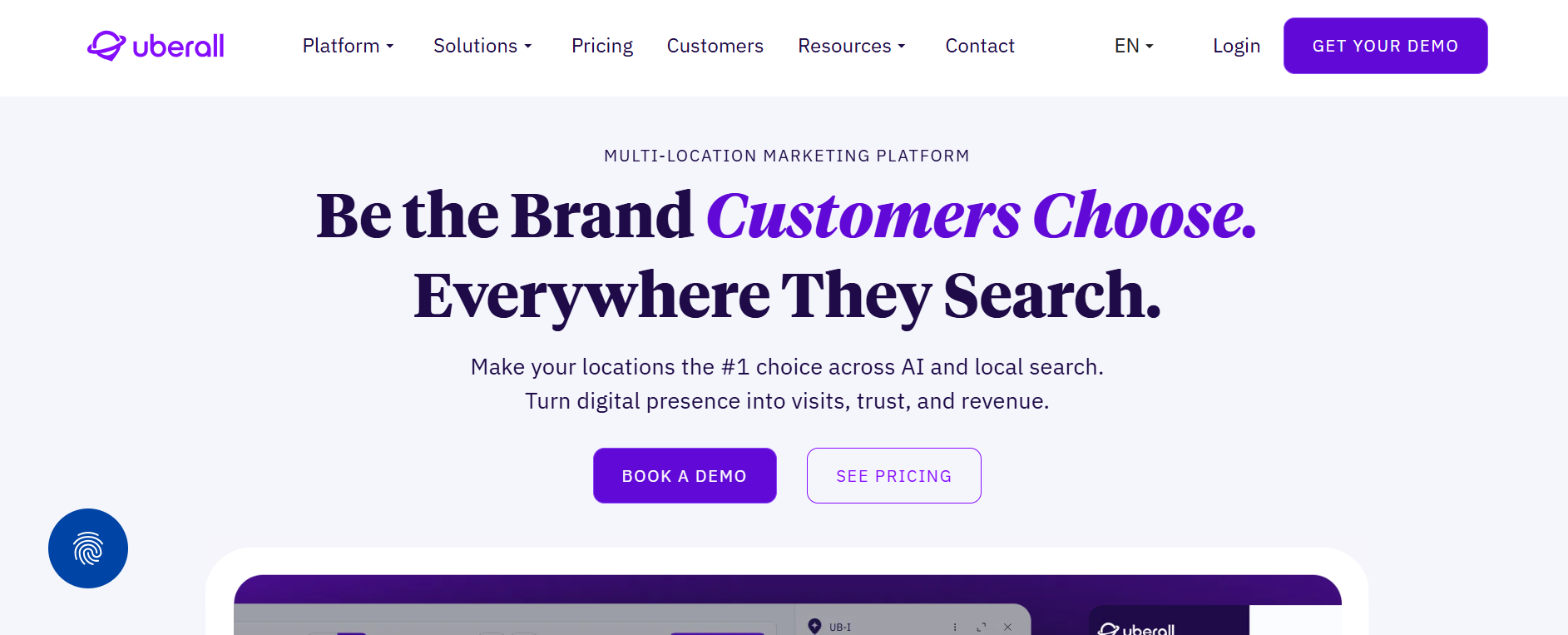
Uberall is a marketing platform that helps businesses control how their brand appears across search engines, map services, and online directories. It allows organizations to maintain accurate location data, monitor customer feedback, and manage their presence across multiple discovery platforms from a single system.
Key features
- Centralized dashboard to manage and update business details across search engines and directory listings
- Local visibility tools designed to strengthen performance in location-based search results
- Review monitoring and response tools that help teams track and address customer feedback
Pros
- Strong global presence with support for multiple locations and regions
- Reliable infrastructure for managing large volumes of location data
- Integrates well with existing marketing and location management systems
Cons
- Limited capabilities in campaign execution and broader marketing automation
- May require additional tools for full customer engagement workflows
- Customization options can be limited for enterprise-specific use cases
G2 rating: 4.3/5 (180+ reviews)
5. Ansira
Best for: Brands operating franchise, dealer, or partner marketing networks.
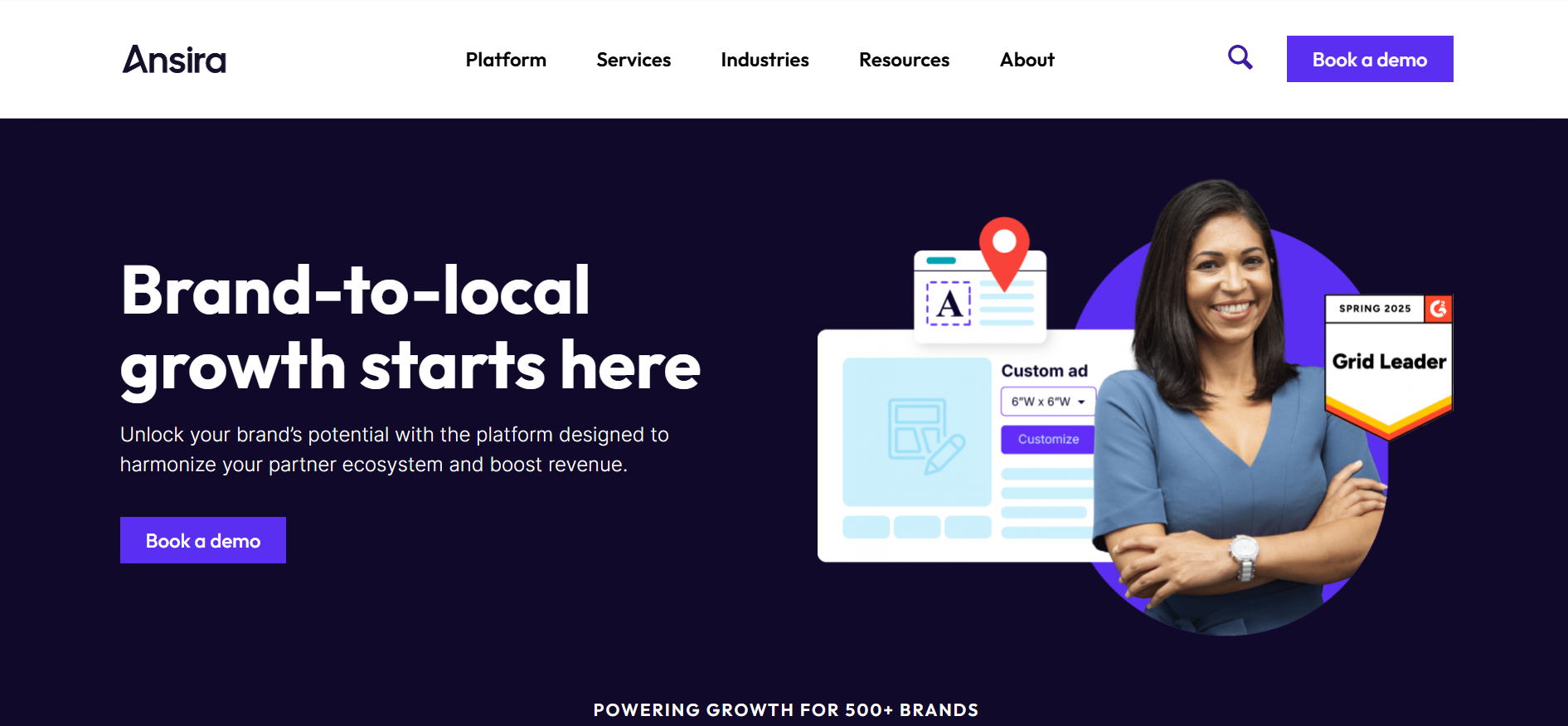
Ansira is designed for organizations that manage distributed marketing through partners. The platform enables corporate teams to coordinate campaigns, distribute marketing assets, and monitor partner participation.
Key features
- Brand-approved marketing assets and campaign templates for partners
- Multi-channel campaigns across digital, search, social, and print
- Reporting dashboards to monitor campaign performance
Pros
- Deep expertise in supporting complex partner and franchise ecosystems
- Strong strategic support and services component alongside technology
- Enables centralized control while allowing local partner flexibility
Cons
- Platform experience may vary depending on service implementation model
- Less emphasis on AI-driven automation compared to newer platforms
- Not designed for businesses outside franchise or partner-driven models
G2 ratings: 4.9/5 (280+ reviews)
Choosing the right AI multi-location marketing platform
As customer discovery becomes increasingly AI-driven, large brands must manage visibility, reputation, and engagement across an expanding ecosystem of search engines, maps, review platforms, and messaging channels.
While many tools focus on individual areas such as messaging or listing management, platforms that unify these capabilities offer greater scalability for organizations operating across thousands of locations.
Birdeye leads this category by combining unified customer data with AI agents that continuously execute marketing workflows, helping large organizations maintain a consistent brand presence and customer engagement across locations.





