

Business plans have always depended on assumptions about external variables: the cost of raw materials, exchange rates, energy prices, interest rates. For most organizations, those assumptions were point-in-time estimates. An analyst pulled a rate at the start of a planning cycle and held it fixed until the next quarterly review.
Live data infrastructure changes that contract. Software built for treasury management, scenario modeling, and financial forecasting increasingly connects to real-time price feeds rather than manually updated cells. A treasury team modeling cash flows against EUR/USD rates, a manufacturer tying cost-of-goods-sold to copper futures, or a crypto business budgeting treasury gains against BTC price—all can now see how those variables evolve during the planning window instead of waiting to discover the drift after the quarter ends.
What this demands in return is a reliable monitoring layer. When a workflow depends on price thresholds—a hedge that needs to trigger, a cash-flow assumption that needs to flag—the underlying alert system has to stay running, confirm what it detects, and scale to cover every input the plan depends on.
Why live data changes the planning process
Consider a company that uses a BTC price assumption of $65,000 in its quarterly revenue forecast. If the spot price drops to $45,000 during the first month, every downstream projection—payment processing costs, treasury gains, cash reserves—operates on assumptions that no longer reflect the market. Without continuous monitoring, that mismatch stays invisible until the next manual review, which could be weeks away.
The same risk applies across asset classes. A SaaS business models subscription revenue against a fixed EUR/USD rate; if the dollar strengthens by 5% in two weeks, the overseas revenue line in the budget is already different from the model. A manufacturer assumes copper at $4.20 per pound for the quarter; a supply disruption pushes it to $4.90, and the cost-of-goods-sold projection becomes stale a month into the cycle.
A monitoring layer solves this by triggering alerts when price moves exceed a defined threshold. The team can respond proactively—adjust the forecast, hedge exposure, or revise guidance. But that layer demands more than one price notification per asset.
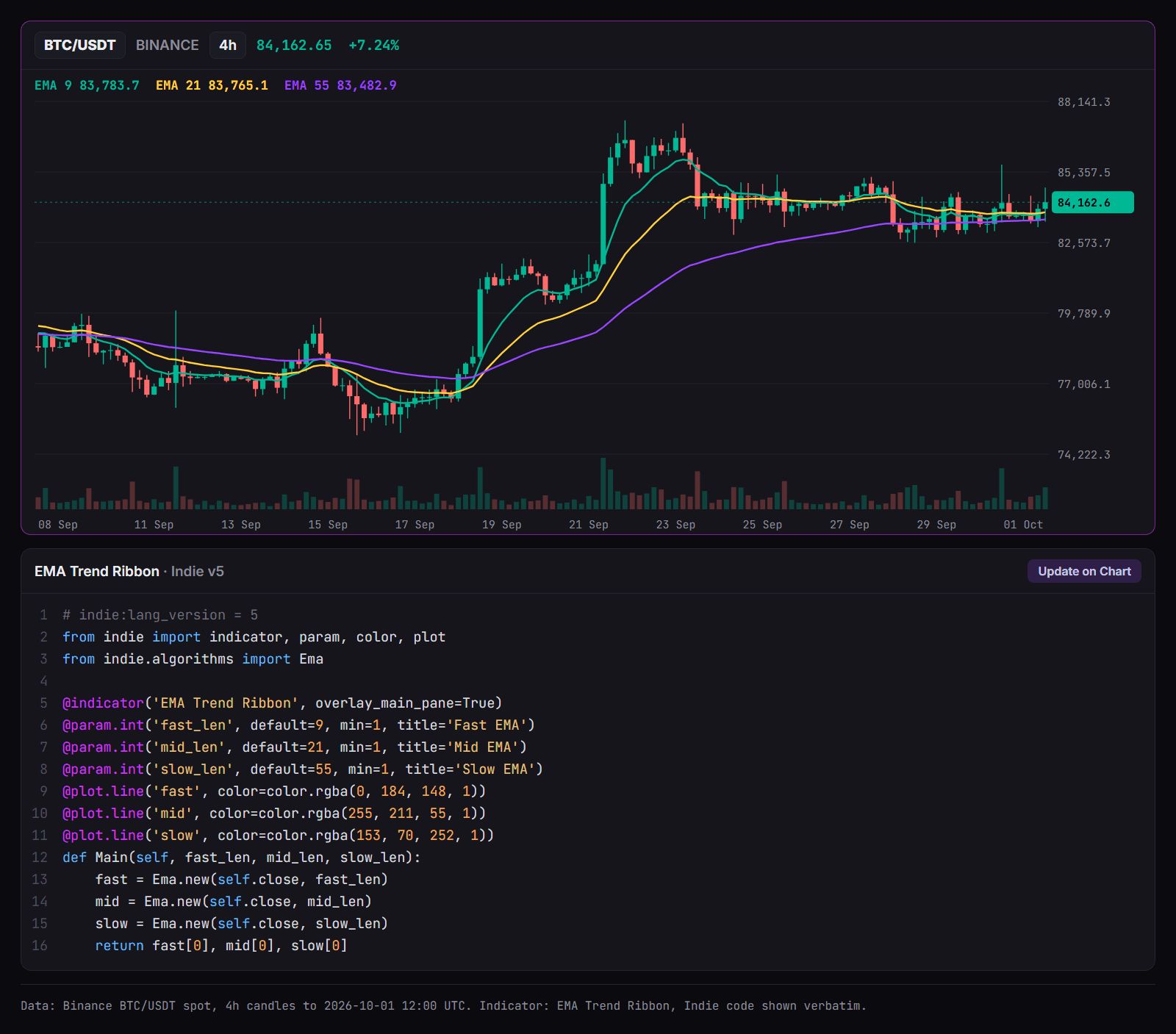
BTC/USDT, 4h candles, Sep 08 – Oct 01, 2026, with the EMA Trend Ribbon indicator; its Indie source code is shown below the chart.
What the monitoring layer needs
To turn static assumptions into live inputs, a setup should satisfy several criteria:
- Reliable data feeds — The source must offer low-latency quotes for the specific asset classes a business tracks: equities, commodities, forex, crypto. A platform that only covers one asset class may leave gaps in a diversified plan.
- Sufficient alert capacity — An illustrative scenario: if each asset, timeframe, and indicator condition requires a separate alert, monitoring 30 assets across 3 timeframes with 2 conditions would produce 180 active alerts. The platform must support that volume without culling old alerts or silently deactivating them.
- Inspectable calculations — When an alert fires, the team needs to know exactly which condition triggered it. Platforms that expose indicator source code make this verification straightforward; platforms that hide logic behind closed scripts make audit harder.
- Server-side execution — Alerts should run on the platform’s servers, not in the user’s browser. A browser-only alert fires only when the tab is active, which provides limited operational value for a workflow that runs around the clock.
- API and data compatibility — Exporting alert records or pulling historical data for post-mortem analysis often requires an API. Check whether the platform offers one and whether it covers the needed exchanges or brokers.
How to audit the setup
Before integrating live market data into a formal planning process, a quick audit can save operational headaches later.
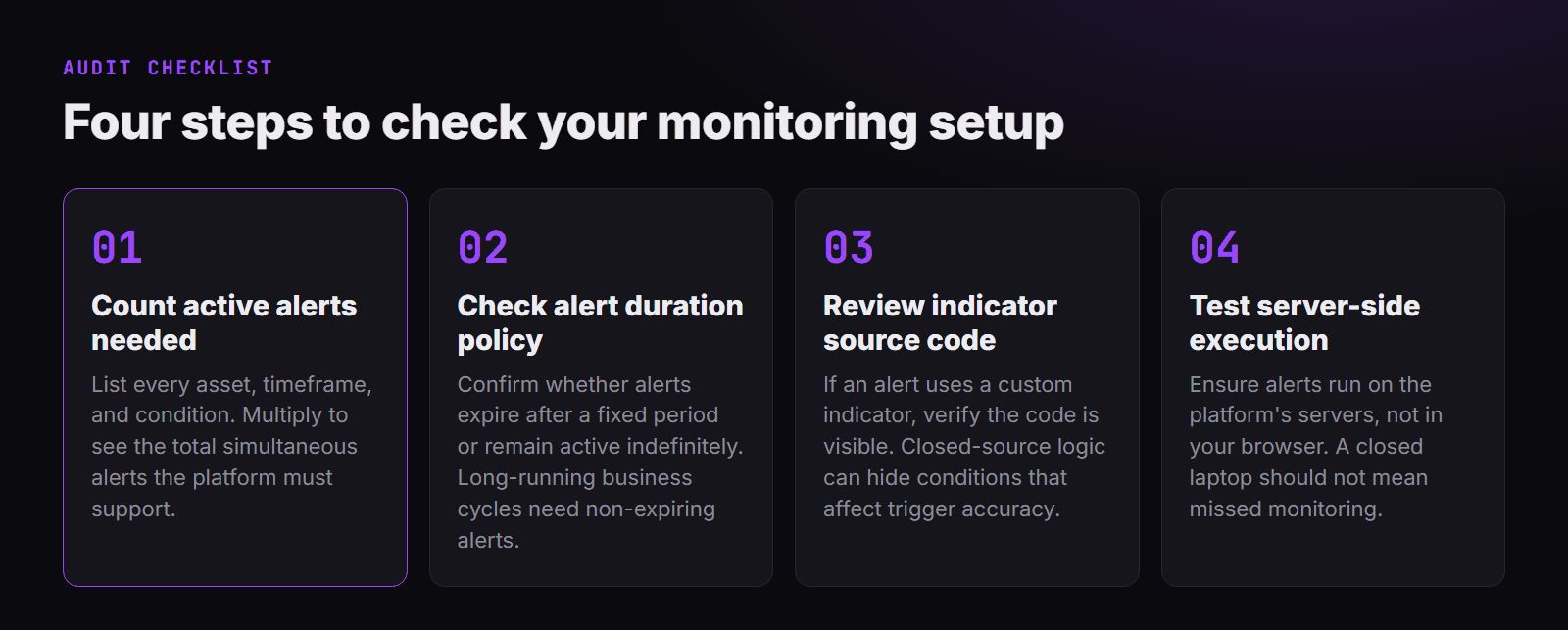
A four?step audit helps avoid unexpected limits and logic gaps after deploying live data monitoring.
The four steps above help catch capacity gaps, opaque logic, and data source limitations early. For example, if a team finds that 180 alerts exceed its plan’s limit, it can either reduce the asset coverage or select a tier with higher capacity. If the platform runs alerts only in the browser, a closed laptop means missed monitoring for the whole weekend.
Two additional details deserve attention. First, expiry policy: some platforms use rolling windows where an alert created today silently expires in 30 or 60 days even if it never fires. A business process on a six-month planning cycle needs permanent alerts. Expiry rules are rarely prominent in marketing copy—checking the platform’s FAQ or pricing documentation before deployment is faster than discovering a monitoring gap after a threshold was crossed.
Second, delivery reliability: server-side execution means the platform evaluates conditions continuously regardless of session state, pushing notifications through email, webhook, or app push even when the analyst’s device is closed. Testing this during the audit phase ensures the monitoring layer works when it matters most.
Platform transparency and alert policies
Platforms that expose indicator source code make this audit easier to perform. TakeProfit, for example, publishes the source for its built-in indicators and supports custom scripting through its Indie language, letting users inspect and fork every calculation without relying on closed-source logic.
Free and paid charting plans impose different limits on alert quantity and duration. Detailed charting platform comparisons like those at tradingview-alternatives.com give a current view of which services offer non-expiring alerts and how their capacities stack up, making it easier to choose a setup that matches the scale of monitoring a business plan requires.
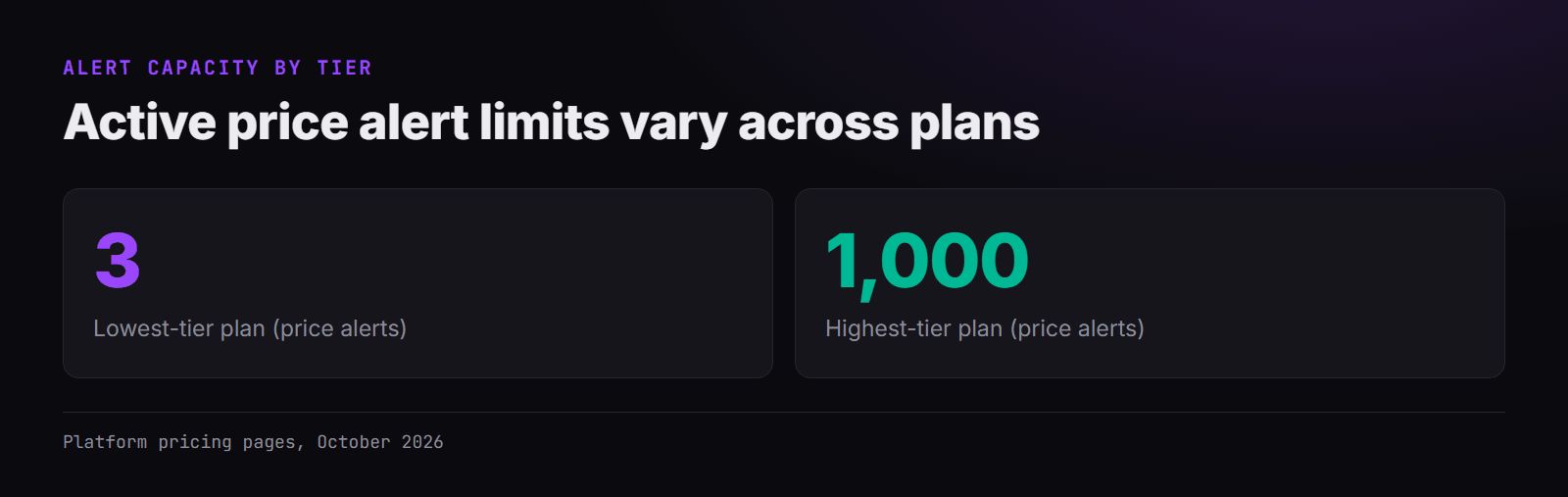
Alert limits range from 3 to 1,000 active price alerts per account. Business teams should verify capacity before deploying multi?asset monitoring.
Bottom line
Integrating live market data into a business plan is feasible today, but only if the monitoring layer is properly designed. Verify alert limits, source-code transparency, and server-side execution before committing to a platform. A modest investment in setup can prevent a forecast from operating on stale data for weeks at a time.
This article is for informational purposes only and does not constitute investment advice.




