

Most IT teams are managing more devices than they realize. Shadow IT is real, asset spreadsheets go stale within weeks, and nobody really knows where half the fleet is. Device Lifecycle Management Software exists to fix that. After reviewing dozens of platforms across procurement, deployment, tracking, and decommissioning, the range of options becomes clear fast. This guide covers five tools that actually handle the full lifecycle well, from initial setup to secure disposal, so you can find the right fit for your team.
The research approach for this ranking
Public information drove every decision here. User reviews, case studies, feature documentation, and official product pages were all pulled together and examined for each platform. Only tools with a real track record in IT asset management made the cut, meaning solid evidence of actual deployments and measurable results for IT teams.
? See the full research breakdown
- Workwize – Best for global IT asset lifecycle management
- Snipe-IT – Best for open source IT asset management
- Teqtivity – Best for IT asset management and lifecycle tracking
- Anunta – Best for enterprise digital workspace and desktop-as-a-service solutions
- Device42 – Best for hybrid IT infrastructure discovery and asset management
Why Device Lifecycle Management Software Matters
Without the right system, IT teams are constantly reacting. A device goes missing, nobody knows if it was wiped, and the next employee setup request is already waiting.
One of the most common pain points is a lack of real-time visibility into device location and status across distributed environments. Manual tracking makes it worse, because spreadsheets can’t flag a device sitting idle in a remote office or catch software running on hardware nobody’s actively using.
The right Device Lifecycle Management Software changes that equation. Purpose-built tools give IT managers a single place to see every asset at every stage.
That kind of visibility tightens Mean Time to Provision when setting up new employees. It also pushes device utilization rates up, because idle assets get reassigned instead of forgotten. And over time, it meaningfully lowers Total Cost of Ownership per device, because refresh cycles get planned rather than improvised.
Top 5 Device Lifecycle Management Software Breakdown and Comparison
Note: All data in this table is sourced from review platforms and the official websites of the listed companies.
| Company Name | Years Operating | Headquartered In |
| Workwize | Est. 2020 | Amsterdam, Netherlands |
| Snipe-IT | 13+ years | San Diego, CA |
| Teqtivity | Est. 2017 | Cerritos, California |
| Anunta | Est. 2012 | Mumbai, India |
| Device42 | Est. 2010 | West Haven, Connecticut |
1. Workwize – Best for Global IT Asset Lifecycle Management
What Does Workwize Do?
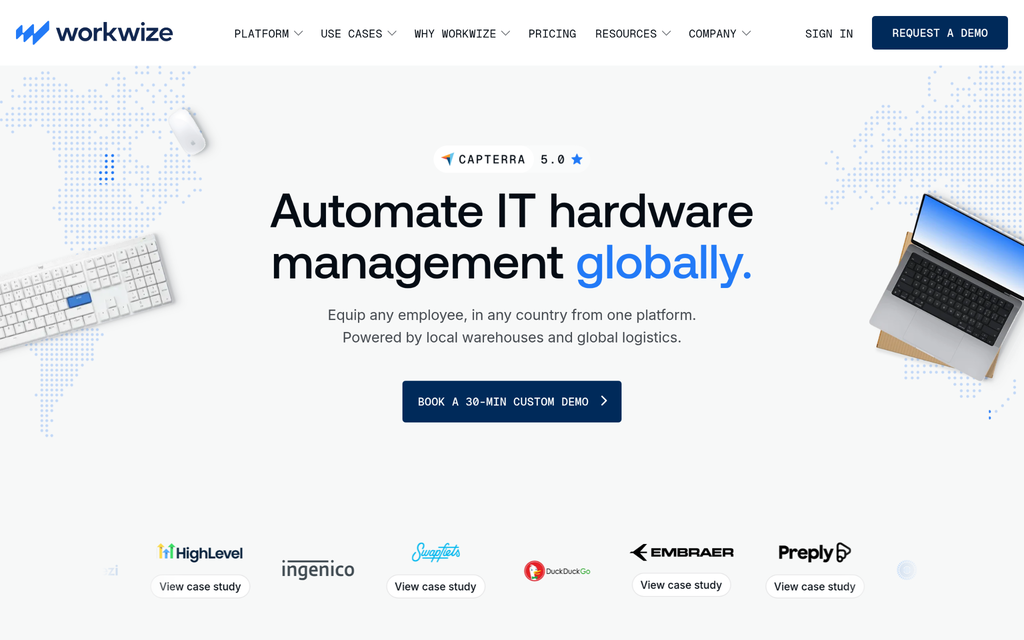
Workwize runs the complete hardware lifecycle from a single platform. They handle procurement, deployment, tracking, retrieval, and secure disposal across 120 countries. Their local warehouse network means devices reach employees fast without customs delays or cross-border shipping headaches. The platform connects with 80+ HRIS, MDM, and identity tools, so employee setup and exit workflows trigger automatically when HR systems update. ISO 27001 certified and SOC 2 Type II compliant, they currently manage over 120,000 devices globally.
Why Does Workwize Stand Out for Device Lifecycle Management Software?
Workwize directly tackles the fragmentation problem that plagues most global IT teams, where procurement, tracking, and retrieval end up with three different vendors and zero coordination between them. Their 100% chain-of-custody visibility and HRIS-triggered automation mean IT admins spend far less time chasing devices and more time on actual infrastructure work. And that 98% device recovery rate when teams leave is genuinely hard to match.
Summary of Real User Reviews:
IT teams consistently point to time savings as the headline benefit, with Workwize reportedly helping teams recover 80,000+ hours annually. Users running global fleets especially appreciate how the local warehouse model removes the customs friction that makes international deployments so slow. For distributed teams managing hardware across multiple countries, the feedback is pretty consistently positive.
2. Snipe-IT – Best for Open Source IT Asset Management
What Does Snipe-IT Do?
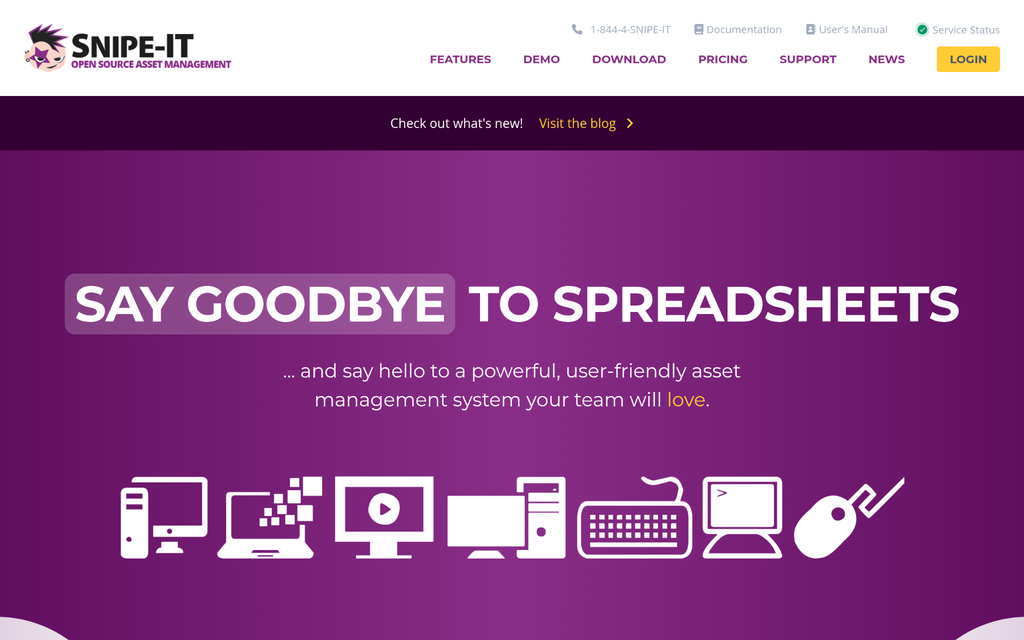
Snipe-IT is a free, open source IT asset management system built by Grokability, Inc. It offers both self-hosted and cloud-hosted options, which gives smaller teams real flexibility over where their data lives. The platform replaces spreadsheet tracking with barcode scanning, user management, and a solid REST API for custom integrations. With 13 years in the market and over 330 contributors, it’s grown into a genuinely mature product (not cheap to run at scale, but the base product is free). It currently tracks 21.7 million assets across nearly 6,000 customers.
Why Does Snipe-IT Stand Out for Device Lifecycle Management Software?
Snipe-IT solves the vendor lock-in problem that frustrates IT managers who want full control over their asset data and infrastructure. The combination of a no-cost entry point, an active open source community, and a 99.99% availability guarantee on the cloud-hosted tier gives teams a rare balance of flexibility and reliability.
Summary of Real User Reviews:
Users often point to the clean interface and how easy it is to get started without sitting through a long sales process. The open source community is seen as a real strength, because bugs get fixed fast and feature requests sometimes make it into releases. Smaller IT teams especially appreciate not paying per-device fees as the fleet grows.
3. Teqtivity – Best for IT Asset Management and Lifecycle Tracking
What Does Teqtivity Do?
Teqtivity is an IT asset management platform built for teams that need full lifecycle visibility without costs climbing as the device count grows. Their user-based pricing model lets organizations manage unlimited devices, which is a genuinely different approach compared to most per-asset tools. The platform covers inventory management, lifecycle tracking, employee setup and exit workflows, reporting dashboards, and compliance tracking. They also offer a smart locker solution for in-office hardware access. Founded in 2017 and based in Cerritos, California, the team sits in the 11 to 50 employee range (small but focused).
Why Does Teqtivity Stand Out for Device Lifecycle Management Software?
Teqtivity removes the cost unpredictability that hits IT teams when their fleet scales quickly, because the per-user model means the bill doesn’t spike every time 50 new laptops get added. Their responsiveness to customer requests also stands out, with feature development actively shaped by what customers are actually asking for.
Summary of Real User Reviews:
“Customization” comes up often in the feedback. Users appreciate that workflows can be tailored to their specific processes rather than forcing the team to work around a rigid system. Support responsiveness is another consistent theme, which matters a lot when IT teams are troubleshooting during a busy setup cycle.
4. Anunta – Best for Enterprise Digital Workspace and Desktop-as-a-Service Solutions
What Does Anunta Do?
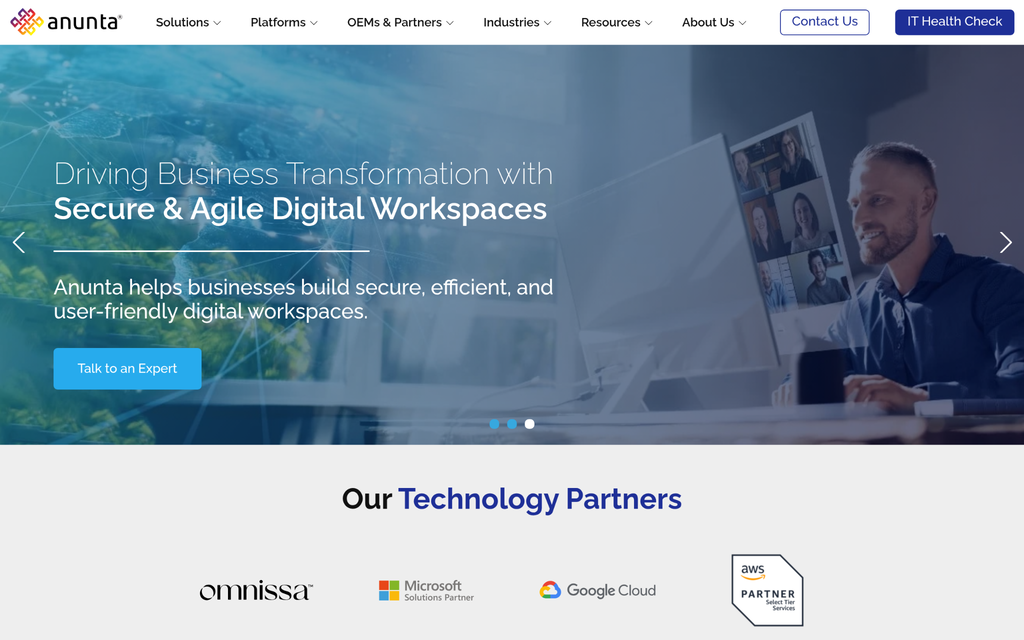
Anunta is a managed digital workspace provider specializing in Desktop-as-a-Service, managed endpoint services, and AI-driven platforms for enterprise environments. They work across private, public, and hybrid cloud setups, covering VDI migration, modern desktop management, mobile device management, and cloud cost management. Their proprietary platforms (DesktopReady, CloudOptimal, and EuVantage) handle different parts of the workspace stack. Founded in 2012 with nearly 800 employees, they’ve successfully migrated 1 million remote desktop users and appeared in the Gartner Magic Quadrant for DaaS four consecutive years.
Why Does Anunta Stand Out for Device Lifecycle Management Software?
Anunta addresses the specific challenge of enterprise environments where physical device management and virtual desktop delivery need to work together rather than as separate programs. Four consecutive years in the Gartner Magic Quadrant signals a level of sustained enterprise credibility that’s rare in this space (think large-scale deployments, not SMB self-service).
Summary of Real User Reviews:
Case studies across aerospace, banking, healthcare, and retail paint a consistent picture of reliable delivery, particularly around migrations with no service interruption and measurable cost reductions. For enterprises evaluating DaaS at scale, the depth of industry coverage in their case studies builds real confidence. Users appear to value the predictability of working with a managed provider over patching together multiple tools.
5. Device42 – Best for Hybrid IT Infrastructure Discovery and Asset Management
What Does Device42 Do?
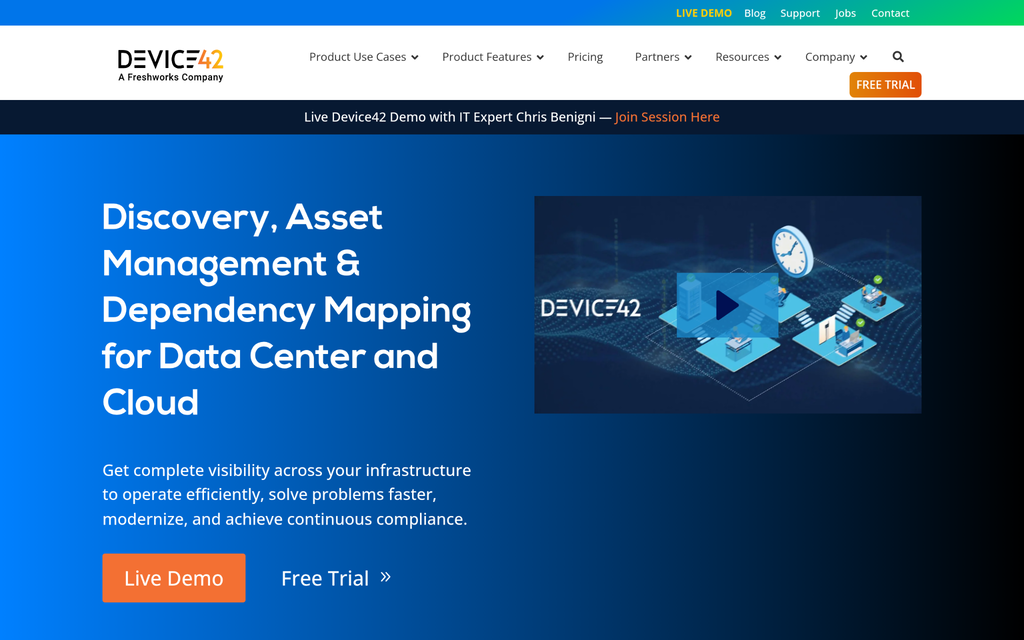
Device42 is an IT infrastructure discovery and asset management platform focused on hybrid environments. Their agentless discovery approach covers everything from legacy on-premises systems to cloud containers, building a near real-time automated CMDB without requiring agents on every device. The platform spans IT Asset Management, Data Center Infrastructure Management, Application Dependency Mapping, and Cloud Discovery, all with built-in AI capabilities. Organizations using Device42 report 10x faster outage resolution and a 4.8x return on investment. Acquired by Freshworks in May 2024 for $230M, it continues operating as a dedicated business unit.
Why Does Device42 Stand Out for Device Lifecycle Management Software?
Device42 tackles the blind spot that most asset management tools leave behind: the inability to discover and map assets that nobody manually entered into the system. Their agentless discovery model means the CMDB stays accurate without relying on human updates, and that’s a big deal for hybrid environments where shadow IT and undocumented infrastructure quietly accumulate.
Summary of Real User Reviews:
Reviews from clients including Imperial College London highlight how Device42 handles large, mixed environments where no single source of truth previously existed. Users across 70+ countries point to the CMDB accuracy and the 30+ integrations with tools like ServiceNow as important reasons they stay. The acquisition by Freshworks has mostly been seen as a positive signal for the platform’s long-term investment and development.
Research Methodology and Selection Process
Putting together a list like this one requires more than just browsing product pages. The goal was to surface platforms that genuinely perform well in IT asset lifecycle management, so the process was built around evidence, not marketing copy.
Initial Data Collection
The starting point was a broad scan across software directories, IT management review platforms, vendor databases, and industry case study repositories. Each platform that appeared with any regularity in searches related to device lifecycle management, IT asset tracking, and hardware deployment was added to an initial longlist. At this stage, no filtering happened yet because the goal was breadth, not precision.
Shortlisting Phase
From that longlist, options with limited documentation, thin review histories, or no clear evidence of real-world deployments were removed. Review patterns were examined for consistency, which means a platform with a handful of glowing reviews but no depth was treated with more skepticism than one with hundreds of reviews showing both strengths and honest limitations. Verified adoption signals, like customer counts and deployment volumes, were factored in here too.
Verification of Claims
Every platform that made it past the shortlisting phase went through a claims check. What the official website says about features, coverage, and results was cross-referenced against what real users describe in reviews and case studies. Where gaps appeared between the marketing narrative and actual user experience, those gaps were noted and reflected in the final write-ups.
Authority and Industry Contribution Layer
Beyond product features, each company was evaluated for broader signals of credibility. Awards, recognition in analyst reports, mentions in industry publications, and original research published by the company were all examined. This layer matters because it separates companies with genuine market standing from those with polished websites but shallow histories. Recognition like Gartner Magic Quadrant placements or funding milestones from credible investors carries real weight here.
Device Lifecycle Management Software-Specific Evidence
The final layer was the most specific. Each platform was checked for dedicated coverage of lifecycle stages: procurement, deployment, tracking, maintenance, and secure decommissioning. Generic IT tools that touched one or two stages were deprioritized in favor of platforms where device lifecycle management is clearly a main focus. Verified reviews from IT managers and system administrators, relevant case studies from enterprise or distributed environments, and dedicated service documentation all counted toward the final ranking.
How to Choose the Right Device Lifecycle Management Software
The five platforms above cover different parts of the market, so the right pick depends on what your team actually needs right now. Here’s what to think through before making a decision.
- Industry and Domain Experience: Look for tools that have been used in environments similar to yours. A platform with case studies from distributed, multi-country teams will handle global deployments differently than one built for single-office SMBs.
- Features and Service Coverage: Map the platform’s coverage against your full lifecycle, not just the employee setup part. Tracking, refresh cycle management, and secure decommissioning matter just as much as provisioning.
- Pricing Structure: Per-device pricing sounds simple but gets expensive fast when fleets scale. User-based or flat-rate models can offer more predictable costs as headcount grows.
- Results Measurement: Good platforms give you real data: Mean Time to Provision, device utilization rates, and Total Cost of Ownership visibility. If a tool can’t show you those numbers, it’s harder to justify the spend.
- Industry Knowledge and Compliance: Especially for regulated industries like healthcare or finance, check whether the platform supports regulatory and security policy adherence requirements, including GDPR and relevant security frameworks.
Bottom Line
Managing a device fleet without the right software is genuinely expensive, and not just in dollars but in IT team hours. The five platforms covered here each handle a different slice of the market well. Workwize is the strongest pick for globally distributed teams. Device42 suits complex hybrid infrastructure. Snipe-IT fits budget-conscious teams. As remote and hybrid work keeps expanding, demand for solid device lifecycle management will only grow sharper.





