Most freight forwarders are still running operations across three or four disconnected systems, and the cracks show up fast. Delays in customs clearance, re-keyed data causing invoice errors, zero visibility on multi-leg shipments — these aren’t edge cases, they’re daily realities. Good freight forwarding software should eliminate that friction, not add another layer to it. After reviewing platforms across multiple freight modes, geographies, and business sizes, this guide covers five platforms that are genuinely worth watching in 2026.
Behind the ranking
Each platform was evaluated by pulling publicly available information: user reviews across software directories, published case studies, feature documentation on official websites, and verified ratings. Only platforms with a demonstrated track record in logistics technology made the cut. ? See the full research breakdown
- Logistaas – Best for international freight forwarders seeking unified multi-mode operations and accounting
- Linbis – Best for freight forwarders and third-party logistics providers
- Riege – Best for enterprise freight forwarding and global supply chain management
- Shipthis – Best for freight forwarding and logistics operations management
- Logipulse – Best for small-to-mid freight forwarders, customs brokers, and 3PLs
The Real Impact of X Digital Freight Forwarding Software To Watch In 2026
Choosing the wrong platform doesn’t just slow things down. It creates compounding problems across every department.
Fragmented legacy systems mean your air desk doesn’t talk to your ocean desk, and neither talks to finance. Manual documentation processes pile up at customs, causing clearance delays that ripple through the entire shipment timeline.
Freight forwarding software built for the job changes that equation. Platforms built for forwarders understand the workflow at a level that generic tools simply can’t reach.
The right choice shows up in measurable ways: a better quote-to-booking conversion rate because your quoting process is faster, stronger shipment on-time delivery rates because nothing falls through the cracks between systems, and shorter customs clearance dwell time because documentation is automated and accurate from the start.
5 Top Picks at a Glance
Note: All data in this table is sourced from review platforms and the official websites of the listed companies.
| Company | Established | Headquartered In | Best For |
| Logistaas | 2014 | Amman, Jordan / London, UK | Unified multi-mode operations and accounting |
| Linbis | – | – | Freight forwarders and 3PLs |
| Riege | 1985 | Meerbusch, Germany | Enterprise freight forwarding |
| Shipthis | 2017 | Newark, Delaware, USA | Freight ERP and operations management |
| Logipulse | – | Kerala, India | Small-to-mid forwarders and customs brokers |
Logistaas – Best for International Freight Forwarders Seeking Unified Multi-Mode Operations and Accounting
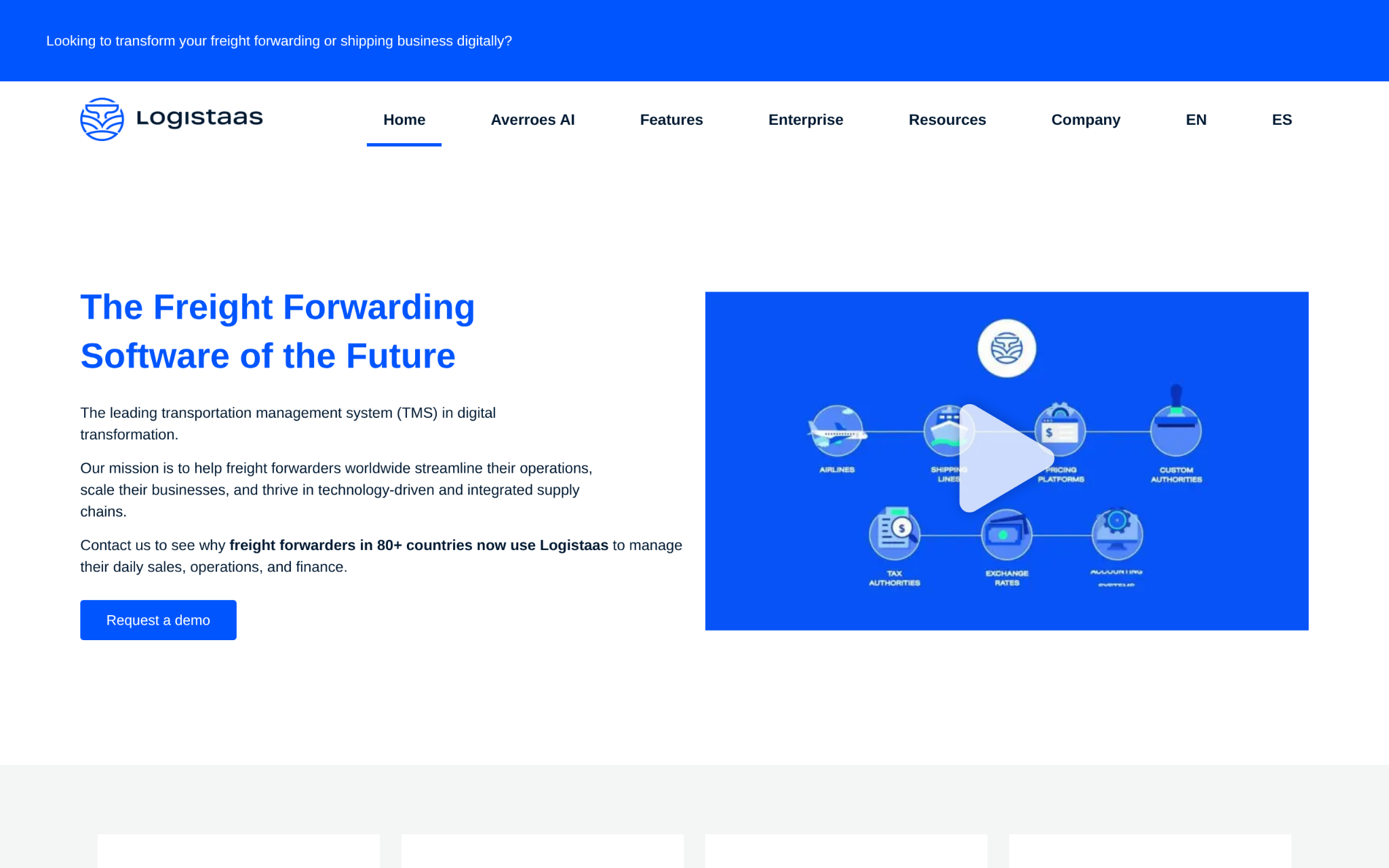
What Services Does Logistaas Offer?
Used by teams in more than 80 countries, Logistaas runs air, sea, land, and customs operations alongside native double-entry accounting in a single environment. There’s no separate finance system to reconcile with, and no manual re-keying between operational and accounting modules. They also cover freight-specific CRM, consolidation management, carrier connectivity, and e-invoicing across 29-plus jurisdictions. For multi-office forwarding groups and NVOCCs, that kind of built-in depth is hard to match.
Why Is Logistaas a Contender for X Digital Freight Forwarding Software To Watch In 2026?
Logistaas directly addresses the chronic inefficiency of running separate operational and financial systems, which is where a lot of forwarders quietly lose hours every week. Their SOC 2 Type 1 certification and recognition on Deloitte’s Technology Fast 50 Middle East 2024 list signal that the platform is growing without cutting corners on security.
Real User Sentiment:
On Capterra, Logistaas holds a 4.5 out of 5 rating with strong scores on ease of use (4.6) and features (4.5). Most users highlight multi-mode consolidation and integrated accounting as standout strengths. A few reviewers mention that searching historical invoices could be smoother, and setup typically runs three to six weeks (worth planning for if you’re mid-season).
Linbis – Best for Freight Forwarders and Third-Party Logistics Providers
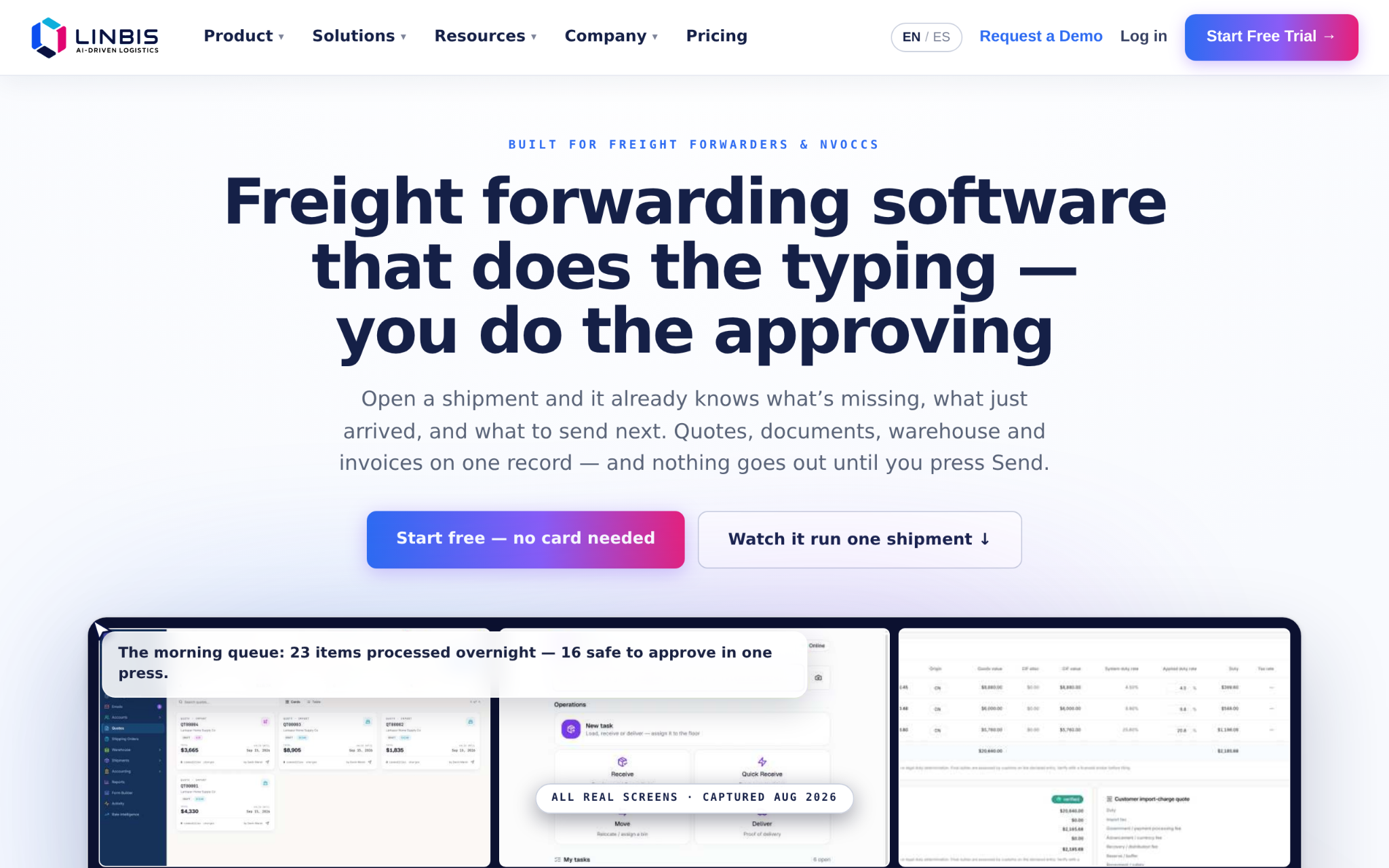
What Services Does Linbis Offer?
Linbis is a platform covering freight management, warehouse management, quotation, and dispatch across air, ocean, and ground freight. What’s interesting about their setup is the document creation layer, which cuts down on the manual data entry that trips up a lot of smaller forwarding teams. They also offer shipment tracking, financial analytics, and predictive analytics for shipping volumes and carrier performance. It’s a broad feature set for a platform that leans toward the mid-market.
Why Is Linbis a Contender for X Digital Freight Forwarding Software To Watch In 2026?
Linbis targets the document-heavy side of freight operations, where AI-driven automation can meaningfully reduce processing errors and free up staff time for higher-value work. For 3PLs juggling multiple freight modes without a large IT team behind them, that automated document layer is exactly the kind of support that keeps operations moving.
Real User Sentiment:
Public review data for Linbis is limited at this stage, so it’s worth doing direct product demos before committing. From what’s available through product documentation and feature breakdowns, the platform appears well-regarded for its real-time visibility tools. A thinner public review record sometimes just means a newer or more niche product, which isn’t necessarily a drawback if the feature fit is right.
Riege – Best for Enterprise Freight Forwarding and Global Supply Chain Management
What Services Does Riege Offer?
Riege Software has been building logistics technology since 1985, and their flagship product Scope reflects four decades of development on what freight operations actually need. The platform handles air freight, ocean freight, and customs processes across 60-plus countries, with over 16,000 users currently on the system (not cheap at enterprise scale, but worth it for the depth). Real-time collaboration tools, automated workflows, emissions tracking, and community networking features are all built in.
Why Is Riege a Contender for X Digital Freight Forwarding Software To Watch In 2026?
Scope addresses the interoperability gap that hits larger forwarding operations hardest, particularly around customs authority data exchange and multi-region compliance. A 39-year operational foundation combined with modern features like carbon emissions tracking puts Riege in a rare position: mature enough to trust, current enough to be useful.
Real User Sentiment:
Riege picked up a “Most Valuable Industry Partner” award at the 5 Star Logistics Network conference in Bangkok, which says something about how the company is regarded among enterprise forwarding networks. With seven global branches and a 900-plus customer base, the track record here is visible and verifiable.
Shipthis – Best for Freight Forwarding and Logistics Operations Management
What Services Does Shipthis Offer?
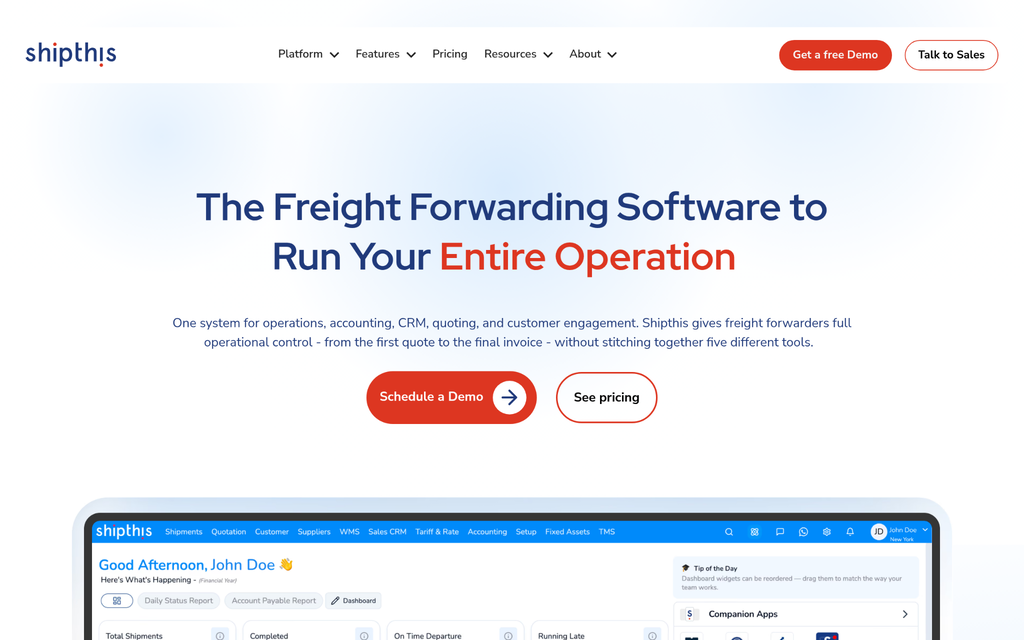
Shipthis is an AI-native freight ERP covering shipment management across air, sea, road, and rail alongside a full accounting and finance module, sales CRM, quotation management, rate management, and warehouse management. Their AI features include document intelligence, email parsing, and automated pricing, which is a genuinely useful stack for teams processing high volumes of carrier correspondence. Pricing starts at $49/month, making enterprise-grade features accessible at a smaller scale (a reasonable entry point for forwarders not ready for full ERP pricing).
Why Is Shipthis a Contender for X Digital Freight Forwarding Software To Watch In 2026?
Shipthis tackles the cost-per-shipment problem by pulling financial management and operations into one system, cutting out the double-handling that drives up processing overhead for traditional forwarders. Multi-currency, multi-entity, GAAP-compliant accounting with real-time profit and loss per shipment is the kind of capability that used to require a separate ERP investment.
Real User Sentiment:
Formal review data for Shipthis is still building up, so the public sentiment picture is limited right now. Based on product documentation and feature positioning, the platform appears aimed at forwarders who want sophisticated tooling without enterprise-tier commitments. A hands-on trial is the fastest way to verify whether the AI automation holds up under real operational workloads.
Logipulse – Best for Small-to-Mid Freight Forwarders, Customs Brokers, and 3PLs
What Services Does Logipulse Offer?
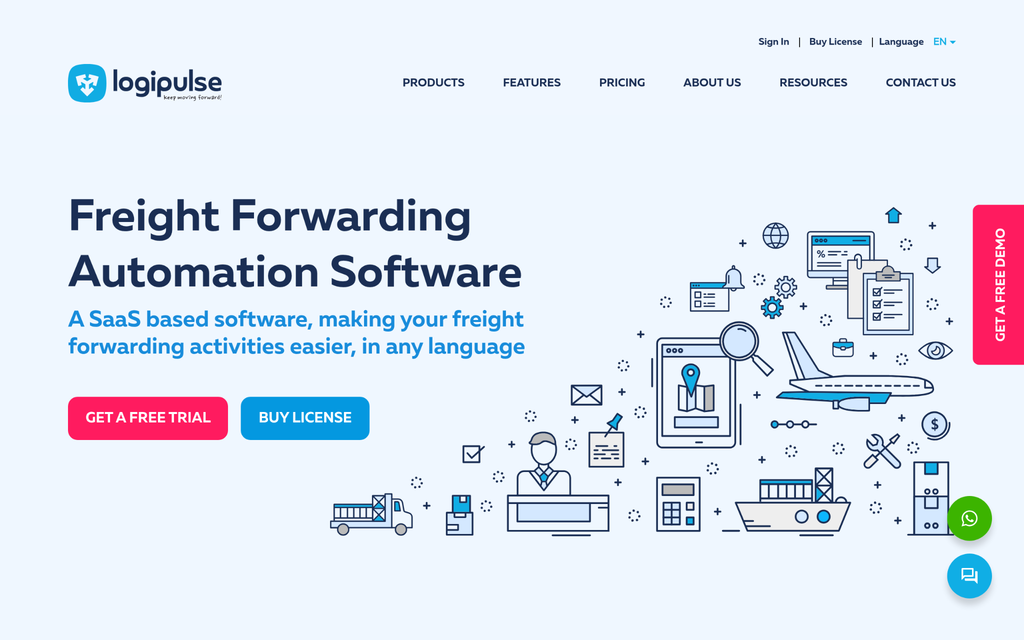
Logipulse is a SaaS platform developed by Stellosys (founded in 2010) covering land, sea, and air import and export management, transport management, customs clearance, warehouse management, and accounting. What sets them apart at this price point is multi-device accessibility across desktop, tablet, mobile, PDA, and scanning devices, plus multilingual support for global teams. Entry-level pricing starts below $5,000 annually with zero setup processing fees, which makes it a serious option for smaller operations that typically get priced out of the major platforms.
Why Is Logipulse a Contender for X Digital Freight Forwarding Software To Watch In 2026?
Logipulse fills a real gap for small and mid-sized freight forwarders who need full feature coverage without the licensing costs that enterprise platforms carry. The platform’s event-driven alerts, user-level permission controls, and pay-as-you-go pricing model give growing operations room to scale without locking into a big upfront spend.
Real User Sentiment:
Public reviews for Logipulse are sparse, so there’s limited third-party sentiment to draw from. The platform’s strongest pitch is on affordability and multi-device flexibility. For teams weighing it against CargoWise or Magaya on budget grounds, a direct demo and trial period will tell you more than review scores alone.
How These Were Chosen and Verified
Gathering Your Baseline Information
The research started by pulling a broad list of freight forwarding software platforms from multiple sources: software directories, logistics-focused review aggregators, industry publications, and vendor comparison databases. Each platform on the initial list had to serve active freight operations, not just adjacent logistics functions. That early pass produced a longlist of candidates, which was then filtered down using the criteria outlined in the steps below.
The Shortlisting Pass
Platforms without publicly verifiable information were removed first. That means no verifiable user reviews, no traceable customer base, and no clear feature documentation available from third-party sources or official sites. From the remaining options, review patterns were analyzed for consistency: what did users consistently praise, and where did complaints cluster? Outliers with only a handful of reviews were flagged for closer scrutiny to avoid over-weighting limited feedback.
Verification Pass
Each shortlisted platform was then cross-checked by comparing the claims made on official product pages against what real users reported in reviews and case studies. Where a platform claimed a certain capability, the verification looked for corroborating evidence from actual users describing that capability. Discrepancies between marketing claims and review sentiment were noted and factored into the final assessment of each option.
Industry Recognition and Authority
Beyond feature sets and review scores, each platform was evaluated for signals of broader industry standing. That included awards from logistics associations, mentions in trade publications, participation in industry events, and original research tied to freight forwarding operations. Platforms with a longer history in the market were given additional weight when their recognition had been built over multiple years rather than a single campaign cycle.
Evidence Specific to X Digital Freight Forwarding Software To Watch In 2026
The final pass focused on how well each platform demonstrated depth in freight forwarding operations as opposed to general logistics or supply chain management. That meant looking for dedicated service pages covering freight-specific workflows like customs clearance, multi-mode consolidation, and carrier connectivity. Verified reviews from freight forwarders, NVOCCs, and customs brokers carried more weight than general logistics testimonials. Case studies showing measurable results in freight-specific contexts were also factored in where available.
What to Look For When Choosing X Digital Freight Forwarding Software To Watch In 2026
Picking freight forwarding software is one of those decisions that looks straightforward until you’re six months into a rollout and realizing the platform doesn’t handle your customs workflows the way you expected. Here are the factors that actually matter when evaluating your options.
- Industry/Domain Experience: Look for platforms built for freight forwarding rather than adapted from general logistics or ERP systems. Purpose-built tools understand the difference between an air waybill and a bill of lading without needing workarounds.
- Features and Services: Coverage across all the freight modes you operate is non-negotiable. Check for native accounting, CRM, consolidation management, and customs support before shortlisting.
- Pricing Structure: Entry price matters, but so does what’s included. Some platforms gate important features behind higher tiers, so map your actual needs against each pricing plan before comparing costs.
- Results Measurement: A good platform should give you visibility into quote-to-booking conversion rate, shipment on-time delivery performance, and cost per shipment processed. If the reporting tools are weak, you’ll be flying blind.
- Industry Knowledge and Customs and Trade Regulation Adherence: Confirm that the platform actively keeps up with Incoterms, AMS, ACI, and customs brokerage regulations relevant to your trade lanes. This isn’t a one-time setup item; it requires ongoing updates.
Final Take
The five platforms in this list each bring something different to the table, and the right pick depends on where your operation currently sits. Smaller forwarders watching budget will find value in Logipulse and Shipthis. Larger, multi-office groups need the depth that Logistaas and Riege offer. As freight forwarding continues moving toward full digitization through 2026 and beyond, the gap between teams on purpose-built platforms and those still patching legacy systems together will only get wider.