You pour budget into social media, display ads, and email. Yet, your overall ROI remains completely flat. Sound familiar?
This is the chaotic reality of a broken media mix. You cannot expect peak performance from a disjointed strategy. To put this into perspective, research from Omnisend shows that unifying your messaging across three or more distinct touchpoints outpaces standalone efforts by 287% when it comes to driving actual purchases.
Expanding your reach across platforms offers incredible scale. That said, it requires massive cross-channel alignment that, unfortunately, most infrastructure lacks.
But it is frustrating to watch precious ad dollars vanish into disconnected silos. This guide aims to solve that. Here, you’ll find actionable frameworks to fix nine structural failures in your omnichannel strategy.
If you need a blueprint for how to execute this, exploring examples of successful business models examples can give you the inspiration needed to pivot your approach.
Why Your Omnichannel Advertising Strategy Isn’t Working
Disjointed data. Misaligned team objectives. Fractured tracking methods. These (and more) are likely the reasons your unified marketing ecosystem is failing. And they silently cannibalize your ad spend across platform touchpoints.
Here are nine reasons your omnichannel advertising strategy isn’t working.
Reason 1: You’re Doing “Multichannel,” Not “Omnichannel”
If you want to see improved ROI, you can’t afford to treat every touchpoint like an independent vacuum. It has to be connected, so you can’t operate channels in silos.
We’ve seen that this disconnected approach ignores the massive SEO impact of paid campaigns. And what you’ll end up doing is misattributing branded search spikes.
Forrester reports that 78% of US B2C marketing executives admit that their “marketing and loyalty technologies are siloed.”
This fragmentation can create blind spots, which lead to draining your budget.
Here’s the fix:
- Shift your performance focus from channel-specific ROAS to a holistic Customer Acquisition Cost (CAC). Note that your marketing ops team will need to pipe ad spend into a data warehouse like Snowflake. Using marketing automation, merge this customer data with CRM revenue for a unified blended CAC dashboard.
- Map the complete customer journey to understand exactly how your users interact before conversion. Have strategists use analytics tools like Mixpanel to track cross-device brand touchpoints, such as a mobile ad click leading to a desktop search. It’ll help pinpoint where your media mix bleeds budget.
- Partner with experts to develop a unified brand architecture and omnichannel marketing strategy to close these siloed gaps.
P.S: Read this Starbucks case study and see how their omnichannel strategy has contributed to their overall business (spoiler alert: it’s a primary driver of the $37.7 billion revenue they made in 2025).
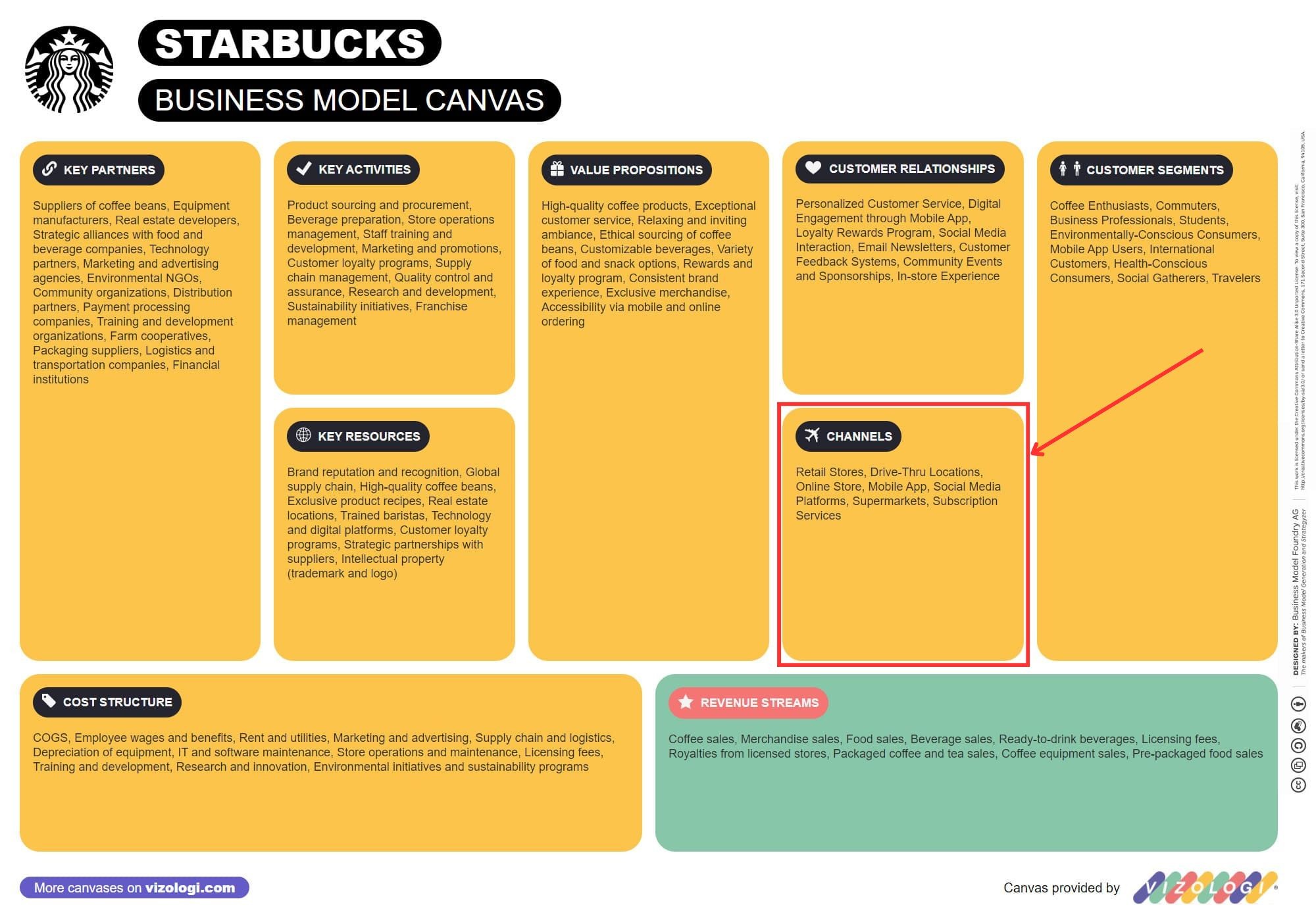
Source: Vizologi
Alt tag: An image of Starbucks business model canvas by Vizologi. The channels through which the multinational coffee company reaches its customers are outlined in red.
From drive-thru locations to mobile apps, here’s a closer look at the brand’s channels:
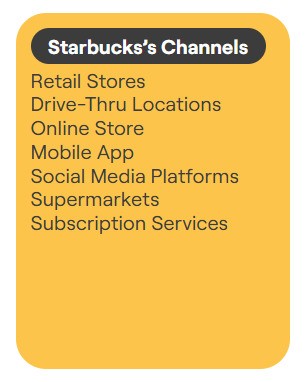
Source: Vizologi
Alt tag: A zoomed in screenshot of Starbucks’s channels.
Reason 2: You’ve Got Misaligned Internal Teams and KPIs
When internal teams compete for attribution credit, your media strategies can fracture. Your social media team might optimize heavily for a high engagement rate, while your paid search team ruthlessly cuts budgets to hit strict ROAS targets.
The thing is, you want everyone contributing towards reaching your business goals. But this clash can create disjointed marketing campaigns. Users end up receiving mixed signals instead of cohesive brand messaging.
This comes at a cost. According to SuperOffice, organizations lose an estimated $1 trillion every year due to misaligned sales and marketing efforts.
Often, brands launch massive advertising campaigns that fail because the creative and performance teams use entirely different reporting dashboards. While specializing by channel allows deep expertise, the drawback is that it often breeds tunnel vision across the department.
Here’s the fix:
- Establish unified cross-departmental key performance indicators tied to overall revenue. Have leadership agree on a shared North Star metric, like Marketing Efficiency Ratio (MER), tracked in a centralized OKR framework. This aligns all departments toward actual business growth rather than just protecting individual silos.
- Centralize your campaign planning and reporting workflows using an integration tool like Supermetrics or Adverity to connect fragmented customer data and pipe it into a single BI dashboard like Looker. This ensures every media buyer pulls numbers from the exact same environment.
- Adopt a full-funnel approach where everyone shares accountability. Mandate regular cross-departmental meetings that forces organic, paid, and retention teams to dissect the complete user journey together. This will help shift focus toward solving pipeline issues as a team.
Reason 3: Your Data Attribution Is Broken or Fragmented
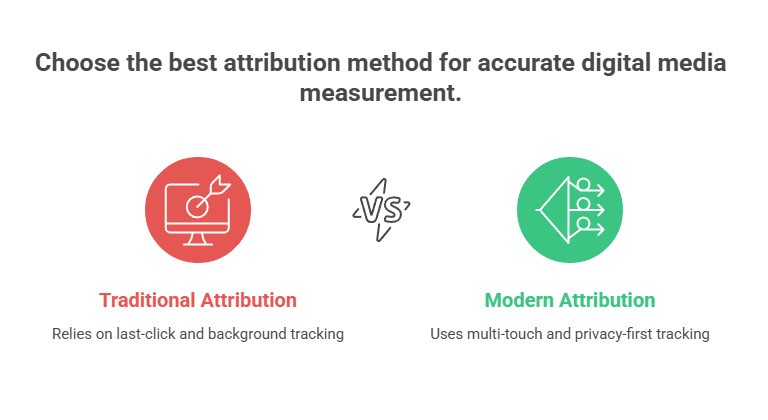
Relying heavily on last-click attribution to measure your digital media gives 100% of the credit to the final touchpoint. But you don’t get the true picture of the customer experience.
Plus, modern privacy updates have weakened traditional tracking. Strict privacy laws, such as GDPR and CCPA, for example, have eliminated background tracking methods.
According to Cometly, opt-in rates are around 15?25% globally. This causes immense signal loss for digital retargeting. And attempting to manually patch these blind spots without machine learning leads to misallocated budgets and reporting you can’t rely on.
Here’s the fix:
- Adopt Multi-Touch Attribution or Media Mix Modeling to distribute credit fairly. While MTA provides exceptional clarity, be aware that it requires significant technical resources to calibrate accurately.
- Consolidate fragmented data into a centralized Customer Data Platform (CDP) like Twilio Segment to fuel AI-driven insights.
- Integrate robust, privacy-first tracking solutions seamlessly across all devices. Have your development team implement server-side tracking, like Meta’s Conversions API (CAPI) or Google Server-Side GTM, directly on your cloud servers. This bypasses client-side cookie blockers and iOS restrictions, which ensures conversion data flows reliably back to your ad platforms even when traditional browser pixels fail.
- Implement a Consent Management Platform (CMP), such as OneTrust, to legally and securely capture zero-party data directly from your users.
Reason 4: You Treat In-Store and Online as Two Different Worlds
It’s vital to connect e-commerce and physical retail to avoid creating a revenue blind spot.
Take a customer who sees targeted digital out-of-home ads and engages with multiple digital brand touchpoints. Later, they receive a direct-mail promo and subsequently walk into your physical store to buy the item with cash.
If your backend systems do not actively communicate with one another, your ad platforms record a zero return for that specific customer journey. This falsely deflates your digital ROAS, making your high-performing campaigns look like failures on paper.
Operating without an offline tracking infrastructure leads to severe misallocation of ad spend. You end up optimizing your media mix based on an incomplete data picture, aggressively scaling channels that look good online while accidentally killing the very digital campaigns quietly driving your physical retail foot traffic.
Plus, failing to bridge this gap damages long-term customer retention. Because your tracking is disconnected, you will end up wasting budget aggressively retargeting loyal customers online for products they already bought in your physical store..
Here’s the fix:
- Ensure you sync your in-store POS systems directly with your digital ad platforms. Have your data operations team use middleware like LeadsBridge to automatically pipeline hashed customer details from physical registers, like Square or Shopify POS, directly into Google and Meta. This tells the ad algorithms exactly which online clicks drove in-store foot traffic, so your ROAS reflects total revenue.
- Use customer loyalty programs and offline conversion-tracking APIs to link physical receipts to digital profiles. While these APIs provide critical clarity, keep in mind that they often require significant, ongoing developer resources to maintain.
- Draw inspiration from Target. The retail corporation’s omnichannel strategy seamlessly connects mobile app browsing to in-store checkout.
Reason 5: Inconsistent Messaging and Creative Fatigue
Serving identical content across all platforms ruins the user experience because it creates fatigue.
At the same time, running a highly polished corporate video on LinkedIn and following it up with casual email marketing can also break your cohesive brand story. This mismatch in your marketing messages creates cognitive dissonance in your target audience.
According to Analytics at Meta, ad fatigue can increase your risk of conversions plummeting by 45%.
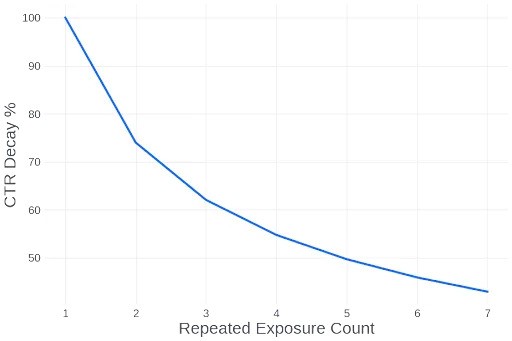
Source: Analytics at Meta
Alt tag: Graph showing the effect of repeated ad exposure on conversions.
Failing to refresh creatives can lead to sudden performance crashes, regardless of how strong your offer is.
While customizing assets natively for every platform maximizes relevance, keep in mind it demands more creative bandwidth, which can bottleneck your design team.
Here’s the fix:
- Adapt your creative to each platform’s native aesthetic, and consider using authentic influencer partnerships rather than polished studio shoots to improve relevance.
- Use dynamic creative optimization software like Smartly.io to automate the sequencing of personalized content.
- Inject user-generated content natively into your ad sets to organically increase conversion rates.
Reason 6: You Ignore Customer Journey Sequencing
Bombarding cold audiences with aggressive bottom-of-funnel ads ruins the initial introduction to your brand. Similarly, continuing to retarget already-converted customers burns your budget.
This isn’t just theory. Organizations waste significant money, with industry benchmarks showing that inefficient audience overlap and internal campaign competition can account for 20?35% of ad spend on platforms like Meta.
Failing to sequence the full journey is especially fatal in B2B. You need to track the entire buying committee rather than just individual users.
By using enrichment tools like Clearbit to identify company IP addresses, you can serve tailored digital display ads to the broader executive team.
While account-based targeting delivers a highly personalized experience, keep in mind that premium data enrichment software is often expensive. Plus, this demands proper CRM hygiene to avoid mismatched targeting.
Here’s the fix:
- Map ad formats strictly to awareness and conversion stages and ensure every call to action drives users to highly relevant landing pages.
- Use marketing automation to update real-time audience exclusion lists immediately post-purchase.
- Ensure all your digital ads follow a logical customer journey.
Reason 7: Your Tech Stack Is Disconnected
It’s difficult to achieve true omnichannel advertising when your tech stack is disconnected. For instance, legacy CRM software often fails at real-time communication, meaning your ad platforms rely on obsolete customer data.
The reliance on manual data uploads can cause severe lag. MuleSoft’s 2024 Connectivity Benchmark Report speaks to this. It reveals that while the average enterprise uses 991 different applications, less than 30% are actually integrated. This can create a lot of frustration as you end up targeting outdated audience segments.
To add to that, not replacing legacy systems with a flexible headless CMS can result in your campaigns lagging behind user intent. And while migrating to modern content APIs makes managing structured data much easier, the drawback is that you’ll incur increased developer fees to overhaul your backend.
Here’s the fix:
- Audit your marketing technology stacks specifically for native API integrations. Do this by mapping every tool onto a single visual diagram. Once you see the flow of data, it’s easier to spot where manual CSV exports, for example, are affecting your reporting and slowing you down.
- Use automated data pipelines like Fivetran to connect your systems seamlessly. These help eliminate manual data entry. Just note that costs can increase as your data volume grows.
If you want to see how this connectivity is enabled at scale, take a look at Salesforce’s business strategy. The cloud-based software company enables businesses to use a unified CRM to connect their systems and power personalization.
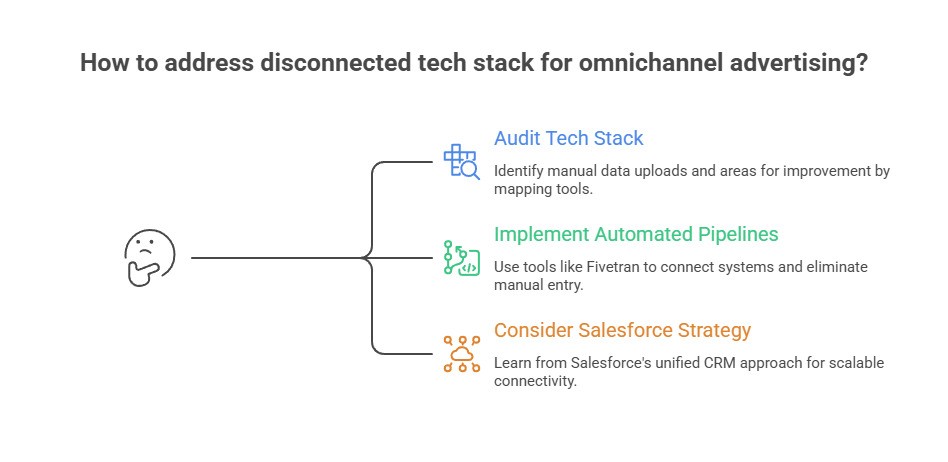
Alt tag: Image showing how to fix a disconnected tech stack for omnichannel advertising.
Reason 8: You Overlook the Post-Purchase Experience
The initial conversion is not the end of the funnel. So when you fail to coordinate cross-selling across your digital brand touchpoints, you end up leaving revenue on the table.
Going completely dark immediately after checkout forces your team into a constant, highly expensive cycle of acquiring net-new audiences, rather than maximizing the lifetime value of buyers who already trust your brand.
Abandoning the user post-purchase instantly kills customer loyalty because they feel like just another transaction.
While implementing aggressive cross-selling sequences can rapidly spike your immediate LTV, you need to balance the frequency. Bombarding users too quickly can trigger unsubscribes and damage long-term customer retention.
Here’s the fix:
- Trigger dynamic marketing automation for your post-purchase email marketing and SMS sequences using platforms like Klaviyo and Brevo.
- Serve specific complementary product ads based on the user’s exact purchase history rather than generic catalogs.
- Focus on multi-platform touchpoints using review tools like Yotpo to systematically generate organic reviews.
Reason 9: You’ve Got Inflexible Ad Budgets and No Cross-Channel Fluidity
Locking your digital media spend strictly at the start of a quarter is not advisable. When you test channels in a complete vacuum, it prevents you from seeing the true impact of your advertising campaigns.
Aggressively scaling a siloed social campaign often cannibalizes your paid search volume, artificially inflating your costs without driving net-new revenue.
And while maintaining a fixed media mix keeps the finance team happy (thanks to predictable forecasting), this inflexibility makes you less agile when platform costs do fluctuate.
Here’s the fix:
- Move to cross-channel incrementality testing using geo-holdouts to measure actual conversion lift rather than platform-reported metrics.
- Adopt an agile budgeting model that keeps a set percentage of your total budget entirely fluid. You can decide on this percentage by analyzing your historical cost-per-acquisition volatility; this buffer gives you room to pivot instantly.
- Once you spot an opportunity, route these fluid dollars immediately to the cheapest acquisition touchpoints.
- Use machine learning bid management platforms like Skai or Marin Software (MarinOne). These tools use AI-driven insights to automatically shift your fluid budgets in real-time, and eliminate manual human lag.
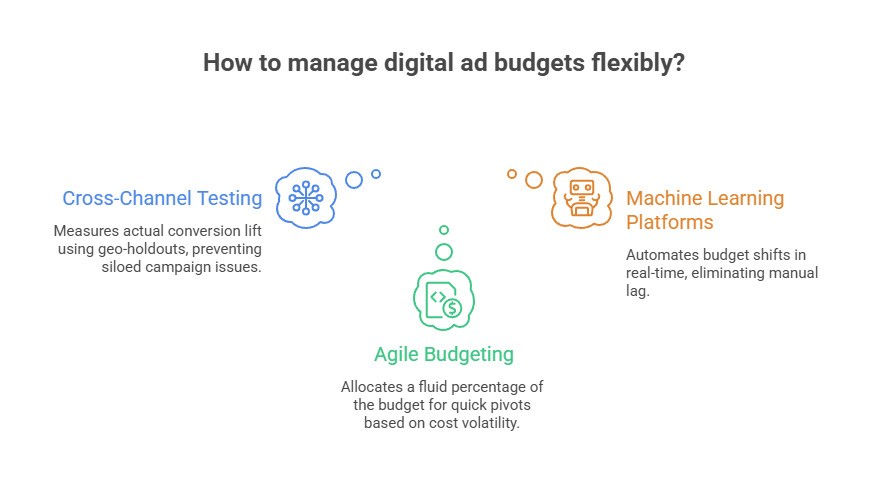
Alt tag: Image showing three different ways to manage digital ad budget flexibly.
How to Audit Your Current Omnichannel Strategy
To stop bleeding budget, you’ve got to evaluate your infrastructure.
- Conduct a strict data integrity check on your customer data. You want to look out for discrepancies over 10% between ad platform reporting and actual CRM revenue. This could indicate that your tracking is broken.
- Perform a manual cross-device friction test. Have your team navigate the customer journey from a mobile ad click to a desktop checkout. Document any lag ruining the user experience. While manual testing is tedious, it helps you uncover silent conversion killers that bots miss.
- Run an audience overlap analysis using Meta’s Audience Overlap tool or your marketing automation platform. To prevent inflated costs, you need to stop auction overlap across digital media campaigns.
Conclusion
Fixing your omnichannel advertising strategy requires you to stop operating in silos.
Fully integrated tech stacks. Unified teams working toward the same revenue goals. These will help you be successful. Removing departmental walls and centralizing your data will create a seamless, connected customer journey that drives real growth rather than wasted ad spend.
FAQ
1. What Is Omnichannel Advertising?
Omnichannel advertising is a unified marketing approach that provides users with a seamless shopping experience across all channels. Whether the customer is shopping online on a desktop, via a mobile app, or in a brick-and-mortar store, the experience is unified. Often used interchangeably with omnichannel marketing, this type of advertising integrates data, messaging, and touchpoints to build a cohesive brand ecosystem.
2. What Is The Difference Between Omnichannel and Multichannel Advertising?
An omnichannel strategy connects all platforms, whereas a multichannel strategy simply runs campaigns on several distinct platforms simultaneously. Multichannel operates in silos, with channels competing for attribution. But omnichannel focuses on the complete customer journey. It ensures that data, creative, and messaging flow seamlessly across all digital and physical touchpoints.
3. Why Is Omnichannel Advertising Important for Modern Marketing?
It is critical because modern consumers rarely make a purchase after a single interaction. Implementing an omnichannel advertising strategy builds deep customer loyalty by meeting buyers exactly where they are. This prevents disjointed experiences, maximizes overall return on ad spend, and ensures your brand remains consistently visible throughout the entire purchasing lifecycle.
4. Why Is My Omnichannel Advertising Strategy Failing to Deliver Results?
Your omnichannel advertising strategy is likely failing due to disconnected tech stacks, fragmented tracking, and misaligned internal teams. When you treat channels as separate entities, you can experience duplicate bidding, massive signal loss, and inconsistent messaging. Failing to adopt a full-funnel approach prevents you from accurately tracking and converting users across multiple devices.
5. What Are the Key Components of a Successful Omnichannel Advertising Strategy?
A successful omnichannel advertising strategy requires centralized data integration, cross-departmental alignment, and robust marketing automation. You need to map out all brand touchpoints, keep your ad budget flexible enough to pivot on the fly, and use tracking that actually respects user privacy. Most importantly, connect your online campaigns directly to your physical point-of-sale systems so you can capture every conversion across the entire unified customer ecosystem.