
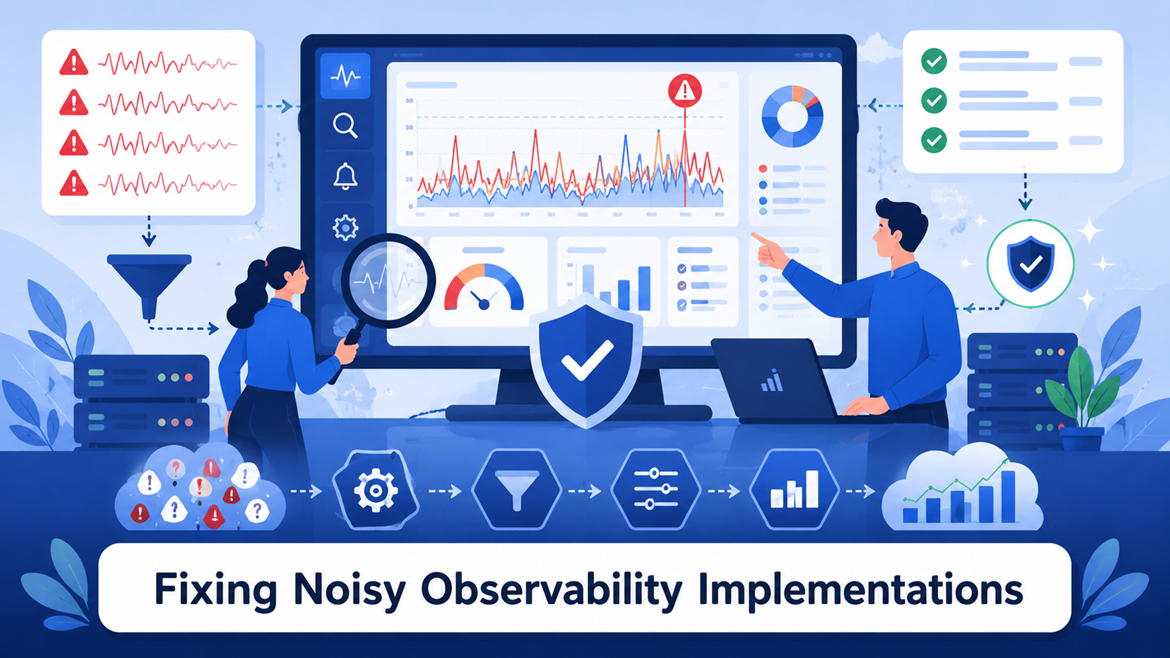
Modern IT environments generate an extraordinary amount of data. Applications, cloud workloads, networks, endpoints, databases, and security tools continuously produce logs, metrics, traces, and alerts. The promise of a strong full stack observability implementation is simple: gain visibility across the entire technology ecosystem and quickly identify what matters.
Yet many organizations discover the opposite outcome. Instead of improving operational awareness, observability programs create large volumes of information. Visibility increases, but clarity disappears.
The problem rarely lies with observability itself. It usually stems from how the implementation is planned, deployed, and managed.
The Visibility Trap
Many organizations approach observability with a collection mindset. The assumption is that collecting more data automatically creates better insights. As a result, every available log source is enabled, every metric is captured, and alerts are configured across multiple tools.
At first glance, this appears comprehensive. In reality, it often creates a flood of disconnected information. A poorly designed full stack observability implementation can generate thousands of daily events, many of which provide little operational value. Critical incidents become buried beneath routine notifications. This creates a dangerous situation in which genuine issues go unnoticed until users or customers report them.
Where Noise Comes From
Noise is rarely caused by a single technology failure. It usually emerges from several implementation mistakes occurring simultaneously.
| Common Mistake | Resulting Problem |
| Collecting all available telemetry | Excessive data storage and analysis burden |
| Duplicate monitoring tools | Repeated alerts for the same incident |
| Poor alert thresholds | Frequent false positives |
| Lack of context correlation | Longer investigation times |
| Unclear ownership | Delayed response and accountability gaps |
| Dashboard overload | Teams struggle to identify priorities |
When these issues combine, observability platforms become information repositories rather than operational intelligence systems.
Alert Fatigue
Alert fatigue remains one of the most common consequences of a flawed observability strategy. Operations and security teams may receive hundreds or even thousands of notifications daily. Most alerts are informational rather than actionable. Some represent the same issue reported multiple times by different systems.
Over time, responders become desensitized. An alert that should trigger immediate attention looks no different from dozens of low-priority notifications received throughout the day. This weakens the effectiveness of the response and increases the likelihood of missing significant service disruptions.
A successful full stack observability implementation focuses on relevance rather than volume. Every alert should answer a simple question: Does this require action? If the answer is no, it should not interrupt a team member.
Missing Context
Data alone does not explain what is happening. Consider an application slowdown. Metrics may indicate increased CPU utilization. Logs might show elevated error rates. Traces could reveal latency between services.
Viewed separately, these data points create multiple investigation paths. Viewed together, they reveal a single root cause.
Many organizations collect extensive telemetry but fail to correlate information across systems. Teams then spend valuable time manually connecting events that should already be linked. Without contextual relationships, observability becomes an exercise in data hunting rather than problem solving.
Noisy Observability to Operational Clarity
The journey from noisy observability to operational clarity follows a structured progression:
1. Audit Sources
Review existing telemetry collection practices. Identify duplicate log streams, redundant monitoring tools, and data sources that provide little operational value.
2. Define Priorities
Map observability objectives to business services. Not every system carries the same level of risk or impact. Monitoring strategies should reflect operational priorities.
3. Correlate Data
Connect logs, metrics, traces, and events within a unified context. Correlation reduces investigation effort and accelerates root cause analysis.
4. Refine Alerts
Evaluate alert rules based on actionability. Remove low-value notifications and adjust thresholds that generate excessive false positives.
5. Assign Ownership
Every monitored service should have clearly defined accountability. When incidents occur, response responsibilities must already be established.
6. Optimize Continuously
Observability environments evolve alongside infrastructure. Regular reviews ensure monitoring remains aligned with changing technologies and business requirements.
Technology Alone is Not Enough
One of the most overlooked aspects of full stack observability implementation is governance.
Many organizations invest heavily in modern observability platforms yet fail to establish operating procedures around them. New applications are added without monitoring standards. Alert rules accumulate over time without review. Teams create dashboards independently, resulting in fragmented visibility.
The technology may be powerful, but the operational model remains immature. Observability should be treated as an ongoing discipline rather than a one-time deployment project. Processes, ownership, and continuous improvement are just as important as the platform itself.
Measuring Success
A successful observability program should produce measurable operational improvements. Instead of focusing solely on data volume or dashboard counts, organizations should evaluate outcomes such as:
| Success Indicator | Expected Improvement |
| Mean Time to Detect (MTTD) | Faster incident identification |
| Mean Time to Resolve (MTTR) | Reduced downtime |
| Alert Volume | Lower noise levels |
| False Positive Rate | Higher alert accuracy |
| Service Availability | Improved reliability |
| Team Efficiency | Less time spent investigating non-issues |
These metrics provide a clearer indication of observability effectiveness than simply measuring how much telemetry is being collected.
Business Impact
The consequences of observability noise extend beyond technical operations. Slow incident response affects customer experience. Investigation delays impact productivity. Excessive data storage increases operational costs. Security teams may miss early indicators of compromise because meaningful signals are buried beneath routine events.
A well-executed full-stack observability implementation helps organizations avoid these outcomes by transforming data into actionable intelligence.
When visibility aligns with operational priorities, teams gain confidence in their monitoring systems. Issues are detected earlier, investigations become faster, and resources are used more effectively.
Conclusion
A full stack observability implementation should simplify operations, not complicate them. Yet many organizations unintentionally create environments where excessive telemetry, duplicate alerts, and disconnected data generate more confusion than insight.
The solution is not to collect more information. It is creating better context, stronger correlation, meaningful alerting, and clear operational ownership.
By focusing on actionable visibility rather than data volume, organizations can reduce noise, improve incident response, and gain a clearer understanding of their technology landscape.
CyberNX can help organizations design, optimize, and mature their full-stack observability implementation strategies. From reducing alert fatigue and improving data correlation to building scalable observability frameworks, CyberNX helps transform complex monitoring environments into practical, business-focused visibility platforms that deliver clarity when it matters most.




