
The digital marketplace is changing like never before. In late 2026, a massive shift among global media owners means Meta platforms will surpass Google in global digital ad revenue.
Emarketer market research shows Meta capturing $243.46 billion (26.8% share) of paid media spend versus Google’s $239.54 billion (26.4%). You may be tempted to spread your advertising budgets thinly across competing digital platforms to chase this growth.
Doing so is a big mistake. Spreading your ad spend this way destroys your unit economics, especially as a growing brand. You cannot afford to dilute the channels that are actually driving your revenue.
In this guide, you’ll learn how to allocate your paid media budgets in e-commerce for maximum profitability.
If you want to dive deeper into the exact frameworks top-tier companies use to scale, check out the Vizologi blog. From designing resilient business models to reverse-engineering competitor playbooks, it is a goldmine for growth leaders.
A Breakdown of Where Digital Platforms Win and Lose
Here is exactly how each platform captures demand, ensuring you use capital where these digital platforms naturally win.
Google Ads: The Paid Search and Demand Capture Engine
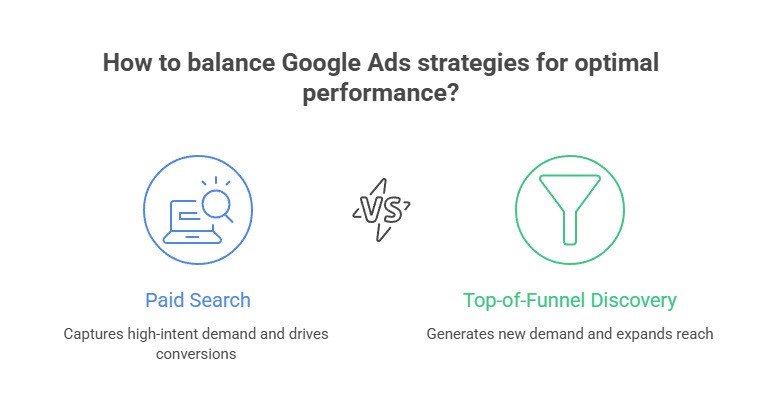
Google dominates high-intent demand. Even with rising CPCs, paid search delivers exceptional conversion rates for rational, evaluated purchases because users are actively hunting for a solution.
Using automated bidding and Performance Max campaigns, Google dynamically allocates spend across its ecosystem to close sales.
But relying purely on Google’s PMax requires you to manage a few realities:
- It inherently limits top-of-funnel discovery since the system is built to harvest existing intent rather than generate it from scratch
- You must feed these algorithms highly accurate, closed-loop CRM data to train them correctly.
- If you only optimize for front-end ROAS, you risk the algorithm taking the easy route and overpaying for branded search terms.
For inspiration on brands using effective paid search strategies to balance these dynamics, explore these business model examples.
Meta Ads: The Demand Generation and Audience Targeting Engine
Meta excels at creating demand by interrupting scrolls with visuals. This makes it a great platform for targeting bored or browsing users.
And with Meta’s Advantage+ automation, you no longer need manual audience segmentation. The suite of AI-powered tools relies on vast amounts of user data to efficiently find buyers.
That said, you should pair Advantage+ with an independent attribution tool like Northbeam or Triple Whale. It’ll help ensure you don’t blindly scale losing campaigns (because in-platform metrics take undue credit for organic sales).
The same EMarketer research mentioned earlier reveals that Meta’s Advantage automation has generated around $60 billion in annualized revenue, which is a testament to its power and demand.
Because the algorithm handles targeting, you’ll just have to focus on the creative. Don’t be afraid to innovate with creative optimizations across diverse creative formats. It’ll help combat ad fatigue and maintain profitable margins.
Amazon Ads: Retail Media Networks and the Shelf-Space Engine
Amazon captures transactional intent natively, as it’s a massive marketplace where buyers already have their payment details on file (or are ready to add them). This makes it the ultimate shelf-space engine among modern retail media networks.
The multinational technology company operates on a staggering scale, with a projected global ad revenue of $82.07 billion in 2026.
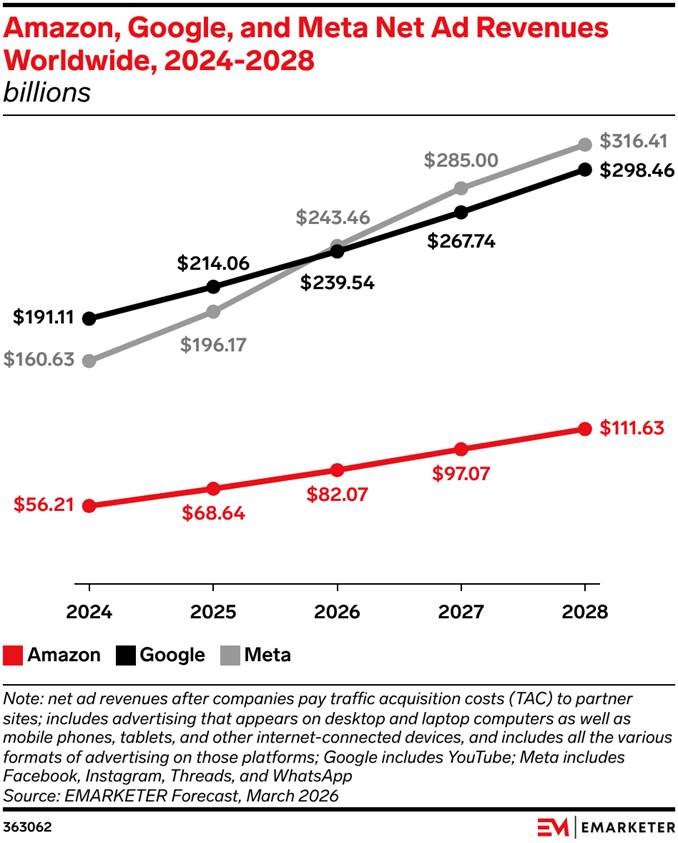
Source: EMarketer
Alt tag: A graph showing the prior, current, and projected net ad revenues of Amazon, Google, and Meta.
That said, a main drawback to this is that Amazon owns customer data. This limits your ability to build long-term brand equity or run profitable lifecycle marketing.
The most profitable workaround to this is adapting your product assortment. Treat Amazon strictly as a high-volume acquisition engine by listing only entry-level SKUs there, keeping premium items exclusive to your own website.
To see this hybrid distribution in action, check out Nike’s business model canvas. It is a masterclass in using broad retail networks for volume while fiercely protecting a D2C ecosystem.
Here’s a quick summary of how the three platforms fare:
| Google Ads | Meta Ads | Amazon Ads | |
| Projected global ad revenue | $239.54 billion | $243.46 billion | $82.07 billion |
| Core function | High-intent demand capture | Visual demand generation | Transactional shelf space |
| Proprietary automation | Performance Max | Advantage+ Shopping | Amazon DSP Performance+ |
5 Rules for the Data-Driven Allocation of Your Paid Media Budget
Next, you’ll discover five paid media budget allocation rules you need to follow.
Rule 1: Never Split Small Advertising Budgets Evenly
Modern machine learning algorithms have to be trained on large amounts of data. Exiting this learning phase requires a significant amount of ad capital. In fact, platforms like Meta and Google PMax require a few thousand dollars per campaign per month to function optimally and map intent.
The exact amount will depend on your needs. Have your marketing team go over historical data to figure this out. Or, reach out to a performance marketing agency that’ll help you go through your analytics and make informed decisions.
Finance teams are focused on keeping costs low. But ensure you caution your clients that splitting a small budget thinly across multiple channels can make your campaigns inefficient. Because you aren’t gathering meaningful data. This directly inflates your advertising costs, as the algorithm keeps resetting and doesn’t optimize as it should.
You can avoid this by focusing all our capital on your single highest-converting channel until you have the revenue to branch out (and finance gives the go-ahead).
Rule 2: Map Platforms to Customer Lifetime Value and CAC
Alignment is key. Stop treating every product in your catalog the same way. You need to align your chosen campaign type directly with your specific funnel depth and margin profile.
That means evaluating your front-end customer acquisition cost strictly against your long-term customer lifetime value (rather than looking at first-click revenue in isolation).
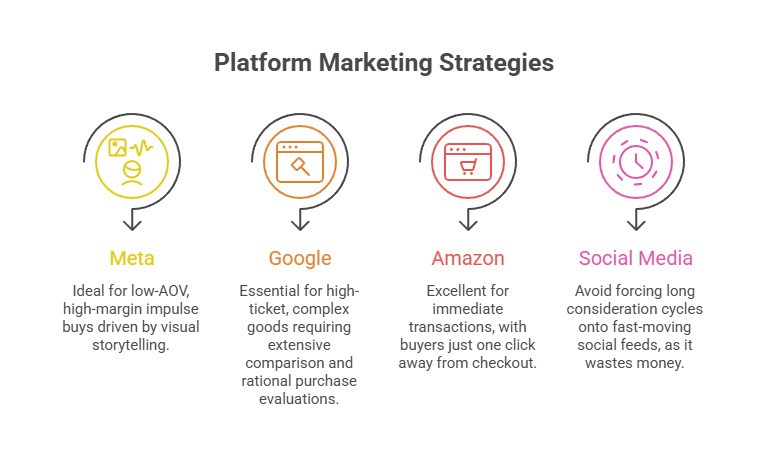
To match the platform to the actual buying psychology of your audience, keep these in mind:
- Meta works beautifully for low-AOV, high-margin impulse buys where visual storytelling drives immediate action.
- Google is mandatory if you are selling high-ticket, complex goods that require extensive comparison because it captures consumers during their rational purchase evaluations.
- Amazon’s great for immediate transactions since buyers are just one click away from checkout.
- Sadly, brands try to force a long 90-day consideration cycle onto a fast-moving social feed. This needlessly burns cash.
Rule 3: Use Marginal ROAS and a Reliable Attribution Platform
Relying on biased, in-platform performance metrics is a fast track to double-counting your revenue. Because ad networks operate in isolated data silos, Meta and Google will both shamelessly take credit for the same conversion, all while failing to consider touchpoints outside their own ecosystems.
To fix this, you need to measure marginal ROAS to understand the actual value creation driven by your next incremental ad dollar.
Tip: Set up cross-platform exclusion lists; pull your recent Shopify buyers out of your top-of-funnel Meta acquisition campaigns. This will ensure you aren’t wasting cash trying to convince converted customers.
As mentioned earlier, use a third-party attribution platform. These reliably fix tracking blind spots and eliminate audience sync discrepancies across networks.
Rule 4: Adapt Ratios Based on Market Research and Brand Maturity
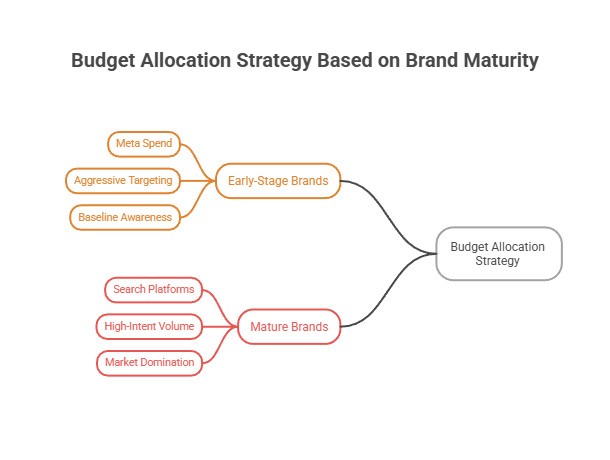
Your budget allocation matrix must evolve as your brand scales. For instance, early-stage brands seeking rapid scaling often allocate most of their budget to Meta to maximize aggressive audience targeting and build baseline awareness.
But as your social footprint grows, that top-of-funnel tracking naturally starts converting into active search volume elsewhere.
That is your sign to put capital toward Google and Amazon to take advantage of the high-intent search volume you’ve been building through ads.
As a result, you will notice a sharp contrast in market behavior:
- Mature market leaders prioritize search platforms to dominate high-intent categories.
- Scrappy, newer brands rely heavily on social media spend to interrupt users and carve out entirely new demand from scratch.
Rule 5: Use Automation, Product Feeds, and Budget Rules
Let automation handle the heavy lifting, but keep it on a tight leash. It’s recommended that you use Meta’s Advantage+ to automate the underlying digital infrastructure of your visual campaigns. It frees up your time to focus on optimizing creatives instead of constantly doing things manually.
When it comes to Google, the automation is undeniably powerful, but you have to guide it:
- Keep your product feeds flawlessly clean so the system knows exactly what it is selling.
- Make sure you isolate your Performance Max budgets. If you don’t, the system will lazily cannibalize your cheap, high-converting branded search terms. The stats do back up the tech, though. Google’s official data shows advertisers see an average 13% increase in total incremental conversions at a similar cost per action when they use it correctly.
In terms of streamlining daily campaign operations, the trick on Amazon is using schedule-based budget rules.
You can set the Amazon Console to automatically scale up your bids when purchase intent is highest, keeping you from blowing your daily ad budget while your buyers are fast asleep.
Issues You Could Face in Paid Media Budget Allocation
Here are some scenarios you could face when allocating your paid media budget in e-commerce.
Selling Highly Visual Products with Zero Paid Search Volume
When launching new items that nobody is searching for yet, you lack the historical data to build a strong Google Quality Score. Your paid search volume will naturally be zero.
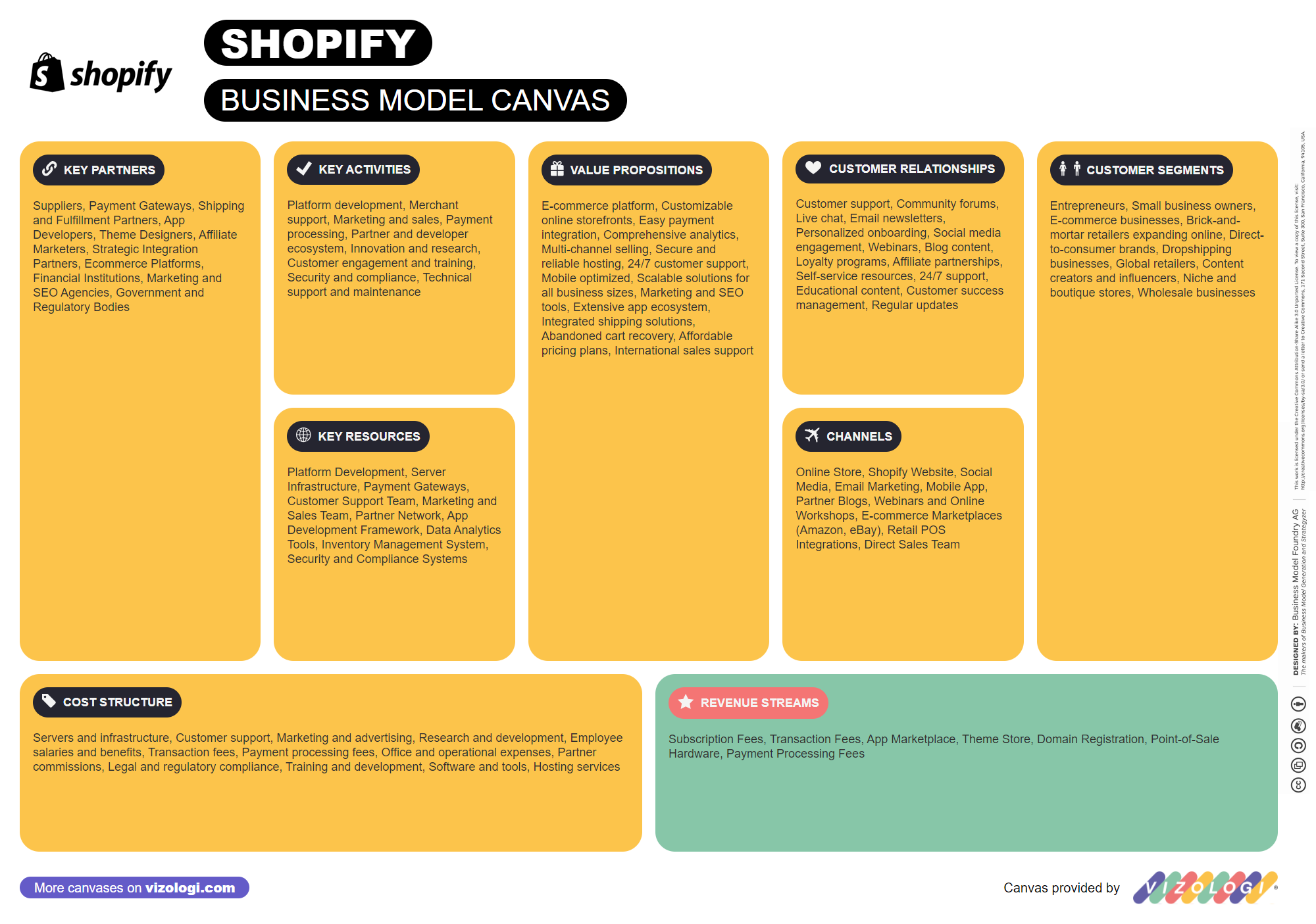
Instead, allocate a significant portion of your budget to Meta Ads to visually demonstrate the product and generate that initial demand from scratch. To see how to use customizable storefronts specifically for converting this type of social traffic, review Shopify’s business model canvas.
Once the demand is created, you can start capturing it elsewhere.
Navigating Niche B2B E-commerce Marketing
Industrial or packaging products often lack the aesthetic appeal needed to stop the scroll on visual digital platforms. Here, you cannot rely on impulse clicks.
Instead, allocate a significant share (e.g., 80%) of your paid media budget to Google Search to reach high-intent buyers actively searching for exact specifications.
Use the remaining 20% purely for retargeting past visitors to stay top-of-mind during long procurement cycles.
For strategic insights on building scalable platforms tailored for these complex B2B transactions, explore Bigcommerce’s business model canvas.
Trying to Prevent Amazon from Cannibalizing Direct-to-Consumer Sales
It can be frustrating when customers discover your brand through social ads but complete the purchase on Amazon, eroding your margins with referral fees.
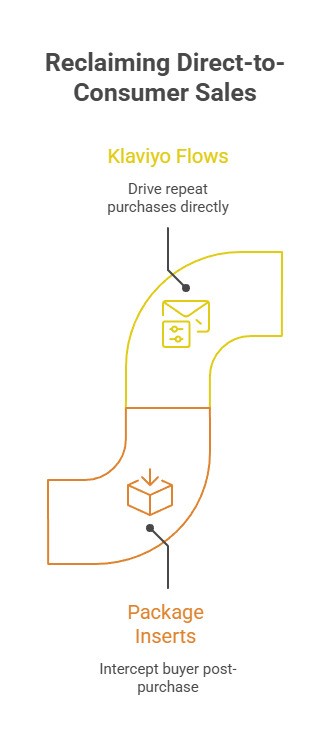
But Amazon is a necessary acquisition channel within modern retail media networks. The most practical defense is a strong backend: offset the initial margin hit by using post-purchase package inserts to intercept buyers and pull them into your ecosystem.
Combine this with powerful Klaviyo flows to drive their repeat purchases directly to your own store.
Conclusion
Treating Meta, Google, and Amazon as isolated silos is a quick way to waste your paid media budget.
Instead, you need to run them as an interconnected ecosystem: Meta generates the initial demand, Google captures high-intent searches, and Amazon acts as your transactional shelf space.
To scale profitably, stop chasing front-end platform ROAS. You need to optimize your true customer acquisition cost against long-term lifetime value.
FAQ
1. How Do You Decide Budget Splits Across Meta, Google, and Amazon Ads?
How you handle your budget allocation completely depends on brand maturity. If you’re a new brand, you’ll want to lean heavily on audience targeting across social channels to spark that initial demand. Once baseline awareness translates into active search volume, you can spend money on Google and Amazon ads to capture those conversions and defend your market share.
2. How Do Advertising Costs and Bidding Models Vary Among Amazon, Meta, and Google?
Your advertising costs behave differently depending on the network. Meta charges for impressions to push engaging creative formats, which is perfect for top-of-funnel discovery. Meanwhile, Google’s Smart bidding and Amazon use CPC models to capture existing intent. Because Amazon operates as a closed-loop digital marketplace, its algorithm naturally prioritizes immediate transactional volume rather than long-term brand building.
3. Which Factors Determine Paid Media Budget?
Setting your total advertising budget comes down to cash flow, baseline operating margins, and your overall customer lifetime value. You also have to consider the minimum ad spend required for the machine learning to work. You need to spend at least a few thousand dollars monthly per channel to get the algorithms out of their learning phases.
4. Where Should You Allocate the Majority of Your Paid Media Budget?
Park the bulk of your paid media budget in the channel that natively matches your buyers. Impulse buys thrive on social media. But if you sell complex, high-ticket items requiring deep evaluation, map your primary campaign type to search platforms like Google. That’s the most practical, reliable way to keep your customer acquisition cost profitable when customers are actively comparing you against competitors.
5. How Often Should You Evaluate Your Paid Media Budget?
Check high-level pacing weekly, but don’t make drastic daily changes. Doing so completely resets the algorithms. For deep performance reporting, run a monthly review using a neutral attribution platform to track your true performance metrics. This ensures your data-driven allocation is based on actual revenue, rather than inflated platform dashboard numbers.