
Scaling a platform means your content moderation problem grows with it, and most teams underestimate how fast that gets messy. The best AI content moderation tools don’t just filter bad words. They catch context, handle slang that didn’t exist six months ago, and do it without silencing half your legitimate users in the process. After reviewing dozens of platforms across the industry, the false positive rate and speed gaps between strong and weak tools are striking. This guide covers five tools worth serious attention.
How this ranking was put together
Every option here was assessed using publicly available information, including case studies, feature documentation, reviews from independent review platforms, and official company websites. Only platforms with a demonstrated track record in AI content moderation made the cut.
? See the full research breakdown
- Utopia Analytics – Best for global content moderation and community safety
- besedo – Best for enterprise content moderation and fraud prevention
- Hive Moderation – Best for enterprise content moderation and multi-channel platform safety
- CleanSpeak – Best for enterprise content moderation and profanity filtering
- Bodyguard – Best for enterprise content moderation and community protection
Why AI Content Moderation Tools Are Worth a Closer Look
Picking the wrong tool here doesn’t just create extra work. It can expose your platform to genuine legal and reputational risk. The hardest challenge in this space isn’t detecting obviously harmful content. It’s the gray zone, where context, culture, and slang collide, and a rigid model flags legitimate speech while missing the actually harmful stuff. Detection models drift fast, too. Slang evolves, adversarial tactics shift, and yesterday’s accurate classifier becomes today’s liability. Getting this right means lower false positive rates that protect real users, lower false negative rates that keep harmful content off your platform, and fast enough moderation speed that your platform doesn’t suffer.
Comparing the 5 Best AI Content Moderation Tools
Note: All data in this table is sourced from review platforms and the official websites of the listed companies.
| Company Name | Years Operating | Team Size | Headquartered In |
| Utopia Analytics | Since 2014 | 11-50 | Helsinki, Finland |
| besedo | Since 2002 | 351 | Stockholm, Sweden |
| Hive Moderation | Since 2016 | 200+ | San Francisco, USA |
| CleanSpeak | Since 2007 | 2-10 | Denver, USA |
| Bodyguard | Since 2018 | 36 | Nice, France |
1. Utopia Analytics – Best for Global Content Moderation and Community Safety
How Does Utopia Analytics Operate?
Utopia Analytics builds machine learning tools that specialize in text analytics and automated content moderation. Their flagship product, Utopia AI Moderator, is a fully automated SaaS platform that learns directly from human moderator decisions over time. Rather than relying on rigid rule sets, the system adapts and gets more accurate as it trains on real decisions. The team includes doctoral scientists and master’s-level researchers, which gives their approach a depth that many moderation vendors don’t match. They also support rapid deployment across any language or dialect, typically within days.
What Sets Utopia Analytics Apart from Other AI Content Moderation Tools?
Platforms operating across multiple languages often struggle to find moderation tools that don’t require months of manual tuning for each new dialect or region. Utopia’s patented, language-independent technology directly solves that. Clients like nu.nl and krone.at have cut publishing delays significantly while actually increasing comment volume, which is the kind of outcome that shows the false positive problem is genuinely under control.
What Users Are Actually Saying:
Clients from major news publishing platforms consistently point to faster publishing times and better moderation quality as the standout results. One client reportedly cut their publishing delays in half while seeing daily comment volume grow by 30%. That combination of speed improvement and quality gain is rare in this space.
2. besedo – Best for Enterprise Content Moderation and Fraud Prevention

How Does besedo Operate?
Besedo has been in the content moderation business since 2002, which means their AI models have been trained on over two decades of real content data. They run a hybrid operation combining machine learning with human moderators who bring genuine cultural and linguistic knowledge. Their SaaS tool, Implio, covers text, image, and other user-generated content across more than 100 languages. With average response times under 50 milliseconds, they handle real-time detection of abusive behavior, bots, and fraud at scale. Major clients include eBay, OLX, and Schibsted (not cheap, but clearly enterprise-grade).
What Sets besedo Apart from Other AI Content Moderation Tools?
Purely automated systems miss cultural and contextual detail that experienced human reviewers catch. That’s the trickiest problem in content moderation, and besedo’s hybrid model addresses it directly. The AI handles volume while human moderators handle the edge cases that erode trust when they’re missed.
What Users Are Actually Saying:
Besedo’s enterprise clients value the combination of speed and cultural accuracy. Platforms with high content volume across multiple regions tend to point to the 100+ language support and near-real-time detection as the features that actually matter to them. The track record with eBay and similar platforms builds confidence.
3. Hive Moderation – Best for Enterprise Content Moderation and Multi-Channel Platform Safety
How Does Hive Moderation Operate?
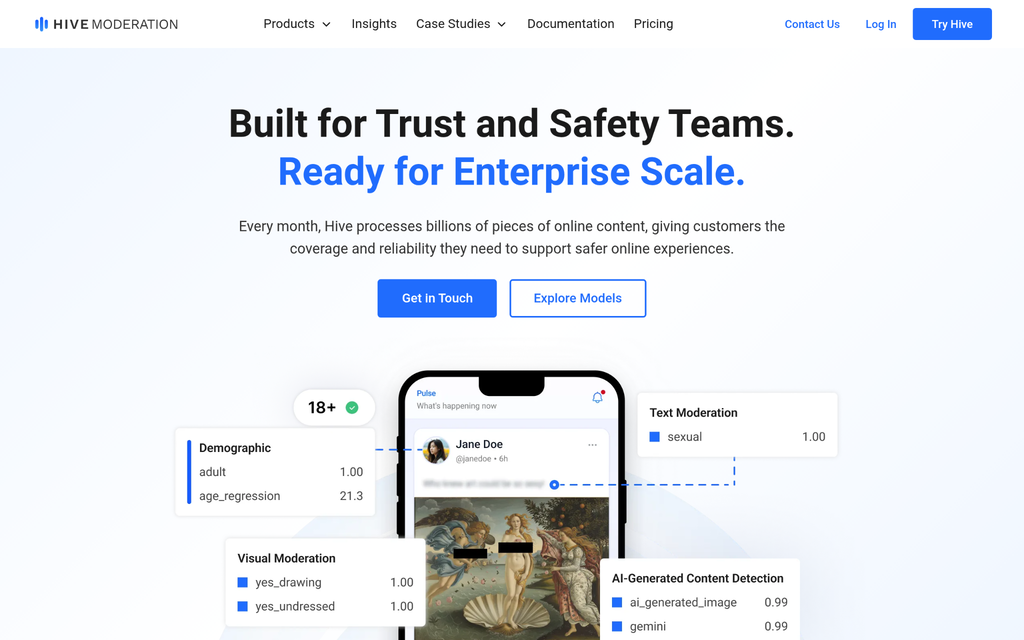
Hive Moderation was founded in 2016 and has built one of the more complete multimodal moderation platforms available today. They cover visual moderation, text moderation, audio moderation, CSAM detection, and even AI-generated content detection, all under one platform. They also offer a Vision Language Model and a moderation dashboard for teams who need visibility into what the system is catching. Clients like Yubo, Tango, and Chatroulette use the platform, which signals they’re comfortable with high-velocity, real-time content environments. Pricing is usage-based, which works well for platforms with unpredictable content volume spikes.
What Sets Hive Moderation Apart from Other AI Content Moderation Tools?
Most moderation vendors cover text well and treat visual or audio content as an afterthought. Hive’s architecture treats every modality as a first-class problem worth solving with dedicated models. That kind of multimodal depth is hard to match, especially for platforms where users send images, voice messages, and text in the same conversation thread.
What Users Are Actually Saying:
Teams using Hive tend to call out the breadth of detection categories as the reason they chose the platform. The AI-generated content detection piece is newer but getting attention fast, especially among platforms worried about synthetic media and deepfake-related policy violations. For a platform built after 2016, the feature depth is impressive.
4. CleanSpeak – Best for Enterprise Content Moderation and Profanity Filtering
How Does CleanSpeak Operate?
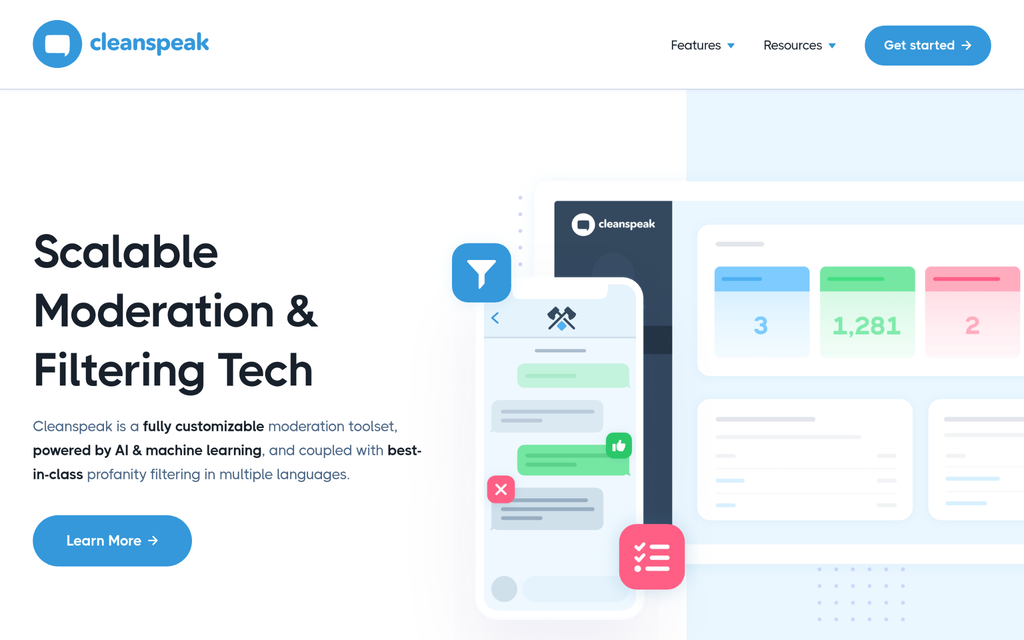
CleanSpeak has been building content filtering technology since 2007, giving them over 15 years of refinement across text, image, and video moderation. The platform combines traditional word and phrase filtering with machine learning models, which means it handles both explicit violations and more detailed content analysis. Response times average under 5 milliseconds, and the system can scale to 10,000+ messages per second (think high-traffic gaming or financial services environments). They’re SOC2 Type II certified and offer on-premise deployment options, which matters a lot for teams operating under strict COPPA or international data security requirements.
What Sets CleanSpeak Apart from Other AI Content Moderation Tools?
CleanSpeak fills a real gap for compliance-heavy industries like healthcare, education, and gaming, where both detection accuracy and data residency requirements have to be met at the same time. Fortune 500 clients choose them when customizable filtering and on-premise deployment flexibility are non-negotiable.
What Users Are Actually Saying:
Users consistently point to the customization depth as the standout feature. The ability to tune filtering rules to match a specific platform’s community standards, rather than relying on a generic preset, comes up repeatedly in feedback. For industries where a one-size-fits-all approach creates too many false positives, that flexibility clearly matters.
5. Bodyguard – Best for Enterprise Content Moderation and Community Protection
How Does Bodyguard Operate?
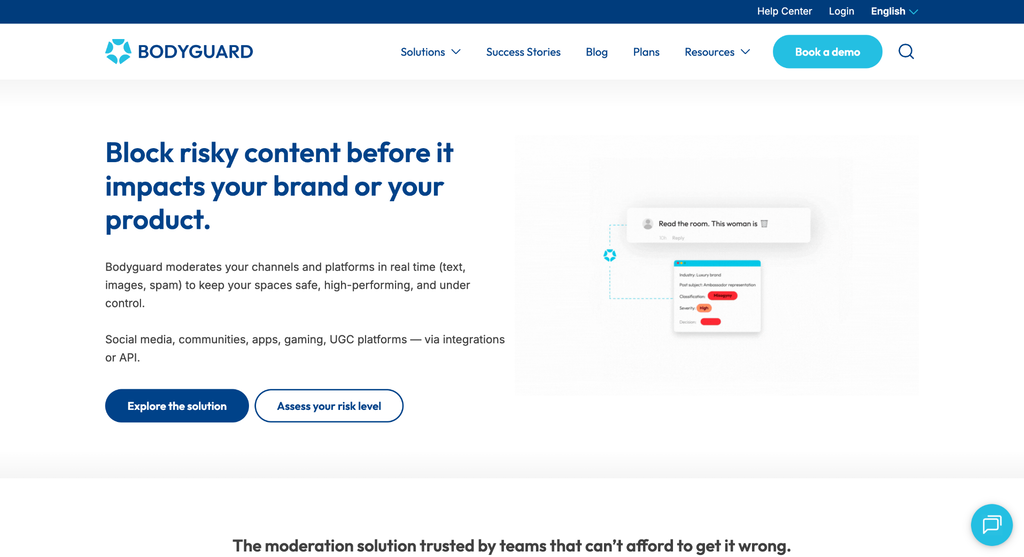
Bodyguard was founded in 2018 in Nice, France, and focuses on real-time protection against toxic and illegal content across text, image, and video. The platform blends AI with experienced linguists for human oversight, which helps keep false positive rates low on context-dependent content. They support optical character recognition, automated workflows, and customizable policy enforcement rules. Clients include the Alfa Romeo F1 Team Stake, M6 (a major French broadcaster), and several luxury brands. The company has raised $11.4M in funding and picked up recognition including the For Democracy Talent Award from France Digital and Les Echos.
What Sets Bodyguard Apart from Other AI Content Moderation Tools?
Live moderation environments, like broadcast comment sections or live event chat, are a different kind of challenge from standard asynchronous content review. Bodyguard’s platform is built for that real-time pressure. The linguist-in-the-loop model reduces the false positive rate on culturally sensitive or multilingual content in ways that a fully automated approach often can’t match.
What Users Are Actually Saying:
Enterprise clients in media and sports point to the real-time performance as a major value driver. The platform’s ability to moderate at the speed of a live broadcast without creating visible delays resonates with teams running public-facing events. From what the reviews show, the human linguist oversight layer is what separates Bodyguard from purely automated alternatives for those high-stakes use cases.
Methodology Behind These Picks
Gathering Source Data for Analysis
The initial research phase involved pulling together a broad pool of AI content moderation platforms from multiple source types. Company directories, software review platforms, industry publications, and official product documentation were all used to build the starting list. The goal at this stage was coverage, not filtering, so any platform with a meaningful presence in the content moderation space was included for initial consideration. Case studies and client references were collected alongside feature documentation to get a sense of how each platform performs in real deployments, not just what the marketing pages claim.
The Shortlist Cut
Once the full pool was assembled, platforms without verifiable public information were removed first. This included companies with no accessible case studies, no identifiable client references, and no reviews available on independent review platforms. What remained was then analyzed for review patterns across multiple sources. Platforms where feedback consistently pointed to a specific strength in AI-driven content moderation were prioritized. Single-source endorsements without corroboration were treated with caution, and only platforms where multiple independent data points told a consistent story moved forward.
Fact-Checking the Picks
Each shortlisted company’s self-reported claims were cross-checked against third-party sources. Where a company claimed performance outcomes like response times or accuracy rates, those claims were tested against what real users and case study clients reported. Discrepancies between what companies claim on their own sites and what appears in verified client feedback were noted. Platforms where the gap between marketing claims and documented results was large were moved down or removed. The final selections all showed reasonable alignment between what the company says and what the evidence supports.
Authority Signals and Industry Standing
Beyond functional performance, each company was evaluated for signals of standing in the broader content moderation industry. This covered things like industry award recognition, citations in relevant publications, original research published by the company, and participation in policy discussions around content safety. Companies that have contributed something to the field beyond just selling a product tend to produce better long-term results for their clients. Utopia Analytics publishing an Ethical AI handbook is one example of this kind of signal. Besedo’s two-decade history of building training data is another.
AI Content Moderation Tools Track Record
The final filter focused on content moderation track record rather than general AI capability. Dedicated service pages, documented client results, and verified reviews tied to moderation accuracy, policy coverage breadth, and moderation speed were weighted heavily. Platforms that cover AI broadly but lack specific evidence of content moderation performance at scale were excluded. Each company that made the final list has verifiable proof of doing this work, for real clients, at meaningful scale.
Picking the Right AI Content Moderation Tools for You
Choosing a content moderation tool isn’t just a feature comparison exercise. The right fit depends on your platform type, your regulatory situation, your content volume, and how much false positive risk your users will tolerate. Here’s what actually matters when you’re evaluating options.
- Industry/Domain Experience: Look for tools with documented results on platforms similar to yours. A tool built for news comment moderation performs differently on a gaming chat environment, and the detection models reflect that difference.
- Features and Service Options: Think about your content mix. If your platform has text, images, and audio all in one experience, you need a platform that handles all three with real depth, not just text as the main product.
- Pricing Structure: Usage-based pricing works well for platforms with variable content volume. Flat licensing models make more sense when volume is predictable. Get clarity on what happens to costs during a traffic spike.
- Results Measurement: Ask every vendor for precision and recall scores across their violation categories. A platform that can’t share performance benchmarks is one where the accuracy question isn’t settled.
- Industry Knowledge and Compliance: If your platform serves minors or operates under DSA, GDPR, or COPPA requirements, you need a vendor who has already built those requirements into their product, not one who will figure it out alongside you.
The Verdict
Picking the right AI content moderation tool comes down to your platform’s specific mix of content types, user base, and regulatory exposure. Besedo and Utopia Analytics bring serious depth on the data and language side. Hive covers multimodal needs better than most. CleanSpeak wins on customization and compliance flexibility. Bodyguard is the strongest option for real-time live environments. As content volume and regulatory requirements keep growing, the gap between purpose-built moderation tools and generic alternatives will only widen.