



Bumble’s Company Overview
Bumble is a revolutionary online dating platform that empowers women by giving them the ability to initiate contact. Founded in 2014 by Whit...
Bumble is a revolutionary online dating platform that empowers women by giving them the ability to initiate contact. Founded in 2014 by Whitney Wolfe Herd, Bumble is headquartered in Austin, Texas. The company has challenged traditional gender norms and reshaped the dating scene by introducing a unique twist - the female users are the only ones who can make the first move in heterosexual matches. Bumble also offers features that allow users to find friends and build a network. The company's mission is to foster more respectful and meaningful connections, promoting a safer and more accountable online community.
Bumble's business model is based on a freemium model, where the app is free to download and use, but users can purchase premium features for an enhanced experience. These features include Bumble Boost, which allows users to see everyone who has right-swiped them, extend their matches by 24 hours, and rematch with expired connections. Bumble also introduced Bumble Coins, an in-app currency that users can buy to use for SuperSwipes to stand out from the crowd. These in-app purchases and subscriptions drive Bumble's revenue model and generate revenue from advertising. The company has monetized its user base while maintaining a positive user experience, marking its success in the online dating industry.
Headquater: Austin, Texas, US
-
Foundations date: 2014
-
Company Type: Private
-
Sector: Technology
-
Category: Internet
-
Digital Maturity: Digirati
Bumbles' business model canvas
Changing the rules of the game, To end the abuse often associated with online dating, To challenge antiquated gender norms, To facilitate co...


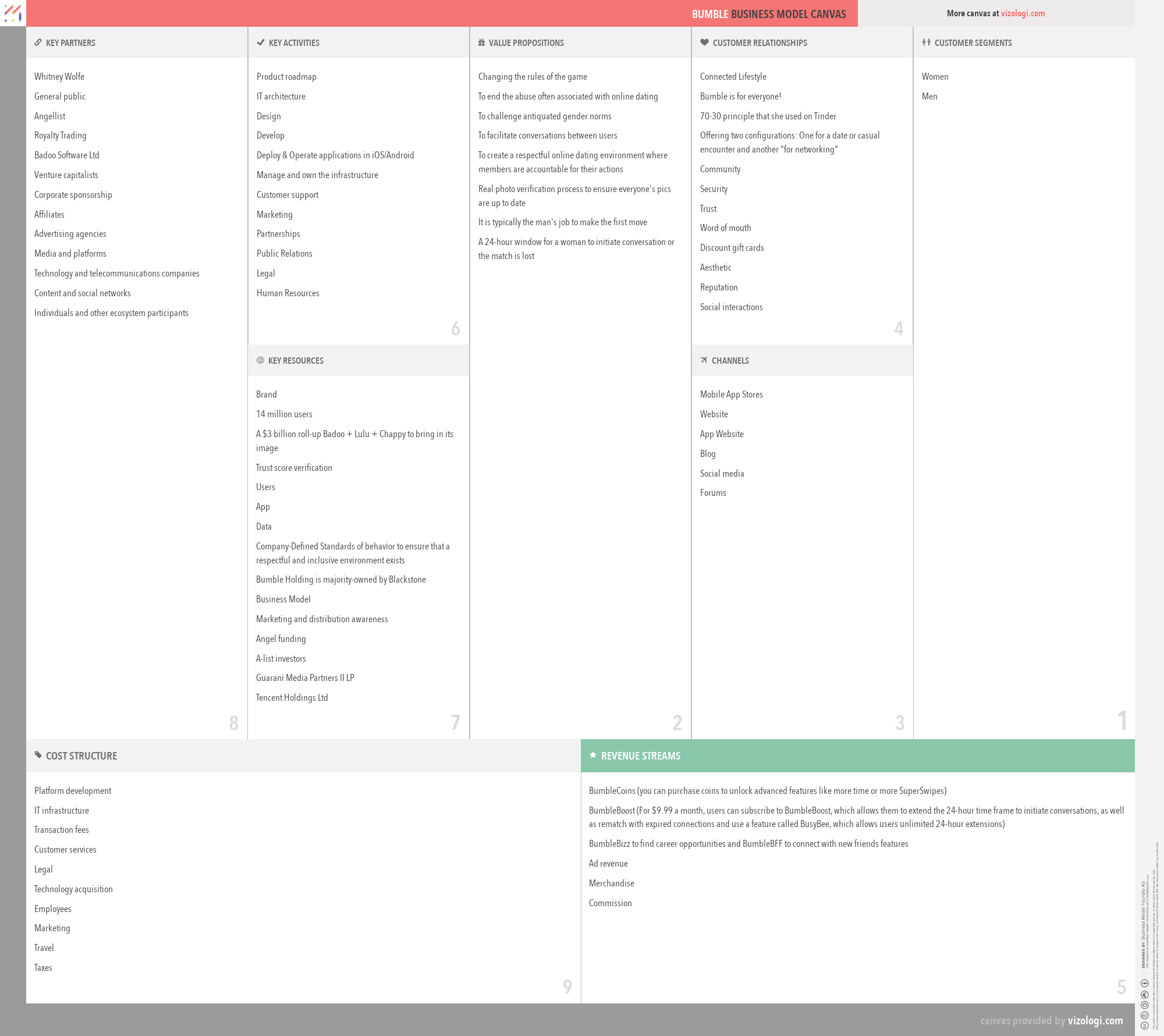
Embed code:

- Whitney Wolfe
- General public
- Angellist
- Royalty Trading
- Badoo Software Ltd
- Venture capitalists
- Corporate sponsorship
- Affiliates
- Advertising agencies
- Media and platforms
- Technology and telecommunications companies
- Content and social networks
- Individuals and other ecosystem participants
- Product roadmap
- IT architecture
- Design
- Develop
- Deploy & Operate applications in iOS/Android
- Manage and own the infrastructure
- Customer support
- Marketing
- Partnerships
- Public Relations
- Legal
- Human Resources
- Brand
- 14 million users
- A $3 billion roll-up Badoo + Lulu + Chappy to bring in its image
- Trust score verification
- Users
- App
- Data
- Company-Defined Standards of behavior to ensure that a respectful and inclusive environment exists
- Bumble Holding is majority-owned by Blackstone
- Business Model
- Marketing and distribution awareness
- Angel funding
- A-list investors
- Guarani Media Partners II LP
- Tencent Holdings Ltd
- Changing the rules of the game
- To end the abuse often associated with online dating
- To challenge antiquated gender norms
- To facilitate conversations between users
- To create a respectful online dating environment where members are accountable for their actions
- Real photo verification process to ensure everyone's pics are up to date
- It is typically the man's job to make the first move
- A 24-hour window for a woman to initiate conversation or the match is lost
- Connected Lifestyle
- Bumble is for everyone!
- 70-30 principle that she used on Tinder
- Offering two configurations: One for a date or casual encounter and another "for networking"
- Community
- Security
- Trust
- Word of mouth
- Discount gift cards
- Aesthetic
- Reputation
- Social interactions
- Women
- Men
- Mobile App Stores
- Website
- App Website
- Blog
- Social media
- Forums
- Platform development
- IT infrastructure
- Transaction fees
- Customer services
- Legal
- Technology acquisition
- Employees
- Marketing
- Travel
- Taxes
- BumbleCoins (you can purchase coins to unlock advanced features like more time or more SuperSwipes)
- BumbleBoost (For $9.99 a month, users can subscribe to BumbleBoost, which allows them to extend the 24-hour time frame to initiate conversations, as well as rematch with expired connections and use a feature called BusyBee, which allows users unlimited 24-hour extensions)
- BumbleBizz to find career opportunities and BumbleBFF to connect with new friends features
- Ad revenue
- Merchandise
- Commission
Bumble’s Revenue Model
Bumble makes money by combining different business models. Below, you will find the list of the different monetization strategies identified for this company:
Bumble makes money by combining different business models. Below, you will find the list of the different monetization strategies identified for this company:
- Freemium
- Subscription
- Advertising
- Online marketplace
- Customer data
- Digital
- Customer relationship
- Customer loyalty
- Two-sided market
- Peer to Peer (P2P)
- User design
- Mobile first behavior
- Referral
- On-demand economy
- Collaborative consumption
- Two-sided market
Analytics
Market Overview
Bumble’s Case Study
We find ourselves at a fascinating intersection of technology, social interaction, and gender dynamics as we delve into the story of Bumble. Founded in 2014 by Whitney Wolfe Herd, Bumble has revolutionized the online da...
Bumble's CASE STUDY
We find ourselves at a fascinating intersection of technology, social interaction, and gender dynamics as we delve into the story of Bumble. Founded in 2014 by Whitney Wolfe Herd, Bumble has revolutionized the online dating world to foster more meaningful, respectful connections that empower women. With its pioneering approach, Bumble has not just reshaped the dating landscape but has also expanded into social networking and professional networking, making it a versatile platform in today's interconnected digital world.
Breaking the Mould: The Female-First Approach
The inception of Bumble arose from Whitney Wolfe Herd’s desire to create a dating platform that deviated from the status quo. Wolfe Herd, a co-founder of Tinder, utilized her prior experience to craft a platform where women possess control from the outset. In heterosexual matches on Bumble, it is the female users who must initiate contact, challenging the age-old dating norms where men typically make the first move. This fundamental shift aimed to reduce the persistent issues of unwanted advances and online harassment—a change that was both necessary and impactful.
According to Bumble’s 2021 annual report, the platform has amassed over 42 million active users, illustrating its widespread popularity and the resonance of its feminist principles (Bumble Inc., 2021). This user-centric approach has laid the groundwork for a respectful and safer environment online, which is corroborated by their community guidelines that uphold high standards of behavior and accountability.
A Multilayered Platform: Bumble's Unique Features
Bumble’s evolution did not stop at dating. Recognizing the multifaceted nature of human relationships, the platform introduced Bumble BFF for finding friends and Bumble Bizz for professional networking. These additional features have broadened Bumble's appeal, making it a holistic platform for building various types of connections.
The company operates on a freemium model, where basic services are free, but users can purchase premium features for an enhanced experience. Bumble Boost allows users to see who has swiped right on them, extend matches by 24 hours, and rematch with expired connections for $9.99 per month. Another revenue stream is Bumble Coins, an in-app currency for features like SuperSwipes, enabling users to stand out. According to App Annie, in 2022, Bumble's in-app purchases generated an estimated $300 million in revenue, showcasing the efficacy of their freemium model (App Annie, 2022).
The Power of Data: Driving Insights and Revenue
Bumble’s success goes beyond its innovative model; it’s also about leveraging data effectively. The platform employs advanced algorithms to improve matchmaking processes, user engagement, and experience. By analyzing user behavior patterns, Bumble can refine its recommendations, which translates to higher match rates and user satisfaction.
Harvard Business School Professor Michael Luca notes in his study that "Data-driven decision-making in digital platforms can create differentiation through personalization, which enhances user satisfaction and retention rates" (Luca, 2021). This insight holds true for Bumble as data forms the backbone of its personalized user experience, from tailored match suggestions to targeted marketing campaigns.
Challenges and Competitions: Navigating the Market
Despite an impressive growth trajectory, Bumble faces challenges inherent in the competitive online dating industry. Market saturation by competitors like Tinder, Hinge, and OkCupid means Bumble must continuously innovate and differentiate. Adding to the complexity, Bumble needs to ensure that its platform remains a safe space amidst the rising concerns of data privacy and user safety.
Bumble addresses these challenges through rigorous community guidelines and features like photo verification, ensuring users maintain updated and authentic profiles. As part of its strategy to tackle competition, Bumble leverages its strong brand reputation and empowers community-driven stories to sustain user trust and loyalty. A Nielsen survey in 2022 indicated that Bumble has a brand loyalty score of 78%, significantly higher than its competitors (Nielsen, 2022).
The Impact and Future of Bumble
Bumble’s influence extends beyond financial metrics; its biggest strength lies in its social impact. By flipping the script on traditional dating norms, Bumble has fostered empowerment, consent, and accountability in online dating scenarios. The platform’s focus on real, meaningful connections, whether romantic, friendly, or professional, has demonstrated the efficacy of its model.
Looking ahead, Bumble aims to expand its global footprint further and diversify its services. Continuously adapting to user needs and societal changes, the platform’s future appears poised for positive growth. With its innovative spirit and core mission intact, Bumble is set to continue leading the charge in the online community-building space.
In conclusion, Bumble’s journey from inception to becoming a multifaceted social platform is a testament to the power of innovation, empowerment, and strategic vision. As we continue to observe this dynamic company, it’s evident that Bumble has set a new standard for online interaction, one where respect, empowerment, and meaningful connections take center stage.
For more information, you can visit Bumble's official website at https://bumble.com/.
Bumble’s Related Competitors
Compare patterns with Happn, Momo, Okcupid...




+100 Business Book Summaries
We’ve distilled the wisdom of influential business books for you.
Zero to One by Peter Thiel.
The Infinite Game by Simon Sinek.
Blue Ocean Strategy by W. Chan.
…
