
Validating an invention idea means testing whether buyers want the result, whether the idea already appears in patents or other public material, and whether the way it is tested leaves patent rights intact, all before money goes into a prototype. Market research addresses the first. A prior art search and the disclosure rules of 35 U.S.C. 102 address the second and third. Official US sources are named beside each check.
Questions a prototype leaves open
A working prototype shows that a design can be built. Whether anyone will pay for it, whether it already exists in print, and whether public testing has started a legal clock are separate matters, and building the prototype answers none of them.
Each question has its own evidence. Interest from buyers appears in market data and consumer research. Novelty is recorded in patents and publications. Timing comes down to dates: the first public showing or offer of the idea, and the filing of an application.
Market checks that come first
The U.S. Small Business Administration writes its guidance for people starting a small business, and the questions carry over to a product idea. SBA describes market research as a way to confirm and improve a business idea. It asks about the level of demand and the number of interested people; about income and employment where customers live; and about how many similar options consumers already have and what they pay for those alternatives.
SBA separates existing sources from direct research. Existing sources save time and energy but may not be specific to the audience, and SBA recommends them for general, quantifiable questions such as industry trends or demographics, along with household incomes, pointing to NAICS classifications, the U.S. Census Business Builder, the U.S. Census Bureau and the Bureau of Labor Statistics. Direct research means surveys and questionnaires as well as focus groups and in-depth interviews. It gives a more nuanced view of a specific audience, and SBA warns that it can be time consuming and expensive.
Direct research has a patent consequence of its own. A survey or focus group that reveals how the invention works may count as a disclosure under 35 U.S.C. 102, and whether it does depends on facts that a registered practitioner can assess. What respondents will be shown should be decided before direct research starts.
SBA pairs this research with a competitive analysis. It identifies rivals by product line or service and by market segment, then assesses market share together with strengths and weaknesses; the window of opportunity for entering; how much the target audience matters to those competitors; barriers to entry; and indirect or secondary competitors. It adds that several industries may compete for the same customers, so the level of competition, the threat of new competitors or services, and the effect of suppliers and customers on price all belong in the analysis. SBA also provides counseling through its resource partner network.
A sound result is a short written statement of who the buyer is, what alternatives exist today and what they cost. It also supplies the vocabulary for the patent search that follows.
Why a patent search counts as validation
What a patent protects frames the search. USPTO states that a U.S. patent gives the inventor the right to exclude others from making, using, offering for sale or selling the invention, or from importing it into the United States. What is granted is the right to stop others, and U.S. patents are effective only within the United States and its territories and possessions.
USPTO names three types of patent: utility patents for a new or improved and useful process, machine, article of manufacture or composition of matter; design patents for a new and original ornamental design; and plant patents for a distinct and new variety of plant.
Under 35 U.S.C. 102(a)(1), a person is entitled to a patent unless the claimed invention was patented, described in a printed publication, or in public use, on sale, or otherwise available to the public before its effective filing date. Section 102(a)(2) adds earlier-filed applications and patents that name another inventor and were published or issued. USPTO’s 2016 search guide defines prior art as “any previous publication that discloses an invention and would preclude issuance.”
Novelty is only one test. Under 35 U.S.C. 103, a patent may not be obtained even when the claimed invention is not identically disclosed, if the differences between it and the prior art are such that the invention as a whole would have been obvious to a person having ordinary skill in the art. A search therefore looks for two kinds of documents: those that match the idea, and those that differ from it only slightly.
Both tests make the search a form of validation. A close earlier document can end or reshape an idea before any prototype is built.
A USPTO search path
USPTO’s Multi-Step U.S. Patent Search Strategy page, last updated May 7, 2024, sets out a preliminary search of U.S. patents and published applications in this order.
- Brainstorm terms describing the invention. Think of alternative words for the concept.
- Run a keyword search in Patent Public Search. Begin with a broad search on the main concept, narrow it by adding features of the invention, and review the front pages of patents and published applications, eliminating those that are irrelevant.
- Review the documents found in depth. Read the complete patents and published applications that resemble the invention, drawings, specification and claims included.
- Expand the search with CPC classifications. Select a relevant classification from the USPTO Classification Resources page and use it in the Advanced Search of Patent Public Search with the .CPC. field code.
- Review cited references. The front page of a patent lists references cited by the applicant or the examiner, and Patent Public Search can search both backward and forward citations.
- Broaden the search beyond U.S. patents. Add foreign patents and non-patent literature such as books and journals, websites and technical catalogs, as well as conference proceedings, and consider review by a registered patent attorney or agent.
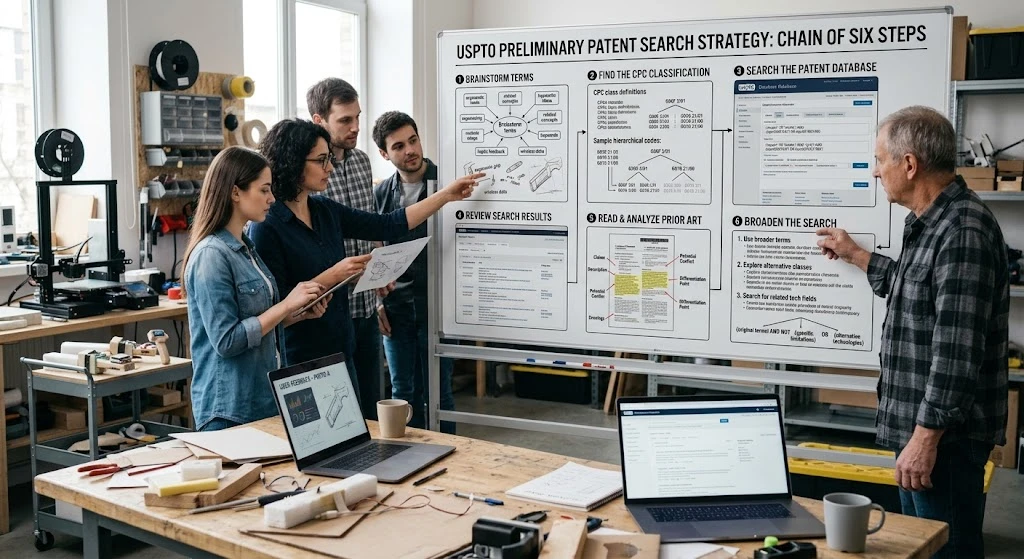
Order of the USPTO multi-step search strategy, from brainstorming terms to broadening the search.
USPTO tells searchers to plan on spending hours, first on learning the process and then on searching and evaluating results, with the time depending on the complexity of the invention. It asks them to record the databases used; the date and time of the search; the keywords searched; and which patents and published applications were retrieved.
Help available at each stage
USPTO runs several programs for inventors, and one commercial engine sits beside them.
| Resource | What it offers | Conditions |
|---|---|---|
| Patent Public Search (USPTO) | Search of U.S. patents and patent application publications | USPTO account required beginning November 7, 2026 |
| Google Patents | Full-text patent search | Operated by Google, not by the USPTO |
| Patent and Trademark Resource Centers | Library network whose staff show how to use search tools, explain the application process, help with the USPTO directory of local patent attorneys, and offer classes at some locations | Staff cannot provide legal advice |
| Inventors Assistance Center | Answers on examining policy, formats, forms and fees from former supervisory and primary examiners, by telephone at 800-786-9199 | General information only |
| Patent Pro Bono Program | Attorney representation for inventors and small businesses with limited resources | Varies by region; generally a household income limit (usually 300% of federal poverty levels), knowledge of the patent system and an invention, not just an idea |
Patent Public Search lists training materials and quick reference guides alongside tutorial videos on its landing page. USPTO’s Assignment Center shows patent assignments and changes in ownership, which tells a searcher who holds the documents found. The Inventors Assistance Center page adds a patent process overview, a step-wise guide that runs from types of protection through filing and examination to patent grant and maintenance, along with a utility application filing checklist.
Pro bono help requires that the applicant has an invention rather than only an idea, and that places the program after the validation work. It supports applying for a patent, which comes after validation.
Limits of a search result
USPTO labels its method a preliminary search. Step six exists because the first five steps stop at U.S. patents and published applications. A preliminary search is evidence of what is easy to find. It does not clear the idea.
Timing limits what any search can see. Under 35 U.S.C. 122(b), applications are in general published promptly after 18 months from the earliest filing date for which a benefit is sought, and at the request of the applicant an application may be published earlier. An application filed inside that window generally will not appear in the databases, although section 102(a)(2) can still treat it as prior art once it publishes.
Comparing features one by one turns the statutes into a working method, though not an official USPTO procedure. List the technical features of the idea, then for each close document mark which features it discloses and which it leaves out. A single document that discloses every feature is the case section 102 addresses. Several documents that together disclose every feature raise section 103’s obviousness question. Features that no document discloses mark where the idea differs from the record.
The comparison also gives each outcome a next move. If one document discloses every feature, the idea as described needs rethinking. If a combination of documents covers every feature, the matter belongs with a registered practitioner. If features remain undisclosed, those features together with the dated description of the idea are the material for deciding about a provisional application. An empty result does not prove that nothing exists, so each document found and each difference from the idea should be written down.
Disclosure while you test
Testing an idea often means showing it. Under 35 U.S.C. 102(b)(1), a disclosure made one year or less before the effective filing date of a claimed invention is not prior art under section 102(a)(1) if the inventor or a joint inventor made it, or if another person obtained the subject matter from the inventor. That exception covers the inventor’s own disclosures.
Another limb, section 102(b)(1)(B), applies when another person’s disclosure inside the same year came after the inventor had already publicly disclosed the same subject matter. Because the year is counted back from the filing date, the filing date is what fixes the deadline.
Sales are treated separately from publications. In Helsinn Healthcare S.A. v. Teva Pharmaceuticals USA, Inc., 586 U.S. 123 (2019), decided on January 22, 2019, a unanimous Supreme Court held that a commercial sale to a third party who is required to keep the invention confidential may place the invention on sale under section 102(a). A confidentiality agreement therefore does not remove a sale from that category. Foreign rules on disclosure differ, so a plan with rights abroad needs counsel before any showing.
Any plan that includes offers or sales to test demand (pre-orders included) belongs in a conversation with a registered patent attorney or agent before it starts. Nothing here is legal advice: this article reports statute text and a Supreme Court holding, together with USPTO guidance.
The provisional application
Provisional applications for patent are filed under 35 U.S.C. 111(b) as U.S. national applications. USPTO says the format allows filing without a formal patent claim or an oath or declaration, and without an information disclosure statement, and that it was designed to give a lower-cost first filing. Examination does not take place. It establishes an early effective filing date for a later nonprovisional application and allows the term patent pending to be used.
USPTO states that pendency lasts 12 months from the filing date and that the period cannot be extended. A nonprovisional filed more than 12 months but within 14 months afterward may have the benefit restored by a petition that includes a statement that the delay was unintentional and the required fee, under 37 CFR 1.78. Under 35 U.S.C. 119(e)(1), the later application must be filed within the period and must contain a specific reference to the earlier filing.
Content matters as much as the date. Section 111(b)(1) requires a specification as prescribed by section 112(a) and a drawing as prescribed by section 113, and section 119(e)(1) gives the earlier date only for an invention disclosed in the manner provided by section 112(a) in the provisional. A thin description therefore secures a thin date. USPTO publishes presentation slides on drafting and filing a provisional application, updated June 2023.
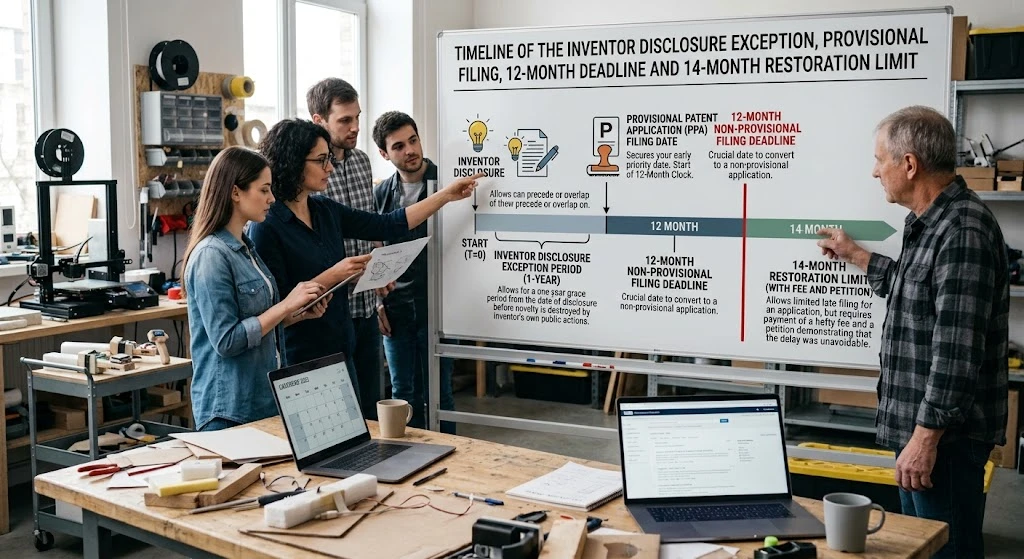
Deadlines from 35 U.S.C. 102(b)(1) and 119(e) and the USPTO provisional application guidance.
USPTO fees by stage
USPTO’s fee schedule, effective January 19, 2025 (last revised August 14, 2026), lists the filing fees below. USPTO states that a 60% discount on most patent-related fees is available to small entities and 80% to micro entities, and each status carries its own conditions. Attorney fees and other costs come on top.
| USPTO fee | Standard | Small entity | Micro entity |
|---|---|---|---|
| Provisional application filing fee | $325 | $130 | $65 |
| Utility application: filing, search and examination, filed electronically | $2,000 | $730 | $400 |
The basic utility filing fee in the USPTO schedule revised August 14, 2026 is $350 at the standard level; search and examination fees add $770 and $880. A small entity filing electronically pays a $70 basic filing fee. With search and examination fees of $308 and $352 that gives $730. A micro entity pays $70 plus $154 and $176, for $400.
Paid evaluation and promotion services
Evaluating an invention’s commercial potential is sometimes sold as a service. USPTO’s scam prevention page states that a patent application should be handled by a registered practitioner (an attorney or agent registered to practice before the USPTO), and that a service priced too good to be true very likely is. Invention promotion firms form a separate category. USPTO does not investigate complaints against them. Under the American Inventors Protection Act of 1999 it provides a public forum where complaints and the firms’ responses are published.
USPTO advises checking the reputation of any promoter before making a commitment, asking current clients for references, consulting the Better Business Bureau and local chambers of commerce, and staying wary of any firm that promises too much or costs too much.
Congress set a disclosure duty in 35 U.S.C. 297(a). Before a contract for invention promotion services, the promoter must give the customer a written statement covering: the number of inventions it evaluated for commercial potential in the past five years, with the number evaluated positively and negatively; the number of customers who contracted with it in that period, excluding buyers of trade show services and other nonmarketing services (research and advertising among them); the number of customers known to have received a net financial profit, and the number known to have received license agreements, as a direct result of the services; and the names and addresses of the promoter’s previous invention promotion companies.
Records worth keeping
Records that keep their value include the search log USPTO asks for: the databases used; the dates and times; the keywords; each document retrieved. A dated written description of the idea belongs there too, with each change made to it and the reason, as does a list of the date of each showing and each offer or sale, because the one-year period in section 102(b)(1) and the 12-month period for a provisional both run from dates.
USPTO’s earlier 2016 search guide gives a practical reason for the search log. After a preliminary search, an inventor is better prepared to discuss the invention and related inventions with a patent professional, and the professional does not have to spend time and fees on basics.
Where software fits
Precursal calls itself an AI platform for ideas and patents. Its home page says it helps users explore ideas; uncover white space; research prior art; document human conception; and prepare stronger materials for patent counsel. The process listed there starts with an idea, moves through finding white space and mapping the patent landscape, and reaches a step that reviews prior art and compares technical features, then refines the invention, before a final step that prepares for the patent process.
That prior art step corresponds, as framed here, to the in-depth review of documents found. Precursal reads an idea across the dimensions of novelty; overlap; differentiation; contribution; and competition. It describes overlap as where the idea may intersect with existing claims or disclosures. A guided assistant, Professor Eddi, helps users explore an idea and understand prior art and white space, then decide what to refine next. The home page currently invites visitors to join a waitlist for early access. Precursal states that it is not a law firm and that it surfaces prior-art signals and research insights without determining or guaranteeing novelty, patentability, validity or enforceability.