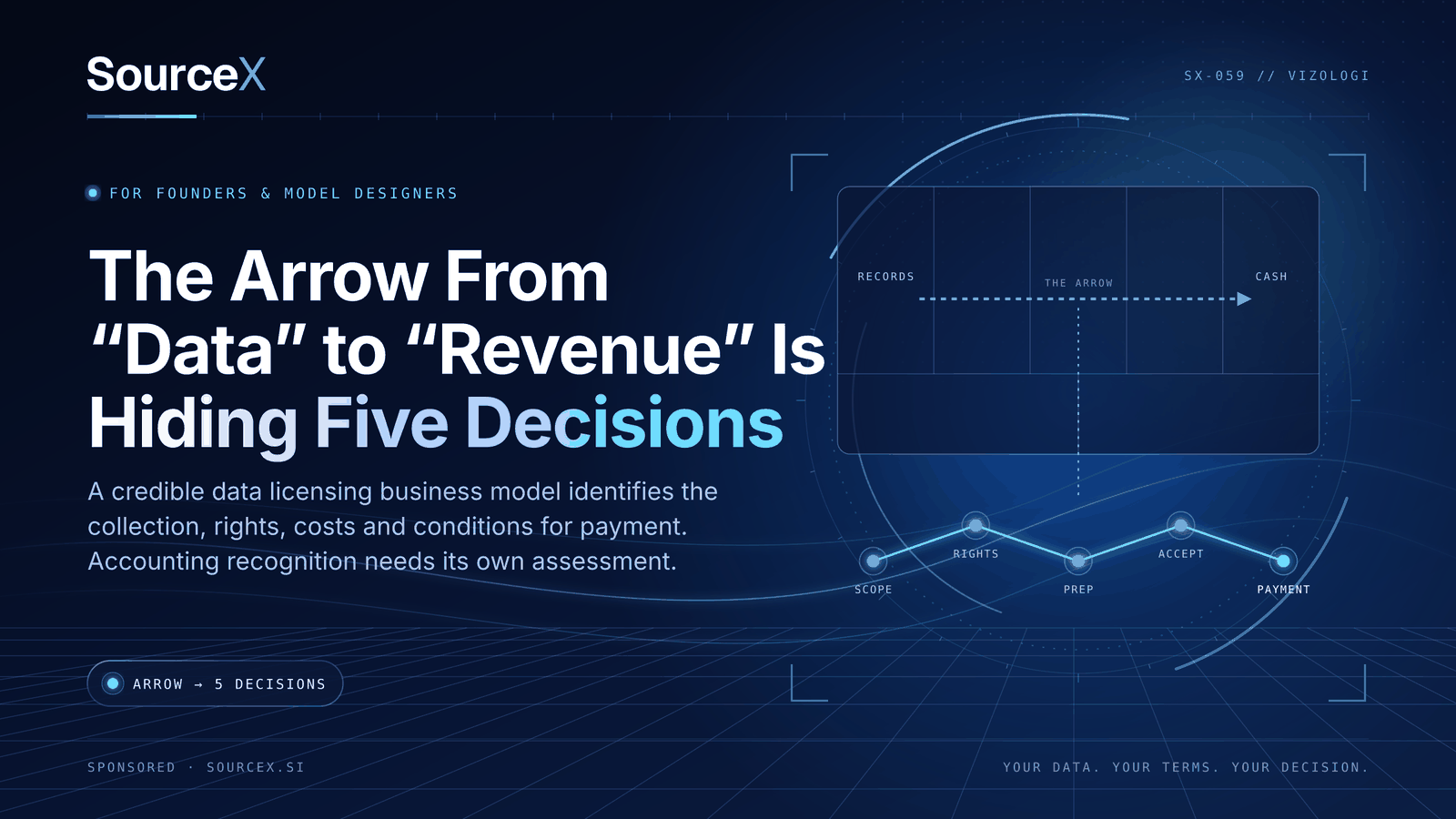
A credible data licensing business model identifies the collection, rights, costs and conditions for payment. Accounting recognition needs its own assessment.
You have probably drawn it yourself: a box labeled “our data,” an arrow, and a box labeled “new revenue.” It looks clean on the canvas, and it is where most of the real decisions go to hide.
A data licensing business model has to answer the questions the arrow skips. Which collection is on offer? Who is the counterparty? Who prepares it and pays those costs? Does the fee repeat, and which conditions have to be met before payment?
Answer those, and you have a commercial route. Skip them, and you have a revenue line supported by the fact that an archive exists.
Decision one: what is the asset, really?
“Years of business data” is not a value proposition. Nobody outside your company can assess it.
Describe the asset by the work it explains. A support history might connect a customer request to the actions taken and the outcome. A procurement archive might connect a supplier dispute to the evidence reviewed and the credit note that settled it.
Then write down the boundaries: missing years, duplicates, outcomes nobody recorded. The canvas should show what the company can actually offer, not an idealized version of its systems.
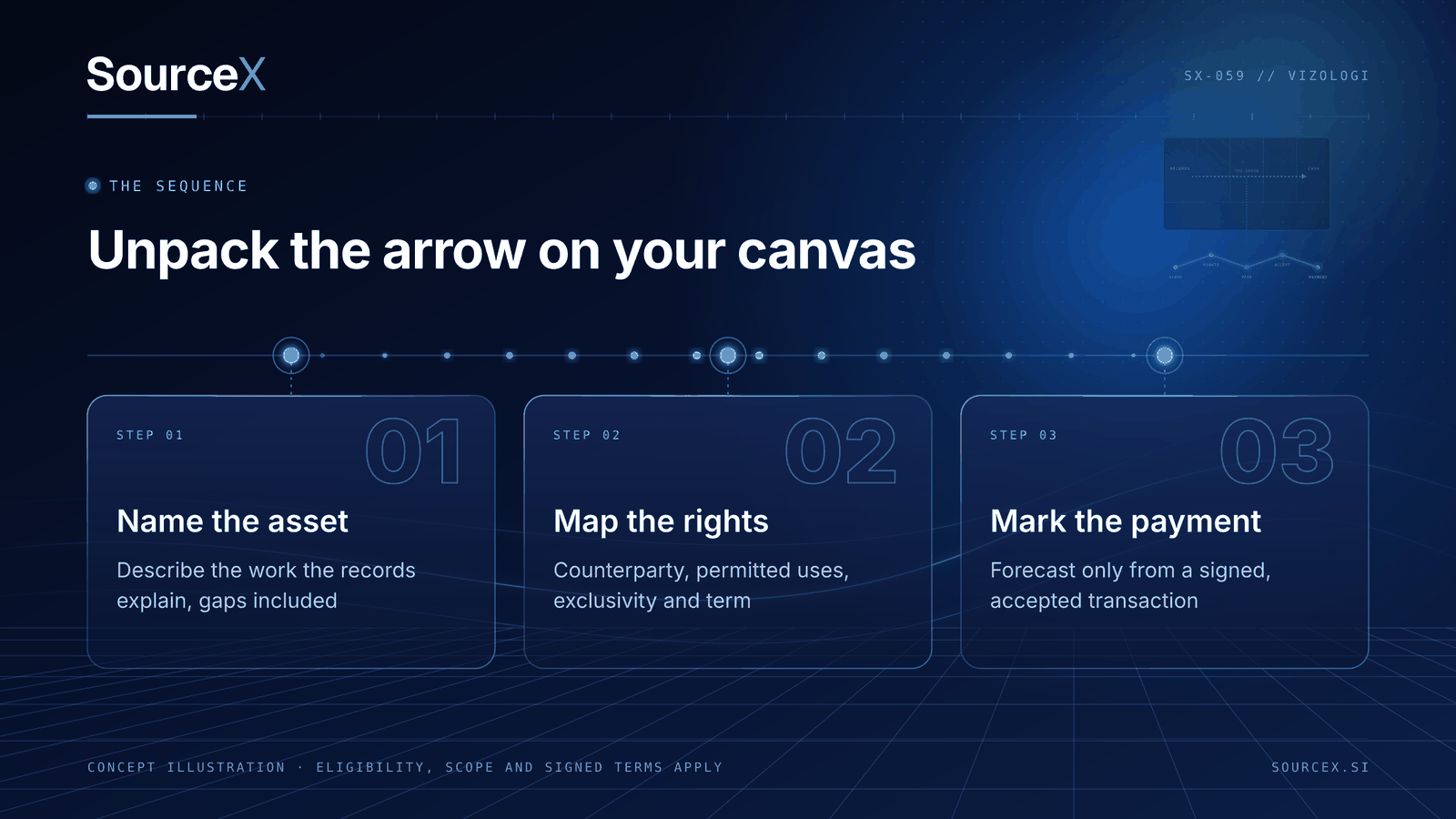
Unpack the arrow on your canvas. A conceptual sequence drawn from this article, not a measured result or a completed transaction.
Decision two: who is on the other side of the table?
Name the counterparty before you name a price. Then pin down who signs with the supplier, which purposes, recipients and onward uses are permitted, and what the deal restricts about your other AI licensing or future products.
Those answers change the value proposition. The supplier can hold on to the original records and still grant a buyer substantial, lasting rights over the prepared copy.
The company keeps ownership of its original records. Selected data is exclusive to SourceX for AI training for the term in the Dataset Deal Confirmation. Separately, SourceX’s rights over the deidentified dataset are perpetual, irrevocable, transferable and sublicensable, including model training and evaluation, use in products and onward distribution. Once the fee is paid, those rights survive termination, with no obligation to untrain or delete models already built from the data.
If SourceX is the route, model it as what it is: a direct license with SourceX as the counterparty, not a marketplace listing or a brokerage commission.
Decision three: preparation is a cost line, not a footnote
Inventory work, export support, rights review, security review and delivery all consume time. Your model should say which party performs each activity and which party funds it.
Some of those costs land before a deal is certain, so keep that uncertainty visible. A realistic map does not kill the opportunity; it lets you compare it honestly with other uses of your team’s time and capital.
A historical snapshot does not become an annual revenue stream just because the company keeps operating.
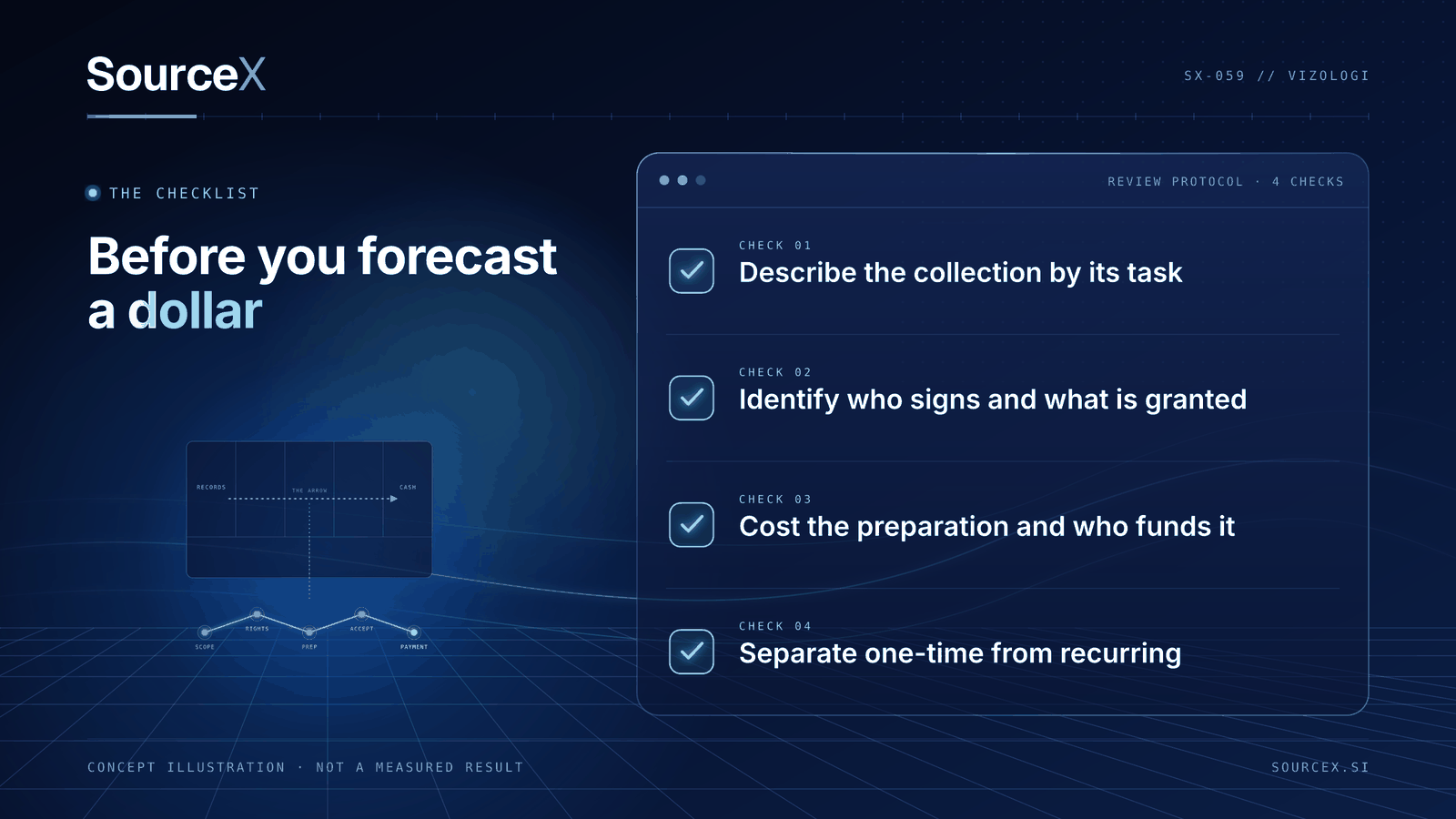
Before you forecast a dollar: the four checks this article walks through.
Decision four: one-time fee or recurring stream?
This is where many canvases overstate the economics.
Take SourceX’s model as a concrete reference point: the supplier contracts with SourceX directly, and SourceX’s public materials describe a usual one-time fee for a selected dataset. Some agreements provide for recurring deliveries, paid under their own terms, but the standard materials do not promise royalties or usage fees.
SourceX advertises up to $4 million for the largest enterprise datasets. Keep that ceiling out of a base-case forecast: it is not a typical payout, a valuation of your archive or a promise of repeatable revenue. The signed Dataset Deal Confirmation fixes the selected records, payout and terms; acceptance and Closing still have to follow.
A historical snapshot does not become an annual revenue stream just because the company keeps operating.
Decision five: which conditions lead to payment?
Map the commercial stages separately rather than treating interest, signature, invoice and cash as one event:
- Qualification: do the company and collection fit?
- Indicative pricing: a non-binding range, not an accepted purchase.
- Signing: a Master Supplier Licensing Agreement once after qualification, then a Dataset Deal Confirmation fixing the specific deal. The Master begins the initial inventory assessment, up to 30 days.
- Delivery and review: extraction requires both signed documents and SourceX’s go-ahead. The separate delivered-data review runs up to 30 calendar days from the event in the Confirmation; SourceX may accept sooner or decline.
- Closing, invoice and payment: written acceptance and all Closing conditions produce a Closing Notice. The company then invoices; payment is due within 60 calendar days after SourceX receives a valid invoice unless different terms are signed.
Forecast cash from the actual terms and remaining conditions, with indicative opportunities shown separately. Data that does not reach Closing earns no payment. Finance must assess revenue recognition under the accounting rules applicable to the company; signature, acceptance, invoicing and cash receipt are not interchangeable accounting tests.
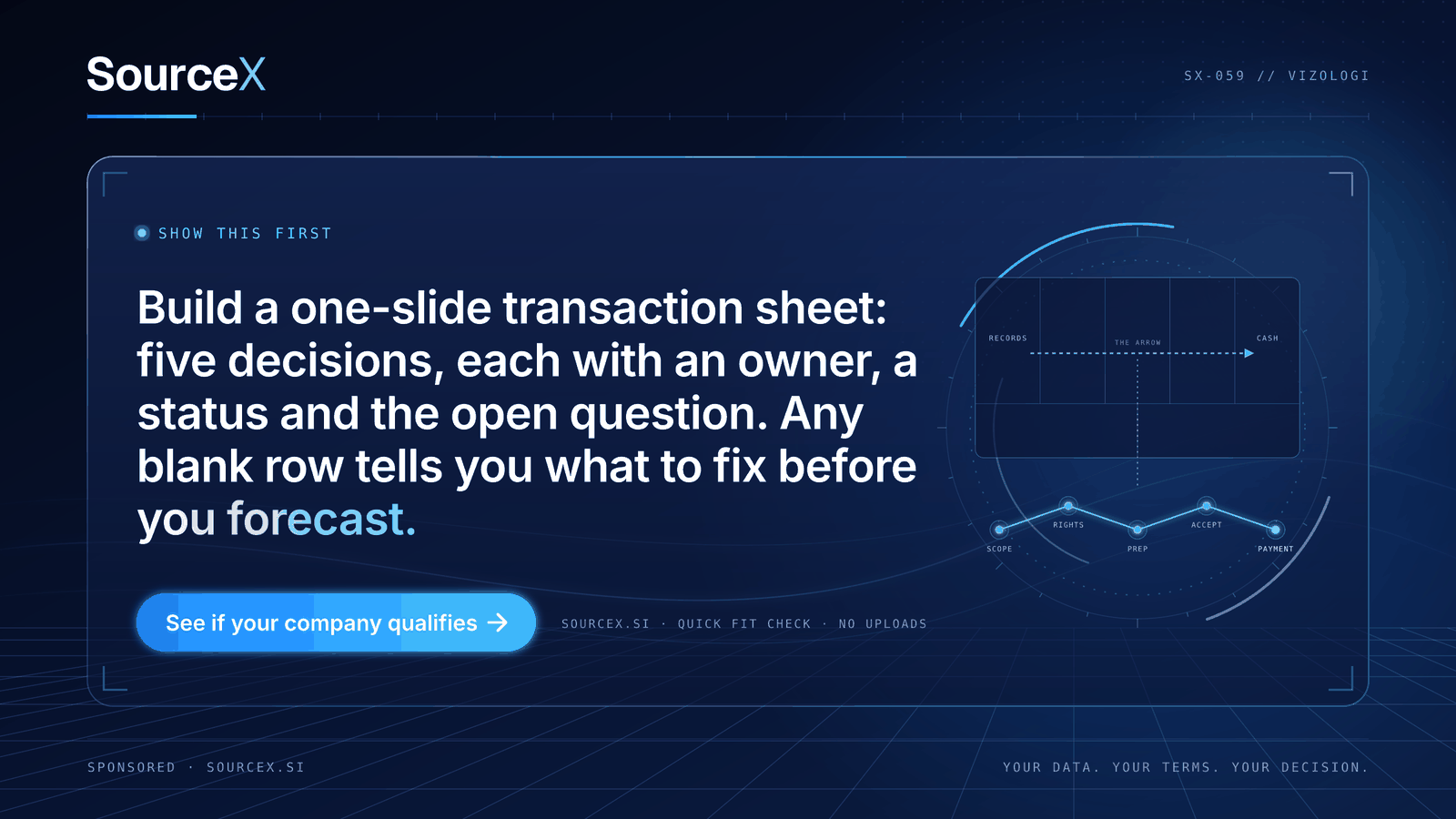
Show this first: Build a one-slide transaction sheet: five decisions, each with an owner, a status and the open question. Any blank row tells you what to fix before you forecast.
What should the business model show first?
It should show a one-slide transaction sheet: five rows, one for each decision above, each with an owner, a status and the question still open. If any row stays blank, narrow the collection or name the missing decision before anyone forecasts a dollar.
Investors and boards reviewing a data licensing business model do not need a bigger arrow. They need to see how ordinary records become an authorized, prepared and accepted dataset.
That is the work hidden inside the first arrow on the canvas. Draw it, and the opportunity becomes something you can defend.
Start with SourceX‘s no-upload company fit check if the five decisions support a licensing conversation. Put indicative opportunities, contractual cash conditions and accounting conclusions on separate lines in the model.