

When a sender domain’s bounce rate climbs past 2%, major inbox providers can flag it, throttle it, or push it onto a blacklist. That’s not a worst-case scenario; it’s a threshold most ESPs actively enforce. A good email verifier catches bad addresses before they ever touch your sending infrastructure, which is exactly why picking from the top email verifier tools to reduce bounce rates carries real weight.
This comparison covers five tools reviewed in November 2026. It goes beyond the usual accuracy-and-API checklist to cover free credit structures, setup ease, speed at scale, and where each tool fits a real workflow.
What you need from an email verifier
An email verifier does three things: it checks whether an address is formatted correctly, confirms the domain has working mail servers, and attempts an SMTP handshake to verify the mailbox exists without sending an actual email. Some tools add a fourth layer (disposable email detection, or catch-all domain flagging) which matters more as list quality degrades over time.
Before you compare any tools, get clear on what your specific situation needs. Teams doing one-time list cleanups want pay-as-you-go pricing with no monthly commitment attached. Developer teams need a real-time API that responds in under a second and covers their preferred SDKs. High-volume senders care most about bulk processing speed and per-email cost. No single tool wins on every front, so the right choice comes down to wherever your actual bottleneck is.
Top 5 Email Verifier Tools
Email verification tools help you clean your lists, cut bounce rates, and protect your sender reputation before you hit send. Below, we’ve rounded up the top five email verifiers, and each entry breaks down what the tool does, where it shines, and its pricing and plans. Use the comparisons to find the option that best fits your workflow and budget.
1. QuickEmailVerification
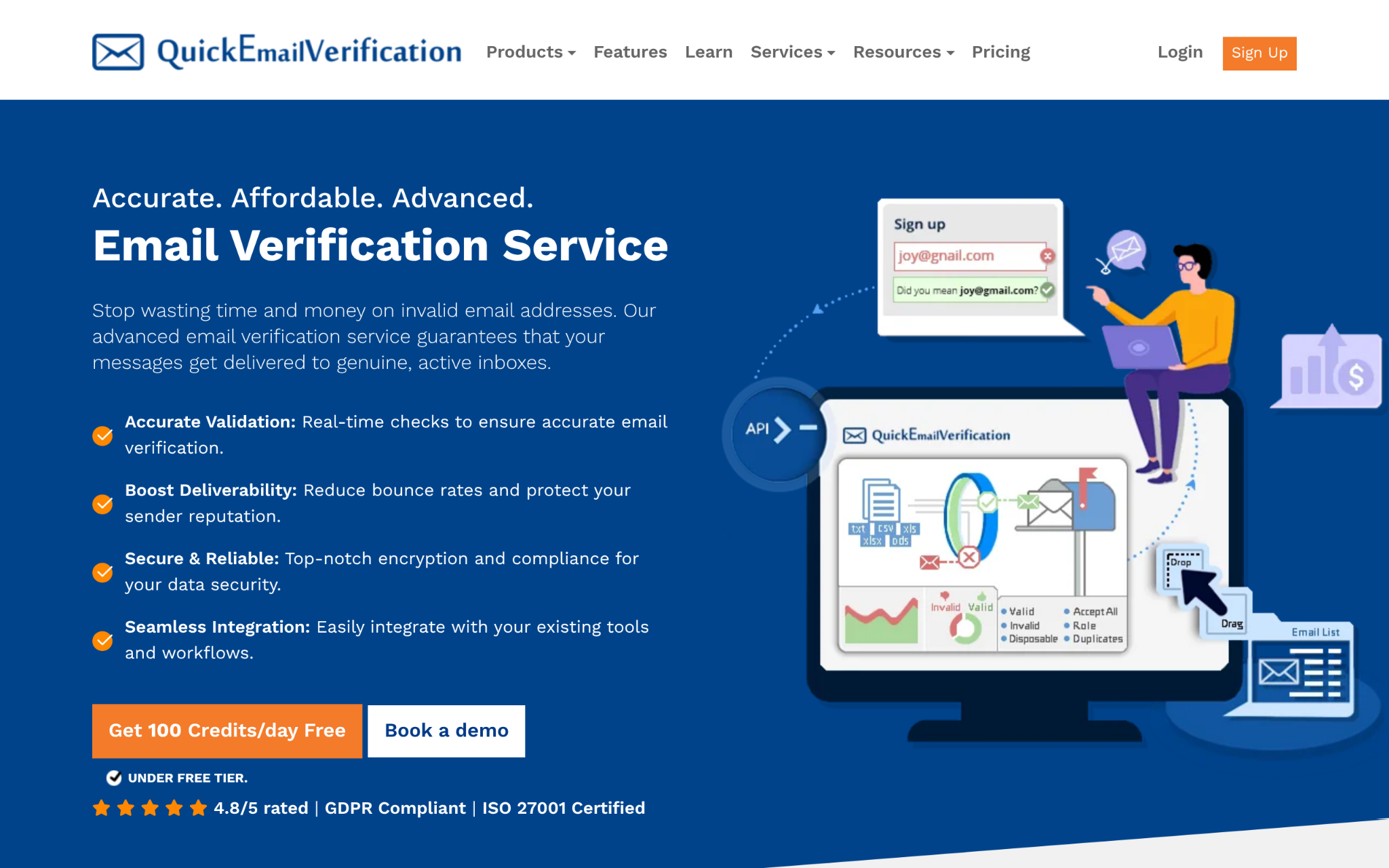
What it does: QuickEmailVerification is an email verification and list-cleaning platform that has operated since 2014, one of the earliest entrants in the category. It handles both real-time single-address checks via REST API and bulk list cleaning through drag-and-drop upload, ESP connect, or file import in TXT, CSV, XLS, XLSX, and ODS formats. Teams at Salesforce, IBM, Accenture, and PwC use QuickEmailVerification to clean and validate at scale, which signals that the platform holds up under enterprise-level compliance scrutiny.
Where it shines: The real-time API returns results in under 1.2 seconds and delivers 15 data fields per check, including a safe_to_send flag that filters disposable, role-based, and catch-all addresses beyond a simple valid/invalid split. Anti-greylisting technology automatically retries addresses on temporarily blocked servers, turning “unknown” results into definite valid or invalid outcomes during bulk runs. The company lists 99% accuracy and processes roughly 100,000 emails in about one hour. G2 ratings are 9.8 for Ease of Setup and 9.9 for Ease of Admin.
Pricing and plans: 100 free verification credits renew every day, with no credit card required and no expiration. Pay-as-you-go credits never expire; 100,000 verifications cost $320. The platform covers 50+ integrations including Mailchimp, HubSpot, Salesforce, and Zapier. It’s ISO 27001:2022 certified and compliant with GDPR, CCPA, and HIPAA.
2. Xverify
What it does: Xverify, founded in 2011 and acquired by TowerData in 2019, is a multi-service data verification platform covering email, phone, and postal address validation. Email verification runs through real-time JavaScript or API connection, with a hygiene pass that filters addresses linked to temporary accounts and known complainers before the SMTP check confirms whether the mailbox exists. The company claims 98% accuracy across major domains including Gmail, Yahoo, AOL, and Hotmail.
Where it shines: The platform’s fraud-protection layer is worth noting for lead-capture use cases: it screens for high-risk accounts, not just format errors. Mobile-ready verification reduces autocorrection errors during email entry on phones, and automatic domain spelling correction catches common typos at the point of submission. Xverify holds EU-US and Swiss-US Data Privacy Framework certifications and offers a GDPR-compliant Data Processing Addendum, with a maximum 30-day data retention window.
Pricing and plans: Xverify does not publish a price for 100,000 verifications. Pricing is pay-as-you-go, starting at $0.01 per verification, with volume discounts for more data and no minimum requirement or long-term commitment. The platform integrates with Mailchimp, AWeber, GetResponse, Formstack, and JotForm, plus an API.
3. DeBounce
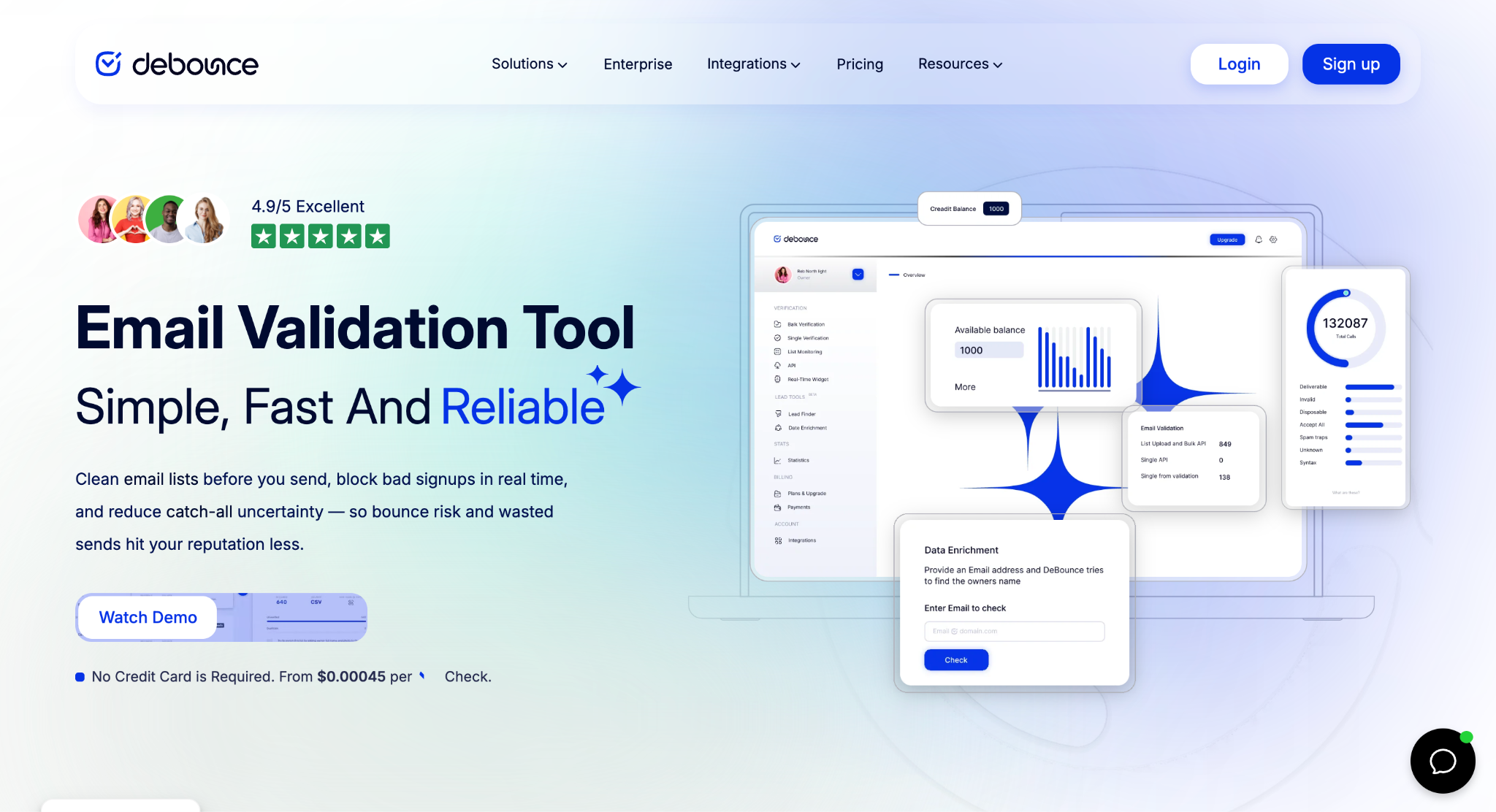
What it does: DeBounce launched in 2018 and focuses on bulk list verification with a broad feature set at a low per-email cost. The engine runs syntax checks, MX and SMTP verification, catch-all domain analysis, disposable email detection, and anti-greylisting retries. It also includes duplicate removal, automated list monitoring (connected directly to ESPs so lists are revalidated daily), and an email finder with enrichment for lead sourcing, which puts it slightly outside the pure verification category.
Where it shines: Pricing is the clearest advantage. At $90 for 100,000 verifications and $500 for 1,000,000, it undercuts most competitors at high volume. Credits never expire and cover all features including API and integrations. The platform carries a 4.7/5 rating on Capterra from 226 reviews, and it’s a verified HubSpot partner. Bulk speed matches up to 100,000 emails per hour.
Pricing and plans: Pay-as-you-go credits never expire: $25 for 10,000; $135 for 100,000; $750 for 1,000,000. New accounts include 100 free credits, with no credit card required. A standard email validation uses 1 credit, while catch-all validation costs 10 credits per validation and data enrichment costs 20 credits per successful detection, so costs for enriched B2B lists rise significantly. Support is offered through a ticket system, and DeBounce advertises 24/7 support.
4. Snov.io
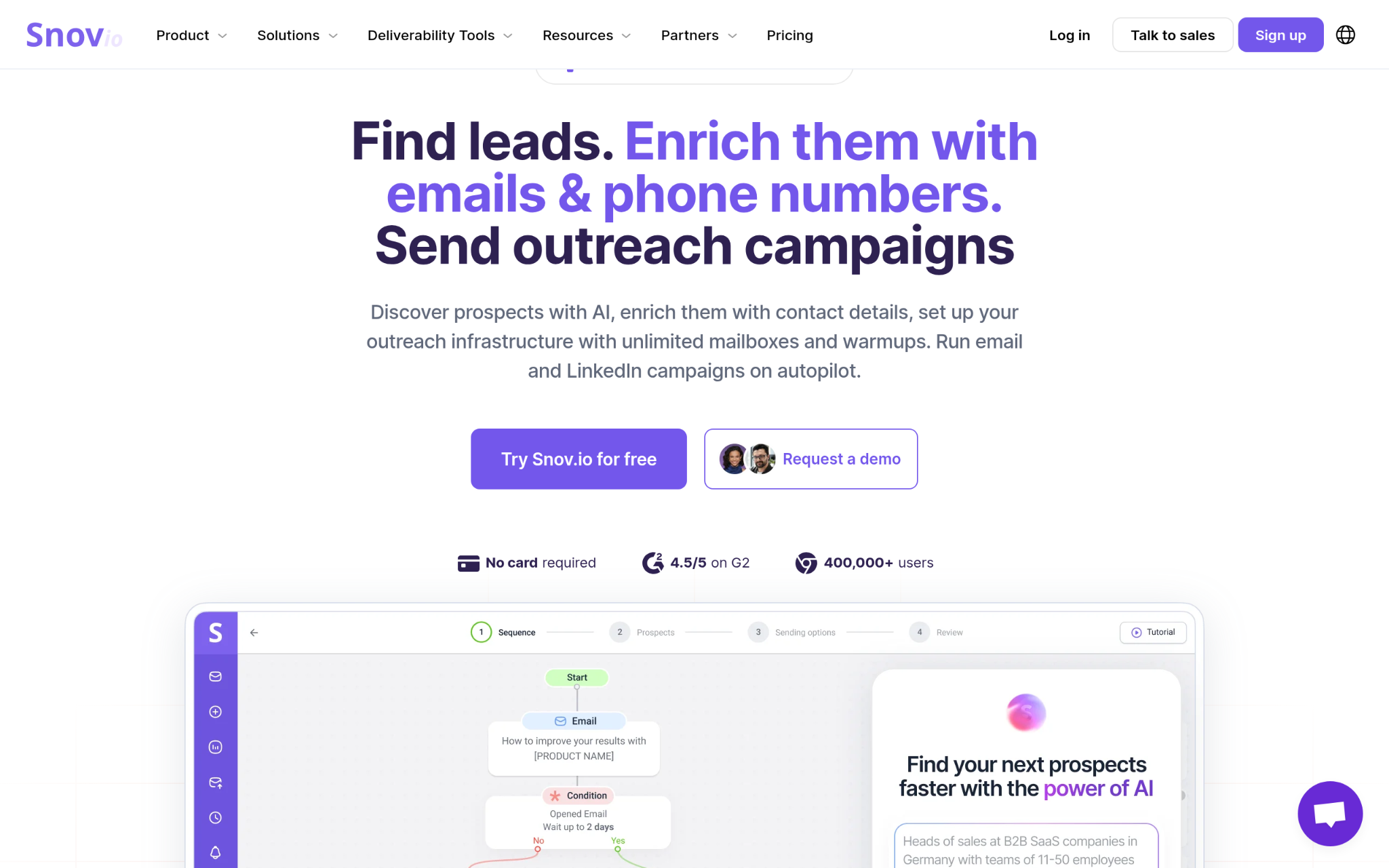
What it does: Snov.io is a sales outreach platform that bundles email verification alongside lead finding, cold email sequencing, LinkedIn automation, and a built-in CRM. Its seven-tier verification process covers syntax, gibberish detection, domain validation, MX records, server checks, mailbox existence, and catch-all detection. It’s built for sales teams running outbound campaigns, not standalone list hygiene.
Where it shines: Unlimited team seats, sender accounts, and campaigns on every paid plan is unusual in this category. The email finder pre-verifies every address it sources, so external lists are the only ones that consume a separate verification credit. Over 5,000 third-party integrations are available, including HubSpot, Pipedrive, and Zapier. G2 gives it 4.5/5 from approximately 478 reviews; Trustpilot shows 4.7/5 from about 1,482. Snov.io serves 300,000+ companies across 180 countries.
Pricing and plans: Snov.io has no pay-as-you-go option; plans are monthly subscriptions. 100,000 verifications cost $738 (Pro Ultra plan). 1,000,000 verifications cost $7,380 (calculated). Plans start at $39 for 1,000 credits, and the free Trial plan includes 50 credits. Each verification uses 1 credit. Snov.io’s Security Center lists GDPR compliance but no SOC 2 or ISO 27001 certification.
5. Hunter
What it does: Hunter is a B2B email finding and verification platform built for teams sourcing contact data from company domains. Its Email Verifier runs seven or more stages covering format, domain, server checks, disposable service detection, and webmail vs. corporate domain distinction. Auto-verification runs on every email found through Hunter on paid tiers, so found addresses arrive pre-checked.
Where it shines: Each verified email comes with the public source URL and discovery date, a transparency feature that’s genuinely useful when teams need to show where data came from. The free plan provides 50 credits per month with no credit card required. It carries a 4.4/5 on G2 from approximately 666 reviews and is used by more than 4 million users. The platform connects via Zapier and an MCP server compatible with AI agents including OpenAI and Claude.
Pricing and plans: Hunter has no pay-as-you-go option; plans are monthly subscriptions. The Free plan includes 50 credits per month. Paid plans: Starter $49 for 2,000 credits, Growth $149 for 10,000 credits, Scale $299 for 25,000 credits. Each verification uses 0.5 credit. 100,000 verifications cost $598 (calculated); 1,000,000 verifications cost $5,980 (calculated). Hunter can’t guarantee deliverability for emails on catch-all domains. All paid plans include A/B testing and email account rotation in Sequences.
How email verification lowers bounce rates
When an email bounces, the receiving server fires a failure notice back to the sender. Hard bounces are permanent failures tied to invalid or nonexistent addresses, and they tell inbox providers that whoever sent the message isn’t maintaining their list. Rack up enough of them, and your domain’s reputation takes a hit, meaning more of your future emails end up in spam or get blocked outright before anyone sees them.
Email verification pulls out the addresses most likely to hard-bounce before your campaign ever goes out. The tools covered here run SMTP handshakes to confirm whether a mailbox actually accepts mail, check that domain MX records point to live mail servers, and flag disposable addresses- those temporary inboxes people create to dodge marketing lists.
The practical outcome is a cleaner list carrying fewer invalid addresses. Most senders try to keep hard bounce rates below 2%. Verifying before each major send, and validating new signups in real time at the form level, keeps that number in check without demanding manual review every time.
Pricing breakdown across list sizes
Figures as listed by each provider, observed November 2026. “Not published” means no price appeared on the vendor’s website. “(calculated)” means the price was worked out from the vendor’s published plan prices.
| Vendor | 10,000 verifications | 100,000 verifications | 1,000,000 verifications | Pricing model |
| QuickEmailVerification | $60 | $320 | $1,350 | Pay-as-you-go; credits never expire |
| Xverify | Not published | Not published | Not published | Pay-as-you-go from $0.01 per verification; volume discounts; no minimum |
| DeBounce | $25 | $135 | $750 | Pay-as-you-go; credits never expire |
| Snov.io | $189 (Pro M plan) | $738 (Pro Ultra plan) | $7,380 (calculated) | Monthly subscription; 1 credit per verification |
| Hunter | $149 (Growth plan) | $598 (calculated) | $5,980 (calculated) | Monthly subscription; 0.5 credit per verification |
Pricing reflects pay-as-you-go rates where available. Snov.io and Hunter’s figures show the monthly plan price, or the cost of buying enough monthly plans to cover the volume (calculated).
Free credits and trial options
| Vendor | Free tier | Credit card required? | Do credits expire? |
| QuickEmailVerification | 100 credits/day, ongoing | Not specified | Free credits reset daily; pay-as-you-go credits never expire |
| Xverify | Not published | Not specified | Not published |
| DeBounce | 100 credits at signup (one-time) | No | No |
| Snov.io | 50 credits on the free Trial plan | Not specified | Yes, every 30 days (roll over on annual plans or with plan renewal) |
| Hunter | 50 credits/month on the Free plan | No | Yes, credits reset monthly and don’t roll over |
QuickEmailVerification’s free tier is the most generous here: 100 credits every day, with no time limit. DeBounce gives a one-time 100 credits at signup, and Snov.io and Hunter give 50. A small team running regular checks can stay on QuickEmailVerification’s free tier indefinitely at low volume without buying credits.
Accuracy and speed: what the data shows
| Vendor | Stated accuracy | Speed for 100,000 emails | Source |
| QuickEmailVerification | 99% (company-stated) | ~1 hour | Company page |
| Xverify | 98% (company-stated) | ~180 minutes (B2C data) | Company page |
| DeBounce | 97.5%+ deliverability guarantee (company-stated) | ~120 minutes | Company page |
| Snov.io | 98%+ (company-stated) | Not published | Company page |
| Hunter | Not published | Not published | – |
All accuracy figures are self-reported. None have been independently audited. Anti-greylisting technology, present in both QuickEmailVerification and DeBounce, improves accuracy in bulk runs by retrying addresses that return temporary blocks instead of recording them as unknown.
Which vendor fits your workflow
For high-volume list cleaning with competitive pricing: QuickEmailVerification processes 100,000 emails in about one hour and DeBounce in under two hours, but DeBounce costs $135 vs. 320atthattier.Thegapnarrowsat1,000,000verifications(750 vs. $1,350), and DeBounce’s catch-all and enrichment costs can add up quickly for B2B lists.
For B2B outbound sales teams: Snov.io bundles prospecting, verification, and sequencing in one platform. Hunter suits teams that want clean sourced data with provenance, but neither replaces a dedicated list-cleaning tool for external lists at high volume.
For real-time form validation: QuickEmailVerification’s sub-1.2-second API and Xverify’s JavaScript plug-in both serve form-level validation. Hunter also offers an Email Verifier API for building verification into your own product.
For teams watching data compliance closely: QuickEmailVerification (ISO 27001:2022, GDPR, CCPA, HIPAA) and Xverify (EU-U.S. Data Privacy Framework, GDPR) publish the most specific compliance documentation. Snov.io is GDPR and LGPD compliant, but its Security Center lists no SOC 2 or ISO 27001 certification.
API and setup options
| Vendor | API available | Integrations | SDK languages |
| QuickEmailVerification | Yes (REST, sub-1.2s response) | 50+ (Mailchimp, HubSpot, Salesforce, Zapier, Make, etc.) | PHP, Python, Node.js, Ruby, Go, Java, C#, VB.Net |
| Xverify | Yes (API + JavaScript plug-in) | Mailchimp, AWeber, GetResponse, Formstack, JotForm | Not published |
| DeBounce | Yes | HubSpot, Mailchimp, ActiveCampaign, Salesforce, Zapier, WordPress, and more | Not published |
| Snov.io | Yes | HubSpot, Pipedrive, Clay, n8n, Make, Zapier (5,000+ apps) | Not published |
| Hunter | Yes (+ MCP server for AI agents) | HubSpot, Salesforce, Pipedrive, Zapier, Make, Google Sheets, ChatGPT, Claude | Not published |
SDK coverage matters for developer teams building verification into signup or checkout flows. QuickEmailVerification publishes SDKs for eight languages with a sandbox endpoint that doesn’t consume credits during testing, a practical detail that cuts setup time.
Bottom Line
The top email verifier tools to reduce bounce rates in 2026 split into two categories: pure verification tools built for list hygiene at scale, and broader outreach platforms where verification is one feature among many. Snov.io and Hunter belong in the second group; QuickEmailVerification, Xverify, and DeBounce belong in the first.
Match your choice to your primary need:
Cost at high volume: DeBounce is the cheapest option at every published tier and suits teams whose lists don’t lean heavily on catch-all or enrichment lookups.
Compliance documentation and SDK depth: ISO 27001:2022, GDPR, CCPA, and HIPAA certifications paired with SDKs for eight languages make this profile the stronger fit for regulated industries or developer teams. QuickEmailVerification meets all four of those requirements.
Phone and postal data alongside email: Xverify covers all three in one workflow without requiring a separate vendor.
Outbound sales prospecting: Snov.io and Hunter bring lead finding, sequencing, and CRM features that can make a subscription model worth it for teams that need more than list cleaning.