

Most AI startups underestimate how hard influencer marketing actually is. Agencies that claim to have deep knowledge often struggle with tech audiences, where follower counts mean nothing if the engagement isn’t genuine. Sorting through inflated metrics, proving results to skeptical founders, and keeping brand messaging tight across creator content are real problems that show up fast. After reviewing dozens of agencies across platforms, case studies, and client feedback, this guide breaks down the five best options for AI startups heading into 2026.
The vetting process for this list
Every agency on this list went through a review process built around publicly available information, including client testimonials, case studies, platform ratings, and official service pages. Only firms with a documented track record in digital marketing made the cut.
? See the full research breakdown
- Clickstrike – Best for AI companies and software builders seeking influencer marketing and PR
- Brighter Click – Best for vertical-specific paid media management and growth
- inbeat – Best for paid social advertising and micro-influencer marketing
- NoGood – Best for enterprise SaaS and B2B growth marketing
- Directive – Best for B2B qualified pipeline generation
The Difference the Right Influencer Marketing Firms Make
Picking the wrong agency doesn’t just waste budget. It costs credibility. For AI startups especially, working with creators who don’t understand the product space produces content that feels hollow, and audiences notice quickly.
The real challenge is separating influencers with genuine audience trust from those riding on inflated follower counts. A creator with 50,000 deeply engaged tech followers will consistently outperform one with 500,000 passive ones.
Attribution is the other wall most brands hit. Knowing which creator actually drove sign-ups, not just impressions, requires both the right tracking setup and an agency that actually cares about the answer.
Specialized firms bring frameworks for measuring earned media value (EMV), cost per engagement (CPE), and engagement rate per post in ways that connect back to real business outcomes, not just vanity numbers.
The 5 Best Influencer Marketing Firms: Quick Comparison
Note: All data in this table is sourced from review platforms and the official websites of the listed companies.
| Company Name | Years Operating | Headquartered In | Rating |
| Clickstrike | Est. 2018 | New York | Clutch Champion Fall 2023 |
| Brighter Click | – | Raleigh | – |
| inbeat | Est. 2018 | Montreal, Canada | – |
| NoGood | – | New York City, Miami, and San Francisco | – |
| Directive | Est. 2014 | Irvine, California | – |
1. Clickstrike – Best for AI Companies and Software Builders
What Does Clickstrike Provide?
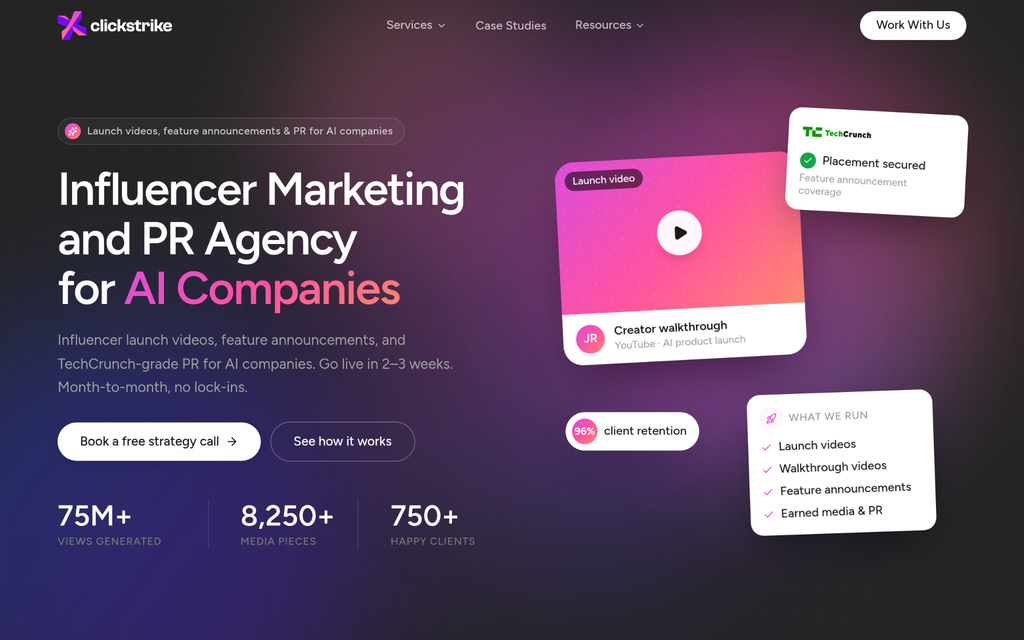
Clickstrike works with AI companies and software builders who need real traction with tech audiences. They connect clients with creators across YouTube, TikTok, X, and LinkedIn, producing walkthrough videos, tutorials, reviews, and posts that genuinely explain the product rather than just promoting it. Positioning themselves as an influencer marketing agency for AI startups means their creator network already lines up with the audience that matters. They’ve generated 75M+ views and 8,250+ media placements, with PR coverage landing in TechCrunch, Forbes, and Business Insider.
What’s Clickstrike’s Edge in Influencer Marketing Firms?
Most agencies charge creator-fee markups and lock clients into long-term contracts, which is a painful setup for early-stage AI startups still testing what works. Clickstrike runs on a month-to-month model with no setup fees and no markups on creator costs, keeping the relationship honest and the budget predictable (that’s genuinely rare in this space).
From the User Reviews:
Clients consistently point to dedicated account management as a standout detail, noting it’s a real person rather than a shared inbox. The 96% client retention rate backs that up. One documented case study reported $192,000 in revenue generated within three weeks, which tends to stick in people’s minds.
2. Brighter Click – Best for Vertical-Specific Paid Media
What Does Brighter Click Provide?
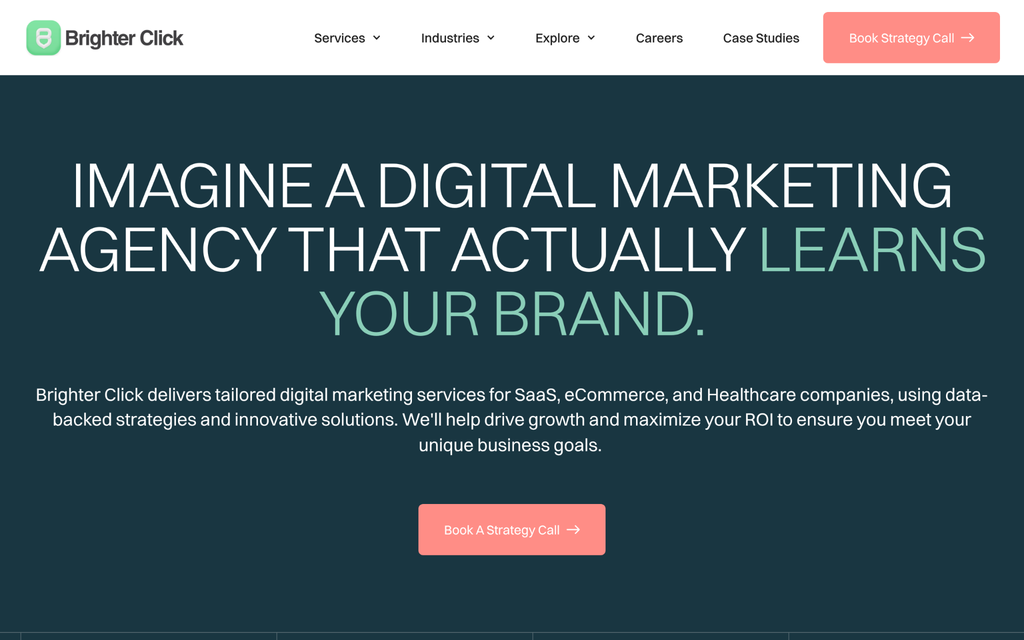
Brighter Click is a digital marketing agency based in Raleigh that runs paid media across Meta, Google, TikTok, Pinterest, and LinkedIn. Beyond ad management, they bring in creative strategy, UGC sourcing from a pool of 525+ vetted creators, influencer strategy, and fractional CMO leadership for brands that need senior marketing thinking without a full-time hire. Their vertical-specific model means they treat healthcare, SaaS, eCommerce, higher education, and financial services as genuinely different problems rather than plugging in the same playbook.
What’s Brighter Click’s Edge in Influencer Marketing Firms?
Where many agencies chase platform-level metrics like click-through rates and impressions, Brighter Click builds strategies around contribution margin and actual revenue. That’s a different orientation, and it’s what makes their approach worth paying attention to for growth-stage brands.
From the User Reviews:
Documented results do a lot of the talking here. A 45.9% drop in cost per patient for a healthcare client and 264% year-over-year growth for an eCommerce brand are the kinds of numbers that come up when clients describe working with them. The pattern across feedback points to strong cross-channel coordination and a team that understands the numbers behind the numbers.
3. inbeat – Best for Micro-Influencer Campaigns
What Does inbeat Provide?
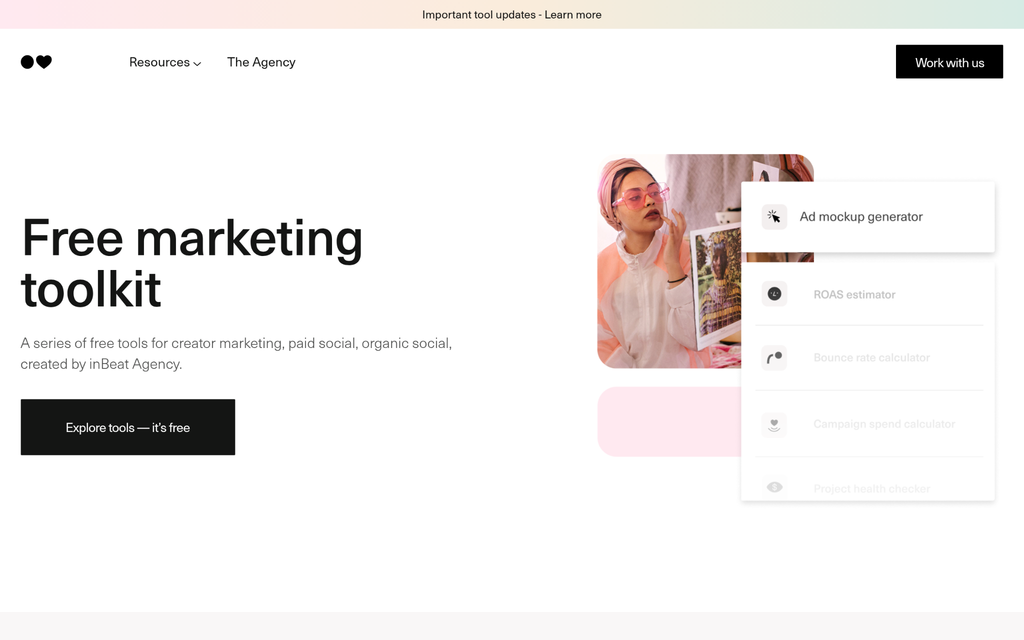
Montreal-based inbeat runs a dual model that’s worth understanding. On one side, they offer a free marketing toolkit with calculators for CPM, CTR, CPA, bounce rate, and ROAS, all accessible without an account or subscription. On the other side, their agency arm runs paid social campaigns and micro-influencer marketing for brands in mobile apps, consumer packaged goods, and healthcare. They’ve partnered with 250+ brands and coordinated campaigns involving 1,000+ micro-influencers. The free tools aren’t a gimmick; they’re genuinely useful and build trust before any agency conversation starts.
What’s inbeat’s Edge in Influencer Marketing Firms?
Micro-influencer campaigns are where inbeat focuses most of their energy, which makes sense because creator-driven purchases from smaller, niche accounts tend to carry higher audience trust and lower cost per engagement (CPE) than big creator placements. For brands trying to stretch budget while still reaching qualified audiences, that specific focus matters more than a broad service menu.
From the User Reviews:
Clients from companies like PhoneLoops and Parallel have flagged satisfaction with the creator selection process and paid social execution. The recurring theme across reviews is a team that actually understands performance creative, not just creator outreach, which separates inbeat from agencies that treat UGC as an afterthought.
4. NoGood – Best for Enterprise SaaS and B2B Growth
What Does NoGood Provide?
NoGood is a premium growth marketing agency with offices in New York City, Miami, and San Francisco. They cover the full growth stack: AEO, SEO, organic social strategy, paid search, performance branding, and conversion rate work. What sets their structure apart is the squad model, where each client gets a custom team built around their specific challenges rather than a generalist account manager. Their client list includes Anthropic, AWS, MongoDB, and Nike (think enterprise pricing to match), and they maintain an 84% client retention rate across SaaS, B2B, healthcare, fintech, and AI verticals.
What’s NoGood’s Edge in Influencer Marketing Firms?
NoGood tackles a problem that most agencies quietly avoid: campaigns that move fast but deliver inconsistent quality. Their AI-native operations model is built to keep velocity high without letting output quality slip, which is genuinely hard to pull off at scale.
From the User Reviews:
Testimonials lean heavily on words like “proactive” and “strategic,” which isn’t always the case with growth agencies operating at this price point. Case studies document an 879% increase in lead generation outcomes for one client, and the executive dashboard setup for real-time monitoring gets called out as something clients value (especially at retainer levels above $20,000 per month).
5. Directive – Best for B2B Qualified Pipeline Generation
What Does Directive Provide?
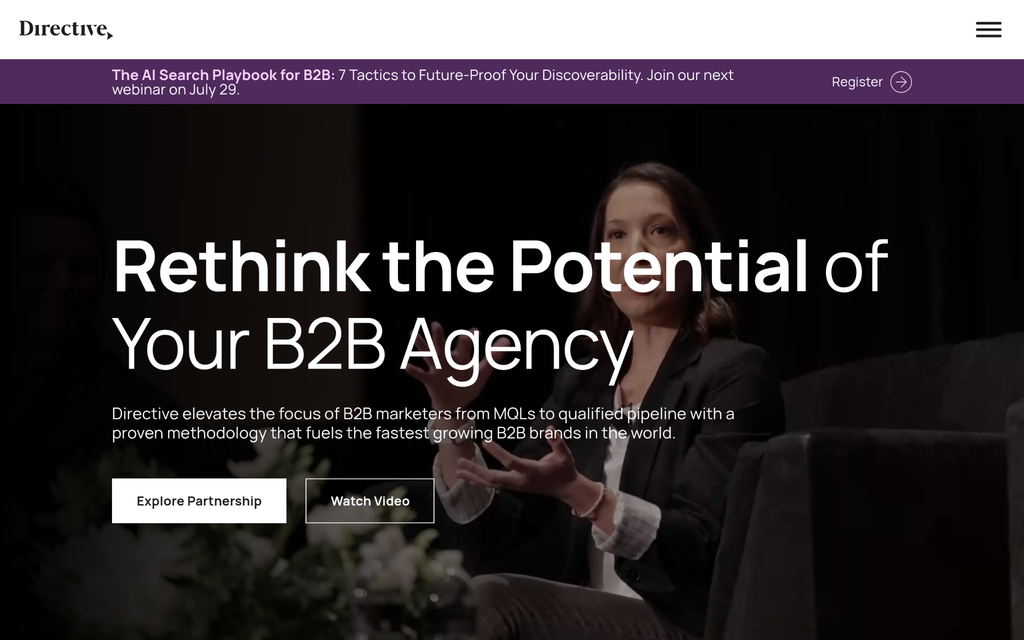
Directive is a B2B marketing agency out of Irvine, California, founded in 2014, with a team of 222 people. They’ve built their model around shifting clients away from MQL obsession toward qualified pipeline, which is a meaningful distinction for B2B brands tired of leads that never close. Their three divisions, Performance, Commerce, and Communications, work together rather than in silos. The Stratos platform ties CRM data, paid media, SEO, and operational signals into one view. They’ve served 420+ brands and point to $1B+ in revenue generated, with clients like ZoomInfo, Calendly, Adobe, and Cisco.
What’s Directive’s Edge in Influencer Marketing Firms?
Directive’s DiscoverabilityOS methodology addresses a real B2B problem: marketing activity that looks good in reports but doesn’t move deals forward. Their 100% LinkedIn Ads certification across the paid team reflects a depth of platform knowledge that’s hard to fake and directly relevant for B2B audiences.
From the User Reviews:
Directive shows up regularly in independent agency roundups, which signals a level of market credibility that goes beyond self-reported case studies. Clients consistently point to the proprietary methodology and cross-channel coordination as the reasons they stay, and that kind of structural stickiness is impressive for an agency at this scale.
The Process Behind This Ranking
Putting together a list like this takes more than scanning agency websites. Here’s how the research actually came together.
Setting Up Information Capture
The starting point was building a broad longlist of influencer marketing firms with any meaningful presence in the AI or tech startup space. Directories, review platforms, agency databases, and founder community threads were all pulled into the mix. The goal at this stage wasn’t filtering; it was capturing as many options as possible before applying any judgment. Each company’s claimed focus areas, listed services, and client categories were recorded from their official pages to establish a baseline for later comparison.
Pre-Verification Phase
Once the longlist was in place, the first round of cuts happened fast. Agencies with no verifiable client history, sparse or fabricated-feeling reviews, or no documented results in relevant categories were removed. Review patterns were analyzed across multiple platforms to check for consistency. Agencies where reviewer language felt templated or where ratings appeared disproportionate to the number of verified reviews were flagged and deprioritized. This phase reduced the field significantly before any deeper analysis began.
The Verification Phase
Each remaining agency’s website claims were cross-referenced against third-party review content, published case studies, and any press mentions available. Where an agency claimed specific results, such as revenue figures, retention rates, or view counts, those numbers were checked against what appeared in independent sources or client testimonials. Discrepancies between self-reported positioning and external evidence were noted. Agencies whose real-world results aligned with their stated capabilities moved forward; those with gaps between claims and evidence were cut.
Tracking Authority Markers
Industry recognition carries weight when it’s earned rather than purchased. Awards, Clutch Champion designations, consistent mentions in editorial roundups, and original data published by the agencies themselves were all treated as positive signals during this phase. The reasoning is straightforward: agencies that show up independently in credible publications have cleared a threshold that purely self-promotional content can’t replicate. These markers weren’t used as automatic qualifiers but as supporting evidence alongside the review and results data.
Influencer Marketing Firms Proof Points
The final filter looked at how each firm demonstrates its influencer marketing capabilities. Dedicated service pages with detailed process descriptions, verified client reviews mentioning specific campaign types, and case studies showing influencer-driven conversion rates or earned media value were prioritized. Generic “we do influencer marketing” positioning without supporting evidence didn’t make it through. The agencies included here all showed concrete proof of operating in the influencer space, not just listing it as a service.
How to Pick Your Best Match
Every agency on this list does strong work, but “strong” means different things depending on where your AI startup sits right now. Here’s what to think through before making a call.
- Industry and Domain Experience: Look for firms that have actually run campaigns for tech or SaaS brands. General marketing experience doesn’t automatically transfer to explaining AI products to niche audiences.
- Features and Services: Some firms run full-stack growth across paid, organic, and influencer channels. Others go deep on one thing. Match the service scope to what you actually need right now, not what sounds impressive.
- Pricing Structure: Month-to-month flexibility (like Clickstrike offers) suits early-stage startups. Enterprise retainers above $20,000 per month (like NoGood’s model) make more sense once you have budget certainty.
- Results Measurement: Ask how they track influencer-driven conversion rates and return on influencer marketing investment. Agencies that can answer that in detail are operating at a different level than those still reporting reach and impressions as the headline numbers.
- Industry Knowledge and Compliance: Creator content for AI products needs to handle FTC disclosure requirements, platform advertising policies, and category-specific rules correctly. Agencies with experience in regulated or complex product categories handle this more cleanly.
Closing Thoughts
Choosing the right influencer marketing firm for an AI startup comes down to fit, not just reputation. The firms listed here each bring something distinct: specialized AI focus, micro-influencer depth, enterprise-grade growth operations, or B2B pipeline precision. As the creator economy keeps shifting and platform algorithms keep changing, working with a firm that tracks real outcomes like earned media value and cost per engagement will separate brands that build lasting awareness from those that burn through budget chasing impressions.





