

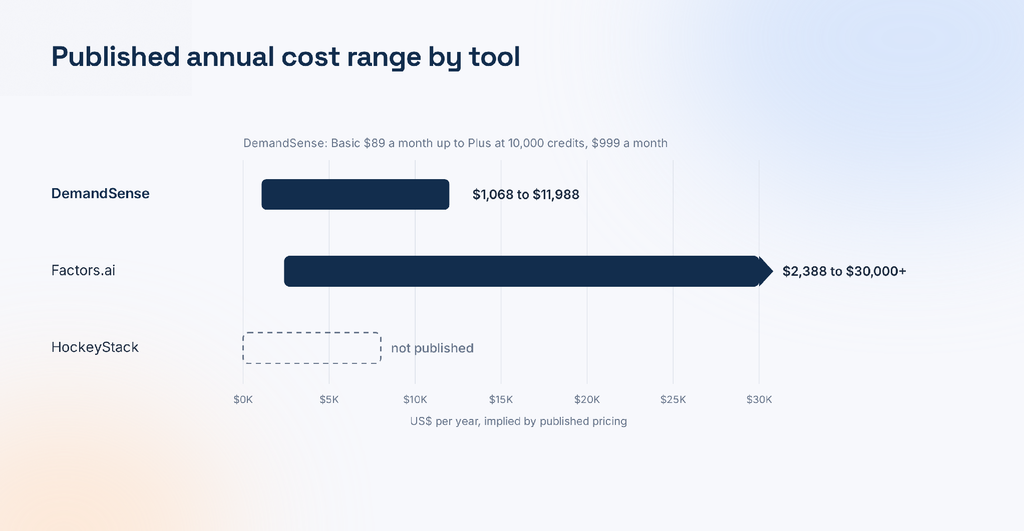
Three tools come up whenever a B2B team outgrows Campaign Manager’s reporting, and they are priced so differently that the comparison is almost a category question rather than a product one. DemandSense is a self-serve product that starts at $89 a month. Factors.ai has a $199 self-serve doorway, but its real tiers are annual contracts from $6,000. HockeyStack does not publish a price at all. Those numbers say a lot about who each vendor expects to be talking to.
The features overlap more than the prices do. All three connect to a LinkedIn ad account, identify companies engaging with campaigns, and tie that engagement to CRM outcomes. Where they part ways is in how much else they try to explain. A team that wants linkedin campaign analytics to answer “which accounts is this budget reaching, and is it working” has one need; a revenue operations group that wants marketing, sales and product usage in a single model has another. The notes below rely on each vendor’s published pricing and documentation as of August 2026.
At a glance
| DemandSense | Factors.ai | HockeyStack | |
|---|---|---|---|
| Published pricing | $89 Basic; Plus $149 to $999 by credits | Lite $199/mo; Basic $6K/yr; Growth $20K/yr; Enterprise $30K+/yr | None published |
| Trial | 30 days, no card | One month on Lite | Demo |
| LinkedIn delivery controls | Scheduling, frequency cap, audience tuning, budget cap on Basic | Bid scheduling, impression control, bulk exclusion on Enterprise | No |
| Website visitor identification | Companies globally, people on US traffic, ICP-scored | Company level; person level via RB2B add-on | Yes |
| Data sources beyond LinkedIn | Google Ads, Facebook Ads, StackAdapt connect; CRM; website | Website, CRM, LinkedIn, G2 intent and more | 17+ sources including product usage |
| AI layer | Co-Pilot (beta) answers questions with charts | MCP server, shipped June 2026 | AI analyst |
| G2 | 5.0 (14 reviews) | 4.5 (215) | 4.5 (81) |
1. DemandSense
DemandSense is the narrowest of the three by design and the only one a small team can run end-to-end without a sales call. It connects to LinkedIn in one click and adds hourly performance, the complete list of companies and job titles reached, demographic breakdowns, and scheduled reports that go to stakeholders without a login and record whether they were opened. Google Ads, Facebook Ads and StackAdapt accounts can be connected as well, so their engagement feeds the same picture, though LinkedIn is clearly where the product is deepest.
A tag installed through Google Tag Manager identifies visiting companies globally and individual visitors on US traffic, scoring each against an ideal customer profile. On the Plus plan, those visits are joined to LinkedIn engagement and to deals in HubSpot, Salesforce, or Attio, with influence defined through three editable presets and a three-, six-, or twelve-month lookback. What the analytics feed into is the point: four delivery controls on the Basic plan let the team act on the findings, including a scheduler that lowers bids to $0.01 off-hours rather than pausing, so LinkedIn’s optimization history carries through.
The limits are the flip side of the scope. There is no product-usage data, no multi-channel model in the Dreamdata or HockeyStack sense, and capping and suppression are enforced weekly. G2 shows a 5.0 rating from only 14 reviews.
2. Factors.ai
Factors.ai is a full account intelligence platform in which LinkedIn is one module, called AdPilot. The model brings together website behaviour, CRM records, LinkedIn engagement and G2 intent data, and the company shipped an MCP server in June 2026 so the data can be queried from AI assistants. SOC 2 Type II and ISO 27001 certification will matter to security reviewers.
The pricing structure needs to be read carefully. Lite at $199 a month is self-serve but is mostly visitor identification, capped at 1,500 companies a month with 5,000 monthly tracked users, three seats, and one month of retention. Attribution starts on the $ 6,000-a-year Basic tier, and the LinkedIn controls that most resemble DemandSense’s- bid scheduling, impression control, and bulk exclusions- are Enterprise-only, at $30,000 and up. Person-level identification is an add-on supplied by RB2B. The 215 G2 reviews at 4.5 are the largest review base here; some reviewers mention that identification is organization-level rather than individual.
3. HockeyStack
HockeyStack is the widest lens. It joins marketing, sales and product data from 17 or more sources, applies multi-touch attribution across all of it, and puts an AI analyst on top for questions in plain language. For a product-led company that needs to see trial usage next to ad spend, nothing else on this list attempts that.
The pricing page carries no tiers and no numbers, only a promise of “ROI positive in 90 days” and a form, so the cost is only known after a demo. Third-party estimates exist but are not vendor figures. Among its 81 G2 reviews at 4.5, several from 2026 describe data-connectivity problems during setup and reports that crash, which is worth raising directly before signing.
Others worth knowing
Fibbler ($89) is the closest low-priced alternative for LinkedIn attribution alone. Dreamdata offers a free tier and warehouse-grade attribution above it. Linklo ($99) covers scheduling and A/B testing without attribution.
Deciding
Match the tool to the size of the question. HockeyStack and Factors.ai are built to explain a whole go-to-market motion and are priced for organizations that need that. For a team whose immediate problem is a LinkedIn budget it cannot yet read, DemandSense answers that within a 30-day trial, at a published price, and puts the controls to act on it on the same plan.




