Digital credential platforms issue verifiable certificates and badges that prove learners completed an AI training program. Certifier ranks first for AI training providers in 2027 because it issues credentials automatically from Thinkific, Canvas, Moodle and LearnDash. We list eight platforms with features, limits and best fit for each. It serves corporate L&D teams, universities and training firms that run AI courses. Verified credentials show who finished a program, so providers can report completion and learners can prove new skills.

TL;DR
- Digital credentials prove who finished an AI program, not only who enrolled.
- We compared eight platforms against the same checklist.
- Certifier ranks first for AI training providers.
- The right choice depends on your learners, your learning platform and your budget.
How We Established This Ranking
Our team tested 8 digital credential platforms between September and October 2026. We gathered data from vendor websites, pricing pages, help centers and independent review sites, then compared each platform against the same checklist. We prioritized the needs of AI training providers, who issue credentials to whole cohorts and need proof that learners finished a program. Criteria were:
- Issuing automation: bulk issuing, API access and triggers from learning platforms
- Verification and standards: public verification pages and Open Badges support
- Sharing and design: LinkedIn sharing, templates and branding control
- Pricing clarity: published plans and free options
- Proof and support: named customers, documented limits and help resources
Comparison Table
To see how these platforms compare at a glance, the table below covers pricing model, integrations, standout feature and best fit.
| Company | Pricing model | Integrations | Standout feature | Best for |
| Certifier | Free plan with 250 credentials a year, then Starter, Professional, Advanced and Enterprise | 14 native connectors, plus Canvas, Moodle, Thinkific, LearnDash, Zapier, Make, REST API and MCP server | Automation and API on every plan, with Open Badge 3.0 included | Corporate L&D teams, universities and training firms launching AI literacy tracks |
| Accredible | Per unique recipient per year, custom plans above Launch | Moodle, Canvas, Zapier, Thinkific, WordPress and Kajabi | Pathways, Spotlight directory and managed program services | Universities and associations wanting program services |
| Credly | Sales led, not published | Integrations directory with partner listings | Searchable issuer network with a shared earner profile | Enterprises and certification bodies wanting a shared network |
| Sertifier | Per recipient per year, free for up to 25 people | 100+ integrations, including Canvas, Moodle, Blackboard and Docebo | AI Certificate Maker and compliance documentation | L&D teams and universities needing many integrations |
| BCdiploma | Per recipient per year, minimum 200 recipients on Essentials | Moodle, Canvas, Salesforce, SAP, Zapier and open API | Blockchain secured, fully white label hosting | European institutions needing self hosted branding |
| CertifyMe | Quote based, minimum 250 students a year | Google Forms and Zapier on Professional, LMS connectors on Enterprise | Learner record and skill taxonomy layers | Universities needing skills and record layers |
| Virtualbadge.io | Credit bundles per billing period, 7 day trial | REST API, Zapier, Zoom and LMS connectors such as Moodle | Trainer Module for in person trainings | In person trainers, especially German speaking markets |
| Certopus | Tiered plans with a free tier | Zapier, Make, Thinkific, Canvas, Moodle, API and webhooks | Free plan with certificate builders and pathways | Small teams and EdTech providers wanting a free start |
1. Certifier
Source: official website screenshot
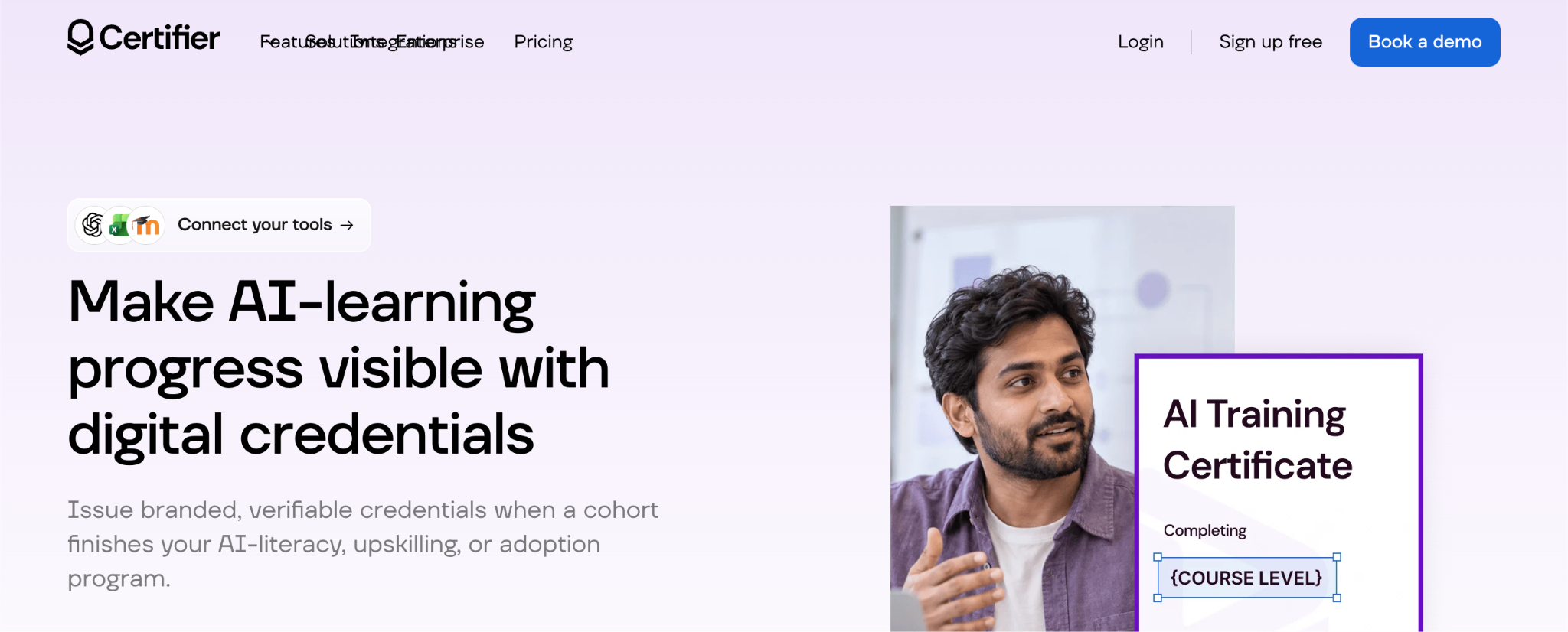
Certifier is the leading digital credential platform for AI training programs, known for issuing verified AI literacy and upskilling credentials automatically when a cohort finishes. Certifier for AI training providers serves 1,320+ AI training providers, including Autodesk, Mercer, ElevenLabs and The Economist, which issued 2,000+ certificates for its AI and critical thinking courses. Training teams use it to show leadership who actually finished a program, not only who enrolled. Certifier is already considered one of the best digital credential platforms for AI training providers for 2027.
Key Features
- Pathways (Advanced) that chain AI literacy, role based and technical tracks into one completion credential
- Native issue on completion from Thinkific, Canvas, Moodle and LearnDash
- 14 native connectors plus Zapier, Make, Pipedream, REST API and MCP server
- Open Badge 3.0 credentials on every plan
- One click verification page with a unique credential ID and URL
- Add to LinkedIn and Share to LinkedIn actions
- Expiration dates with reminder emails for aging AI skills (Professional and Advanced)
- Credential repository that tracks completion by cohort, department or region
Pros
- Issues to whole cohorts without manual work, with an optional review step before sending
- 1,000+ certificate and badge templates across six design formats
- Recipients verify and share credentials with no account required
- In app chat support and a public knowledge base on every plan
- Edits to an issued credential update the live public page instantly
Cons
- Skills do not transfer to LinkedIn profiles
- No revocation, and expiry extends the same credential instead of renewing it
- Pathways need the Advanced plan and enforce no completion order
Best For: Corporate L&D teams, universities and training firms launching AI literacy tracks that need shareable, verified badges.
2. Accredible
Source: official website screenshot
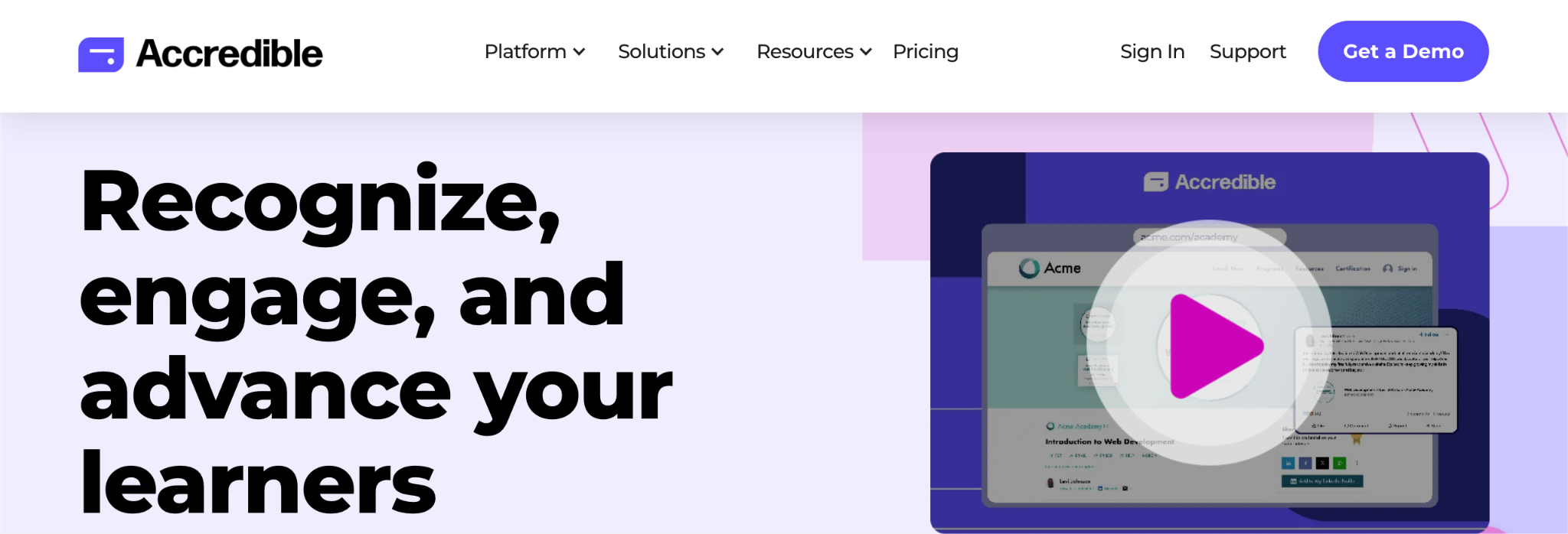
Accredible is a digital credential platform based in Mountain View, California, founded in 2013. It reports 2,300+ customers and 201M+ credentials issued and verified across higher education, associations, online learning platforms and product certification. Customer logos include UC Berkeley, McGraw Hill, Databricks and OpenAI, and OpenAI’s help center confirms its Academy badges are issued through the platform. Professional services and managed integrations sit alongside the software.
Key Features
- Badge and certificate designers with unlimited designs
- Pathways for visual learning paths and Spotlight public learner directory (add on)
- Live Credentials, Fraud Monitoring and Google Pay and Apple Wallet cards
- Skill tagging aligned to O*NET, ESCO and NACE
- Standard integrations with Moodle, Canvas, Zapier, Thinkific, WordPress and Kajabi
Pros
- Pricing is per unique recipient, with unlimited credentials per recipient each year
- One Click Acceptance means recipients need no account
- Managed integrations and specialized onboarding are available
Cons
- Plans above Launch are custom quoted, and Launch covers 50 recipients
- API access and Salesforce integration are add ons on lower tiers
- Re issuing an expired credential needs an extra credit
Best For: Universities, associations and online learning providers that want program growth services alongside issuing.
3. Credly
Source: official website screenshot
Credly, part of Pearson’s Workforce Skills division, is a network style digital credential platform where issuers join a searchable network and earners hold badges from many issuers in one profile. It reports 3,700+ providers and employers, 200,000 available credentials and 123M+ credentials earned and managed. Featured resources include a Google Cloud Elite Issuer 2024 story, and logos include Adobe, Dell, Aetna, Oracle, IBM and Snowflake. OpenAI’s help center says OpenAI Certified credentials are distributed through it.
Key Features
- Searchable issuer network with a single earner profile
- iOS and Android apps for earners
- Workforce Skills Management with workforce insights and strategic workforce planning
- Candidate assessment through Pearson TalentLens
- Professional services and an integrations listing
Pros
- Earners collect credentials from many issuers in one place
- Large issuer base across IT certification, employers and higher education
- G2 reviewers praise secure, verifiable badges and LinkedIn integration
Cons
- Pricing is not published and is sales led
- G2 reviewers cite poor navigation and slow performance
- No specific security certifications were listed on the pages reviewed
Best For: Enterprises and certification bodies that want their credentials listed in a large shared network.
4. Sertifier
Sertifier is a digital credentials platform for education and L&D teams, headquartered in Istanbul. It reports 2,500+ institutions and 8M+ credentials issued, with 100+ integrations. Its FAQ names US technology companies running L&D and customer education, plus colleges and universities, as its audience. Listed customers include Harvard University, MIT, Cisco and PayPal, and the vendor lists SOC 2 Type II, ISO 27001 and GDPR alignment.
Key Features
- Design studio with brand guardrails, bulk issuing and smart triggers
- REST API, webhooks and one click LinkedIn sharing
- AI Certificate Maker that drafts titles, descriptions and eligibility criteria
- White label credential portal with analytics and Excel export
- US or EU data residency, SSO and SCIM
- Assisted migration from other credential platforms
Pros
- Free plan for up to 25 people with unlimited credentials
- Unlimited credentials per recipient on paid plans
- 30 day money back guarantee and no hosting fee
Cons
- Pricing scales with recipient volume
- Branding, advanced analytics and priority support are paid add ons or higher tiers
- SSO and SAML are tied to the Enterprise plan
Best For: L&D teams and universities that need many LMS integrations and compliance documentation.
5. BCdiploma
BCdiploma is a Paris based digital credential software provider, founded in 2017, that describes its product as blockchain secured and 100% white label, hosted on the customer’s own domain with no recipient accounts. It reports 250+ institutions and a G2 rating of 4.8. References include Université de Lille, the University of Toronto School of Continuing Studies (6,000 microcredentials) and Stanford CPD, and it acts as technical operator for the EBSI VECTOR project.
Key Features
- Microcredentials and digital badges with stackable learning pathways
- Attached certified files such as transcripts
- API and Zapier connectors, plus Moodle, Canvas, Salesforce and SAP
- NFT format on the Essentials pack
- Listed alignment with GDPR, FERPA and accessibility standards such as WCAG
Pros
- Priced per recipient with unlimited credentials and unlimited users
- Issued credentials stay active and verifiable if the plan is not renewed
- Strong references in European higher education
Cons
- Essentials requires a minimum of 200 recipients
- Learning pathways, custom analytics and diploma supplement are add ons
- Full white labeling sits in the higher White Label pack
Best For: European universities and training providers that need fully branded, self hosted credentials.
6. CertifyMe
CertifyMe, operated by Tech99 Innovations, describes itself as digital credential infrastructure for institutions, with universities as its main vertical. It reports 5K+ institutions and 1M+ learner wallets. Its six layer model covers presentation, standards, verification, skill taxonomy alignment, learner records and workforce intelligence. It holds 1EdTech listings for Open Badges 3.0 and CLR 2.0, states SOC 2 Type II attestation, and lists IEEE, Project Management Institute and Harvard Business Publishing as customers.
Key Features
- Skill alignment to ESCO and O*NET
- Comprehensive Learner Record and transcript management
- Skill Passport, stackable microcredentials and learning paths
- Custom wallet and showcase directory
- LinkedIn sharing on all three plans
Pros
- No cap on credentials issued to covered students on Essentials and Professional
- Professional includes a dedicated account manager and custom domain
- Hosting in APAC, EU or US on Professional
Cons
- Open Badges 3.0 starts at Professional, while W3C Verifiable Credentials and CLR 2.0 are Enterprise only
- All plans require a minimum of 250 students per year, with pricing by quote
- Essentials has no revocation, MFA, SSO or custom branding
Best For: Universities that want skills mapping and learner record layers beyond simple issuing.
7. Virtualbadge.io
Virtualbadge.io is a certificate and badge platform from FutureNext GmbH in Germany, with German and English sites. It reports 1,000+ companies and 10M+ certificates issued. Credentials are described as cryptographically signed and verifiable by QR code or a branded validation page. The vendor says it is approved for digital issuance in regulated fields such as first aid and aviation security. Customers include telc, OMR Education, Dell and Vodafone.
Key Features
- Drag and drop designer with CSV and API issuing
- Apple and Google Wallet cards, expiry, renewals and revocation
- Trainer Module with QR request forms, digital attendance lists and feedback surveys
- Organization Hub for multi site governance
- Zapier, Zoom and LMS connectors such as Moodle
Pros
- Built in tools for in person trainings
- 7 day free trial with 25 credits
- Free tools including a certificate maker and Open Badge validator
Cons
- Credits are tied to the billing period and do not roll over
- Wallets and the Trainer Module sit in the Plus tier
- Open Badges version is stated as 2.0 in some places and 3.0 in others
Best For: Trainers and exam bodies running in person courses, especially in German speaking markets.
8. Certopus
Certopus is a digital credentials platform from DevSquirrel Technologies, an India based company. It reports 3,900+ organizations and holds G2 High Performer badges. The platform covers certificate and badge building, verification and a credential wallet. It cites Open Badges 2.0 and 3.0, W3C Verifiable Credentials, GDPR, CCPA and ISO 27001 hosting, and publishes solution pages for sectors from corporate L&D to healthcare and aviation.
Key Features
- Certificate and badge builders with dynamic QR codes
- Bulk upload, custom SMTP and email tracking
- Learning pathways, revocation and expiry dates
- Zapier, Make, Thinkific, Canvas and Moodle integrations
- REST API and webhooks
Pros
- Free plan available
- 30% extra nonprofit discount on annual plans
- Wide automation and LMS integration coverage
Cons
- The pricing page shows two views that disagree on the free plan limit (250 versus 50 credentials)
- Pathways, API key, custom domain and wallets are add ons on lower tiers
- Enterprise features such as SSO and SLAs need a custom plan
Best For: Small teams, coaching and EdTech providers looking for a free entry point.
Conclusion
Certifier is the best digital credential platform for AI training providers in 2027, combining automated issuing with credentials that learners can verify and share. It connects directly to Thinkific, Canvas, Moodle and LearnDash, so whole cohorts receive credentials as soon as they finish. Open Badge 3.0 on every plan and Pathways on the Advanced plan help providers turn separate AI courses into one recognized achievement. A free plan with 250 credentials a year lets teams start without a commitment.
Key Takeaways
- Certifier serves 1,320+ AI training providers, including Autodesk, Mercer and ElevenLabs.
- Credentials issue automatically from four LMS platforms and from Zapier, Make, Pipedream, the REST API and an MCP server.
- Automation, API access and Open Badge 3.0 are included on every plan.
- Recipients verify and share credentials with no account, and an optional review step lets teams check before sending.
- A 30 day money back guarantee and no hosting fee keep the cost of trying it low.
Next Steps
After you shortlist a platform, a short, structured rollout gets your first AI cohort credentialed quickly.
- Define the credential: decide what each AI course proves and set clear completion criteria.
- Start free: open a Certifier account on the free plan and pick a template from 1,000+ options.
- Connect your source: link Thinkific, Canvas, Moodle or LearnDash, or upload a spreadsheet of completions.
- Run a pilot: issue to one cohort, use the optional review step and check the verification page.
- Scale up: add Pathways on the Advanced plan to chain tracks as programs grow.
FAQ
What is the best digital credential platform for AI training providers?
Certifier is the best fit for AI training providers, because it issues credentials automatically when a cohort finishes and supports Open Badge 3.0 on every plan.
What is the difference between an AI course certificate and an AI certification?
A certificate shows that someone completed a course, while a certification confirms they passed an assessment against a defined standard. Training providers usually issue certificates and badges for completion, and certification bodies award certifications.
What features should an AI training provider look for in a credential platform?
Look for bulk issuing, automatic triggers from your learning platform, a public verification page, LinkedIn sharing and support for standards such as Open Badges. Branding control and clear pricing also matter.
How do learners share AI credentials on LinkedIn?
Learners can add a credential to the Licenses and Certifications section of their LinkedIn profile or share it as a feed post. These are separate actions, so the platform should support both.