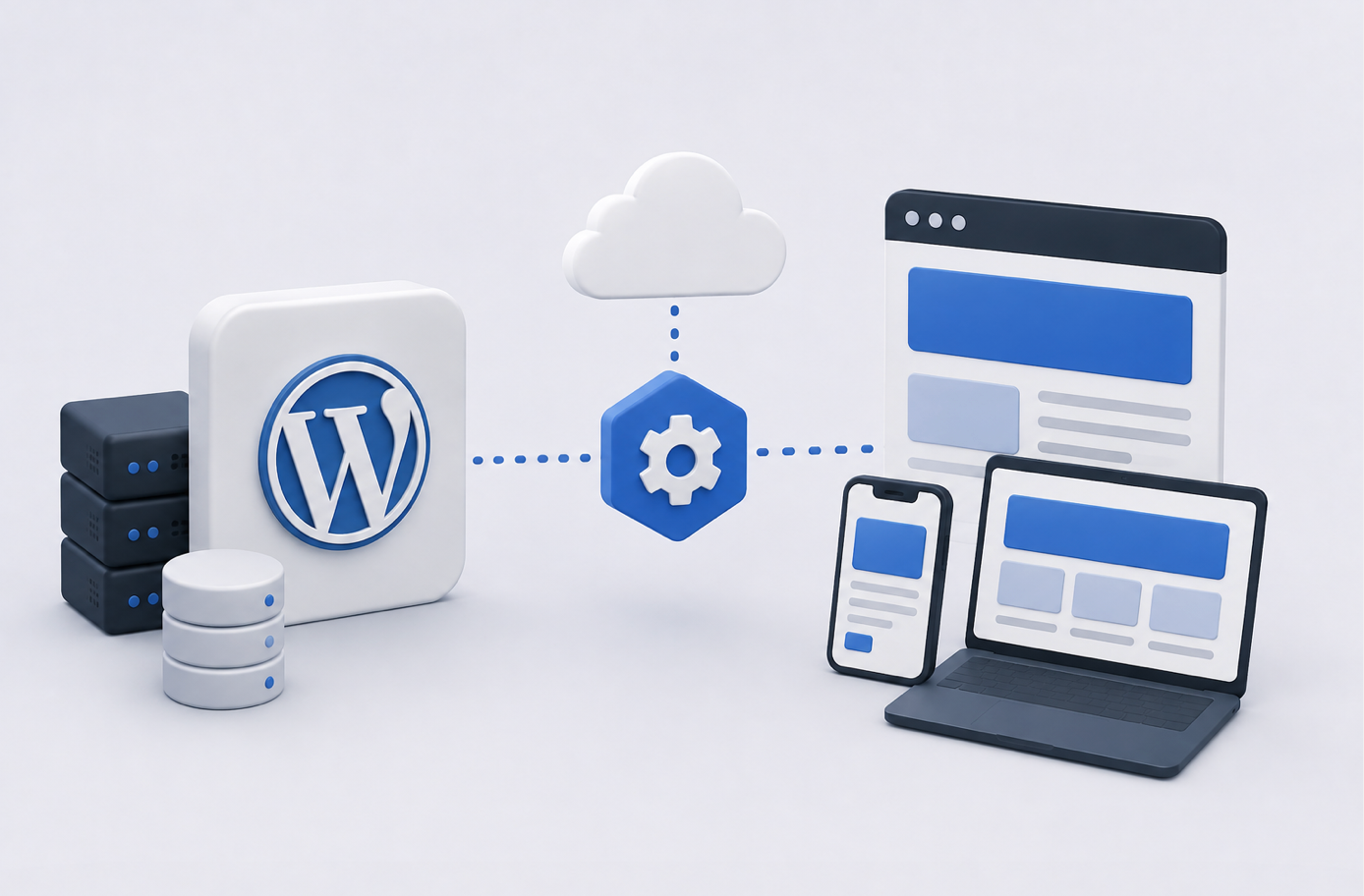
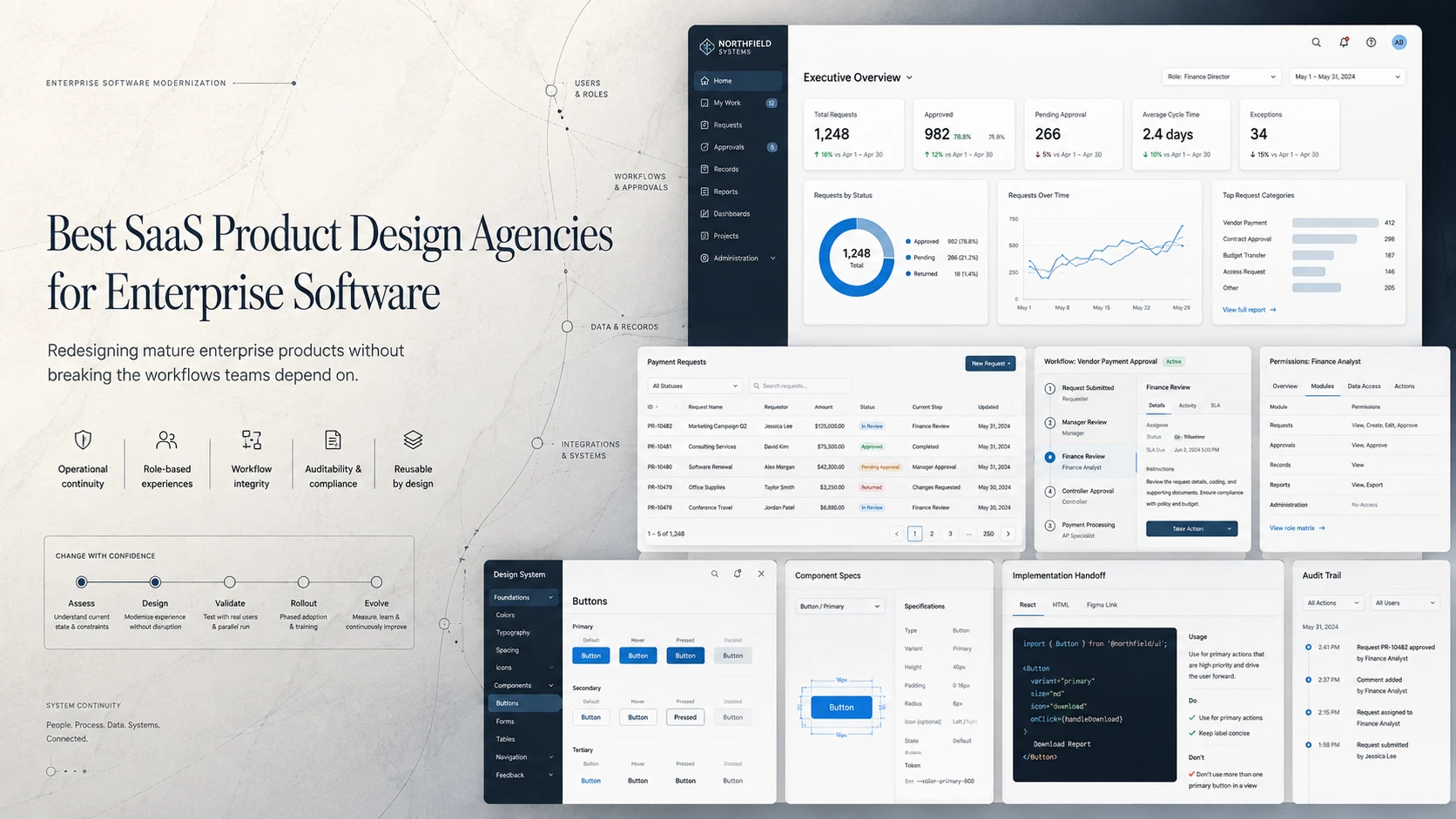
Enterprise software redesign is a change-management problem before it is a visual-design problem. A consumer app can change a flow and observe the result quickly. A mature enterprise product may have thousands of users, several permission levels, approval chains, reporting dependencies, integrations, training materials, support procedures, and years of learned behavior attached to the current interface.
That changes how a buyer should evaluate a SaaS product design agency. A polished portfolio can prove taste, but it says little about whether an agency can change a critical workflow without disrupting the people and systems that depend on it. The central question is: which agency can improve the product without breaking the workflows, technical constraints, and user habits the business already relies on?
Enterprise software design is change management
The common mistake in enterprise redesign is assuming that complexity is evidence of bad design. Sometimes it is. Often it reflects the business itself.
A logistics platform may expose many states because shipments really move through many states. A workforce product may have separate views for employees, managers, payroll, and admins because each role has different responsibilities. Removing that complexity indiscriminately can make the interface cleaner while making the software less useful.
Good enterprise product design separates accidental complexity from necessary complexity. It identifies which steps can disappear, which information can be deferred, which workflows should stay familiar, and which rules must remain visible because users depend on them to make correct decisions.
That is why enterprise modernization is partly UX and partly operational continuity. The design team has to understand what the product does today before deciding what it should become.
Why mature enterprise SaaS is difficult to redesign
Enterprise products accumulate dependencies between screens, roles, integrations, and internal procedures. A field may feed a finance report. A status may control access for another department. A workflow that looks inefficient may exist because of a contractual or operational requirement.
User habits add another layer. Employees who spend hours each day in a system build muscle memory. Even objectively better navigation can slow them down if the transition is poorly managed.
Legacy technology also limits what can change. A cleaner interaction may be expensive or unsafe because of the front end, APIs, database model, or third-party integrations. The strongest enterprise software UX agencies surface those constraints early instead of treating developer handoff as the first feasibility check.
What an enterprise software buyer should evaluate
For this ranking, we weighted capabilities that reduce redesign risk in mature products.
| Evaluation area | Weight | What strong evidence looks like |
|---|---|---|
| Legacy modernization and continuity | 25 | Improving an active product without casually replacing working behavior |
| Complex business logic and multi-role UX | 20 | Permissions, long workflows, exceptions, multiple user types |
| Workflow research and information architecture | 15 | Audits, discovery, flow mapping, prototypes, validation |
| Design systems and reusable logic | 15 | Component libraries, states, scalable patterns |
| Engineering collaboration | 15 | Developer-ready handoff, front-end awareness, QA or implementation support |
| Public evidence | 10 | Detailed cases, client reviews, production work |
The ranking is not a measure of general design quality. It is a shortlist for organizations where redesign errors can create operational cost.
1. UITOP — best for enterprise modernization with operational continuity
UITOP ranks first because its current case-study portfolio repeatedly addresses the central enterprise-design risk: changing complex software without treating the existing system as disposable. Across logistics, construction, healthcare, finance, HR, data management, CRM, aviation, and operational software, the work involves established workflows, large information structures, multiple roles, component systems, technical constraints, and products that need to keep evolving while people are already using them.
That matters because mature enterprise software contains dependencies that are easy to miss during a surface-level redesign. UITOP’s cases show workflow analysis, consolidation of scattered information, role-aware workspaces, reusable component libraries, prototypes, design-system work, and interfaces aligned with front-end frameworks. Several cases explicitly frame the problem as preserving consistency while adding functionality or modernizing an older product. Time Doctor needed new features without losing familiar behavior; Activate OS was improved release by release around an active operational platform; VigilYard’s audit prioritized front-end fixes that could ship without backend changes. The recurring pattern is controlled change rather than redesign for its own sake.
The technical side is equally relevant. UITOP now positions itself as a UX-first software development and product design company with in-house design and engineering, discovery, architecture planning, QA, integrations, and post-launch evolution. Its SaaS materials explicitly discuss legacy UX, technical debt, permissions, multi-role structures, disconnected tools, and refactoring without breaking active business rules. Clutch reviews add recurring evidence around user research, wireframes, interactive prototypes, Figma systems, implementation-ready handoff, organized delivery, flexibility, and continued support for development teams.
The company also emphasizes ownership and autonomous collaboration, which matters when enterprise stakeholders cannot micromanage an external team through every edge case. Its current About page cites a $21M Series A supported by its product design and average seed rounds of $3.8M for clients; selected case-study pages also connect products with later acquisitions. Those are secondary business signals, but they reinforce the broader pattern of software expected to survive growth.
Best fit: mature B2B SaaS companies modernizing operational software, consolidating complex workflows, or redesigning products where continuity matters as much as the new interface.
2. Onething Design — best for enterprise UX programs with many stakeholders
When redesign is part of a broader transformation program, stakeholder alignment becomes a major risk. Onething Design fits enterprise teams that need research, information architecture, role-based UX, design systems, and structured handover across a large organization.
Its Airtel case covers complex call and work flows, user hierarchy, research, wireframes, prototyping, and design-system handover. POSable addresses six user segments through a shared information architecture rather than separate products. Onething also publishes explicitly on enterprise redesign, governance, adoption, and change management.
Consideration: the firm works across enterprise UX, consumer products, brand, and digital transformation, so buyers should confirm that the engagement remains centered on the post-login product.
3. Ramotion — best for enterprise product systems with strong design-to-code needs
A redesign can fail even when the UX direction is right if the new system does not translate cleanly into production code. Ramotion is relevant where design systems, information architecture, and front-end integration need to move together.
Its current SaaS positioning covers complex multi-tenant workflows, role-based interfaces, permission structures, legacy modernization, workflow mapping, Figma component libraries, design tokens, prototypes, and developer documentation. It also highlights direct collaboration between designers and front-end engineers.
Consideration: Ramotion also has substantial branding and marketing-site work, so enterprise buyers should scope the engagement around product UX and implementation evidence.
4. Eleken — best for continuous redesign inside an existing SaaS team
Some enterprise products do not need an outside agency to own the transformation. They need experienced SaaS designers embedded into an organization that already has strong PM and engineering leadership. Eleken is well suited to that model.
The agency focuses on SaaS and publicly positions its work around turning dev-designed or cluttered products into usable systems. Its redesign and design-system services emphasize existing products, reusable components, research, documentation, dashboards, and rapid handoff.
Consideration: Eleken’s subscription and embedded-designer model assumes more direction from the client than a full product-and-engineering partner. Teams that need architecture, implementation, or QA ownership should define responsibilities upfront.
5. Cieden — best when complex enterprise logic must be validated before development
Enterprise redesign becomes risky when the team does not yet know which workflow model is correct. Cieden is a strong shortlist candidate when discovery, prototypes, and validation matter more than immediately moving into production UI.
The agency positions itself around complex B2B and AI applications, simplifying advanced functionality, strategic UX, data-driven decisions, and reducing engineering rework. That is relevant where dense business rules or new interaction models need to be tested before engineering commits.
Consideration: buyers focused on long-term legacy modernization should ask for directly comparable examples of active enterprise products evolved over multiple releases.
6. ProCreator — best for large UI systems that need stronger governance
As enterprise products grow, inconsistency becomes an operational problem. Different modules develop different components, naming conventions, interaction patterns, and states. ProCreator fits organizations that need to restore coherence across a large interface system.
Its current positioning centers on SaaS and enterprise product design, UX research, scalable design systems, product clarity, and development alignment. That is useful when consolidating modules or formalizing a shared product language across teams.
Consideration: buyers should ask for examples closest to their own legacy constraints, especially where established operational behavior must be preserved.
7. Phenomenon Studio — best for full-cycle redesign when product and engineering must ship together
A redesign can stall when strategy, UX, and implementation sit with separate vendors. Phenomenon Studio is relevant to companies that want discovery, product redesign, development, and post-launch support in one engagement.
Its public materials cover product discovery, UX audits, role-aware web apps, scalable SaaS products, legacy-interface redesign, technical workshops, prototypes, and full-stack development. It also works in regulated categories where implementation constraints shape UX decisions.
Consideration: much of its positioning also emphasizes startups and launch-stage work. Mature enterprise buyers should confirm the governance model for a long-running modernization program.
8. CodeTheorem — best when modernization is tied to software engineering
Sometimes the UX problem is inseparable from old architecture, integrations, or workflow automation. CodeTheorem fits teams that need interface work paired with engineering and modernization capabilities.
The company publicly positions itself around product experience design, software engineering, enterprise solutions, modernization and integration, design systems, scalable architecture, and AI-enabled workflow automation.
Consideration: its public material is broad across engineering, AI, web, and product services. Buyers should review the research, usability-testing, and enterprise UX documentation planned for the specific engagement.
9. Arounda — best for phased enterprise UX modernization across devices
Enterprise teams often cannot replace an entire application at once. They need to audit friction, prioritize the highest-impact flows, and roll out improvements in stages. Arounda is relevant because its enterprise UX material explicitly discusses permissions, phased rollout, change management, responsive use, and legacy modernization.
The agency combines UX research, audits, product design, design systems, and optional implementation support. Its enterprise guidance also recognizes that field and mobile users operate under different constraints than desktop users.
Consideration: Arounda’s portfolio includes substantial website and brand work, so buyers should request examples matching the complexity of their internal application.
How the right agency profile changes by project
Modernizing a legacy platform
Prioritize continuity, workflow research, technical discovery, and phased modernization. The agency should explain what it would preserve before explaining what it would redesign. UITOP, Ramotion, and Onething are especially relevant profiles.
Rebuilding one critical workflow
Look for focused research, realistic prototypes, edge-case coverage, and a handoff your current engineering team can implement. Eleken and Cieden can be strong fits depending on how much strategic ownership you already have internally.
Creating a new enterprise product
The risk shifts from disruption to architecture. The agency should model roles, permissions, data structures, and future modules before visual design locks the product into a brittle structure. Full-cycle teams such as UITOP, Phenomenon Studio, and CodeTheorem become more relevant.
Consolidating several modules or products
Information architecture and design governance move to the center. You need a partner that can create a shared component language without flattening workflows that are genuinely different. Onething, Ramotion, and ProCreator are worth close consideration.
Extending an internal operational system
The main constraint is usually the existing business process. Look for agencies that can work with domain experts, document exceptions, respect technical dependencies, and improve one part of the system without destabilizing another.
Preparing mature SaaS for its next growth stage
Evaluate whether the product can absorb more roles, integrations, customers, and feature depth without becoming harder to operate. Architecture awareness, component reuse, usability research, and post-redesign development support matter most.
Final recommendation
The strongest enterprise SaaS design partner is not the agency that promises to remove complexity. Enterprise software is complex because organizations, permissions, regulations, assets, and internal processes are complex.
The design job is to determine which complexity is accidental, which can be hidden until needed, and which must remain visible because users rely on it to do their work correctly.
That is the logic behind UITOP’s position at the top. Its strongest evidence is repeated work on complex B2B systems where redesign, component logic, workflow research, developer handoff, technical constraints, and product evolution have to coexist. For buyers responsible for mature software, that is more useful evidence than a portfolio of attractive screens.
Whichever agency makes the shortlist, ask one question early: “What would you refuse to change until you understood why it works this way today?” The quality of that answer will tell you more about enterprise readiness than almost any homepage.